Author: adminus1

  • In Auschwitz, a Mother’s Scarf – 1943 .US

    In Auschwitz, a Mother’s Scarf – 1943 .US

    In Auschwitz, a Mother’s Scarf – 1943

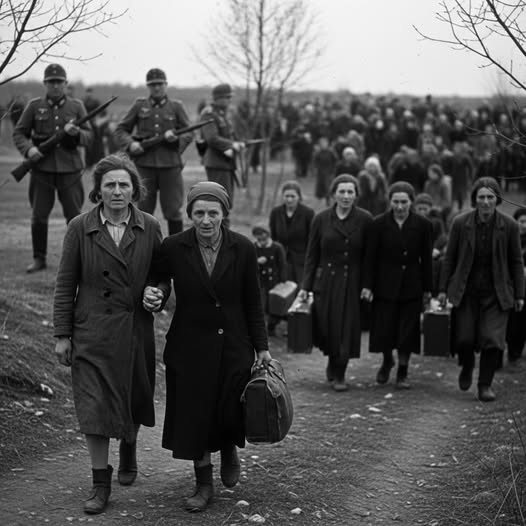
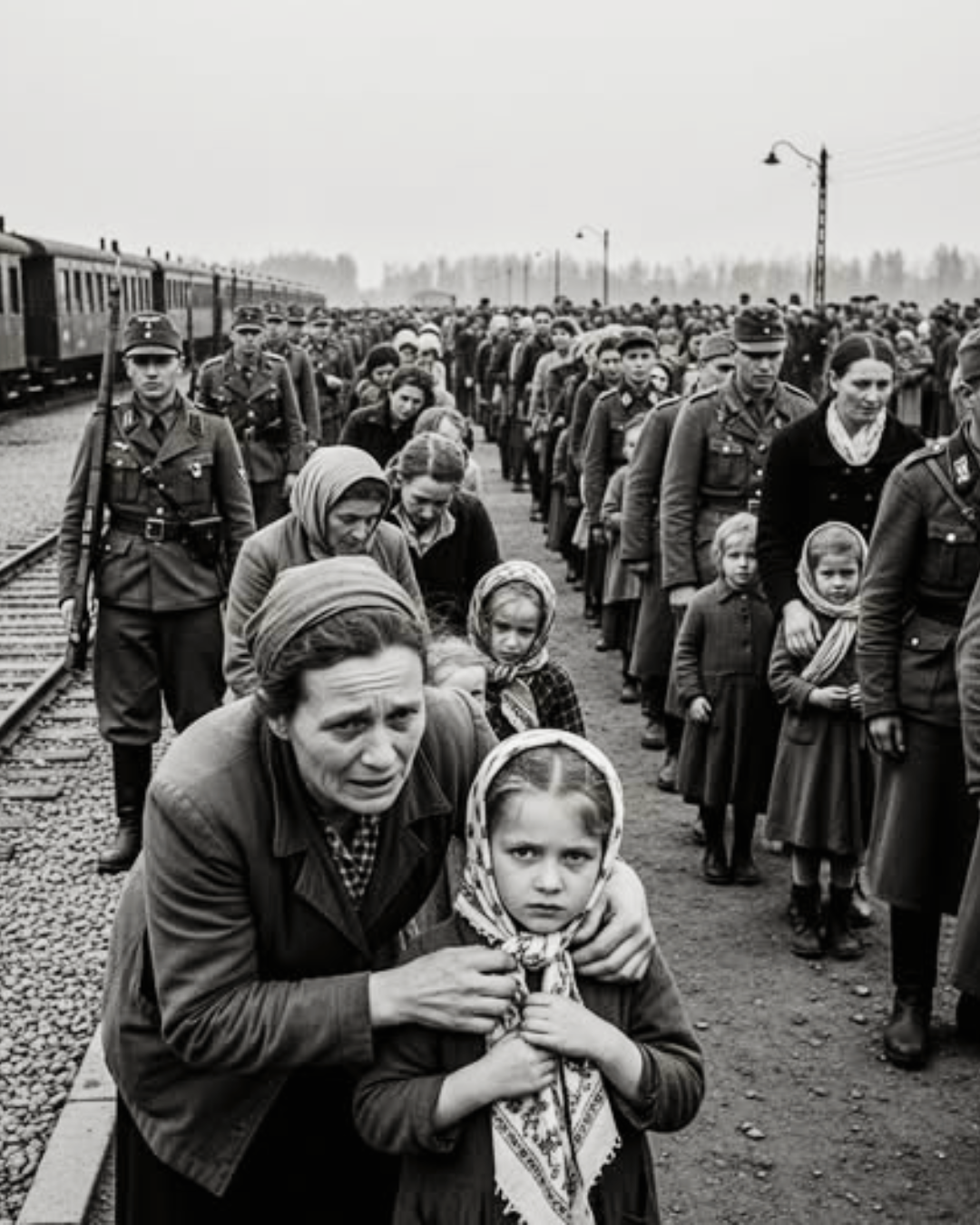
    In 1943, at the height of World War II, the name Auschwitz already loomed like a dark shadow in the darkness of occupied Europe. But for thousands of families crammed into sealed train carriages, the name was a mystery, a destination unknown except that it marked the end of a journey of no return. These trains departed from stations across Europe, carrying men, women, and children, packed like cattle, prisoners of a fate they had not chosen. Among them, a mother and her daughter, huddled together, were about to pass through the gates of hell.

    The journey seemed endless. In the cramped, stuffy cattle cars, the air was thick with fear and desperation. Children cried, the elderly suffocated, mothers tried to soothe, to invent comforting stories to transform the horror into something bearable. But nothing could mask the truth: bodies collided, thirst burned throats, and every pause meant the breath of life evaporated. The girl didn’t understand everything, but she saw her mother’s face harden day after day, and that was enough to make her sense that the danger was imminent, irreversible.

    When the gates finally opened, a silent scream echoed through the crowd. Before them stretched endless tracks, floodlights, guard towers, and men in uniform barking orders in a foreign language. This was Auschwitz-Birkenau, the concentration and extermination camp that had become a symbol of the Holocaust. Families were herded onto the ramp in organized chaos, where every move of the SS seemed calculated to destroy all humanity. Men on one side, women and children on the other. Armed soldiers howled, dogs barked, and their steps quickened, as if everyone was trying to delay the inevitable separation.

    At that moment, a gesture of overwhelming intensity occurred. The mother, sensing the imminent loss of her daughter, gently tugged at the scarf. In a flash, she wrapped it around the girl’s neck, smoothed the fabric with a trembling hand, and whispered in her ear, “This will keep you warm.” The girl, surprised, didn’t understand at first. She looked at her mother’s scarred face and saw a quiet certainty in that look: they might be separated, but that piece of cloth would unite them forever.

    This simple, delicate gesture became an invisible armor. In the ruthless world of the Nazi concentration camps, where everything aimed to destroy human bonds, the scarf became a symbol. For the little girl, it was no longer a simple veil, but tangible proof of an unbreakable love. Every time she held it, she felt the warmth of a mother’s hands, the softness of a caress, the echo of a familiar voice.

    World War II brought with it many scenes of suffering: separated families, children torn from their parents, spouses sent to opposing fronts under the icy gaze of SS officers. In Auschwitz, one of the cruelest practices was the destruction of family ties upon arrival. Children were deprived of their mothers, wives of their husbands, to break any psychological resistance. Despite this methodical process of dehumanization, certain acts endured, and it was in them that the invisible greatness of those who faced the horrors with dignity was revealed.

    In this story, the scarf embodies much more than a material object. It represents memory, identity, and heritage. When the little girl was pushed into the line of children, she instinctively clung to the fabric, as if she were still holding her mother’s hand. The soldiers considered this piece of cloth nothing more than a normal garment. They couldn’t imagine it held a world within it: laughter from long ago, shared meals, stories told by the fire. What was nothing to them was, in reality, all that remained of their previous lives.

    Testimonies from Holocaust survivors confirm that such objects—a scarf, a ribbon, a spoon—could become talismans of survival. In the world of concentration camps, the memory of a loved one or the vestige of a loving gesture provided unexpected inner strength. This is what historians today call “invisible resistance”: resistance not with weapons, but with symbols, memories, fragments of humanity preserved despite everything.

    We know that in many cases the separation was permanent. Mothers were removed, often directly to the gas chambers, and children were sorted according to age and health. However, this little girl’s story, passed down through the years, reminds us that even in the chaos of the Holocaust, a seed of humanity could survive. The scarf, later found by witnesses, remains a trace of this silent transmission.

    In the memory of the Holocaust, this story holds special significance. It reminds us that the Shoah is not just a matter of numbers—millions of victims—but also of countless individual stories. Every gesture, every object, every word whispered amidst this chaos carried immense weight. It is these stories that give body and voice to the victims, preventing them from disappearing into the anonymity of statistics.

    Even today, at Auschwitz, museum visitors can admire display cases filled with children’s shoes, toys, and abandoned clothes. These objects speak of broken lives, but also of unbreakable bonds. One can imagine this scarf placed among them, like a thread connecting the past to the present. It would remind every visitor that even during World War II, in the face of absolute cruelty, maternal love still found a way to reveal itself.

    This story isn’t just about a mother and her daughter. It’s universal. It tells us that tenderness, solidarity, and love can withstand barbarity. It reminds us that remembering the Holocaust shouldn’t just be about death and suffering, but also about preserving dignity, the humanity that endures despite everything. In a world where genocide still marks history, this story serves as a warning: we cannot completely destroy humanity as long as there remains a gesture, a word, a hug, a scarf wrapped around a child’s neck.

    Thus, the Auschwitz scarf became more than just a mere souvenir. It symbolized a message. Its frayed threads convey a mother’s desire to protect, love, and leave a mark. It is proof that, even when all seemed lost, the future can still be imagined, cherished in memory.

    In 1945, when Soviet troops liberated the camp, they discovered the extent of the crime. But they also discovered, thanks to the testimonies of survivors, these preserved fragments of humanity. The scarf, passed down from generation to generation, remained in the memory of this child, now an adult, as a daily reminder of his mother’s unconditional love.

    Telling this story today means participating in the collective effort of remembrance. It means reminding younger generations that behind every Holocaust figure lies a face, a voice, a gesture. It means ensuring that the scarf continues to carry the message: love and human dignity survive absolute horror.

    In a world where witnesses are gradually disappearing, the responsibility to pass on knowledge now falls upon us. Remembering Auschwitz, the deportations, and the concentration camps is not just a historical obligation. It is an act of resistance against oblivion, a way to combat the ideologies that still seek to destroy humanity.

    And at the heart of this memory is a simple scarf that reminds us that even in the deepest darkness, there always remains a thread of light.
  • The Man Who Tried to Get Up – Poland, 1945 .US

    The Man Who Tried to Get Up – Poland, 1945 .US

    The Man Who Tried to Get Up – Poland, 1945

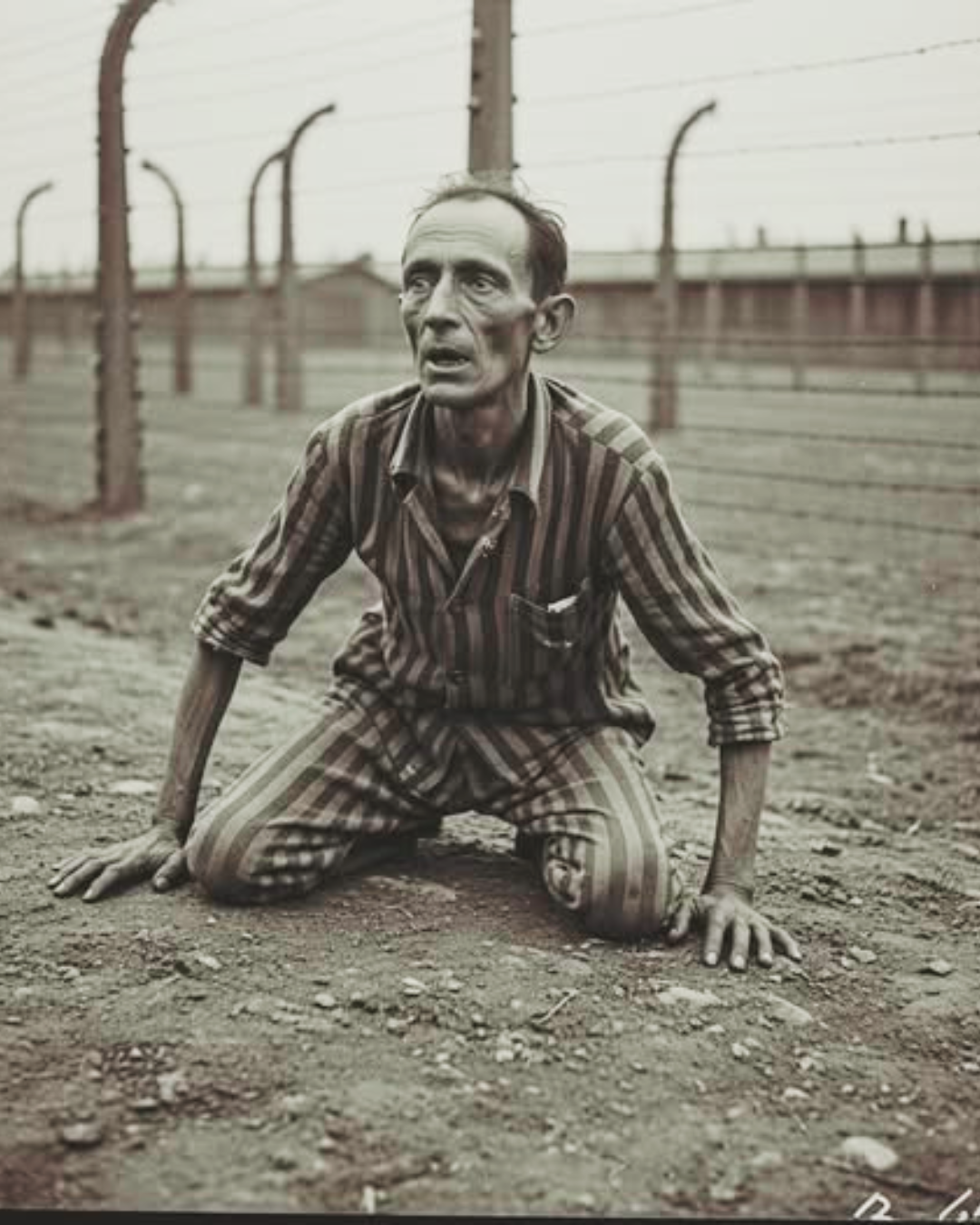
    The spring morning fog still hung heavy over the camp’s barbed wire when a new sound pierced the silence-filled air: the roar of Allied tanks. For those surviving behind those barbed fences, every sound carried the weight of a potential miracle. Yet, after so many illusions, no one dared truly believe it. Winter had stolen everything: strength, flesh, faces. But that morning, in Poland, in a concentration camp where death had learned to walk in the open, a figure emerged from the dust.

    He was only a shadow, a skeleton dressed in the prisoners’ striped uniform. His ribs protruded like the bars of the cage in which he was imprisoned, and his hands trembled with fever and weakness. Yet, when he saw the strange soldiers beyond the barbed wire, he understood the meaning of duty. Deep in his memory, buried under the weight of hunger and fear, the gesture of his ancestors endured: rising to welcome a guest. Even in the hell of the Nazi camps, hospitality, that simplest and most universal human dignity, still endured.

    Then he placed his hands on the dry earth, leaned on his knees, and tried to straighten his body, now reduced to a mere ruin. Every movement was torture, every breath a wrench. But he advanced, step by step, staggering as if the air itself weighed more than the world. And as he collapsed, his mouth half open, he muttered in a broken voice:

    —Excuse me … I should get up to greet the guests.

    The soldier who rushed to pick him up would never forget that moment. He had seen battlefields, thousands of fallen, but never had he seen such an outpouring of dignity in a broken body. He carried with him not just a man, but a living reminder of what the camps had sought to destroy: humanity.


    Many words recur constantly in accounts of the Second World War: horror, barbarity, extermination. But sometimes it’s the smallest gestures that tell the story most faithfully. This prisoner of war in Poland in 1945, anonymous among Holocaust survivors, embodies what it meant to resist in concentration camps. Not brandishing a weapon, but preserving a gesture, a word, a shred of dignity in a world where everything was designed to reduce man to mere existence.

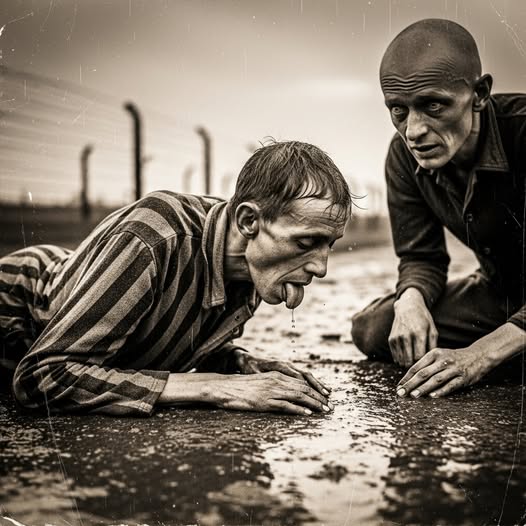
    The Nazis built their camps to erase the individual. Prisoners were little more than numbers tattooed on their skin, silhouettes in striped uniforms, crammed into teeming barracks. Hunger was so intense that many could no longer speak, and thirst, when water was scarce, forced some to lick raindrops from the ground. In this context, the desire to stand face to face with a guest was not a simple reflex of courtesy: it was a self-affirmation, a definitive protest against dehumanization.

    The American soldier—for it was the American army, after crossing the Vistula and Germany, that participated in the liberation of numerous concentration camps in Poland and Germany—later said that that look never left him. It wasn’t fear, nor pain, what he saw in the prisoner’s eyes, but a sort of silent respect, a silent appeal to recognize the value of humanity despite everything.


    This man’s story is similar to that of many others. In 1945, the liberation of the camps in Poland—Majdanek, Auschwitz, Stutthof—revealed to the world the true meaning of the word “genocide.” Soldiers entering these territories discovered thousands of emaciated survivors, but also mountains of corpses, open-air mass graves, and barracks filled with disease and despair. Bergen-Belsen, Dachau, Buchenwald in Germany—they all offered the same nightmarish vision. Yet, amid these human ruins, life persisted.

    The man struggling to get up could have been Jewish, perhaps a Polish resistance fighter, perhaps a Roma, or perhaps simply a civilian trapped in the machine of terror. We will never know his name. But in his struggle to hold his head high, he represented all those who, on the brink of collapse, refused to surrender their dignity. His trembling voice, begging forgiveness for not being able to honor his guests, resonates like a poem more powerful than any political speech.


    To understand the power of this gesture, we must contextualize this story. In Poland, starting in 1939, after the Nazi invasion, the number of camps increased. Auschwitz became the center of the system, a symbol of the systematic extermination of European Jews. But around it existed dozens of other camps and subcamps, where millions of men and women were imprisoned. Living conditions were inhumane: hunger, forced labor, disease. In this closed world, every day was a struggle for survival.

    The camp where this man was held had no name, but it resembled many others. Electrified barbed wire surrounded the wooden barracks. Guards stood on watchtowers, monitoring the slightest movement. The ground turned to mud in the winter and dust in the summer. The prisoners wore the same striped uniforms, reduced to wandering ghosts. When the liberators arrived, many no longer had the strength to rise from their bunks. Others, driven by an unbridled instinct, tried to do so anyway.

    The man collapsed after two steps. But those two steps concealed an entire world: a world of old-fashioned courtesy, a world of respect shown despite hunger, a world of people who, despite blows and humiliations, remained human.


    Even today, visiting the monuments erected on the ruins of the concentration camps, it’s difficult to grasp the magnitude of the events. The numbers—six million Jews murdered, hundreds of thousands of resistance fighters, political prisoners, Roma, deportees—offer a sense of urgency, but they speak volumes about individual suffering. It’s stories like this man’s that make memory tangible. Because behind every statistic lies a face, a voice, a gesture.

    The importance of visual testimony is crucial. Photographs taken in 1945 by Allied soldiers show emaciated bodies, gaunt faces, and eyes wide with hunger. But they also show survivors struggling to get back on their feet, greeting their liberators with tears, smiles, and, sometimes, a simple whisper: “Forgive me…” It is in these fleeting moments that history is conveyed.


    In an age where there’s so much talk about SEO, search, and visibility, it’s important to remember that the most valuable keywords aren’t those that generate profits, but those that perpetuate memory: concentration camp , Holocaust , liberation of Poland , human dignity , World War II . These words, when included in the text, not only optimize search performance, but above all, pay homage to those who can no longer speak.

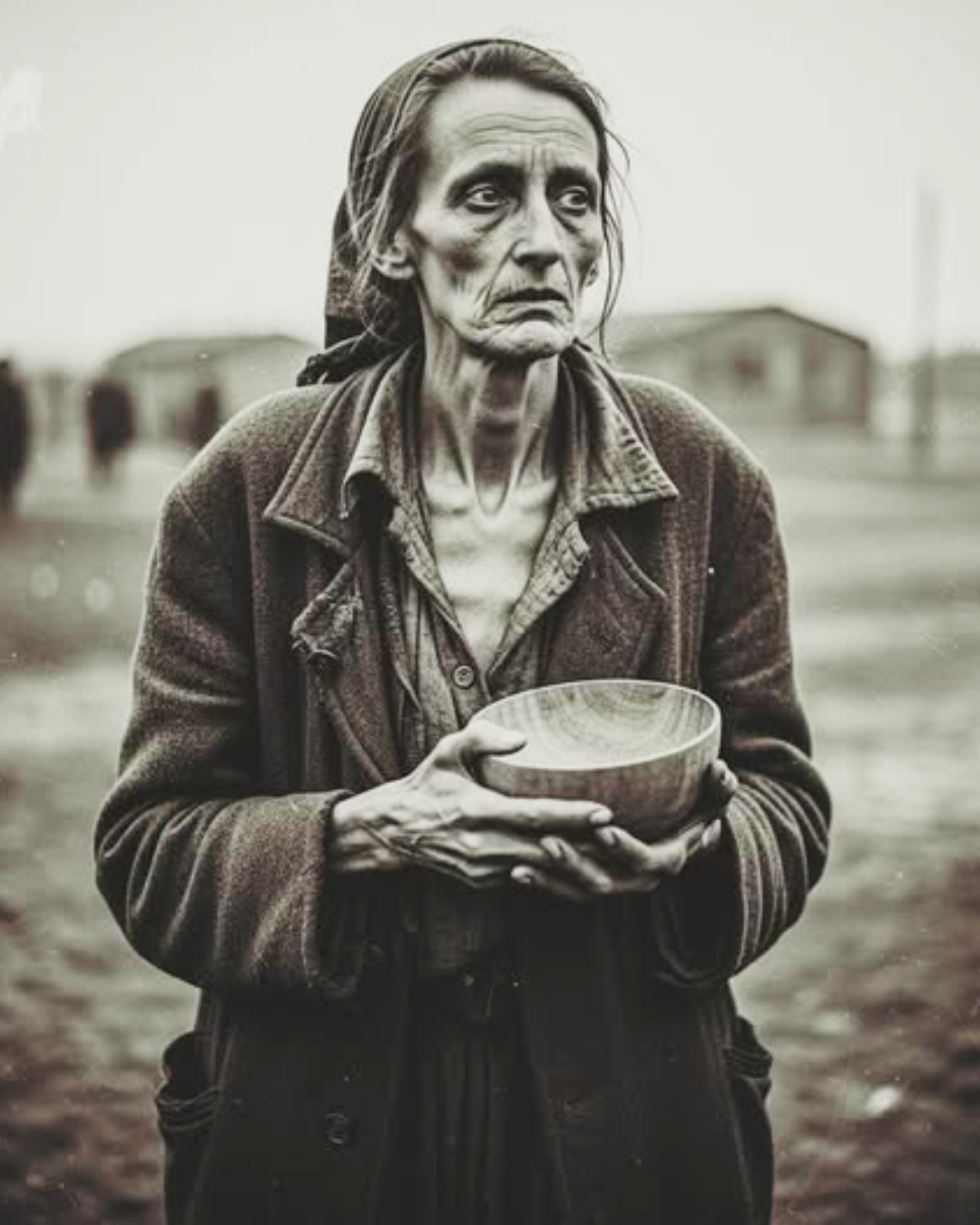
    Because writing about the Holocaust isn’t just about recounting a past tragedy. It’s about anticipating the future. Every time we describe a prisoner struggling to stand despite hunger, every time we tell of a woman clutching an empty bowl like a relic of hope, we defy oblivion with the power of memory.


    The American soldier who gathered the fallen man into his arms later recounted feeling the terrifying lightness of his body, almost weightless. He added, however, that he had never carried such a heavy burden: the burden of bearing witness. In the spring of 1945, the world was discovering not only the enormity of the crime, but also the moral obligation to never forget it.

    This man may not have survived his wounds, perhaps dying within hours of his liberation, like so many others too weakened to experience freedom. But his gesture endured. It was passed down by word of mouth, from generation to generation, as a universal lesson: humanity may falter, but as long as one person tries to rise again and welcome another, it is not entirely lost.


    Today, when we say the words ” Poland 1945 ,” we think of the ruins, the cemeteries, and the columns of survivors staggering toward life. But we should also think of this prisoner who wanted to pay homage to his liberators. His story reminds us that dignity is not measured by physical strength, but by the will to remain human, even when all adversity conspires to silence us.

    And though his name has faded from memory, his gesture remains. In that camp, lost in the heart of Poland, in that spring of liberation, a man tried to get up. He couldn’t walk, but he managed to convey to us what it means to live: to stand, even for just a moment, before another person and tell them—in a single breath—that we are still here.

  • Woman with an empty bowl – Bergen-Belsen, Germany, 1945 .US

    Woman with an empty bowl – Bergen-Belsen, Germany, 1945 .US

    Woman with an empty bowl – Bergen-Belsen, Germany, 1945

    The Bergen-Belsen camp had no gas chambers, yet it became one of the most horrific places of all of World War II. It wasn’t the smoke that killed, but hunger, disease, filth, overcrowding, and slow death. In this field of misery, a woman clung to a wretched object: a simple wooden bowl, cracked at the edges, polished by years and hands. It was her last treasure, a fragment of everyday life transformed into a symbol of hope.

    She was seen wandering, a skeletal figure, dressed in a cloak too large for her emaciated body. Her sunken cheeks bore a shadow of her former beauty, consumed by hunger. Her eyes, sunken in their sockets, reflected only infinite fatigue. Despite the weakness of her legs and the pain in her stomach, she still clutched the empty bowl, as if this piece of wood could still hold the future.

    When another prisoner, as hungry as she, dared to ask why she had never parted with this useless object, she replied, her voice almost hushed, “It’s proof that I’m still waiting for food.” In this camp, where thousands died, where death lurked in every barracks, in every broken bowl, in every lousy blanket, her sentence rang out like a silent scream. It wasn’t just a bowl: it was a declaration of existence.

    Located in northern Germany, the Bergen-Belsen concentration camp was originally established as a camp for Soviet prisoners of war in 1940. However, in 1943, it was converted into a Nazi concentration camp. Unlike Auschwitz or Treblinka, Bergen-Belsen did not have direct extermination facilities. Yet it was a place where death reigned with terrifying intensity.

    In 1945, with the fall of the Reich, tens of thousands of prisoners were transferred to Bergen-Belsen, increasing the camp’s population to 60,000. Designed for several hundred people, the barracks housed several thousand. There was a lack of adequate drinking water, food, and medical care. Diseases—typhus, tuberculosis, dysentery—spread like wildfire. An estimated 50,000 people died in Bergen-Belsen, including Anne Frank, who died of typhus in March 1945, just weeks before liberation.

    In this silent hell, hunger became a weapon. Official rations consisted of scanty, clear soup and crusts of black bread, often covered in mold. Those who did not starve died of disease. The woman with the empty bowl belonged to this army of ghosts, condemned to wait, hope, and survive day by day, minute by minute.

    This woman’s gesture—carrying an empty bowl everywhere—may seem trivial. But in the context of the Holocaust, every detail mattered. The Nazis did everything possible to dehumanize prisoners: stripping them of their names, reducing them to numbers, starving them, cutting their hair, stripping them of their possessions. Keeping an object, even something as insignificant as a chipped bowl, became a way to affirm one’s identity as a human being.

    Even though she no longer had any real hope of food, she refused to give up the ritual of eating. As long as she held the bowl, she was waiting for the meal, and therefore for tomorrow. This wasn’t an illusion, it was a form of psychological survival. By holding that bowl, she was telling the world: “I am still here. I am still a woman, not a shadow. I am waiting for life.”

    It is said that until her last breath she refused to part with it. Even when her strength failed, her fingers remained clenched around the wood, as if the object were one with her.

    On April 15, 1945, British troops reached Bergen-Belsen. What they discovered exceeded their wildest expectations. Thousands of corpses lay on the ground, some for days. Survivors, too weak to stand, crawled in the mud, their eyes wild. Typhus continued to kill hundreds of prisoners every day, even after liberation.

    The woman with the empty bowl did not survive this historic moment. When soldiers entered the camp, they found her body lying on the ground, the bowl carefully placed beside her. She did not experience freedom, but her last companion remained there, a silent witness to her struggle.

    A British officer, moved by this image, wrote in his notebook: “That bowl, placed beside her, seemed heavier than anything I had seen in this camp. It contained not food but all the hope of a woman, all the dignity of a man who had never stopped waiting.”

    Today, the story of the woman with the empty bowl is not widely known. She has no name and no grave. However, she has become a symbol among the countless anonymous stories of Bergen-Belsen.

    Holocaust memorials sometimes display simple objects found in the camps: baby shoes, suitcases, combs, bowls, and spoons. These objects speak more than just numbers. They speak of life, of waiting, of a humanity that the Nazis sought to erase.

    This woman’s empty bowl, though physically absent, remains in our memory as a universal metaphor. It symbolizes hunger, of course, but also dignity, a stubborn expectation of life, and silent resistance.

    World War II and the Holocaust left us with unbearable images. But some of the most powerful are not piles of corpses or gas chambers, but small gestures: a child clutching a rag doll, an old man hiding a piece of bread, a woman tending an empty bowl. These gestures reveal a profound truth: humanity can be stripped of everything except the capacity for hope.

    The woman with the empty bowl from Bergen-Belsen teaches us that resistance doesn’t always mean armed action or loud rebellion. Sometimes it’s simply holding an object, maintaining a ritual, telling the world, “I’m still here.”

    She did not survive the liberation. Her body was buried in one of the mass graves at Bergen-Belsen, along with thousands of others. But her empty bowl is remembered as a symbol of hope. In that shattered wood was more than just a container: it was identity, dignity, a silent statement against barbarism.

    Every time we remember this woman, her bowl, we fulfill our duty of remembrance. Because the Holocaust is not just a matter of numbers and statistics: it is the story of individual lives, small gestures, and invisible resistance.

    In the spring of 1945, in the silence of Bergen-Belsen, a woman held her bowl tightly until the very end. And that bowl, empty of food but full of hope, still speaks on her behalf.

  • The Man Who Licked the Rain – Dachau, 1945 .US

    The Man Who Licked the Rain – Dachau, 1945 .US

    The Man Who Licked the Rain – Dachau, 1945

    That day, rain fell on the Dachau camp like a fragile veil over a gaping wound. It was neither strong nor benevolent; it was a fine, persistent drizzle that mingled with the mud, soaking into the prisoners’ striped clothing and carving furrows across their sunken faces. Yet for some, it meant more than a simple downpour: it became a source of life, a last breath of purity in a world that seemed devoid of humanity.

    The man lay on the ground, his body so thin it seemed his bones were about to break through his skin. His dry lips quivered, and his tongue stretched out toward the damp earth. He lapped up the rain like a child leaning toward a fountain, but with an almost animalistic zeal. Beside him, another prisoner watched, torn between fear and silent compassion. “It tastes clean,” the man on the ground muttered, as if this water, even mixed with the camp’s filth, were the final proof that life had not completely vanished behind the barbed wire.

    This moment, tiny and almost invisible to the SS guards, represented a form of resistance. In this Nazi concentration camp, where hunger tore at the insides more surely than bullets, where thirst devoured throats to the point of driving even the most persistent mad, the taste of a raindrop was like clinging to the thinnest thread of existence. It was a silent confirmation that amid the ashes and despair, a spark of dignity remained, a community between man and the elements that even Nazi ideology could not tarnish.

    To understand this desperate act, the scene must be placed in context. Dachau was not a camp like any other. Rather, it served as a model for all others. Established in 1933, shortly after Hitler came to power, it was the first concentration camp established by the Nazi regime. Initially intended for the internment of political opponents—communists, social democrats, and trade unionists—it quickly became a place of terror, imprisoning Jews, Roma, homosexuals, Jehovah’s Witnesses, Soviet prisoners of war, and anyone else Hitler deemed “undesirable.”

    For twelve years, Dachau was a laboratory of cruelty, a training ground where the SS perfected methods of humiliation, torture, and slow extermination. According to official records, over 200,000 prisoners passed through the camp, and at least 41,500 of them died. Forced labor, medical experiments, starvation, and epidemics were the silent weapons of methodical genocide.

    In the final months of World War II, as Germany crumbled under Allied air raids, the situation at the camp became even more desperate. Convoys overloaded with prisoners evacuated from Auschwitz and other camps in the east arrived, setting off on “death marches,” where many perished before even reaching Dachau. The already overcrowded barracks became extermination camps, where, due to lack of food, care, and space, dozens of bodies accumulated daily.

    In this world where every hour seemed like an eternity, a man licking the rain wasn’t madness; he was a symbol of survival. The camp’s prisoners lived in constant deprivation. The daily food ration consisted of a piece of black bread, sometimes moldy, and a thin soup that was more like hot water with turnips than a proper meal. Drinking water, meanwhile, was scarce and often contaminated. Drinking from puddles was risky, but refusing to drink meant condemning the body to dehydration.

    So when the rain fell, it was a gift from heaven. Some looked up and opened their mouths, as if to catch several drops at once. Others, weaker, bent over the mud and licked the softened earth, savoring what they considered nectar. It wasn’t just an instinctive gesture; it was a silent prayer, an attempt to absorb a particle of hope.

    This gesture exposed the absurdity of the Nazi concentration camp system. These people, once teachers, workers, doctors, and students, had to crawl through the mud to survive. And yet, despite the imposed degradation, some found the strength to continue living in a drop of rain.

    April 1945. Allied troops were approaching. The noise from the front grew closer, and even the thick camp walls could no longer drown out the distant echoes of fighting. The SS, in turn, grew increasingly restless. Some tried to cover up their crimes, while others organized forced marches to clear the camp before the Americans arrived.

    The prisoner who had tasted the rain had no strength to wait for that day of liberation. His body, exhausted by months of deprivation, weakened within hours of that last sip of water. He was found the next day, motionless, his lips still smeared with mud, as if nature had given him one last kiss.

    A few days later, on April 29, 1945, American troops entered the Dachau camp. The sight they encountered was unbearable: piles of corpses, survivors with deathlike faces, blank stares forever marked by unspeakable suffering. Yet amidst this horror, some testified to a strange sense of liberation. For those who survived, even those half-dead, the air suddenly took on a different scent: the scent of regained freedom.

    The story of the man who licked the rain has become a permanent part of survivors’ narratives. It’s not just a macabre anecdote, but a universal parable of human dignity. Everything in Dachau was designed to crush the individual: hunger, beatings, humiliation, and ubiquitous death. Yet, each act of survival became a quiet victory over oppression.

    The rain he licked wasn’t just water. It was a form of communion with nature, a reminder that beyond the barbed wire the world still turns, that Nazi Germany will eventually fall, that hope can survive even in the mud.

    Even today, visiting the Dachau Memorial Site, one feels this heavy, even stifling atmosphere. Walking along quiet paths, among trees that have seen it all, one imagines these people trying to drink a drop of rain. The stones preserve memories, and each visitor becomes an indirect witness to this invisible struggle between death and life.

    Telling this man’s story is a struggle against oblivion. The Holocaust and concentration camps are not just episodes from the past; they are eternal warnings. Behind every number, every statistic, there are faces, unique stories, and personal suffering.

    The Man Who Licked the Rain at Dachau reminds us that inhumanity can reduce a person to a figure crawling in the mud, but it also reminds us that even in the worst circumstances, a spark of humanity remains. This is not only a story of suffering, but also a story of resistance—a quiet, small, yet infinitely powerful resistance.

    At a time when some still dare to deny or minimize the Holocaust, at a time when the world faces new forms of hatred and violence, this image must remain etched in our collective memory. Every drop of rain this man licked is a lesson: freedom, dignity, and life are never taken for granted; they are fragile goods that must be constantly protected.

    “It tastes pure,” he said, savoring the rain. Everything essential is hidden in that whisper: the desire for life, the love of freedom, the belief that even in the heart of hell something pure remains. Dachau was a place of death, but in this man’s memory, it also became a place of witness.

    Today, as visitors pay their respects to the barracks, watchtowers, and mass graves, one can almost hear the echo of this phrase. It encourages us to look beyond the horror, to see the greatness of the human soul in the smallest gestures.

    And if we close our eyes, perhaps we too will taste the rain on our lips, a taste that unites the dead and the living in a single oath: never to forget.

  • Majdanek, July 1944: when the silence of the ashes became the cry of memory .US

    Majdanek, July 1944: when the silence of the ashes became the cry of memory .US

    Majdanek, July 1944: when the silence of the ashes became the cry of memory

    On July 24, 1944, at the beginning of a harsh and stormy summer, Soviet troops reached the outskirts of Lublin. That day, world history changed. Behind rusty barbed wire, behind watchtowers, and gray barracks, lay one of the first major Nazi concentration and extermination camps to be discovered almost intact: Majdanek. Until then, most accounts of the Holocaust had seemed unreal, drowned out by propaganda, mired in disbelief. But at Majdanek, there was no longer any doubt. The earth still exuded human ash.

    The Red Army soldiers entered the death camp in silence. They didn’t yet know what awaited them. Rows of barracks stretched before them, and the air was thick with a persistent, acrid stench. With each step, they stepped over the remnants of a crime so horrific that words hadn’t yet been invented to fully describe it.

    The doors opened, and with them, the world discovered the truth about Nazism. Piles of shoes, mountains of abandoned suitcases, cut-off hair stuffed into rough canvas bags: each object told a story, each fragment carried the memory of a silenced being. Majdanek, the extermination camp, became the first undeniable witness to the Holocaust, exposed to the astonished gaze of those who had just liberated eastern Poland.

    Residents of surrounding villages, summoned by soldiers, were also forced to step in. For years, they had seen columns of deportees traversing the Lublin road. They heard trains, the metallic screech of crowded wagons. Some could smell the smoke that sometimes enveloped the fields like an unnatural fog. But the human brain is adept at rejecting the unacceptable.

    An old peasant woman, hunched with age, slowly walked toward the huts. Her hands trembled, and a black shawl covered her worn face. She stopped abruptly in front of a pile of shoes. She covered her face with her hands and whispered in a broken voice,
    “We smelled the smoke… but we didn’t want to believe it.”

    In that fragile breath, the entire population admitted its helplessness, fear, and blindness. This was not just an empty phrase, but a universal admission: the proximity of evil never guarantees its recognition.

    For Soviet soldiers, hardened by the most horrific battles of World War II, Majdanek was a trauma of a different kind. They saw destroyed cities, corpses lined up in the streets, but never the methodical organization of extermination. Here, everything was thoughtful, planned, industrialized. The crematoria still bore the scars of a recent fire. Mass graves gaped open like gaping scars.

    A young soldier, only twenty years old, wrote in his notebook:
    “I thought I had come to liberate a military camp. I had discovered hell.”

    And this hell had a name: the Shoah. The Nazis wanted to annihilate not just individuals but entire nations, erasing their culture, memory, and future. Majdanek, with its six gas chambers, kilometers of barbed wire, and meticulous documentation, was a testament to the cold logic of extermination.

    Unlike other camps, such as Sobibor and Treblinka, which the Nazis destroyed in an attempt to cover up their crimes, Majdanek was liberated almost intact. This made it irrefutable evidence of what had happened to the world. Allied journalists were invited, photographers immortalized the events, and cameras filmed. Still-warm crematoria, unburned corpses, and warehouses overflowing with confiscated items were shown.

    This was a shock to international opinion. Until then, many had doubted the scale of Nazi crimes. Some considered the testimonies to be propaganda exaggerations. But in the case of Majdanek, doubts were no longer possible. World War II revealed its darkest dimension: a plan for total extermination, rationalized down to the smallest detail.

    A few survivors still wandered among the barbed wire, living specters of the Holocaust. Their gazes carried the weight of unspeakable tragedy. A Polish woman, her face sunken, recounted how she lost her two daughters in the gas chambers. Her voice was almost a whisper:
    “I survived because they needed my hands. But my hands can’t hold anything anymore.”

    These words rang like an eternal condemnation of Nazi ideology. Each human testimony, each story, added a dimension of flesh and tearfulness to what the camp walls were already silently telling.

    The Liberation of Majdanek | National Museum of the Second World War | New Orleans

    One of the most powerful images to emerge from Majdanek is that of shoes, which remain etched in collective memory. Thousands of pairs piled up, in all sizes: tiny children’s shoes, men’s boots, women’s pumps. Each pair was a fragment of a life cut short. The Nazis not only murdered people but also tried to track them down.

    These shoes became a universal symbol of the Holocaust, more powerful than any speech. They spoke without words about the scale of the Holocaust. And when visitors first saw them in 1944, a crushing silence fell. It was the silence of the dead, but also of the living, who could find no words to express the horror.

    The discovery at Majdanek was a turning point. The world could no longer ignore the Holocaust. The Nuremberg trials would soon be based on this tangible evidence. The gas chambers, the documents, the confiscated objects, the bodies themselves: everything became evidence.

    But beyond justice, memory was being built. Majdanek quickly became a place of remembrance, a Holocaust museum, even before the end of the war. Survivors knew that this had to be shown, explained, and communicated. Memory was not only a moral obligation: it became a weapon against forgetting, against the repetition of evil.

    In 1944, as the old peasant woman wept over piles of shoes, she carried within her the burden of all those who looked the other way. Her words—”We smelled the smoke, but we refused to believe”—have endured for decades. They remind us that in the face of barbarism, silence and indifference become complicity.

    Even today, Majdanek poses questions for us. What would we do if we were those neighbors, those peasants, those passersby? Would we dare to speak out, or would we, out of fear or survival instinct, prefer to remain silent? The memory of the camp is there to ensure that this question never fades.

    Majdanek is not just a Polish site, nor even a European one. It is a universal legacy, an open wound in the conscience of humanity. It reminds us that World War II was not just a war for territory, but a war against the very existence of entire nations.

    Visiting Majdanek today, one walks through the silent barracks, where the footsteps of the deportees can still be heard. One sees the watchtowers, the barbed wire, the crematoria. And one understands that memory is a responsibility. The ashes of Majdanek have become ashes of memory, witnesses to a crime that must never be forgotten.

    On July 24, 1944, humanity opened its eyes to one of its worst nightmares. Majdanek, the concentration and extermination camp, revealed to the world the scale of the Holocaust, the reality of the Holocaust, and the methodical cruelty of Nazism. For Soviet soldiers, for the inhabitants of the surrounding villages, for the first witnesses, it was a brutal revelation, a confrontation with the unimaginable.

    But in the ashes, in the shoes, in the empty huts, there was something more than a testament to death: there was a call to life, a call to memory. The old woman who whispered, “We smelled smoke,” leaves us with an eternal lesson: never look away, never surrender to indifference.

    Majdanek still speaks to us and always will. As long as it stands, with its barbed wire and mountains of boots, it will remind the entire world that memory is the only safeguard against the return of barbarism.

  • The Burden of Love – Sobibór, 1943 .US

    The Burden of Love – Sobibór, 1943 .US

    The Burden of Love – Sobibór, 1943

    In 1943, in the heart of occupied Poland, the Sobibór camp operated like a death machine, controlled with icy precision. Trains arrived constantly, loaded with entire families, the elderly, and children. As soon as they stepped off the wagons, they were led by German soldiers, closely watched by trained rifles and dogs. For most, the end was immediate: gas chambers awaited them, hidden behind fences. Sobibór was not a labor camp, but an extermination camp, the centerpiece of “Operation Reinhardt,” the program for the systematic extermination of Eastern European Jews.

    In this landscape where everything seemed doomed, every gesture of humanity became a silent rebellion. Amidst these thousands of faces, history sometimes preserves fragments, suspended moments in which love defied the inexorable logic of death. One of these moments is embodied in the silhouette of a teenager, bent under the weight of his younger sister, whom he carried on his back.

    The girl, exhausted from the endless journey in the cattle car, no longer had the strength to move forward. Her legs buckled with every step, and the stream of prisoners was already flowing around them, driven by the shouts of the guards. But the boy refused to leave her. His arms, still thin from youth, slid beneath her trembling legs, and he lifted her onto his back, as if carrying a promise too precious to abandon. His shoulders were bent, his knees trembling, but he gritted his teeth.

    The girl rested her head against his neck. In a barely audible whisper, she asked, “Am I heavy?” It was a child’s question, fragile, afraid of becoming a burden. But the truth burned through her brother’s muscles: yes, she was heavy; each step wrenched a silent cry from his still-growing body. But his lips refused to yield to reality. “No, you’re as light as a feather,” he replied in a soft, almost calm voice.

    That tender lie, in that moment, became a form of truth. He carried more than just his sister’s burden: he carried their childhood, their memories, everything that still connected them to their lives before the camp. In speaking this way, he transformed pain into strength, burden into love. Every step, even the most uncertain, became a victory over the guards’ indifference, over the erasure Sobibór sought to impose.

    Sobibór was never intended to be a place of storytelling. The camp was designed to leave nothing behind, not even bodies. The victims were exterminated in secret, and traces of their journeys were erased almost immediately. But the Nazis could never have anticipated the power of memory. Survivors, witnesses, fragments of history, like the story of this brother and sister, became a counterweight to forgetting.

    In the echo of their faltering steps, the entire Holocaust is recreated. For beyond the numbers—six million ruined lives—hide small gestures, whispered words, silent vows that create the very fabric of memory. This boy who wouldn’t let go, this little girl who asked if it was hard for her: this is the Holocaust as it was experienced, not as an abstraction, but as a sequence of human moments torn from the horror.

    In October 1943, Sobibór witnessed a unique event: a major prisoner revolt. Led by survivors such as Aleksandr Pechersky and Leon Feldhendler, some 600 prisoners staged an uprising. They killed several guards, breached the fence, and fled into the nearby forest. Three hundred of them managed to escape; only about 100 survived the war. However, this uprising left Sobibór in history not only as a place of death but also as a symbol of resistance.

    It’s possible that the brother and sister in our story didn’t survive long enough to witness this revolt. Perhaps they were led straight to the gas chambers, their voices drowned out by the clamor of shouted orders. And yet their gesture remains. Because in the history of the Holocaust, every fragment, every whisper, every outpouring of love matters.

    Today, writing about Sobibór isn’t just about dwelling on the horror. It’s about bearing witness, about inscribing in memory what those camps tried to erase. Writing about these siblings is an achievement of what historian Saul Friedländer called “integrated memory”: restoring the individual to the heart of the collective. These are no longer just “victims of Sobibór,” but a teenage boy with trembling knees, a little girl with tired eyes, and an exchange of love that defies barbarity.

    The Holocaust forces us to look beyond the numbers. Behind the convoys, barbed wire, and chimneys were hidden families, words, and glances. A brother carrying a sister reminds us that even in the abyss, humanity endured. And this humanity, fragile yet enduring, has become the strength of our collective memory today.

    Visitors to the Sobibór Memorial feel this weight. The camp itself was razed to the ground by the Nazis after the revolt, in a desperate attempt to erase their traces. Yet the earth still bears the scars, and the voices of survivors rise like stones against oblivion. In this silence, one can almost hear a child’s question: “Am I heavy?” And the answer, gentle and firm: “No, you are light as a feather.”

    These words, carried through time, have become more than a fraternal riposte. They are a metaphor for what memory does: transforming the unbearable weight of history into a bearable lightness. Today, we carry the memory of Sobibór, of the Holocaust, not as an impossible burden, but as a shared responsibility.

    The teenager who walked forward, step by step, his sister clinging to him, might not have survived. But their story, like so many others, endures through stories, archives, and testimonies. It tells us that even in the deepest darkness, love remains. And this love, so fragile, so simple, became the greatest resistance.

  • Fragment of paper – Sobibór, 1943 .US

    Fragment of paper – Sobibór, 1943 .US

    Fragment of paper – Sobibór, 1943

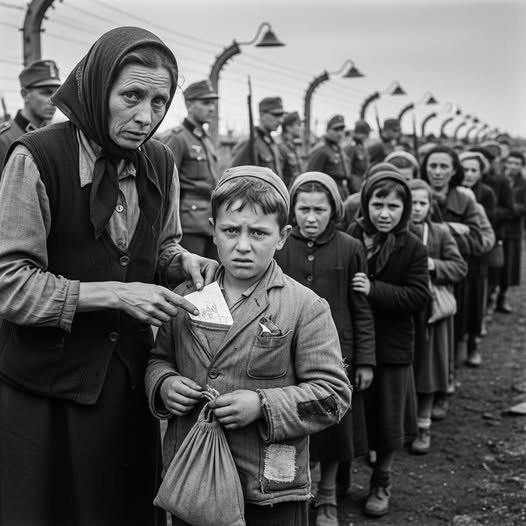
    In Sobibór in 1943, a mother leaned toward her son, as if offering him a final layer of protection in a world that no longer knew her. Barbed wire rose around them, bristling with hooks and lanterns, bathing the scene in a harsh glow. The footsteps of German soldiers echoed in the mud, striking the ground with relentless regularity. The line of deportees moved slowly, weighed down by the weight of silence and fear. In this stifling atmosphere, the mother’s gesture took on an air of intimate defiance. She pulled a crumpled piece of paper from her corset, a relic salvaged from a past long gone. She slipped it into her son’s pocket, clutching the fabric as if to ensure this talisman wouldn’t fly away.

    It was only a fragment of a letter, broken sentences, words left unanswered. Yet this scrap contained far more than ink on paper. It carried memories of home, the smell of the kitchen, the voices of grandparents sitting in the flickering light of a kerosene lamp. In these unfinished lines lay evidence of a normal life, composed of the passing of seasons, births, celebrations, sorrows, and joys. The camp, with its shouted orders, barbed wire, and smoke, could not erase this. The mother knew: as long as her son retained this fragment, a part of their humanity would remain intact.

    The boy, barely ten years old, didn’t understand everything. His eyes scanned the crowd, the shoes, the rifles, not fully grasping what was happening. But he felt the weight of the paper in his pocket, like a heart pounding in his chest. His fingers mechanically clutched the small bag he carried, containing his meager belongings: a dented spoon, a scrap of cloth, and now this fragment that had become sacred.

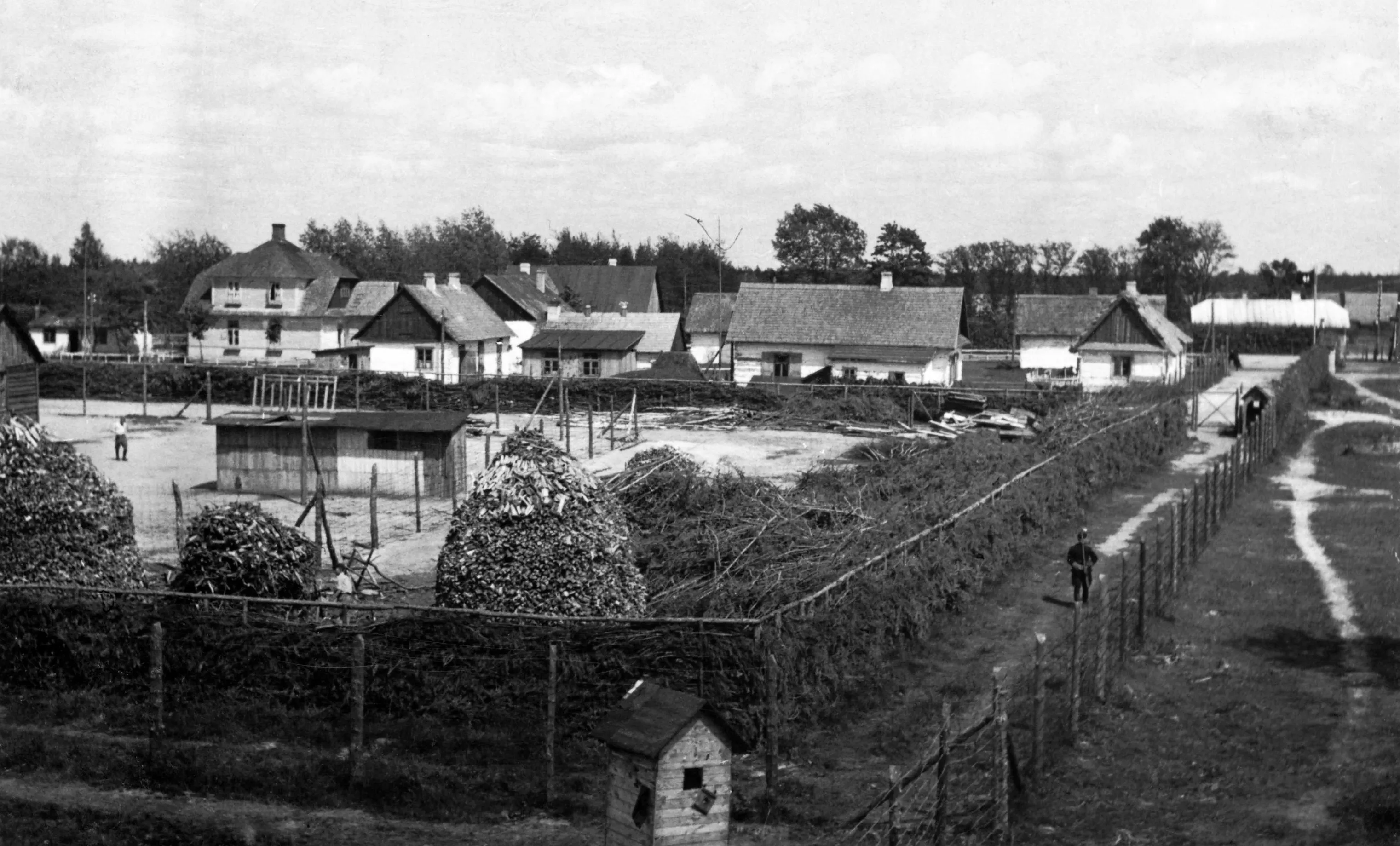
    The Sobibór camp was not like any other. Built in the heart of a Polish forest, it was part of what the Nazis called “Aktion Reinhardt,” a secret operation aimed at exterminating the Jews of Eastern Europe. Unlike Auschwitz, which combined forced labor with extermination, Sobibór had only one function: death. Transports arrived, families were separated, and most deportees went straight to the gas chambers. The camp lived with the macabre rhythm of trains, the echo of screams and orders.

    And yet, even here, in this place destined for utter destruction, fragments of humanity remained. A song whispered in a hut, a stolen gesture of tenderness, a glance exchanged in the mystery of the night. This piece of paper, which the mother chose to pass on to her son, was born of the same instinct: to say that life had existed before, that it could exist again, and that love remained stronger than the machinery of death.

    The German soldiers watched the line, indifferent to this small exchange. To them, the prisoners were mere numbers, anonymous masses. They would never have guessed that hidden in a pocket, amidst so much poverty, was an invisible treasure. What was, in their eyes, merely a meaningless piece of paper, became for mother and child a silent weapon against oblivion.

    Sobibór was a camp where history seemed to vanish in the smoke of the crematoria, but memory always found unexpected paths. Years later, survivors recounted how men and women, at the moment of deportation, tried to leave traces of themselves behind. Some buried letters, others carved their names on the walls of the barracks. Every gesture was a struggle against erasure. The piece of paper entrusted to the boy was part of the same intimate resistance.

    The mother likely knew she would never see her son again. But her act, in that moment, was a promise: you are not alone, you carry within you a home, a memory, and all the love that the Nazis could not destroy. She understood that in a place where everything was confiscated—things, names, even hair—there was still the possibility of transmitting what was most important: a sign of life, proof of existence.

    Years later, a child—if lucky enough to survive the Holocaust—might remember that note. Perhaps they’d never be able to read it, ruined by rain, forced marches, or the chaos of evacuation. But it wasn’t the content that mattered most, but the gesture. The memory of his mother’s hand on his chest, her voice murmuring, “Keep this”—all of it was enough to sustain within him a thin yet indestructible thread, connecting the past with the future.

    The history of the Sobibór camp is not limited to the horrors of deportation. It is also marked by a unique event in the history of the Holocaust: the October Uprising of 1943. On that day, prisoners successfully revolted against their guards. They secretly planned a mass escape, killed several Nazi officers, and breached the perimeter fence. Some 300 prisoners managed to escape into the forest. Although many were captured and executed, about 100 survived the war and later gave testimony, transmitting the memory of the site to the world. This uprising made Sobibór a rare symbol of resistance in the face of planned extermination.

    Perhaps the boy and his mother, those whose memory we share today with a frozen image, did not survive Sobibór. Perhaps that scrap of paper disappeared with them into the flames or the cold earth of mass graves. But their story, whether true or inspired by thousands of similar acts committed in those camps, still resonates. Every trace, even the smallest, becomes testimony. And without this testimony, history would be only silence, an absence.

    Writing about Sobibór, about the Holocaust, also means fulfilling the duty of memory. The words we write today extend this piece of paper. They protect it from oblivion. In the language of the 21st century, where we speak of SEO keywords , optimization, and visibility, it’s strange but necessary to remember that behind every word like “Shoah,” “Sobibór camp,” “memory of the deportees,” “history of World War II” lie millions of lives. Writing is not just an SEO tool; it becomes an act of resistance in the face of oblivion, a tribute to those who were unable to write their own history.

    This story, evoking a simple sheet of paper, reminds us that memory is never abstract. It is constructed from concrete gestures, small mementos, testimonies that seem insignificant, yet become the cornerstones of history. The Holocaust is not just a number, not just six million victims: it is a multitude of individual stories, torn fragments, lives halted mid-sentence.

    Today, visitors to the former Sobibór site, where the monument was erected, feel this burden. The camp itself was destroyed by the Nazis after the revolt, in an effort to erase all traces. But oblivion did not triumph. Survivors, historians, and writers have reconstructed the memory stone by stone, word by word. And in this collective memory, every detail—an unfinished letter, a child’s drawing, an engraved name—takes on inestimable value.

    The piece of paper donated in 1943 has not survived. But it has survived in other ways: through the story it tells, through the gaze of a boy in a photograph, through the trembling hand of his mother. This is perhaps the greatest paradox of Sobibór and the extermination camps: they were built to erase, yet they compel us to remember.

    And so we return to this image: a row of deportees, a mother and son, a discreet gesture. This gesture conceals the greatest of human truths: even in the face of death, love strives to leave its mark. Even in a place destined to annihilate all memory, a simple sheet of paper becomes a manifesto. It is a small victory, but a significant one. The victory of life over death, memory over oblivion, humanity over barbarism.

  • Sobibór 1943: Brotherly Love at the Heart of the Holocaust .US

    Sobibór 1943: Brotherly Love at the Heart of the Holocaust .US

    Sobibór 1943: Brotherly Love at the Heart of the Holocaust

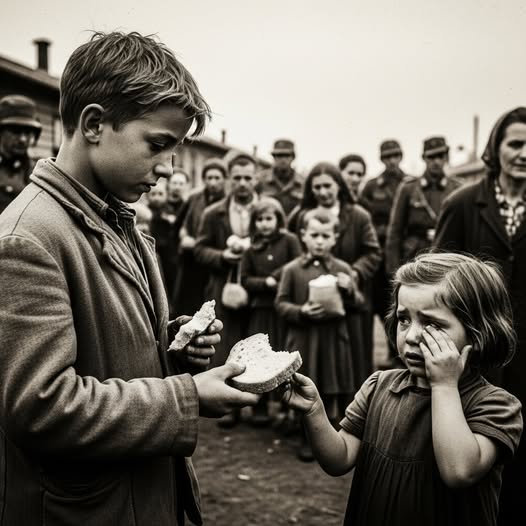
    In the immense fresco of human tragedy that was the Holocaust, certain images endure with poignant force, etching themselves in collective memory in scenes that never fade. Among them, the image of a boy standing in the Sobibór extermination camp in 1943, offering a slice of bread to his tearful sister, remains a universal symbol of love and silent resistance. Behind this simple, almost innocent gesture lies the strength of a brotherly bond that refuses to break, even in the heart of the most inexorable system, intent on the eradication of humanity.

    Sobibór was not a camp like any other. Built in a remote region of occupied Poland, it was part of “Aktion Reinhardt,” a methodical and murderous project aimed at exterminating the Jews of Eastern Europe. Unlike Auschwitz, which combined deportation, forced labor, and extermination, Sobibór had only one function: killing. As soon as the convoys arrived, families were separated, stripped, and then sent to the gas chambers. Few survivors were able to recount what happened there, but their accounts, passed down after the war, offer us fragments of truth and, at times, moments of humanity plucked from the abyss.

    It is in this terrifying setting that the siblings’ story unfolds. The boy, barely twelve or thirteen, already bore the seriousness of adults in his gaze. Hunger, fear, and uncertainty had prematurely aged his features. Meanwhile, his younger sister was merely a fragile child, her face marred by tears and dust. Their mother, in the throng of visitors, tried to offer them a piece of bread—a last gesture of maternal care in a world where everything was being stripped from them. But the child, jostled, lost this precious nourishment. Her empty hands and tearful face spoke volumes: hunger wasn’t just a physical pain; it became a cruel symbol of utter deprivation.

    Then, in the profound silence, broken only by the ragged breaths of the prisoners, the brother did what his heart told him. He watched his younger sister, understood her despair, and without hesitation, he shared with her the only good thing he had left: his piece of bread. He broke it in half with a simple and pure gesture and placed half in the child’s trembling hand. In that moment, the piece of bread was no longer just a meager portion. It became the embodiment of an unspoken vow: “You are not alone. I am here.”

    This gesture, so small to the casual observer, had enormous significance in this place. The Sobibór camp was designed to annihilate all solidarity, all traces of human love. Hunger, fear, and the brutality of the German guards were meant to break bonds, reducing everyone to an individual struggle for survival. But by sharing this bread, the child demonstrated resistance. Resistance that relied not on weapons or shouting, but on maintaining brotherly love.

    In the archives of memory, similar stories remind us that even in limbo, the human spirit strived to preserve a spark of humanity. Holocaust survivors recount how a piece of bread, a hug, or a whisper could save the soul, even if the body remained doomed. Sobibór, in particular, is also the site of a unique uprising: in October 1943, prisoners staged an armed revolt that enabled some 300 of them to escape. But long before that uprising, more subtle resistance was offered daily, through simple gestures like this brother’s.

    This moment, frozen in the imagination, confronts us with a fundamental truth: the Holocaust not only destroyed life but also sought to eradicate bonds, abolish solidarity, and transform human beings into shadows. And yet, love, even reduced to the form of a shared piece of bread, endured. And herein lies perhaps the greatest failure of the executioners: they failed to kill the humanity in the hearts of their victims.

    Today, when we think of Sobibór, we think of the transports, the mass graves, the screams muffled by the walls of the gas chambers. But it’s equally important to remember those flashes of light that illuminated the darkness. The story of this brother and sister has become a symbol: a reminder that even in the face of the most ruthless machine of death, children found the strength to love.

    The memory of the Holocaust is fragile. Each passing year distances us from direct witnesses, and it is our duty to continually remind them so that future generations may understand. This story is not just the story of a bygone era; it is a universal warning. It teaches us that barbarism arises when we deny the humanity of others, but it can be combated by fidelity to the most essential bonds: family, solidarity, and love.

    In a world dominated by numbers—six million murdered Jews, thousands of missing children—we must restore faces and names. The image of this boy and his sister helps us escape abstraction. They are no longer just anonymous victims of genocide; they are children, like those we know, who loved, feared, and hoped. The sharing of bread becomes a universal language: of gift, sacrifice, and hope.

    One might think that this gesture, though beautiful, would have failed to change their fate. Sobibór left few escape routes. Chances of survival were slim, and most of the children were murdered shortly after arrival. But if that piece of bread didn’t save the girl’s life, it preserved something even more precious: her dignity, the feeling of being loved to the end. And for us, who tell this story today, it embodies a spiritual victory over the plan of extermination.

    This story reminds us that the Holocaust is not only a story of death, but also a story of human resistance. The act of a child breaking bread becomes an act of remembrance. By passing it on, we honor not only their suffering but also their strength. Sobibór, a place of death, also becomes a place of witness, where humanity finds, sometimes unexpected, ways to express itself.

    In 2023, during the commemoration of the Sobibór uprising, historians emphasized the importance of telling small, individual stories that bring history to life. They are the stories that move, inspire, and teach. These brothers and sisters, frozen in our memories, are not anonymous figures from history textbooks. They are universal symbols.

    Visiting the Sobibór Memorial today, you walk in a silent land. The forests surrounding the site seem peaceful, but the earth still carries the weight of muffled screams. In this silence, one can almost imagine a child whispering to her sister, “Take this bread.” And perhaps this is the most important mission of remembrance: not to allow this gesture to be lost to oblivion.

    The story of this piece of bread is therefore more than just an anecdote. It is a lesson in humanity, a testimony to spiritual survival, a call to vigilance. In a world where hatred sometimes resurfaces in new forms, remembering Sobibór, remembering these children, is a moral obligation.

    Because telling this story confirms that brotherly love, solidarity, and compassion are stronger than any barbarism. And as long as we continue to pass this memory on, Sobibór will be not only a symbol of death, but also a symbol of quiet resistance and saved humanity.

  • Sobibór 1943: Children’s Song and the Memory of the Holocaust  .US

    Sobibór 1943: Children’s Song and the Memory of the Holocaust  .US

    Sobibór 1943: Children’s Song and the Memory of the Holocaust 

    In 1943, behind the barbed wire fences of a remote location in the heart of occupied Poland, the world fell silent, broken only by screams and shouted orders. This place bore a name that still chills the blood to this day: Sobibór , one of the most horrific extermination camps established by the Nazi regime as part of Operation Reinhardt , the aim of which was the systematic extermination of European Jews.

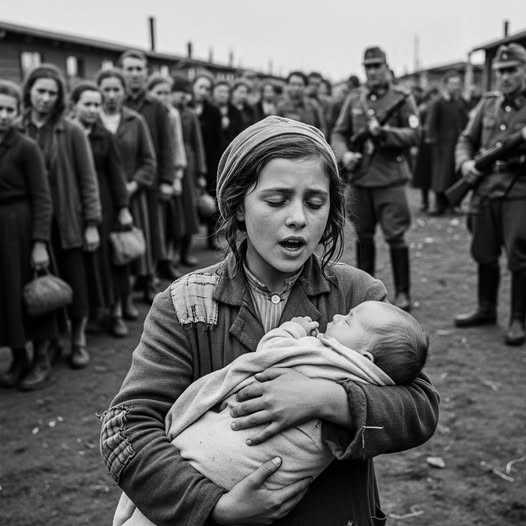
    It was there, amidst the dust, dark barracks, and uniformed soldiers, that a harrowing scene etched itself into history and haunts the memory of humanity. A twelve-year-old girl, prematurely robbed of her childhood, cradled her still-infant brother in her arms. His tiny body trembled with cold and fear, but in the cocoon of her delicate arms, he found his final refuge. She was no longer just a sister: she became his mother, his shield, the promise of life in a world that knew only death.

    The girl walked between columns of deportees. Around her, families were being torn apart, men separated from women, children torn from their mothers—all of this was orchestrated by the icy mechanisms of extermination. Yet in this atmosphere permeated with despair, a song resounded. Her voice trembled, brittle, almost drowned out by the barking of dogs and the shouted orders in German, but she didn’t give up. She sang a lullaby.

    This lullaby, which she undoubtedly learned long ago in her family home, was no longer just a melody. It was an oath. Every word, every breath, said: I will protect you as long as I can . In the world of Sobibor, where the Nazis had reduced men and women to numbers, this song was an intimate rebellion. Where everything was dehumanized, this child affirmed humanity with the simplest gestures: rocking, comforting, loving.

    To understand the symbolic power of this scene, it’s important to remember what Sobibór was. Built in March 1942 in eastern Poland, it was one of the three main extermination camps of Operation Reinhardt, along with Bełżec and Treblinka. Unlike Auschwitz, Sobibór was not a labor and extermination camp: it was used almost exclusively for immediate extermination.

    Upon arrival, most deportees—men, women, children, and the elderly—were taken directly to the gas chambers. Few survived in the camp for more than a few hours. Only a select few were selected for labor: sorting clothes, extracting gold teeth from corpses, burning corpses, and maintaining the gruesome machinery. Surviving witnesses claim that Sobibór was a place designed to ensure oblivion reigned, to ensure that no trace of humanity remained.

    In this setting of total annihilation, the scene of the little girl hugging her brother takes on immense significance. For where everything has been erased, it has left an indelible mark: love, tenderness, a humanity that refuses to die.

    It would be easy to believe that, in the face of the enormity of barbarity, these gestures meant little. But the opposite was true. Every smile exchanged between prisoners, every piece of bread, every tender glance directed at a child, became a victory over the Nazi project. These fleeting moments, invisible in records or archives, are nevertheless the most beautiful proof of what makes us human: our capacity to love, even when all seems lost.

    For this twelve-year-old, singing wasn’t just a way to calm her brother: it was a refusal to surrender completely to terror. It was an affirmation that in this universe of death, a spark of life still exists. It is this spark that today fuels the memory of the Holocaust and reminds us that even in absolute darkness, light shone.

    Sobibór will also go down in history for a unique event: the revolt of October 14, 1943. On that day, approximately 600 camp prisoners, mostly Jews, organized an armed uprising. Led by Alexander Pechersky, a captured Soviet officer, and Leon Feldhendler, a surviving Pole, they implemented a daring plan: they murdered several SS officers, cut off communications, and fled en masse.

    The uprising wasn’t entirely successful—nearly half the prisoners perished within hours or days—but around 300 managed to escape through the barbed wire and surrounding forest. Of these, around 50 survived the war. It was one of the few times a Nazi extermination camp experienced an uprising of this scale.

    The echo of this uprising resonates directly with the image of the girl and her brother. Both are about resistance. On the one hand, armed, organized, collective resistance. On the other, intimate, fragile, yet equally heroic resistance. In both cases, the essence is the same: a refusal to be annihilated, an affirmation of human dignity in the face of barbarism.

    Speaking of Sobibór also brings to mind the tragic fate of children in the extermination camps . Few survived. Nazi policy was particularly clear at Sobibór: no child was to live. Those unable to work were immediately taken to the gas chambers.

    Survivor testimonies evoke unbearable scenes: mothers pleading for the salvation of their little ones, children ripped from their parents’ arms, lullabies sung one last time to lull the youngest to sleep before their deaths. These images are seared into the memory of the Holocaust. They remind us that behind the numbers—six million murdered Jews, including one and a half million children—hidden lives cut short, promises broken, a future that will never come.

    The girl from Sobibor and her brother symbolize all those stolen lives. Their story, though undoubtedly ended in the shadow of the gas chambers, stands as a testament more powerful than any statistics: a testament to brotherly love that, if only for a moment, defied absolute barbarity.

    Today, as time gradually erases the voices of the last direct witnesses to the Holocaust, it is crucial to continue telling these stories. Sobibór is not just a place on a map: it is a scar in the world’s memory.

    Every child’s story, every song, every perspective passed down through the decades becomes a weapon against forgetting. Therefore, the memory of the Holocaust must be taught, transmitted, and constantly recalled. Holocaust deniers and the indifferent must never have the last word.

    Telling the story of the little girl’s song in Sobibór is meant to remind future generations that history is not just battles and dates, but also whispers, tears, and promises kept to the end. It is also meant to remind us that resistance doesn’t always mean fighting: sometimes it lies in the simplest gestures.

    After the October Uprising of 1943, the Nazis decided to destroy Sobibór to erase all traces of its existence. The camp was dismantled, the buildings demolished, and the evidence erased. But history remained. Survivors testified. They shared details, faces, and voices. Thanks to them, Sobibór became a symbol not only of death but also of courage.

    Today, a monument stands on this spot. Each visit is a silent reminder of what happened there. Every stone, every tree seems to carry the echo of lost voices. And among these voices, the voices of the girl and her brother still resonate.

    By remembering this scene at Sobibór in 1943, we not only commemorate history. We also recall a universal truth: even in the most horrific moments, human love has the power to endure.

    The twelve-year-old girl hugging her brother may have vanished in the flames of history, but her gesture endured. It has been etched in collective memory as a timeless testament: in the face of hatred, violence, and death, love endures.

    Sobibór was conceived as a machine for killing and erasure. Paradoxically, however, it remains a place where humanity revealed itself with overwhelming intensity. Every story, every testimony, every memory saved from oblivion is a victory over the Nazi project of total annihilation.

    And in this fight against oblivion, the song of a child, fragile and pure, remains an invincible weapon.

  •  The child from Sobibor who discovered his reflection .US

     The child from Sobibor who discovered his reflection .US

     the child from Sobibor who discovered his reflection

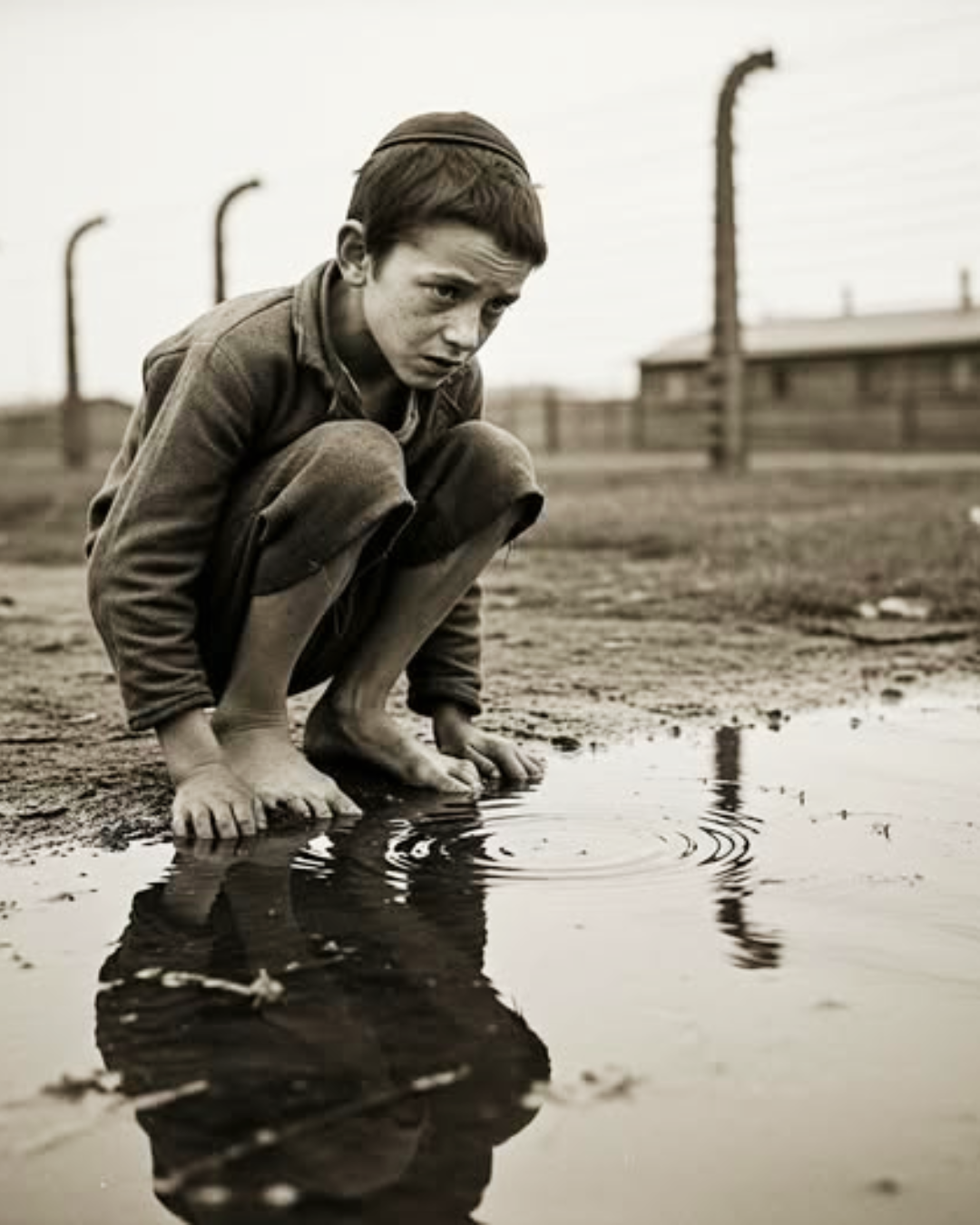
    Sobibór, 1943. In this place, hidden in the heart of the Polish forests, where death was supposed to be invisible and swift, the child leaned for a moment over a pool of stagnant water. Around him, the dust kicked up by footsteps, muffled screams, and the barking of dogs created a scene where nothing was innocent anymore. But there, on the hard-packed earth of the camp, that thin mirror of water brought him an unexpected discovery: his own reflection.

    He hesitated, almost afraid the face in the water was only a ghost. Slowly, he moved his gaze closer and saw gaunt features, sunken cheeks, skin darkened by hunger and grime. The eyes staring back at him were no longer those of a child: they had lost their spark of curiosity, replaced by a silent seriousness, a weariness too great for such a young age. He was surprised, almost terrified, recognizing himself and yet not recognizing himself. The Sobibór camp, a cold and methodical machine dedicated to extermination, had transformed every human being into a shadow, every identity into dust. And yet, in that muddy puddle, he found fragile but undeniable proof: he still existed.

    This reflection, cruel as it was, became a silent witness. Every premature wrinkle, every flicker of fear etched in his pupils spoke of what the executioners sought to steal from him: his childhood, his dignity, his memory. But at the same time, this image whispered to him a deeper truth: it had not vanished. The camp had not yet erased it. There, in that tiny mirror of rain, he found the echo of his name, his being, his humanity.

    Sobibór was not a camp like any other. Built as part of “Operation Reinhardt,” it had only one function: to kill. Trains arrived, deportees disembarked, and within hours, most perished in the gas chambers. For those who survived the few days or weeks forced into forced labor, every moment hung on the brink of extinction. In this closed universe, without horizon or future, even a puddle of water could become a fleeting refuge.

    The child understood that he possessed a fragile treasure. No one could take that moment of recognition from him. The executioners could take away his freedom, his loved ones, his strength; they could not steal the image he had just etched in his memory. Its reflection, hard as a statement and delicate as proof of survival, became an invisible talisman. On cold nights, when screams echoed, he remembered that face he had glimpsed, that look that told him: you are still here.

    In the history of Sobibór, the camp that witnessed an extraordinary uprising in October 1943—when prisoners rebelled and escaped, breaking the silence of their planned death—children’s voices were often silenced. Yet this intimate moment, this child crouching over a puddle, embodies the most universal truth: even in places designed to erase all traces of humanity, identity endures, fragile yet indestructible.

    Finally, he stood, his bare feet sinking into the mud, his gaze filled with a strange determination. Behind him, against the low sky, the barbed wire loomed—symbols of oppression and imprisonment. But deep within him, a certainty dawned: as long as he recognized himself, as long as he saw himself, even in the filthy water of the extermination camp, he carried within him the victory of memory over forgetting.

    Sobibór went down in history as a place of darkness, but also of resistance. This child, unwittingly, participated in this silent resistance. His simple contemplation of his own reflection became an act of inner rebellion, a refusal to erase. In a pool of water, he found proof that life, despite everything, persists.