
Majdanek, July 1944: when the silence of the ashes became the cry of memory

On July 24, 1944, at the beginning of a harsh and stormy summer, Soviet troops reached the outskirts of Lublin. That day, world history changed. Behind rusty barbed wire, behind watchtowers, and gray barracks, lay one of the first major Nazi concentration and extermination camps to be discovered almost intact: Majdanek. Until then, most accounts of the Holocaust had seemed unreal, drowned out by propaganda, mired in disbelief. But at Majdanek, there was no longer any doubt. The earth still exuded human ash.
The Red Army soldiers entered the death camp in silence. They didn’t yet know what awaited them. Rows of barracks stretched before them, and the air was thick with a persistent, acrid stench. With each step, they stepped over the remnants of a crime so horrific that words hadn’t yet been invented to fully describe it.
The doors opened, and with them, the world discovered the truth about Nazism. Piles of shoes, mountains of abandoned suitcases, cut-off hair stuffed into rough canvas bags: each object told a story, each fragment carried the memory of a silenced being. Majdanek, the extermination camp, became the first undeniable witness to the Holocaust, exposed to the astonished gaze of those who had just liberated eastern Poland.
Residents of surrounding villages, summoned by soldiers, were also forced to step in. For years, they had seen columns of deportees traversing the Lublin road. They heard trains, the metallic screech of crowded wagons. Some could smell the smoke that sometimes enveloped the fields like an unnatural fog. But the human brain is adept at rejecting the unacceptable.
An old peasant woman, hunched with age, slowly walked toward the huts. Her hands trembled, and a black shawl covered her worn face. She stopped abruptly in front of a pile of shoes. She covered her face with her hands and whispered in a broken voice,
“We smelled the smoke… but we didn’t want to believe it.”
In that fragile breath, the entire population admitted its helplessness, fear, and blindness. This was not just an empty phrase, but a universal admission: the proximity of evil never guarantees its recognition.
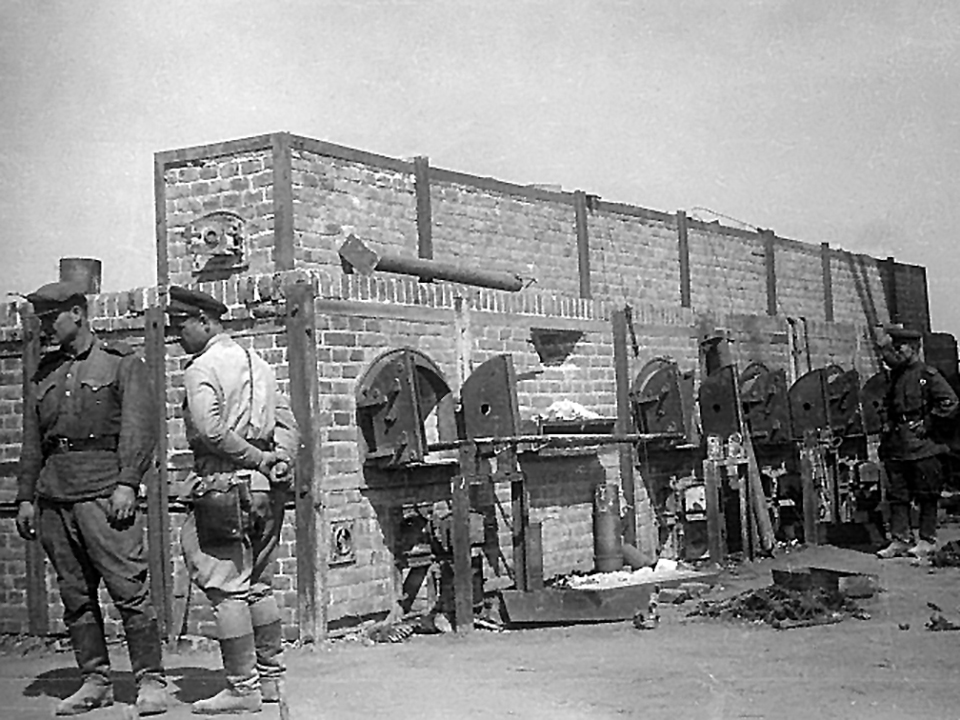
For Soviet soldiers, hardened by the most horrific battles of World War II, Majdanek was a trauma of a different kind. They saw destroyed cities, corpses lined up in the streets, but never the methodical organization of extermination. Here, everything was thoughtful, planned, industrialized. The crematoria still bore the scars of a recent fire. Mass graves gaped open like gaping scars.
A young soldier, only twenty years old, wrote in his notebook:
“I thought I had come to liberate a military camp. I had discovered hell.”
And this hell had a name: the Shoah. The Nazis wanted to annihilate not just individuals but entire nations, erasing their culture, memory, and future. Majdanek, with its six gas chambers, kilometers of barbed wire, and meticulous documentation, was a testament to the cold logic of extermination.
Unlike other camps, such as Sobibor and Treblinka, which the Nazis destroyed in an attempt to cover up their crimes, Majdanek was liberated almost intact. This made it irrefutable evidence of what had happened to the world. Allied journalists were invited, photographers immortalized the events, and cameras filmed. Still-warm crematoria, unburned corpses, and warehouses overflowing with confiscated items were shown.
This was a shock to international opinion. Until then, many had doubted the scale of Nazi crimes. Some considered the testimonies to be propaganda exaggerations. But in the case of Majdanek, doubts were no longer possible. World War II revealed its darkest dimension: a plan for total extermination, rationalized down to the smallest detail.
A few survivors still wandered among the barbed wire, living specters of the Holocaust. Their gazes carried the weight of unspeakable tragedy. A Polish woman, her face sunken, recounted how she lost her two daughters in the gas chambers. Her voice was almost a whisper:
“I survived because they needed my hands. But my hands can’t hold anything anymore.”
These words rang like an eternal condemnation of Nazi ideology. Each human testimony, each story, added a dimension of flesh and tearfulness to what the camp walls were already silently telling.
One of the most powerful images to emerge from Majdanek is that of shoes, which remain etched in collective memory. Thousands of pairs piled up, in all sizes: tiny children’s shoes, men’s boots, women’s pumps. Each pair was a fragment of a life cut short. The Nazis not only murdered people but also tried to track them down.
These shoes became a universal symbol of the Holocaust, more powerful than any speech. They spoke without words about the scale of the Holocaust. And when visitors first saw them in 1944, a crushing silence fell. It was the silence of the dead, but also of the living, who could find no words to express the horror.
The discovery at Majdanek was a turning point. The world could no longer ignore the Holocaust. The Nuremberg trials would soon be based on this tangible evidence. The gas chambers, the documents, the confiscated objects, the bodies themselves: everything became evidence.
But beyond justice, memory was being built. Majdanek quickly became a place of remembrance, a Holocaust museum, even before the end of the war. Survivors knew that this had to be shown, explained, and communicated. Memory was not only a moral obligation: it became a weapon against forgetting, against the repetition of evil.
In 1944, as the old peasant woman wept over piles of shoes, she carried within her the burden of all those who looked the other way. Her words—”We smelled the smoke, but we refused to believe”—have endured for decades. They remind us that in the face of barbarism, silence and indifference become complicity.
Even today, Majdanek poses questions for us. What would we do if we were those neighbors, those peasants, those passersby? Would we dare to speak out, or would we, out of fear or survival instinct, prefer to remain silent? The memory of the camp is there to ensure that this question never fades.
Majdanek is not just a Polish site, nor even a European one. It is a universal legacy, an open wound in the conscience of humanity. It reminds us that World War II was not just a war for territory, but a war against the very existence of entire nations.
Visiting Majdanek today, one walks through the silent barracks, where the footsteps of the deportees can still be heard. One sees the watchtowers, the barbed wire, the crematoria. And one understands that memory is a responsibility. The ashes of Majdanek have become ashes of memory, witnesses to a crime that must never be forgotten.
On July 24, 1944, humanity opened its eyes to one of its worst nightmares. Majdanek, the concentration and extermination camp, revealed to the world the scale of the Holocaust, the reality of the Holocaust, and the methodical cruelty of Nazism. For Soviet soldiers, for the inhabitants of the surrounding villages, for the first witnesses, it was a brutal revelation, a confrontation with the unimaginable.
But in the ashes, in the shoes, in the empty huts, there was something more than a testament to death: there was a call to life, a call to memory. The old woman who whispered, “We smelled smoke,” leaves us with an eternal lesson: never look away, never surrender to indifference.
Majdanek still speaks to us and always will. As long as it stands, with its barbed wire and mountains of boots, it will remind the entire world that memory is the only safeguard against the return of barbarism.
Leave a Reply