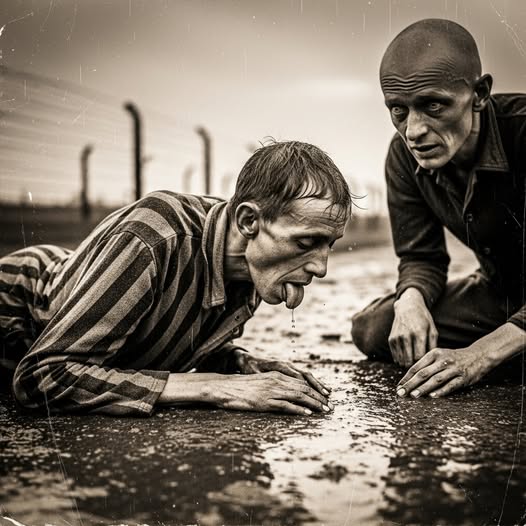
The Man Who Licked the Rain – Dachau, 1945

That day, rain fell on the Dachau camp like a fragile veil over a gaping wound. It was neither strong nor benevolent; it was a fine, persistent drizzle that mingled with the mud, soaking into the prisoners’ striped clothing and carving furrows across their sunken faces. Yet for some, it meant more than a simple downpour: it became a source of life, a last breath of purity in a world that seemed devoid of humanity.
The man lay on the ground, his body so thin it seemed his bones were about to break through his skin. His dry lips quivered, and his tongue stretched out toward the damp earth. He lapped up the rain like a child leaning toward a fountain, but with an almost animalistic zeal. Beside him, another prisoner watched, torn between fear and silent compassion. “It tastes clean,” the man on the ground muttered, as if this water, even mixed with the camp’s filth, were the final proof that life had not completely vanished behind the barbed wire.
This moment, tiny and almost invisible to the SS guards, represented a form of resistance. In this Nazi concentration camp, where hunger tore at the insides more surely than bullets, where thirst devoured throats to the point of driving even the most persistent mad, the taste of a raindrop was like clinging to the thinnest thread of existence. It was a silent confirmation that amid the ashes and despair, a spark of dignity remained, a community between man and the elements that even Nazi ideology could not tarnish.
To understand this desperate act, the scene must be placed in context. Dachau was not a camp like any other. Rather, it served as a model for all others. Established in 1933, shortly after Hitler came to power, it was the first concentration camp established by the Nazi regime. Initially intended for the internment of political opponents—communists, social democrats, and trade unionists—it quickly became a place of terror, imprisoning Jews, Roma, homosexuals, Jehovah’s Witnesses, Soviet prisoners of war, and anyone else Hitler deemed “undesirable.”
For twelve years, Dachau was a laboratory of cruelty, a training ground where the SS perfected methods of humiliation, torture, and slow extermination. According to official records, over 200,000 prisoners passed through the camp, and at least 41,500 of them died. Forced labor, medical experiments, starvation, and epidemics were the silent weapons of methodical genocide.
In the final months of World War II, as Germany crumbled under Allied air raids, the situation at the camp became even more desperate. Convoys overloaded with prisoners evacuated from Auschwitz and other camps in the east arrived, setting off on “death marches,” where many perished before even reaching Dachau. The already overcrowded barracks became extermination camps, where, due to lack of food, care, and space, dozens of bodies accumulated daily.
In this world where every hour seemed like an eternity, a man licking the rain wasn’t madness; he was a symbol of survival. The camp’s prisoners lived in constant deprivation. The daily food ration consisted of a piece of black bread, sometimes moldy, and a thin soup that was more like hot water with turnips than a proper meal. Drinking water, meanwhile, was scarce and often contaminated. Drinking from puddles was risky, but refusing to drink meant condemning the body to dehydration.
So when the rain fell, it was a gift from heaven. Some looked up and opened their mouths, as if to catch several drops at once. Others, weaker, bent over the mud and licked the softened earth, savoring what they considered nectar. It wasn’t just an instinctive gesture; it was a silent prayer, an attempt to absorb a particle of hope.
This gesture exposed the absurdity of the Nazi concentration camp system. These people, once teachers, workers, doctors, and students, had to crawl through the mud to survive. And yet, despite the imposed degradation, some found the strength to continue living in a drop of rain.
April 1945. Allied troops were approaching. The noise from the front grew closer, and even the thick camp walls could no longer drown out the distant echoes of fighting. The SS, in turn, grew increasingly restless. Some tried to cover up their crimes, while others organized forced marches to clear the camp before the Americans arrived.

The prisoner who had tasted the rain had no strength to wait for that day of liberation. His body, exhausted by months of deprivation, weakened within hours of that last sip of water. He was found the next day, motionless, his lips still smeared with mud, as if nature had given him one last kiss.
A few days later, on April 29, 1945, American troops entered the Dachau camp. The sight they encountered was unbearable: piles of corpses, survivors with deathlike faces, blank stares forever marked by unspeakable suffering. Yet amidst this horror, some testified to a strange sense of liberation. For those who survived, even those half-dead, the air suddenly took on a different scent: the scent of regained freedom.
The story of the man who licked the rain has become a permanent part of survivors’ narratives. It’s not just a macabre anecdote, but a universal parable of human dignity. Everything in Dachau was designed to crush the individual: hunger, beatings, humiliation, and ubiquitous death. Yet, each act of survival became a quiet victory over oppression.
The rain he licked wasn’t just water. It was a form of communion with nature, a reminder that beyond the barbed wire the world still turns, that Nazi Germany will eventually fall, that hope can survive even in the mud.
Even today, visiting the Dachau Memorial Site, one feels this heavy, even stifling atmosphere. Walking along quiet paths, among trees that have seen it all, one imagines these people trying to drink a drop of rain. The stones preserve memories, and each visitor becomes an indirect witness to this invisible struggle between death and life.
Telling this man’s story is a struggle against oblivion. The Holocaust and concentration camps are not just episodes from the past; they are eternal warnings. Behind every number, every statistic, there are faces, unique stories, and personal suffering.
The Man Who Licked the Rain at Dachau reminds us that inhumanity can reduce a person to a figure crawling in the mud, but it also reminds us that even in the worst circumstances, a spark of humanity remains. This is not only a story of suffering, but also a story of resistance—a quiet, small, yet infinitely powerful resistance.

At a time when some still dare to deny or minimize the Holocaust, at a time when the world faces new forms of hatred and violence, this image must remain etched in our collective memory. Every drop of rain this man licked is a lesson: freedom, dignity, and life are never taken for granted; they are fragile goods that must be constantly protected.
“It tastes pure,” he said, savoring the rain. Everything essential is hidden in that whisper: the desire for life, the love of freedom, the belief that even in the heart of hell something pure remains. Dachau was a place of death, but in this man’s memory, it also became a place of witness.
Today, as visitors pay their respects to the barracks, watchtowers, and mass graves, one can almost hear the echo of this phrase. It encourages us to look beyond the horror, to see the greatness of the human soul in the smallest gestures.
And if we close our eyes, perhaps we too will taste the rain on our lips, a taste that unites the dead and the living in a single oath: never to forget.
Leave a Reply