Dachau, April 1945 – The Story That Wasn’t Completely Told
When the American soldiers entered the gates of Dachau, the silence of the camp was heavier than the roar of the cannons. It was a silence that resembled not peace, but rather an echo of years of hunger, humiliation, and silent dying. Those who remained alive were shadows of their former selves—emaciated faces, trembling hands, exhausted bodies, yet something more than emptiness flickered in their eyes. There was a spark there that neither the cold of the barracks nor the violence of the guards could extinguish.
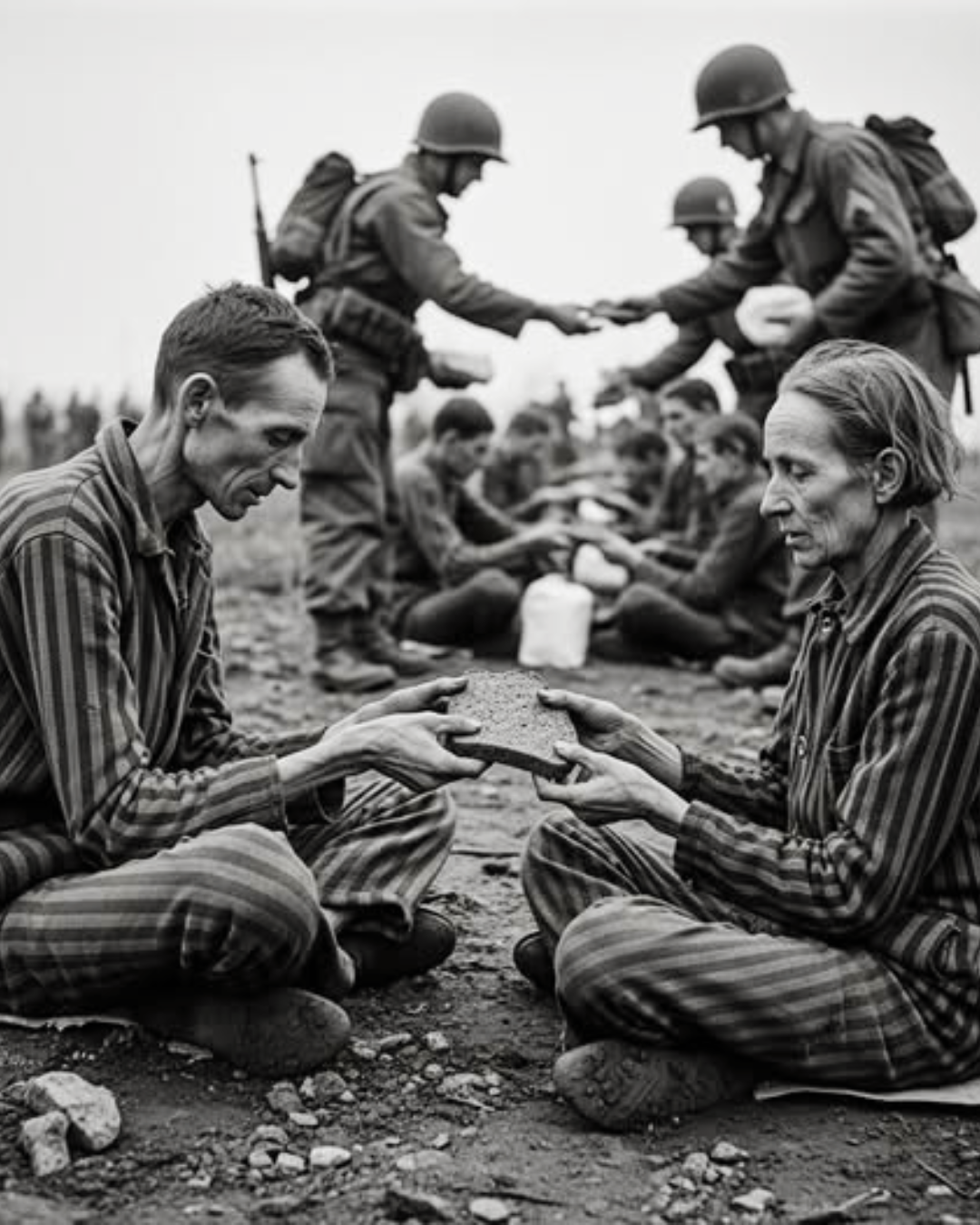
The soldiers arrived with bread. It wasn’t white and fresh, like the bread found in European homes far from the front, but dark, plain, and dry. Yet in the prisoners’ hands, each piece felt as precious as gold. After years of hunger, in which a slice of bread marked the boundary between life and death, this moment took on an almost sacred significance.
The two survivors, sitting opposite each other on the ground, received a single piece. They didn’t look at each other like rivals. There was no jealousy or feverish greed in their eyes. There was only peace. They carefully broke the bread in half, as if touching something sacred. Their hands touched, and the simple act of sharing carried a power greater than words.
“We survived because we never ate alone,” one of them whispered, and in his voice was a truth that should have resonated throughout the world.
In a camp where hunger could lead to desperation and betrayal, the act of sharing a piece of bread was not only an expression of solidarity but also a rebellion against the logic of death. This gesture said: “You can take away our strength, you can take away our home, but you cannot take away the humanity that lies in a small act of caring.”
Each slice of bread at Dachau was more than just food. It was a memory and a promise. A reminder that even in a time when humans were treated worse than animals, the bond between people could be the last and most important form of resistance.
After liberation, many prisoners relived these moments—how the taste of the first piece of bread from their liberators mingled with tears, how their hands trembled not from hunger but from emotion. Every crumb was like proof that the world outside had not forgotten.
The story of Dachau, however, does not end in April 1945. For many survivors, that first piece of bread was the beginning of a long journey toward a new life. But the memory of sharing bread in the darkness of the barracks became their greatest legacy. It was a lesson for future generations—that survival is never the work of an individual, but of a community, woven from the invisible threads of empathy, compassion, and memory.
This image of two emaciated men sharing a crust of bread in the shadow of American soldiers is one of the most poignant testimonies of that era. It’s not the triumph of armies, nor the roar of victorious salvos, but the silence of two hearts that knew that true victory lies in the survival of humanity.
Therefore, as we remember Dachau today, we must remember that every memory, every article, every photo is a candle lit in the darkness. This light serves as a reminder that, in the worst conditions, people still chose love and solidarity over hatred and selfishness.
Just like when a piece of bread—simple, humble, leathery—became sacred.
Note: Some content was generated using AI tools (ChatGPT) and edited by the author for creativity and suitability for historical illustration purposes.
In the spring of 1945, the silence over Mauthausen was no ordinary silence. It was a burden that neither the hills of Upper Austria nor those who emerged from behind the camp barbed wire could bear, alive but broken. Liberation, which arrived in May, was not merely a moment of triumph. It was a moment suspended between death and life, between shadow and light, between memory and oblivion. What happened then remained in the hearts of the survivors forever, but only a few were able to express it later.
The Mauthausen concentration camp, one of the most brutal in the entire Nazi terror machine, became a place where people lost not only their lives but also their names, their dignity, and their hope. In the musty barracks, in the quarries where prisoners perished under the weight of stones, and in the rows of executions whose rhythm dictated each day—there, humanity was suppressed until its last breath. And yet, as the May sun of 1945 spilled its pale light over the barbed wire and American soldiers entered the camp, one flame remained, refusing to be extinguished.
At Mauthausen, soap was never a symbol of hygiene or freshness. It was ironically distributed to prisoners as a reminder of normalcy, but in reality, it only served to exacerbate the absurdity of life in the shadow of the crematoria. Bars of hard, coarse soap, whose scent never washed away the grime of camp life, became silent witnesses to suffering.
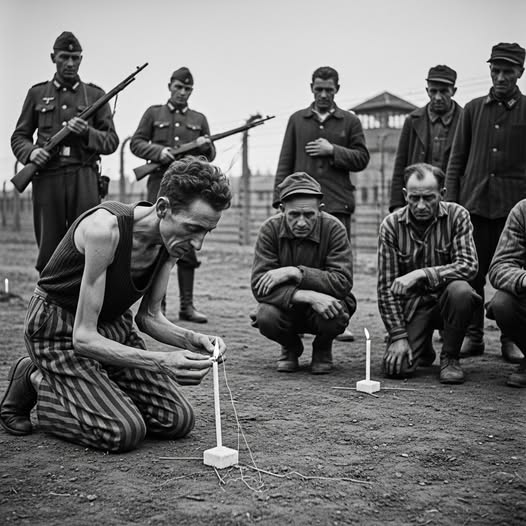
When the camp was liberated, some survivors stumbled upon remnants of these objects—scattered, useless, resembling more shards of a bygone nightmare than anything practical. Among them was a prisoner whose name remained unaccounted for. He was known only as “the one who made the candle.” He was emaciated, his body trembling like a branch in the wind, and his eyes—sunken, dark—stared into space, as if trying to find the faces of long-lost loved ones.
It was he who grabbed the piece of soap, turning it over and over in his hands as if searching for an answer. Perhaps it was then that he realized that what was meant to be a sign of degradation could still be transformed into a symbol of remembrance.
Melting soap in primitive conditions seemed absurd, yet the survivor found a way. In an old vessel, amidst the ruined barracks, he slowly melted it, drop by drop. The other prisoners watched silently, not yet grasping the meaning of his gesture. Then, when the waxy mass had hardened, he shaped it into a small candle. One handed him a piece of string, another brought a metal rod to make a hole for the wick. It was painstaking work, but there was a ceremony behind it, as if every movement of the hand were a prayer.
When the candle was ready, the prisoner knelt and lit it. The flame was weak, flickering, dancing in the wind, but in its fragility lay its strength. A group of survivors gathered around. They watched in silence, a silence deeper than screams, stronger than words. Light reflected in their eyes, and in that glow, the faces of those who were no longer there were also reflected.
“For those who cannot see this day,” the prisoner whispered, his voice trembling like a flame.
At that moment, soap ceased to be an object of shame. It became a sacred symbol. The candle was fragile, capable of extinguishing at any moment, but its light was more powerful than the crematorium fire.
The liberation of Mauthausen in May 1945 brought freedom to the survivors, but also a burden. Many never regained their health or their families. They returned to countries that sometimes refused to listen to them, where survivors’ testimonies were treated as an uncomfortable shadow of the past. Yet those who witnessed the lighting of the soap candle never forgot that moment.
One of them, a Pole from Krakow, wrote years later: “We were surrounded by death, and yet that small flame taught me that life always finds a way to speak. It wasn’t a candle. It was a soul.”
Such testimonies have become the foundation of Holocaust remembrance. Thanks to them, the modern world knows not only numbers and facts but also stories filled with pain and hope.
The soap candle became an unofficial symbol, passed down orally. It’s not found in military reports or administrative archives. It’s a whispered story, told to surviving children and grandchildren, a story that eludes documents but lingers in the memories of the living.
Today, when we speak of the liberation of concentration camps, we often evoke images of American soldiers distributing bread, photographs of emaciated prisoners, and documentaries made by the Allies. But there, in the shadow of these grand images, small stories also remain – like the one about the soap candle. Stories that teach us that the gesture of remembrance can be more powerful than an entire empire built on forgetting.
Today, visiting the Mauthausen memorial, we see stone walls, restored barracks, and exhibitions filled with photographs and documents. But the true lesson of history lies in those moments uncaptured by cameras. In the gesture of the man who fashioned a candle from soap. In the gazes of prisoners who silently gazed at the flame, seeing in it the reflection of those who never returned.
It is this story that makes remembering the Holocaust so important. It is not just a story of death and cruelty. It is also a story of strength of spirit, of restored human dignity, and of hope that refused to be extinguished.
The light of this candle—though fragile and fleeting—illumines the darkness of history to this day. It serves as a warning that even in the deepest shadows, a spark of humanity can be found.
Note: Some content was generated using AI tools (ChatGPT) and edited by the author for creativity and suitability for historical illustration purposes.
May 1945. Europe was plunged into a silence it hadn’t known in years. A silence that carried the weight of screams silenced forever, a silence that echoed with gunfire and the rustle of footsteps as troops entered places whose existence many had previously been unaware of, and whose presence others were afraid to even whisper. One such place was Mauthausen —a concentration camp that had functioned for years as a death factory, its gates only opening in May 1945.
It was then that the American soldiers entered hell. The images they witnessed were beyond imagination. The emaciated figures of the prisoners, more like shadows than people, staggered as if their every move were a miracle. The roads leading from the camp to nearby towns became the scene of a slow march toward freedom. But it was not an easy freedom. The prisoners’ bodies, ravaged by hunger, disease, and exhaustion, often refused to obey. Many stumbled, fell, and had no strength to rise. Their bare feet, wounded and bleeding, scraped against the rough stones and dust, leaving silent testimonies of suffering along the way.
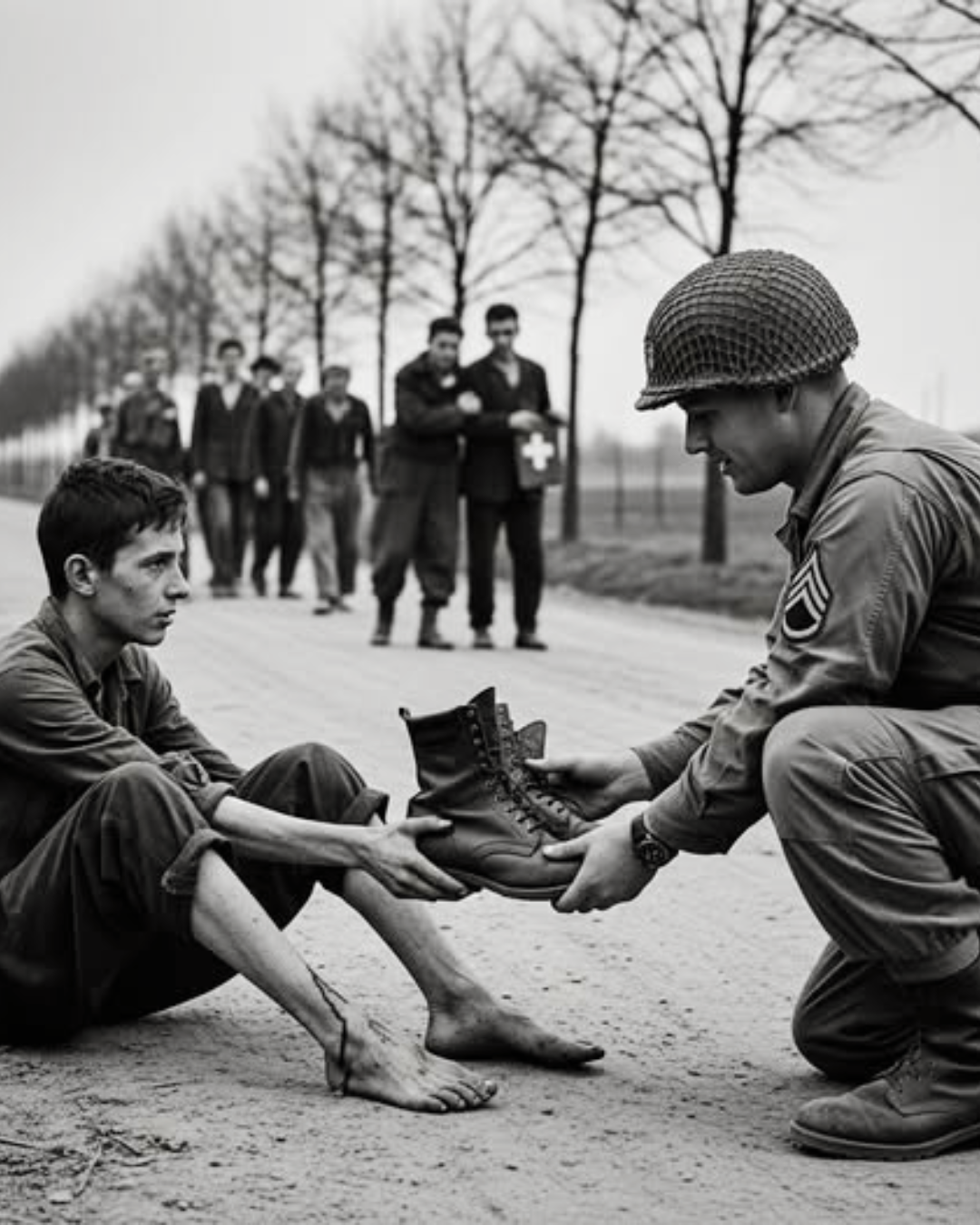
Among them was a boy no older than fifteen. His face, though childlike, was etched with lines of pain and experience that shouldn’t belong to a child. The shoes he’d been given in the camp had long since fallen apart. Each step became agony, as if the earth were trying to hold him back, to drag him back into the abyss he’d just escaped. But the boy kept walking, driven by something that could hardly be described as anything other than a fragile hope for survival .
An American soldier, walking alongside the column of survivors, noticed his difficulties. He stopped, looked at the boy’s bare, bloody feet, and then—without a word—knelt down. He took off his own shoes, which moments before had protected his feet from the cold road, and handed them to the boy. The gesture needed no explanation. It was like a promise: “You are free now. Now your path will be a little easier.”
The boy looked at the soldier uncertainly. He might not have understood the language, but he understood the gesture. With trembling hands, he took the boots and slipped them onto his feet. The metal fittings and rough leather, which were everyday life for the soldier, became a shield for him, a thin barrier separating his body from the hard, foreign ground. For the first time in months, maybe even years, he felt something that could be called protection.
The soldier rose and moved on, barefoot, oblivious to his own discomfort. The boy followed him, his steps unsteady but more confident than before. Each one was a symbol that it was possible to go on, that each day did not have to end in the shadow of death.
Years later, when the boy had grown up, he bore witness. He didn’t speak much about his days in the camp, for the memories were like open wounds. But he always recounted one incident: “That soldier gave me his boots. He gave me back my journey.”
This sentence contained more than a simple exchange of shoes. It contained the entire story of liberation, the entire truth about how the smallest gestures had the greatest power. Shoes became a symbol—not only of warmth and protection, but also of dignity, brutally stripped and then instantly given back.
Mauthausen concentration camp was one of the most ruthless camps of the Third Reich. Established in 1938, it quickly gained a dark reputation as a place where prisoners perished not only from executions but also from overwork. The Mauthausen quarries were the scene of thousands of falls and deaths. Prisoners were forced to carry heavy blocks of stone up the so-called “Stairs of Death”—186 steep steps that claimed the lives of countless people.
When the camp was liberated in May 1945, there were still some 40,000 survivors within its walls. These were people who were extremely exhausted, often unable to move on their own, yet still alive, still fighting for every breath. For them, every gesture of help was miraculous.
The story of the boy and the soldier with the boots never made it into official military reports or the dry studies of historians. It’s not found in the numbers, tables, or statistics that attempt to capture the enormity of the tragedy. But it lived on in the memory of a survivor who knew that the essence of liberation lay in this small gesture.
The liberation of Mauthausen wasn’t just about opening the camp gates. It was about restoring the prisoners’ humanity. And humanity was first restored through gestures like these—a piece of bread passed from hand to hand, a glass of water, a coat thrown over one’s shoulders, and shoes that allowed one to continue walking.
When we look at photos and videos from the liberation of the camps today, we see crowds of survivors, their emaciated figures, their gazes mingled with disbelief. But behind each gaze lies an individual story. Some have never been told. Others survive only in short sentences. “This soldier gave me his boots”—a single sentence, but in reality, an entire chapter of history.
There’s a silence in that sentence that speaks louder than a scream. It’s a silence in which the echo of footsteps resonates—first barefoot, painful, and then, thanks to a pair of soldier’s boots, a little lighter.
Today, Mauthausen is a place of remembrance. Thousands of people from around the world come there to stand in the courtyard, gaze at the quarries, and feel the weight of history. But can one truly experience what it was like to walk barefoot along a rocky path, fifteen years old, and have one’s entire childhood stolen by the camp?
That’s why stories are so important. Because they fill a void that no statistics can capture. They’re the reason why, behind the words “Mauthausen 1945,” we see faces, hands, and footsteps. And we see the shoes that have become a symbol of hope.
The liberation of Mauthausen in May 1945 is a story about the end of a nightmare, but also the beginning of a new path. It was not an easy path, as many survivors had to face the loss of their families, homes, and identities. But every step, even the most painful, was a step towards life.
The gesture of the American soldier who gave his boots to the boy was one of those quiet, almost imperceptible moments that nevertheless convey the full truth of humanity. It wasn’t an act of heroism reported in the newspapers, but an act that restored the boy’s hope and dignity.
And that’s why, as we commemorate the Holocaust, the concentration camps, Mauthausen, and the liberation of prisoners , we should remember not only the numbers and dates, but also these small, silent miracles. For they are what create history that truly speaks to the heart.
Note: Some content was generated using AI tools (ChatGPT) and edited by the author for creativity and suitability for historical illustration purposes.
The spring of 1945 didn’t smell like freedom. It smelled of smoke, damp, and the old, fear-soaked wood of the barracks, which for years had served as a silent testament to human degradation. Buchenwald concentration camp—a place that for thousands had become the border between life and death—had finally reached its moment of liberation. American soldiers entered a silence that was not broken by screams, for the prisoners no longer had the strength to cry out. It was a silence too heavy, as if the entire world had momentarily held its breath.
In one of the barracks sat a group of men in striped uniforms, their faces emaciated, their eyes so sunken they looked like dark wells. Beside them stood a helmeted soldier, a rifle slung over his shoulder, this time not as a symbol of terror, but of liberation. Yet even his presence couldn’t dispel the silence. Only when one of the prisoners held up an object so trivial it seemed insignificant—a rusty spoon—did the silence shatter.
This spoon was no ordinary piece of metal. It was a secret, a symbol, a forbidden song of survival. The man, whose hands trembled like leaves in the wind, had hidden it for years, hiding it in a pallet, in the recesses of the barracks, risking his life if it were ever found. In a camp where every slice of bread was precious and every second could be his last, keeping a useless piece of metal with him seemed madness. And yet, this spoon was everything.
The man raised it high, as others had once raised flags or sacred images. Then, very slowly, he tapped it against the iron frame of the bunk. The sound was faint, uneven, but it echoed off the wooden walls of the barracks. It wasn’t music in the classical sense. It was the melody of life. The other prisoners raised their heads, their gazes off the ground for the first time in a long time. They listened.
“It’s not music,” the man whispered, his voice breaking. “But it means we’re alive.”
In that moment, the rusty spoon became more than just an instrument. It became proof that a person can take even the smallest particle of freedom with them into the darkness.
From the very beginning, Buchenwald concentration camp was a place designed to destroy not only the bodies but also the souls of its prisoners. Founded in 1937, it grew over the years, becoming a symbol of terror and a factory of suffering. In 1945, when the US Army entered its gates, they found over 21,000 survivors, their eyes bearing the weight of generations. Each had their own story, each their own small symbols of survival. For some, it was a piece of bread hidden in the seam of their striped uniform; for others, a fragment of a prayer repeated silently; for this man, a spoon that had become a song.
Was it possible that such a simple sound could bring more hope than the most beautiful symphony? That the rhythm of metal clattering against metal could replace the orchestra that never existed? The prisoners in the barracks listened as if spellbound. Their faces lit up with shy smiles that hadn’t been allowed to appear for years.
This sound became a song about Buchenwald , a song about survival, about people who, despite everything, did not allow the remnants of their humanity to be taken away.
Today, when we visit memorial sites, we often ask: how could they survive? How could they maintain hope in a world that seemed designed solely for destruction? The answer lies not in great deeds, but in the smallest gestures. The rusty spoon, picked up at the moment of liberation, was proof that even in hell, a person can create the melody of life.
What happened at Buchenwald in 1945 was never recorded in official reports. American soldiers described hunger, disease, and the piles of bodies. Historians focused on the numbers, on political decisions, on what could be measured and documented. But no one recorded the scene in the barracks, when a few survivors listened to the rhythm of a spoon, a glint in their eyes that belonged no longer to the past, but to the future.
The song about the rusty spoon never made it to sheet music. It had no melody, no words to write down. Yet it endured in the memories of those who heard it. It endured as an echo of that moment, a symbol that freedom sometimes comes in the quietest of sounds.
Can we still hear that song today? Can we see value in the simplest things that carry the power to survive? In a world where the sounds of everyday life drown out everything else, it’s worth pausing for a moment and remembering that clatter. For it tells us more about humanity than thousands of history books.
The liberation of Buchenwald in 1945 was the end of one nightmare, but also the beginning of another—one in which they had to learn to live anew. Those who survived returned to the ruins of their homes, to worlds that no longer existed. Many of them carried untold stories. Some would only tell them years later, others never. But for all of them, that spoon, that rhythm, that song were proof that even in the darkest place, a spark of light could be found.
That’s why, when we talk today about Buchenwald, Auschwitz, and Majdanek, we can’t limit ourselves to statistics. We must tell the story of such moments. About the song about the rusty spoon, which was a hymn to life where everything was supposed to die.
Note: Some content was generated using AI tools (ChatGPT) and edited by the author for creativity and suitability for historical illustration purposes.
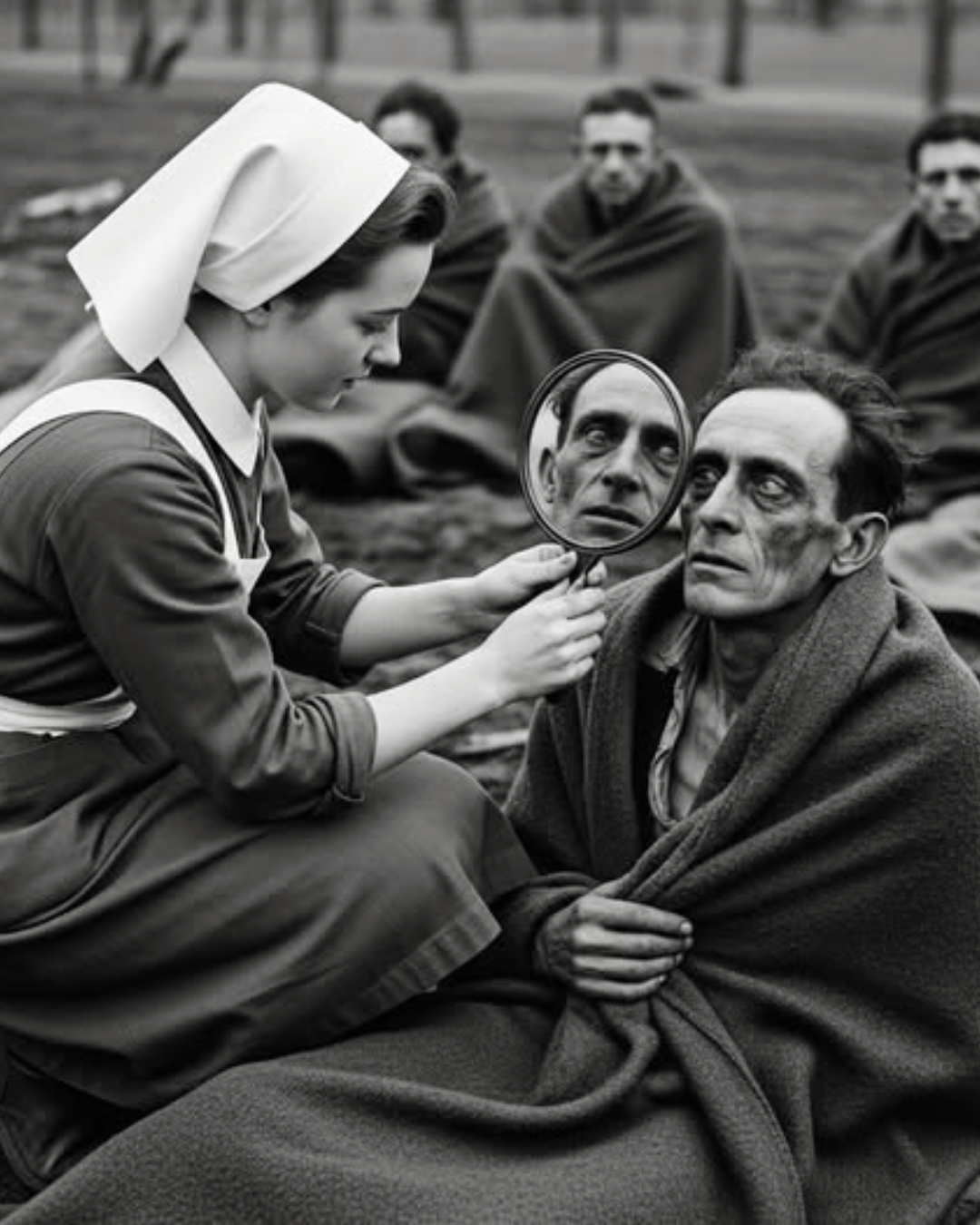
No one can say precisely when this gesture was born—simple, yet burdened with an unimaginable weight. She was a British nurse, one of those who, in the first days after the liberation of Bergen-Belsen, tried to restore meaning to a place where meaning had long since died. She held a small, round mirror in her hands. Inconspicuous, fragile, so different from the brutal reality it faced. When she raised it to the face of the first survivor, silence fell. A silence that spoke louder than the screams of thousands of dead. For in that shard of glass lay a truth no one expected to see. But this was only a prelude, a prelude to something greater, the echoes of which still resonate in the dark recesses of history.
The man whose eyes rested on his own reflection couldn’t tear his gaze away. The gaunt cheeks, the sunken eye sockets, the skin drawn over the bones—the image of a living shadow. The whisper that escaped his lips was more prayer than statement: “I look like death—but I’m still breathing.” Whether it was laughter or a spasm of despair, no one could answer. One thing was certain: in that moment, he touched something he couldn’t yet name. The mirror became a portal, leading to another story. But did we ever know its ending?
The rest of the prisoners waited in line. Each, wrapped in a military blanket, looked like a ghost wandering between worlds. And as the mirror passed from hand to hand, each saw something different in it. For some, it was an encounter with their own death, a death they had successfully cheated. For others, it was a moment of awakening, when they could finally recognize themselves as people, not numbers carved into their skin. But somewhere between these glances lurked another truth, more painful and harder to accept. The question was: would anyone ever dare to speak it?
The British nurse, though she didn’t write her name into the chronicles, became a silent witness to the transformation. This wasn’t a simple reflection—it was a confrontation with a past no human would want to see. As she held the mirror to each face, her hands trembled. Perhaps she knew she wasn’t simply giving them an image of their bodies. She was giving them a fragment of their souls, still smoldering somewhere, despite years of hunger, disease, and degradation. But was she even aware that something was being created at that moment that would haunt the memories of generations?
Every survivor carried a secret. The camps taught them silence, and this silence weighed heavier than the harshest words. When they looked in the mirror, some cried, others laughed nervously, and still others averted their gaze, refusing to accept their own reflection. These reactions held a story larger than the war chronicles could bear. Each face spoke volumes, yet together they formed an image no one was prepared to see. And although we think we know what happened at Bergen-Belsen, the question remains: what did these people truly see in the glass?
Memories of these moments circulate to this day in the stories of survivors and the few witnesses. Many later said that it was at that moment that they truly felt alive for the first time. Paradoxically, not at the moment of liberation, not at the moment when the barbed wire no longer imprisoned their bodies—but precisely when they looked in the mirror and saw a man they barely recognized. This was their return to life, though painful, for it raised the question: is the one I see still me, or already someone else? And perhaps therein lies the greatest mystery—that not everyone who survived was able to truly return.
The history of small gestures is often lost in the shadow of great battles and political decisions. And yet this mirror—fragile, banal, almost laughably ordinary—became one of history’s most extraordinary witnesses. No one knows its fate. It vanished as if it had never existed. Perhaps it lies forgotten in some museum warehouse, or perhaps it was smashed when no longer needed. But there are those who believe it still exists somewhere, preserving the reflections of those who gazed into it for the first time in years. Is it possible that the fragment of glass still holds traces of those gazes?
And so the story of the first mirror from Bergen-Belsen is not just a memory of war. It is a riddle that still haunts. Each reflection was like a key to a secret no one dared fully reveal. Perhaps that is why this story keeps resurfacing – in dreams, in testimonies, in stories passed down in whispers. Because somewhere, on the border between light and shadow, the question remains: what did those eyes truly see when they looked into the mirror for the first time? And do we, looking at our reflections today, truly see the whole truth?
Note: Some content was generated using AI tools (ChatGPT) and edited by the author for creativity and suitability for historical illustration purposes.
January 1945 brought an event to Europe that would forever be etched in human memory. On January 27, when Soviet troops reached the gates of Auschwitz-Birkenau, they witnessed scenes that were difficult to describe in human words. The barracks were filled with emaciated, half-dead prisoners. Piles of bodies still lay in the courtyards, the crematoria still carried the fresh stench of death, and the eyes of the survivors held a mixture of disbelief, relief, and unimaginable trauma. The liberation of Auschwitz did not mean an immediate end to suffering—it marked the beginning of a slow, painful return to life. Yet it was then, amid the ruins of humanity, that symbols emerged that to this day speak louder than thousands of testimonies. One of these was an empty bowl held in trembling hands.
Everyday life in Auschwitz was defined by hunger. Absolute hunger, which became the language and rhythm of all camp life. Every day, prisoners lined up in long lines for watery soup, more dirty water than food. Wooden or tin bowls were the only personal item prisoners guarded as treasured as possible. Each day, a ladle of thin liquid landed in them, sometimes with a bit of cabbage, rarely with a crumb of potato. For many, this was the only reason, the only reason not to give up just yet.
Hunger was not only physical suffering but also a tool of terror. The Germans knew that a person weakened by hunger loses the will to resist, that they turn into a shadow of their former self. In Auschwitz, hunger was omnipresent, like the smoke rising from the crematoria chimneys. Prisoners dreamed of bread, fantasized about food, and recalled family dinners, which became a memory more painful than the physical pain. The bowl, though usually empty, was their only contact with the idea of survival.
When Red Army soldiers opened the gates of Auschwitz, they saw people in striped uniforms staggering on their feet, clutching the same bowls that accompanied them every day of camp life. This may have seemed incomprehensible to the liberators—why would the prisoners take with them an object that symbolized their captivity, their humiliation, and their hunger?
One of the survivors, an elderly man with a gaunt face, walked slowly, carrying his bowl as carefully as if it were made of glass. The soldier asked him why he hadn’t thrown it away, since he was now free and no longer needed a bowl for dirty soup. The man looked at him and replied quietly:
“It was always empty. Now, maybe it will be full.”
This sentence has gone down in history as one of the most moving testimonies of the liberation of Auschwitz. Because that bowl, for years a symbol of despair and hunger, in that moment became a sign of hope. It was like a prayer for the future, for a life that could begin anew.
The empty bowl was no longer just an object of everyday camp life. It became a metaphor—a vessel of memory that held within itself the entire experience of Auschwitz. Every scratch, every crack in the wood or metal recalled the humiliation, the cold evenings, the thefts of leftover soup, the fights over a crumb of bread. Yet, at the moment of liberation, the bowl also symbolized something more—a promise.
Freedom meant it could finally be full. That the man who had gazed upon its emptiness for years now had the right to see it filled to the brim. This wasn’t just a promise of food. It was a promise of life, community, a table, family. The empty bowl became a symbol of hope that after the Holocaust, after hell, humanity could still be reborn and begin anew.
To fully understand the symbolism of the empty bowl, we must remember that the famine at Auschwitz was neither an accident nor a consequence of war. It was a consciously planned tool of extermination. The Germans knew that a hungry prisoner was an obedient prisoner. Rationing food to a minimum was intended not only to slowly kill but also to destroy interpersonal bonds. Hunger turned people into enemies. In the camp, quarrels over a spoonful of soup, theft of bread, and situations in which the instinct for self-preservation triumphed over empathy were common.
Yet, alongside these tragedies, gestures of solidarity also appeared. Sharing a slice of bread, giving some soup to a weaker inmate, giving up one’s own ration for a sick person. These acts of kindness had immense power, reminding us that even in the most inhumane conditions, a person can remain a human being. The bowl thus witnessed both the greatest wickedness and the greatest kindness.
The story of the empty bowl from Auschwitz teaches us that symbols can have enormous power in the process of historical memory. When we talk about the Holocaust today, we often use statistics: six million murdered Jews, hundreds of thousands of Poles, Roma, political prisoners, victims of medical experiments. But the numbers, though horrifying, do not fully capture the suffering. It is these individual stories—about a slice of bread, an empty bowl, the gaze of a survivor—that make history real, human, and relatable.
Therefore, the memory of Auschwitz cannot be merely an academic recollection. It must be a warning and an appeal. The empty bowl of a survivor is not only a relic of the past, but also a question for us, the present: what will we do to ensure that the world never returns to that darkness?
Many Auschwitz survivors took their bowls with them when they left the camp. Some kept them throughout their lives, as their most important memento. They ended up in museums, at Yad Vashem, at the Auschwitz-Birkenau State Museum. Each one tells a different story—of family, of a lost home, of a desperate fight for life.
For some, the bowl was a testament to degradation. For others, it was proof of survival. For all, it was a vessel of memory that couldn’t be thrown away. Because how could you throw away something that daily determined whether you would survive another day?
The empty bowl has also become a symbol in literature and art. Poets, writers, and artists have depicted it as a sign of hunger, but also of hope. As a symbol of the Holocaust, but also as a warning against all forms of inhumane treatment of humanity.
“It was always empty. Now, perhaps it will be full.”—these words of an anonymous Auschwitz survivor are one of the most important testimonies of the 20th century. The empty bowl, an ordinary object, becomes a symbol that speaks louder than hundreds of pages of documents. It speaks of suffering, hunger, loneliness, but also of hope and faith in the future.
The liberation of Auschwitz was the end of the camp, but not the end of memory. Today, as the decades pass, we must remember those who left the barracks, carrying their empty bowls with them. For each of them was not just a vessel—it was a testament to history that endures and that obliges us never to forget.
The Holocaust was an attempt to annihilate humanity. And yet, even in Auschwitz, humanity endured—in the gesture of sharing bread, in the empty bowl held like a treasure, in the words whispered into history. The empty bowl of a survivor is not just a story of the past. It is a calling to the future.
Note: Some content was generated using AI tools (ChatGPT) and edited by the author for creativity and suitability for historical illustration purposes.
The Mother at the Camp Gate – A Story of Reunion After the Holocaust
At the end of 1945, Europe rose from its ruins like a still-bleeding body. In the plains of Bavaria, the camps that had been built to imprison, humiliate, and destroy had been transformed, almost hastily, into detention centers for those who were now called displaced persons . But behind this administrative name were hidden shattered destinies, shattered families, nameless children, mothers without a grave to mourn. It was at the gates of one of these camps that a scene unfolded that few have dared to recount, but the memory of which still haunts witnesses.
The survivors arrived in waves, dressed in clothes donated by the Red Cross, their eyes clouded with disbelief. Every face seemed to hide a secret, every step echoing a past that could not be erased. The Allied guards stationed at the entrance tried to impose a semblance of order, but nothing could contain the burning tension of this improbable reunion. For each one, as they crossed that gate, carried in their hearts a question they dared not utter: Is someone still waiting for me?
It was there that a woman appeared, a gaunt figure, a headscarf ill-fitting over her thinning hair. She moved forward with an almost unreal determination, as if guided by an invisible force. For weeks, she had been roaming the camps, questioning, searching lists, refusing to give in to the evidence. She had been told that her daughter had last been seen inside a train heading east. She had also been told that she had to mourn, because at that age, few survived. But deep inside her, a thin thread still pulled at her, a thread that no wall or barbed wire had managed to break.
That morning, the gray light bathed the entrance to the camp, and in the crowd of newly arrived survivors, a flash of eyes struck her like a thunderclap. It was a teenage girl, dressed in a skirt that was too wide, her thin arms clutching a blanket. She seemed to hesitate, her gaze lost between hope and terror. The mother stopped, suffocated. At first, she thought she was dreaming, as she had dreamed of that face so many nights. But something in that look spoke the truth that the heart recognizes before reason.
Then, without warning, she screamed. A hoarse, broken cry that cut through the silence like a blade. Her daughter’s name burst from her lips, a name she hadn’t dared to say for months, for fear of hearing it disappear into the void. And in that suspended moment, the young girl looked up. Her body froze. She remained motionless for a moment, as if petrified by the fear that this vision was nothing more than a cruel mirage. Then suddenly, her legs began to run.
The embrace was violent, almost painful. They crushed against each other with a force that was as much rage as love. Tears gushed uncontrollably, and their sobs echoed beyond the barbed wire. The other survivors, crowded around the door, stopped. Some applauded, others wept. In this shattered world, everyone knew what this miracle meant: against all logic, a fragment of family had just been brought back to life.
But amidst the embraces, one question remained, hanging in the air: What about the others? For if a mother could find her daughter, how many thousands would remain unanswered, how many names would never be called, how many cries would go unheard? In the eyes of the spectators, there was joy, but also immense pain, that of knowing they were witnessing a happiness that would never belong to them.
The mother and daughter refused to let go. Around them, the crowd gradually dispersed, but they remained standing, embracing each other as if the separation could return at any moment. Later, they were led to a barracks converted into a dormitory, where makeshift beds housed blended families. Yet nothing could dispel the weight of the past. The daughter recounted little: a convoy, hunger, faces vanished into the smoke. She spoke in fragments, as if her very words were afraid of awakening what still slept within her.
The following night, witnesses said they heard the mother murmuring in her sleep, repeating over and over: I found you, I found you . But some added, in low voices, that she also seemed to be speaking to others, invisible voices, as if each reunion carried the shadow of the absent. In this Bavarian camp, the walls held back more than screams: they kept the secrets that no one dared to write.
Even today, this scene remains an enigma of memory. Was it really his daughter, or a teenager whose features merged with those she had lost? History does not say. What we do know is that through this gesture, through this embrace, an entire broken generation clung to the idea that after barbarity, love could be reborn.
The mother at the camp gate was not just a survivor. She was the face of all those who had searched, waited, prayed tirelessly. And in that embrace, whether truth or illusion, she offered the world a message that even ruins could not smother: love survives the flames of history.
Note: Some content was generated using AI tools (ChatGPT) and edited by the author for creativity and suitability for historical illustration purposes.
The September 1945 reunion: a secret amid the ruins of war
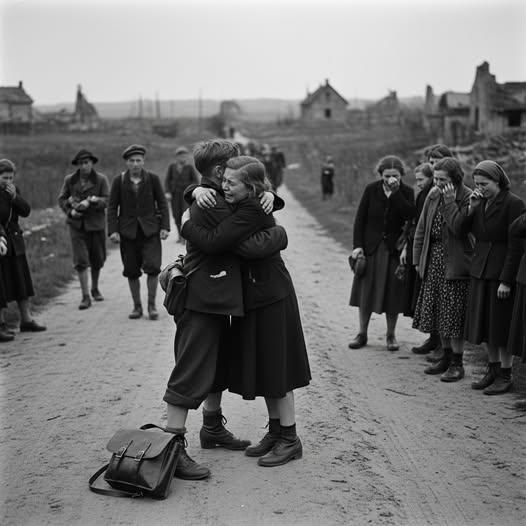
In September 1945, the roads of Poland were nothing more than gaping scars, crisscrossed by silent columns. The survivors, reduced to shadows of their former selves, moved forward, step by step, as if each stone along the path still retained the echo of vanished cries. Among them, a fourteen-year-old boy, barefoot, carried a simple, tattered satchel, his last link to a past he no longer knew how to name. This detail—a worn satchel—seemed insignificant. Yet it contained more than an object: a key that only the future would reveal.
He was walking, his gaze fixed on the ground, when a voice broke the silence. A voice of flesh and memory, emerging from the side of the road, halfway between dream and reality. The boy stopped dead in his tracks. What if it was only an illusion born of hunger and fatigue? His comrades continued to move forward, but he remained frozen, imprisoned by this murmur. In his stillness, a strange promise: war, despite its ruins, could still bring back what was thought lost.
From the crowd of villagers, a young girl emerged, her face ravaged by disbelief. Her eyes betrayed a truth she still dared not accept: she knew this boy. She had thought him dead for years, swallowed by the flames of the camps. And yet, there, amidst the dust and ruins, he stood. She ran towards him, each step hammering doubt, each heartbeat demanding confirmation. Their eyes met, and in that split second, time itself seemed to stand still, as if history were holding its breath.
Then he dropped his satchel and rushed toward her. Their embrace was brutal, desperate, stronger than all the tears in the world. They clung to each other as if their thin bodies could defy death itself. Around them, passersby stopped, murmuring prayers, wiping reddened eyes. But in this public scene, there was an intimate enigma: what had they really lost, and what were they really finding? The answer remained buried, like a secret refusing to come to light.
This dirt road, marked by the footsteps of so many who had disappeared, suddenly became the scene of a fragile miracle. The ruins around them—gutted houses, collapsed roofs, silhouettes of charred walls—were testaments to the past. But what was playing out in the center of this road would belong to the future. The survivors knew that nothing would ever be the same again, and yet, in this embrace, there was the illusion of a possible return. A half-whispered promise: life could be reborn, even on ground saturated with ash.
And yet, behind the joy, a question persisted. How many families would never have this chance? How many children would continue to wander, without a voice calling them, without arms to welcome them? The witnesses present knew: this scene was rare, almost unnatural. It carried within it the bitterness of the absent and the mystery of an inexplicable survival. Some claimed that a miraculous chance had brought them together. Others whispered that a darker force, lurking in the ruins of Europe, was orchestrating this reunion as if to remind humanity that all was not yet said.
In the days that followed, the boy and his sister joined a camp for displaced persons. There, among the tents and makeshift shacks, they tried to rebuild their lives. But every night, in their dreams, the ghosts returned: the silhouette of a vanished mother, the voice of a father muffled within the walls of a camp. The embrace of the path remained their only defense against oblivion. Yet even in this refuge, a silence weighed on them: they did not tell everything. Between them stood an invisible border, made of memories too painful. Perhaps one day, one of them would speak. Perhaps never.
Historians who later examined the testimonies from this camp found mention of these two children. But some details diverged. Was the boy really fourteen, or did he only appear a shadow of it? Was the girl his sister, or a cousin, or even a stranger convinced she had recognized one face among many others? The official history simply notes: “Two children found each other.” But this administrative summary betrays the emotional truth of the moment. Behind the dryness of the archives, a secret remains: what if collective memory preferred to leave doubt hanging in the air to protect the fragile beauty of this moment?
September 1945 was not only a month of liberations and reckoning. It was also a month of unlikely reunions, of gazes that could no longer be separated, of silences heavy with mystery. Europe was healing its wounds, but each survivor carried a personal enigma, a fragment of truth that he hesitated to reveal. The road to Poland where these two children embraced remains, even today, a metaphor for this dual legacy: unspeakable pain and indestructible hope.
And perhaps this is the real secret: in the heart of the ruins, it was not only the family that found itself again, but humanity itself, flickering, fragile, but stubbornly refusing to disappear.
Note: Some content was generated using AI tools (ChatGPT) and edited by the author for creativity and suitability for historical illustration purposes.
The Forbidden Reunion: Two Sisters in the Shadow of the Post-War Era
In October 1945, Prague still bore the scars of war. The walls were gutted, the streets with shattered cobblestones, the air saturated with dust and silence. In a former school building hastily converted into a children’s home, dozens of orphans waited, sitting in rows on wooden benches. Their gazes seemed to float in space, as if each pupil were a mirror of the hell they had experienced. No one spoke, and yet every breath seemed laden with a held-back cry. Behind these walls, some said the war was not yet over. But no one dared to say why.
At the back of the room, a little blonde girl stared at the floor. Her name was Klara, and she no longer had any clear memories of her family. Her days passed in silent expectation, her nights in fear of the nightmares that kept returning. And yet, that morning, a distant voice echoed in the hallway, clear and fragile, a voice she would have recognized among a thousand. It was impossible, she told herself, and yet her heart began to beat faster. The mystery of that voice would shake the entire room.
The door opened. In the frame stood a gaunt figure, wearing a gray dress too big for her body. Her sunken cheeks betrayed deprivation, but her eyes… her eyes were the same as in the memories. Anna, Klara’s older sister. She had disappeared during a roundup in 1943, and everyone believed her to have died in a concentration camp. And yet, there she was, standing, alive, trembling. The children turned, as if witnessing a miracle they dared not understand. Some said she still bore the invisible marks of the barbed wire on her hands.
Klara didn’t hesitate. She jumped off the bench, her bare feet hitting the floor, her thin body running toward the door. Tears blurred her vision, but she didn’t slow down. In that suspended moment, time seemed to stand still. Two figures, two children stolen by the war, threw themselves into each other’s arms. They clung to each other as if the whole world could still tear them away. Around them, the silence grew heavier, laden with respect and pain. Yet some whispered that they weren’t the only survivors carrying a secret.
The teachers, impassive until then, looked away, their eyes moist. For they knew that behind every reunion hid a darker story: that of the missing who would never return. In the room, other children watched the scene, their gazes jealous, admiring, or simply empty. For them, this miracle would never happen. But some, more attentive, noticed that Anna wore a small, dented silver medal around her neck, like a vestige of a story she would not yet tell.
In the following days, the two sisters remained inseparable. Klara talked incessantly, as if making up for lost time, while Anna listened silently. Her eyes sometimes darkened, as if an invisible burden still weighed on her shoulders. She said nothing about her camp, her months of silence, her nights counting the guards’ steps. Yet, every time the sound of boots echoed in the street, she jumped. Some children whispered that she had seen things no one should ever see.
In postwar Prague, stories of reunions mingled with stories of absences. Thousands of children still wandered, displaced, lost, forgotten. Makeshift shelters became sanctuaries of memory and pain. There was talk of blended families, of sisters reunited, but also of those who never returned. The name Auschwitz circulated in hushed tones, like a forbidden word, laden with ghosts. And yet, behind these reunions, another mystery remained: why was Anna the only one from her convoy to return?
One evening, as Klara fell asleep beside her, Anna whispered a few words. She spoke of a woman she had met in the camp, a stranger who had given her a piece of bread, a name, a hope. She did not reveal her identity, but only said, “It’s thanks to her that I’m here.” Then she fell silent. No one ever knew who this woman was, or if she survived. But Anna kept her memory like a secret key, a talisman. Perhaps one day she would tell the story.
Klara and Anna’s reunion became a symbol in the Prague home. The other children, deprived of their families, clung to this story as proof that all was not lost. The teachers themselves spoke of this moment as a sign: life could still conquer death. But behind every smile, behind every embrace, a shadow hung: the war had not only destroyed cities, it had fractured souls. And no one could erase these fractures.
So, in that room with its wooden benches, a larger truth emerged, invisible but omnipresent. The sisters had found each other again, but behind their joy hid the memory of those who were absent, those whose names would never be spoken. In the silence of their nights, the ghosts continued to walk. The story of Prague in 1945 was not just that of an embrace, but of a broken world still trying to put itself back together. And perhaps, deep within that embrace, an even greater secret lay dormant, waiting to be revealed.
Note: Some content was generated using AI tools (ChatGPT) and edited by the author for creativity and suitability for historical illustration purposes.
Behind the barbed wire of November 1945: the meeting that challenged the silence of the camps
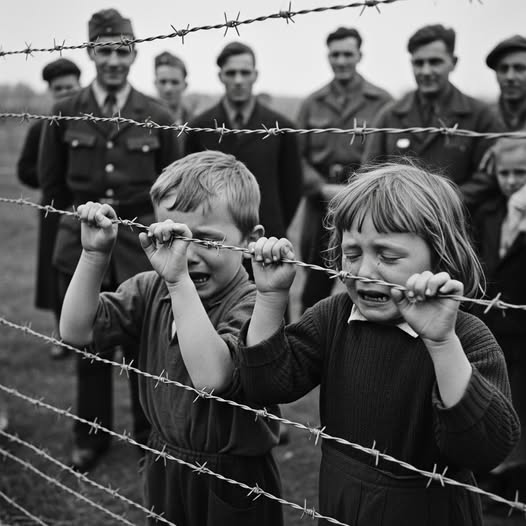
November 1945. Europe had fallen silent, as if the roar of the cannons had carried away the voices of the living. Yet, behind the barbed wire still standing, the camps were not completely empty. They were no longer the death machines they had been, but places of transit, detention, and survival for thousands of displaced people. Among them, a little girl, a frail silhouette in the cold, stood motionless against the bristling metal fence. Her fingers gripped the wire as if the pain of the contact could keep her upright. Her immense eyes stared at the horizon. She seemed to be waiting for something… or someone. But who could still come to these places marked by death? No one would have guessed the answer, and yet it came.
It was a boy, led by aid workers. His hesitant step, his too-young face already furrowed with invisible wrinkles, told another story that no one around dared to interrupt. When he appeared, there was no scream. Just a caught breath. Their eyes met, froze, as if two ghosts had just recognized each other amidst the ruins of the world. The air thickened, and even the adults present held their breath. Was this a brother? A friend from before? Or a twin soul, born of the same suffering? No one knew at the time, and yet everyone sensed that behind this encounter lay something greater than mere chance.
The girl was the first to move. In a desperate burst, she gripped the barbed wire, unafraid of the stings, unaware of the blood trickling down her hands. The boy, on the other side, rushed forward in turn and pressed his palms to hers. It was a silent shock, a fleshless embrace, separated by metal, but stronger than any separation. They remained like that for hours, clinging to each other, as if letting go meant plunging back into the abyss from which they had emerged. Witnesses later recounted that their words, whispered through the wind, were incomprehensible, but that they echoed like a prayer. A prayer that no history book would record, but which remained in the memories of those who had seen it.
It must be remembered that these camps, in the fall of 1945, had not yet been dismantled. Their function had changed, but not their appearance. The barbed wire remained, as did the barracks. Children, like this girl and this boy, were still numerous there, scarred by the war, tossed from one country to another. The Allies tried to register them, to reunite them with their families… but how many families remained whole? The archives speak of thousands of unaccompanied minors. The photos show empty stares, absent smiles. But that day, in the midst of this setting, two eyes met, and it was a crack in the silence, a breach of humanity in the iron fence.
The soldiers, standing in the background, watched without intervening. Some smiled discreetly, others looked away, unable to face the purity of this childish pain. For there was something unbearable and sublime in this scene at once: two children, witnesses to the unspeakable, who refused to let the wire have the last word. Later, some said they had heard the boy repeat a name, always the same, like a litany. Was it the girl’s? Was it a pre-war memory, an interrupted game, a promise whispered long ago on a street corner? No one was ever able to explain it, but those who were present swore that this name still resonated in their dreams years later.
For the historian, this image—for a photograph does indeed exist—is just one illustration among others of the post-war chaos, of the “Displaced Persons camps,” as they were called. But for the witness, it was something else: a suspended moment, a fragment of truth that archives cannot contain. Perhaps this is precisely what still fascinates today: the idea that, behind each snapshot, lies a larger story, one we will never fully know. And it is this mystery that drives researchers, writers, and survivors themselves to continue telling their stories.
SEO requires, let’s remember: this scene takes place in the context of the displaced persons camps of 1945-1946, a subject that many are still unaware of. Warsaw, Bergen-Belsen, Dachau, Landsberg, so many places transformed into detention centers where hundreds of thousands of people lived awaiting an impossible return. The keywords – Holocaust survivors, children behind barbed wire, displaced persons camps 1945, rare historical photographs – refer to this little-known truth: the war was not over in May 1945. For many, it continued, differently, behind other walls, other barbed wire.
Perhaps the most troubling question remains: were these two children reunited afterward? The fence was opened, it is said, a few days later. But no documents attest to what became of them. Did they survive exile, find refuge in a foreign land, grow up separated without ever seeing each other again? Or did they manage to stay together, building a new life despite the shadows? The mystery remains, like so many post-war stories. This vagueness, far from diminishing their importance, on the contrary gives them additional power. For it forces us, today’s readers, to imagine, to fill the gaps with our own humanity.
In November 1945, behind a simple barbed wire fence, two children offered the world a lesson that neither soldiers nor adults could forget. Their embrace across the metal was not just a testament to friendship or rediscovered brotherhood. It was a silent cry: we are still here . And even if history has not recorded their names, even if their fates remain shrouded in mystery, this image is enough to remind us that after the darkest night, the spark of human encounter can reignite a light. Perhaps this is the secret that this scene still whispers to us today, through time and barbed wire: the essential thing is not what we know, but what we guess.
Note: Some content was generated using AI tools (ChatGPT) and edited by the author for creativity and suitability for historical illustration purposes.