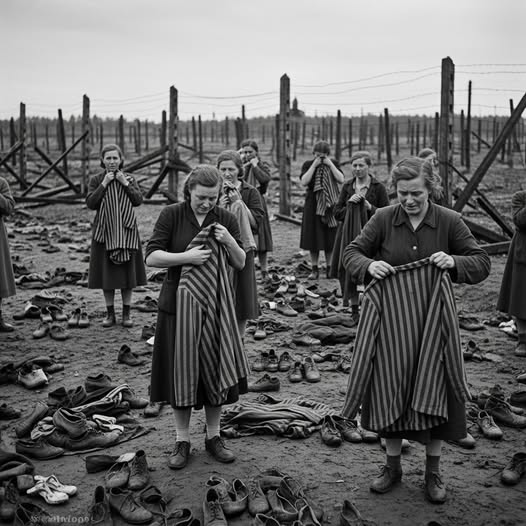
Ravensbrück, Liberation 1945: memory of the Shoah and survivors facing striped clothing

On May 10, 1945, the day after the Liberation, the Ravensbrück camp was nothing but an echoing silence. The barbed wire, rusty and useless, still traced its menacing lines against the gray horizon, but behind it, fear had given way to a chilling stupor. On the muddy ground, thousands of abandoned shoes littered the earth. Chipped clogs, men’s boots too big for these emaciated women, children’s shoes that no one had come to claim. Each pair told a story—of forced marches, nights of terror, moments snatched from human dignity.
The survivors, still dressed in rags, advanced slowly among these remains. They bent down, carefully picking up striped clothes, the dehumanizing uniforms imposed by the Nazi regime. In this simple gesture, however, there was a moving intensity: it was the desire to give a voice to those who could no longer speak, to bring back to memory those who had perished in the furnace of Ravensbrück. For each piece of cloth recovered, a murmured prayer, for each shoe replaced, a name brought to mind.
Liberation was not synonymous with immediate freedom. It came like a burst of light after an endless night, but a light that revealed ruins, hunger, and invisible wounds. In the act of picking up these clothes, the survivors were laying a foundation: they were reclaiming a narrative that their executioners had sought to erase. Where Nazi Germany had sought to reduce women to numbers, they were recreating a fabric of memory, a fragile but indestructible continuity.
Some recognized a scarf, a worn dress, or a frayed coat. These objects suddenly became presences: a smile glimpsed in the barracks, a friendly voice that had consoled, a hand that had shared a piece of bread. Tears flowed then, irrepressible, intertwined with grief and gratitude. For in memory, the dead came back to live for a moment, and memory was transformed into an act of resistance.

This silent work was much more than an inventory. It became a ritual, a way to honor the missing and affirm that their existence would never be swallowed up by oblivion. In concentration camps like Ravensbrück, where more than 130,000 women were deported and so many lives were shattered, every surviving object took on the value of a relic. Striped clothing, vestiges of suffering, became symbols of memory. Abandoned shoes formed an invisible path, connecting absence to presence, loss to continuity, grief to hope.
The survivors knew that this gesture of remembrance had to pass through the generations. They sensed that forgetting would be a second death for those who would never return. That’s why they clung to these objects, touching them like a scar: painful, but alive. Because behind every frayed fabric, behind every pair of orphaned shoes, there was a woman, a story, a dignity trampled but never destroyed.
In Ravensbrück, on May 10, 1945, this field of shoes and clothes not only represented the end of a concentration camp. It embodied the rebirth of a wounded but undefeated humanity. These women, by picking up the traces, affirmed that no regime, no ideology, however brutal, could destroy memory. And this memory, nourished by pain and love, became a weapon against nothingness.

Even today, visitors who discover the Ravensbrück photographs feel the weight of silence. They see these objects and understand that they are not cold relics, but fragments of life. This is the power of Holocaust memory: to remind us that behind every number, behind every statistic, there was a human being, a voice, an interrupted dream. The survivors understood this the day after the Liberation: transforming these material remains into testimonies meant restoring the humanity of the disappeared.
In the contemporary world, marked by new forms of violence and forgetting, this lesson remains burning. Honoring the victims of Ravensbrück is a reminder of the importance of dignity, compassion, and vigilance. The discarded shoes and striped clothing are not just historical objects: they have become universal symbols of resistance and memory, bridges between the living and the dead.
Thus, on May 10, 1945, amidst the ruins of a camp deserted by its executioners, the survivors reclaimed their humanity. They did so through a simple, humble, yet immense gesture: to collect, sort, and preserve. And this gesture still resonates today, like a call to never forget.
Leave a Reply