Blog

  • ⚠️ Unseen Historical Photos That’ll Leave You SPEECHLESS! – Ethereal Relics. VD

    On July 30, 1945, the Pacific Ocean looked almost indifferent.

    Somewhere in the Philippine Sea, the heavy cruiser USS Indianapolis was sailing through the darkness. The ship had already completed a highly classified mission and was carrying its crew toward the next stage of the war. Then, shortly after midnight, Japanese torpedoes struck. Within minutes, the ship was sinking.

    Hundreds of men went into the water.

    For those who survived the sinking, the war had suddenly become something no map could explain: open ocean, exhaustion, thirst, exposure, and the knowledge that no one knew exactly where they were.

    Có thể là hình ảnh đen trắng

    What happened next would become one of the most haunting episodes of the Pacific War.

    But the Indianapolis was only one fragment of a much larger story.

    Across Europe and Asia, millions of people were experiencing their own versions of uncertainty. Some watched soldiers cross their borders. Others waited in ghettos, refugee camps, railway stations, or crowded repatriation centers. Children tried to survive in cities under bombardment. Soldiers returned from battlefields that had changed them forever.

    And years later, photographs would remain behind.

    Not to tell us everything.

    Có thể là hình ảnh đen trắng về văn bản

    But enough to make us ask one question:

    What did the war look like to the people who had to live through it?

    In 1938, before the Second World War officially began, Europe was already moving toward a crisis.

    One of the places where that crisis became visible was the Sudetenland, the largely German-speaking border region of Czechoslovakia.

    Photographs from September and October 1938 show crowds, political rallies, German troops, and Sudeten German supporters surrounding the events that followed the Munich Agreement.

    Konrad Henlein, leader of the Sudeten German movement, had become an important figure in the political crisis. His movement demanded autonomy for the Sudeten German areas, while Nazi Germany increasingly used the issue as part of its pressure against Czechoslovakia.

    Then came Munich.

    Có thể là hình ảnh đen trắng về xe đạp và đường phố

    The agreement of September 1938 transferred the largely German-speaking Sudeten region of Czechoslovakia to Germany. Within days, German forces entered the territory. Photographs show crowds greeting them, banners, salutes, and the carefully staged imagery of political triumph.

    Looking at those photographs today, it is tempting to see them simply as celebrations.

    But history asks us to look beyond the crowd.

    What happened to the people who did not share the enthusiasm?

    What happened to those who suddenly found themselves living under a new political order?

    And what did the images fail to show?

    Có thể là hình ảnh về văn bản

    Photographs can capture a crowd.

    They cannot automatically capture every fear inside it.

    They can show flags.

    They cannot show every private thought behind the faces.

    That distinction matters.

    Because Nazi propaganda understood the power of photographs.

    A camera could transform political expansion into spectacle.

    A marching column could appear orderly.

    A crowd could appear unanimous.

    A political leader could appear inevitable.

    Không có mô tả ảnh.

    But beneath the photographs was a much more complicated reality.

    The Sudeten crisis was not an isolated event. It was part of the expansion of Nazi Germany before the wider European war began. Within less than a year, German troops would occupy the remaining Czech lands as well.

    Then, on September 1, 1939, Germany invaded Poland.

    The photographs changed.

    The atmosphere changed.

    And Europe entered the war.

    Among the images associated with the invasion of Poland are photographs of German and Soviet soldiers in the same theater during the early stages of the conflict.

    Có thể là hình ảnh đen trắng

    The scene can appear almost strangely ordinary.

    Soldiers talking.

    Uniforms.

    Vehicles.

    A moment of human interaction in the middle of a historical catastrophe.

    But the background was anything but ordinary.

    Germany had invaded Poland from the west.

    The Soviet Union invaded from the east later that September.

    The Polish state was caught between two invading powers.

    Có thể là hình ảnh đen trắng

    For the people living there, political agreements made far away were not abstract concepts.

    They determined who controlled their streets.

    Who controlled their homes.

    Who controlled the roads.

    And, increasingly, who controlled their future.

    This is one of the strange powers of an old photograph.

    The image may look calm.

    The history behind it may be anything but calm.

    A soldier can smile.

    A civilian can stand still.

    A street can look almost normal.

    Có thể là hình ảnh đen trắng về trẻ em và đường phố

    And yet, behind that moment, an entire society may be collapsing.

    Then the war expanded.

    Across Europe, occupation became part of daily life.

    Across Asia, Japanese military expansion brought destruction to cities and communities.

    And in China, civilians experienced some of the most sustained aerial bombardment of the war.

    One photograph in the original collection is identified as showing a young Chinese boy carrying water in Chongqing after days of Japanese aerial bombardment in 1940.

    The exact circumstances surrounding the photograph should be treated carefully unless confirmed by the original archive.

    But the broader historical setting is clear.

    Có thể là hình ảnh đen trắng về cửa hàng bán mũ

    Chongqing became one of the major wartime centers of China after the Nationalist government moved there. The city endured repeated Japanese air raids.

    For civilians, the war did not arrive as a single battle.

    It came repeatedly.

    Aircraft overhead.

    Explosions.

    Smoke.

    Buildings damaged.

    Families trying to continue living.

    Children growing up in a world where the sound of aircraft could change the entire rhythm of a day.

    The photograph’s power does not depend on inventing what the boy was thinking.

    We do not know his private thoughts.

    We do not need to.

    Có thể là hình ảnh đen trắng về văn bản

    The image of a child continuing with an ordinary task in an extraordinary environment tells us something by itself.

    Water was still needed.

    Food was still needed.

    Families still had to survive.

    Even during bombardment, life did not completely stop.

    That is one of the least discussed realities of total war.

    People still had to wake up.

    They still had to find food.

    They still had to care for children.

    They still had to repair things.

    They still had to carry water.

    The war might dominate history books, but ordinary life continued underneath it.

    And that ordinary life could become incredibly fragile.

    In Europe, another kind of civilian survival was taking place behind walls.

    The Warsaw Ghetto became one of the most recognizable symbols of the Holocaust.

    Photographs taken inside the ghetto show people attempting to trade, work, beg, and survive under conditions of extreme deprivation.

    Among those images is the photograph of a young boy sitting on a chair in the street with a handful of sweets for sale.

    Có thể là hình ảnh đen trắng về một hoặc nhiều người

    It is an image that can be difficult to look at precisely because there is nothing spectacular about it.

    There is no battlefield.

    No tank.

    No aircraft.

    No dramatic military movement.

    There is simply a child.

    A chair.

    A few sweets.

    And a street inside a ghetto.

    Historical sources identify photographs of children selling sweets and begging in the Warsaw Ghetto during the period when life there remained barely recognizable as normal.

    That distinction is important.

    The photograph should not be turned into an invented story about that particular child’s life.

    We do not know his name from the image alone.

    We should not manufacture a conversation.

    We should not invent what happened to him afterward.

    But we can understand the historical environment in which he was photographed.

    The German occupation had forced Jewish civilians into the ghetto.

    Food shortages became severe.

    Có thể là hình ảnh đen trắng về một hoặc nhiều người, nhà chọc trời, đám đông, bảo tàng Rijksmuseum, đường phố và cầu Queensboro

    Disease spread.

    Poverty became visible everywhere.

    And eventually, the ghetto became part of the machinery of deportation and mass murder.

    The photograph therefore becomes more than an image of a child selling sweets.

    It becomes evidence of a world in which childhood itself had been transformed by persecution.

    A child who should have been thinking about school, games, or family was instead visible in a street where survival had become a daily struggle.

    And this is where historical photographs become difficult.

    They show the small details.

    The chair.

    The clothing.

    The expression.

    Có thể là hình ảnh đen trắng về một hoặc nhiều người và văn bản

    The street.

    But the historian must also look at the larger structure surrounding the image.

    Because the Holocaust cannot be understood only through individual photographs.

    It must be understood through the policies, laws, deportations, ghettos, camps, and systematic persecution that created the circumstances seen in those photographs.

    The child is the human face.

    The historical system is the explanation.

    Both are necessary.

    The same principle applies to photographs of political leaders.

    An image of Adolf Hitler and Joseph Goebbels in 1943 may appear to show only two men standing together.

    But by that point, Nazi Germany had been at war for years.

    The regime controlled enormous resources.

    Millions of soldiers were fighting.

    Millions of civilians were suffering.

    And the German state was carrying out mass persecution and mass murder across occupied Europe.

    The photograph itself may be silent.

    The historical context is not.

    That is why photographs from authoritarian regimes require particular care.

    They were often created for propaganda.

    They were not neutral windows into reality.

    They were selected, framed, reproduced, and distributed because the regime wanted people to see a particular version of events.

    The camera could make power look permanent.

    But no photograph can stop history from changing.

    By 1944, German power was under enormous pressure.

    The Allied invasion of Normandy had opened a new front in Western Europe.

    The Soviet advance from the east was pushing German forces backward.

    The war was turning.

    And as Allied troops moved through France, civilians encountered soldiers who were no longer arriving as occupiers, but as liberators.

    Yet liberation did not mean that everything suddenly became normal.

    Cities had been damaged.

    Families had been separated.

    The dead could not return.

    The displaced had nowhere to go.

    And millions of people across Europe were trying to understand what had happened to their homes.

    Then came 1945.

    Germany collapsed.

    The war in Europe ended.

    But in the Pacific, the conflict continued.

    And this is where the story of USS Indianapolis becomes particularly haunting.

    The ship had already completed a mission of enormous historical significance.

    In July 1945, Indianapolis transported components of the atomic bomb to Tinian. After completing that mission, the cruiser continued toward the Philippines.

    On July 30, Japanese submarine I-58 attacked.

    Two torpedoes struck.

    The ship sank in roughly twelve minutes.

    Approximately 300 men went down with the ship.

    Hundreds more entered the water.

    The official record states that only 316 ultimately survived.

    The tragedy was made worse by the fact that the Navy did not immediately know the ship had been sunk.

    The survivors were scattered across the Philippine Sea.

    Many had little protection from the sun.

    There was almost no food or fresh water.

    They faced exposure, dehydration, saltwater poisoning, exhaustion, and shark attacks.

    Some survivors spent days waiting for help that did not come.

    The ordeal lasted for days.

    Then, on August 2, a Navy aircraft on routine patrol spotted an oil slick and, almost by accident, discovered the survivors.

    A rescue operation followed.

    Men who had spent days in the ocean were finally found.

    But by then, most of the crew was already gone.

    The official record remembers 316 survivors.

    Behind that number are hundreds of individual lives.

    The USS Indianapolis is therefore not simply a story about a ship being sunk.

    It is a story about how quickly certainty can disappear.

    One moment, a sailor is aboard a warship.

    Minutes later, he is floating in an ocean with no ship beneath him.

    One moment, the Navy has a functioning vessel.

    Then the vessel is gone.

    And the men left behind have to survive without knowing whether anyone even realizes they are missing.

    The U.S. Department of Defense describes the sinking as the worst sea disaster in U.S. Navy history in terms of the single loss of life at sea from one ship.

    But there is another detail that makes the story even more unsettling.

    The Indianapolis sank only days before the atomic bomb was used against Hiroshima.

    The war was approaching its final weeks.

    The end was closer than many of the men could have known.

    And yet for the men in the water, history did not feel as though it was ending.

    It felt endless.

    That contradiction appears again and again in wartime photographs.

    Historians can see the approaching end.

    The people inside the photograph cannot.

    For them, the future is unknown.

    A soldier in 1944 does not know that the war will end the following year.

    A child in a bombed city does not know how many more raids are coming.

    A prisoner does not know when liberation will arrive.

    A family waiting in a railway station does not know whether it will ever return home.

    History gives us the advantage of hindsight.

    The people who lived through it had none.

    That is why photographs taken during the war should not be judged only by what we know now.

    They should also be understood through the uncertainty that existed at the moment the shutter closed.

    By the end of 1945, the war was over.

    But the photographs did not stop.

    Instead, they began recording something new.

    The aftermath.

    In Shanghai, Japanese civilians were photographed waiting for examination of their luggage and clothing before repatriation to Japan in December 1945. The photograph is part of the record of a population whose wartime existence in China had now ended.

    Look at the scene carefully.

    There is no battlefield.

    The war has already ended.

    But people are still standing in lines.

    Their possessions are being inspected.

    Their futures are uncertain.

    They are preparing to leave.

    The significance of such photographs is easy to overlook because the violence is no longer visible.

    Yet this is also part of the history of war.

    After armies stop fighting, people still have to move.

    Borders still have to be crossed.

    Property still has to be settled.

    Families still have to find one another.

    And people who spent years living in one country can suddenly become people waiting to return to another.

    Research on the postwar repatriation of Japanese civilians in Shanghai shows that the process was complicated by restrictions, uncertainty, shortages, and strict limits on what people could take with them.

    For some, returning home was the obvious end of the war.

    For others, it meant leaving behind the only home they had known for years.

    The word “repatriation” can sound administrative.

    But behind it were families.

    Suitcases.

    Children.

    Memories.

    And uncertainty about what awaited them in Japan.

    The same was true in Europe.

    After the war, displaced-person camps filled with people who had nowhere immediately to return.

    A photograph identified with the displaced-person camp at Zehlendorf in Berlin in 1947 shows refugees gathered at a registration office.

    Again, there is no battlefield.

    No artillery.

    No aircraft.

    But the war is still there.

    It is visible in the fact that people need a registration office simply to begin figuring out where their lives will go next.

    This is one of the most important things that can be forgotten when looking at photographs of World War II.

    The war did not end for everyone on the day the surrender documents were signed.

    For millions, the postwar years were another journey.

    A search for relatives.

    A search for a home.

    A search for food.

    A search for identity.

    A search for somewhere that still felt like home.

    And then there were those who had survived the camps.

    Those who had survived occupation.

    Those who had survived bombardment.

    Those who had survived the sea.

    They carried memories that photographs could never fully capture.

    The camera could record a face.

    It could not record the nights afterward.

    It could record a child.

    It could not record every year that child might live carrying the memory of war.

    It could record a soldier returning home.

    It could not show everything that soldier had seen.

    That is the limit of photography.

    And perhaps also its strength.

    A photograph does not tell us everything.

    It gives us a doorway.

    What lies beyond that doorway must be reconstructed carefully from evidence.

    This is why historical storytelling must resist the temptation to fill every silence with invention.

    If we see a child in a photograph, we should not automatically invent his name.

    If we see soldiers talking, we should not create their conversation.

    If we see a survivor, we should not pretend to know exactly what he felt unless historical testimony tells us.

    The absence of information is not an invitation to fabricate.

    Sometimes the honest answer is simply:

    We do not know.

    And yet, even when we do not know everything, we can still understand something.

    We can understand the environment.

    The date.

    The war.

    The policies.

    The consequences.

    The choices.

    The human cost.

    That is what gives historical photographs their power.

    They are not stories by themselves.

    They are fragments.

    The historian’s responsibility is to place those fragments into the correct context without turning them into something they were never meant to be.

    The photograph of the USS Indianapolis survivors belongs to a naval disaster.

    The child in the Warsaw Ghetto belongs to the history of persecution and the Holocaust.

    The crowds in the Sudetenland belong to the political crisis that preceded the war.

    The civilians waiting in Shanghai belong to the complicated process of postwar repatriation.

    The displaced people in Berlin belong to a continent trying to rebuild itself after catastrophe.

    Different photographs.

    Different people.

    Different places.

    But one historical thread connects them.

    They all show what happens when decisions made by states and governments eventually reach ordinary human beings.

    Political agreements become borders.

    Military campaigns become occupied streets.

    Bombing campaigns become children carrying water.

    Racial persecution becomes a child selling sweets.

    Naval strategy becomes men floating in the Philippine Sea.

    Military defeat becomes families standing in line with their luggage.

    And the end of war becomes a registration form in a refugee camp.

    That is the human scale of history.

    The maps show the movement of armies.

    The photographs show the people who had to live beneath those movements.

    Perhaps that is why old photographs can feel so unsettling.

    They are silent.

    They do not tell us what happened next.

    We know the future because we live after it.

    They did not.

    The child in the Warsaw Ghetto did not know what the following years would bring.

    The civilians of Chongqing did not know how long the bombing would continue.

    The men aboard Indianapolis did not know that their ship would become one of the most infamous naval disasters in American history.

    The people standing in Shanghai in December 1945 did not know exactly what their lives would look like after returning to Japan.

    The displaced people in Berlin did not know whether they would ever rebuild the lives they had before the war.

    History has given us the ending.

    The people in the photographs had only the moment.

    And perhaps that is the most important thing to remember.

    World War II is often presented through enormous numbers.

    Millions killed.

    Millions displaced.

    Thousands of aircraft.

    Thousands of ships.

    Countless battles.

    But every number represents people.

    Every destroyed city contained homes.

    Every military unit contained individuals.

    Every refugee camp contained families.

    Every prisoner had a life before captivity.

    Every survivor had a future that depended on surviving one more day.

    The war is easier to understand when we remember that scale.

    Not because numbers are unimportant.

    They are essential.

    But because numbers can become abstract.

    A face cannot.

    A child’s face.

    A sailor’s face.

    A refugee’s face.

    A soldier’s face.

    A face looking directly into a camera without knowing that decades later, someone would study the photograph and wonder what that person had seen.

    That is the quiet power of historical memory.

    The people in these photographs did not know they were becoming part of history.

    They were simply living through it.

    And perhaps that is why we should look at these images with something more than curiosity.

    We should look with caution.

    With respect.

    With the understanding that the photograph is not entertainment.

    It is evidence of a human life.

    The Second World War ended more than eighty years ago.

    The buildings have changed.

    The uniforms have become museum pieces.

    The ships have disappeared beneath the sea.

    The borders have moved.

    The survivors have grown old and, one by one, passed away.

    But the photographs remain.

    A child.

    A sailor.

    A refugee.

    A soldier.

    A family.

    A crowd.

    A suitcase.

    A chair.

    A few pieces of candy.

    A ship lost in an enormous ocean.

    And in those fragments, the past still asks something of us.

    Not to glorify war.

    Not to romanticize suffering.

    Not to turn tragedy into spectacle.

    But to remember how easily decisions made at the level of governments and armies can eventually reach the smallest corners of human life.

    A war can begin with speeches and treaties.

    But its consequences are carried by ordinary people.

    That is perhaps the deepest lesson hidden inside these old photographs.

    The war may have ended on paper.

    But for the people who survived it, history continued.

    And when we look at these photographs today, perhaps the question is not simply “What happened?”

    Perhaps the more difficult question is:

    When the people in these photographs could not see the future, what would we have wanted the world to remember about them?

    Some content was generated using AI tools (including ChatGPT) and edited by the author for creativity, storytelling, and historical illustration purposes. Historical facts and key details should be verified against reliable historical sources. Any AI-generated or reconstructed visuals are intended for illustrative purposes and should not be interpreted as original historical photographs or archival evidence.

  • 🚫 These 100 Photos Were Never Meant for Public Eyes! – Ethereal Relics. VD

    Some photographs do not need a long caption to make us stop and look.

    A column of prisoners stretching across the barren landscape of North Africa. Soldiers standing beside a wounded horse in a field hospital. Civilians watching as German forces enter their city. A man wearing the insignia of Nazi Germany, yet using that very symbol to protect people whom his own regime did not consider equals. And then, four years later, on the deck of an American battleship in Tokyo Bay, representatives of a defeated empire bow over a document only a few pages long and sign their names.

    At first glance, these appear to be unrelated moments.

    But placed beside one another, they tell a larger story: World War II was not shaped only by armies, battles, and maps. It was also shaped by ordinary people caught inside an era from which there was no easy escape.

    Không có mô tả ảnh.

    And sometimes, history is seen most clearly not in moments of victory, but in the moments when human beings are forced to confront the consequences of war.

    In early 1941, in North Africa, one of the first major battles demonstrated how quickly a military force could lose its position and its freedom.

    Bardia was a small Libyan port on the Mediterranean coast, near the Egyptian border. Before the war, Italian forces had built an extensive defensive system around the town and port. It was not simply an insignificant point on a map. It was part of Italy’s defensive network in North Africa.

    After Italy entered the war in June 1940, Italian forces advanced into Egypt and captured Sidi Barrani. But that advance soon turned into a series of reversals. By the end of the year, British and Commonwealth forces had begun their counteroffensive.

    Then Bardia became a target.

    Có thể là hình ảnh đen trắng về một hoặc nhiều người

    On January 3, 1941, forces of the Australian 6th Division began their assault. One attack moved against the western side of the defenses while another force attacked from the south.

    What followed happened faster than anyone looking at the massive fortifications might have expected.

    By January 4, much of Bardia had been captured.

    On the morning of January 5, the remaining resistance in the southern sector came to an end.

    But the most striking part of the battle was not simply that a fortified position had fallen.

    It was the number of men who surrendered.

    Australian War Memorial records indicate that Australian forces captured roughly 40,000 Italian prisoners at Bardia, while another account estimates that approximately 36,000 Italian soldiers were taken prisoner and around 1,000 were killed.

    That transformed the military victory into something else entirely.

    Instead of images of advancing armies and triumphant formations, there were now long columns of prisoners moving along the roads.

    Men who had once carried rifles and stood inside defensive positions could no longer decide where they were going.

    They could only keep walking with thousands of others.

    Có thể là hình ảnh đen trắng về giày và cửa hàng bán mũ

    A photograph of prisoners leaving Bardia can easily be viewed as a symbol of victory.

    But look at it long enough, and it begins to tell another story.

    War can transform a man from soldier into prisoner in a matter of hours.

    And for those on the other side, victory was not without a price.

    The Australian 6th Division suffered casualties during the battle, including men killed and wounded.

    That is one of the paradoxes of military history.

    A battle can be summarized in two words:

    Victory won.

    But behind those two words are individual costs.

    Some never came home.

    Some returned carrying wounds.

    Some became prisoners.

    And some survived only as faces in photographs that generations later would struggle to identify.

    But North Africa was not the only place where war created such images.

    Across Europe, the conflict was increasingly penetrating civilian life.

    Có thể là hình ảnh đen trắng

    Cities were occupied.

    Families were displaced.

    Children saw weapons lying in the streets.

    Things that had once belonged to the adult world—rifles, uniforms, military vehicles—suddenly appeared in the lives of children.

    One of the most haunting images associated with Berlin in 1945 shows children surrounded by weapons left behind after the city’s collapse.

    There is no need to invent a private story for each child in the photograph.

    The circumstances themselves are enough.

    War had come all the way into the city.

    Có thể là hình ảnh đen trắng về chim kền kền

    It was no longer somewhere beyond the horizon.

    It was in the streets.

    In the neighborhoods.

    In the homes.

    And in childhood.

    That was one of the fundamental changes brought by modern warfare: the distance between the battlefield and civilian life became increasingly fragile.

    A family could begin the morning living in an ordinary house and end the day with that same house standing dangerously close to the front line.

    A child could learn the sound of aircraft before understanding why those aircraft were crossing the sky.

    An adult could begin the day with work and end it searching for somewhere to take shelter.

    And when the war ended, those people could not simply return to the world that had existed before 1939.

    That world was gone.

    Another image from this period takes us somewhere completely different: Nanjing, China, in late 1937.

    Here, war was not simply a confrontation between military units.

    It became a catastrophe for civilians.

    Có thể là hình ảnh đen trắng về đám cưới

    When Japanese forces captured Nanjing, a safety zone was established to protect people who could not escape the city. Among those involved in efforts to protect civilians was John Rabe, a German businessman and member of the Nazi Party.

    That detail makes the story uncomfortable in a very particular way.

    Because Rabe was not an uncomplicated heroic figure.

    He was a member of a regime that would become responsible for some of the greatest crimes of the twentieth century.

    Yet in Nanjing, he participated in efforts to protect Chinese civilians.

    Historical records show that Rabe used his German status and position to intervene when he encountered threats against civilians. He also participated in the work of the Nanking Safety Zone, which became a refuge for large numbers of people.

    This is where history becomes difficult to categorize.

    Có thể là hình ảnh đen trắng về một hoặc nhiều người, xe điện, đám đông, đường phố và văn bản

    Human beings do not always fit neatly into the simple labels that later generations want to place upon them.

    A person can belong to a brutal political system and still perform acts that save lives.

    That does not erase the nature or responsibility of the regime to which that person belonged.

    But it reminds us that history is made by individual human beings facing individual choices.

    And sometimes, even in an age when loyalty, nationalism, and ideology possessed extraordinary power, an individual could still choose to act differently.

    That is not a way of romanticizing war.

    Quite the opposite.

    It shows how difficult the choices created by war could become.

    Another image in the original collection shows a Jewish Brigade soldier holding an artillery shell bearing an inscription that referred to it as a “gift for Hitler,” during the period of 1944–1945 in Italy.

    Có thể là hình ảnh về văn bản

    The image contains a striking reversal of symbolism.

    During war, weapons are manufactured to destroy.

    Yet human beings often turn objects of war into messages.

    A shell can become an answer.

    A rifle can become a symbol.

    A flag can represent hope to one side and fear to another.

    But behind those symbols remains the cold reality: war is carried out with real objects, against real people.

    Perhaps that is why an apparently small image—a soldier holding a shell—can sometimes tell us more than a speech.

    It shows that war does not exist only on maps.

    Có thể là hình ảnh đen trắng về đường sắt và văn bản

    It exists in the hands of soldiers.

    In the equipment they carry.

    In the words they write upon those objects.

    And in the memories they carry home after the shooting stops.

    By 1944, the war in Europe had entered its decisive phase.

    Following the Allied landings in Normandy, Allied forces began advancing deeper into France.

    One photograph preserved from July 4, 1944, shows medical personnel from the U.S. 2nd Armored Division pausing beside a sign created by local French citizens to thank them.

    The image is tiny compared with the enormous battles taking place across Normandy.

    There is no tactical map.

    No arrows showing the direction of an offensive.

    Có thể là hình ảnh về đường phố và văn bản

    No massive statistics.

    There are simply soldiers, a road, and a message of gratitude.

    Yet moments like this help us understand something important.

    To people living under occupation, Allied soldiers were not merely a military force moving across territory.

    They were evidence that a period of their lives might finally be coming to an end.

    War, in the eyes of generals, can be measured in kilometers gained.

    In the eyes of a civilian, it may be measured by a single question:

    When can we live normally again?

    That question never appears on a military map.

    But it exists in almost every city through which war passes.

    By 1945, that question was finally beginning to receive an answer.

    But the answer did not arrive in a single moment.

    In Europe, Germany surrendered in May.

    In the Pacific, the war continued.

    Có thể là hình ảnh đen trắng về áo khoác ngoài và vùng bắc cực

    Battles were still being fought.

    People were still dying.

    Then, in August, Japan announced its acceptance of the terms of surrender.

    But history still required an official moment to record the end.

    That moment came on the morning of September 2, 1945.

    Tokyo Bay.

    USS Missouri.

    Representatives of Japan came aboard.

    Leading the Japanese delegation were Foreign Minister Mamoru Shigemitsu and General Yoshijiro Umezu.

    They had come to sign the Instrument of Surrender.

    There was no longer a battlefield.

    No advancing army.

    No city under bombardment.

    Only a table, a document, and signatures.

    Yet those signatures would become one of the most recognizable images of the twentieth century.

    According to the U.S. National Archives, on September 2, 1945, Shigemitsu signed on behalf of the Japanese government, while Umezu signed on behalf of Imperial General Headquarters. General Douglas MacArthur accepted the surrender on behalf of the Allied powers.

    The ceremony took place shortly after 9 a.m.

    It was brief.

    The USS Missouri was not a stage.

    It was a battleship.

    And on that deck, representatives of two sides of the war stood before a document whose significance was far greater than the individuals themselves.

    After nearly six years of global conflict, the guns of the Second World War were finally falling silent.

    But there is something particularly striking about that moment.

    No one standing on that deck could know exactly how history would judge them in the decades to come.

    For those aboard the ship, it was an official ceremony.

    For people living in devastated cities, it was the end of an era.

    For prisoners being liberated, it might have been the moment when they finally understood that they would be going home.

    For families who had lost loved ones, the war was ending, but the loss would not end with a signature.

    And for millions of others, peace created an entirely new question:

    What happens after the war?

    Because peace does not mean that everything immediately returns to normal.

    Cities must be rebuilt.

    Soldiers must return.

    The wounded must learn how to live with what happened to them.

    Survivors must face their memories.

    People driven from their homes must find somewhere to live.

    New governments emerge.

    Borders change.

    Societies divided by war must find ways to survive in a transformed world.

    Even those who never fought directly could carry the war with them.

    A child who grew up hearing air-raid sirens was no longer the same child who had existed in 1939.

    A soldier returning from the battlefield was no longer the same person who had left home years earlier.

    A family that had lost someone would spend the rest of its existence learning how to live with that absence.

    That is why historical photographs matter for reasons beyond simply telling us what happened.

    They show us what war did to people.

    A column of prisoners at Bardia.

    A field hospital where a wounded horse is being treated.

    A safety zone in Nanjing.

    Children among the ruins of Berlin.

    A thank-you sign beside a road in Normandy.

    And finally, Japanese representatives standing aboard the USS Missouri.

    These are not, in the strictest sense, one single story.

    But they are fragments of the same age.

    An age in which humanity created warfare on a scale never before seen, while at the same time producing acts of courage, rescue, sacrifice, and compassion that cannot be reduced to statistics.

    That is why it is important to distinguish between what a photograph actually proves and the story we want to tell from it.

    A photograph does not tell us exactly what the person inside it was thinking.

    It does not give us permission to invent dialogue.

    It does not transform speculation into fact.

    But when placed within an accurate historical context, a photograph can open a door.

    Behind the prisoners at Bardia is a battle.

    Behind the signatures aboard the Missouri are nearly six years of war.

    Behind a child standing among the ruins of Berlin is the collapse of a regime and a city.

    Behind a man protecting civilians in Nanjing is the disturbing complexity of human behavior during an age of ideology.

    And behind all of them are millions of lives whose names we will never know.

    Perhaps that is what makes old photographs haunting in such a different way.

    We see a moment.

    But the person inside the photograph lived an entire life before and after that moment.

    A soldier may appear in the frame for only a second.

    A prisoner may be only one face among thousands.

    A child may have stood before the camera for only a few moments.

    But for them, it was not “a historical photograph.”

    It was their life.

    And history, ultimately, is not simply a collection of beautiful or powerful photographs.

    History is what remains after the people inside those photographs are gone.

    In 1945, when the final signatures were placed upon the Instrument of Surrender aboard the USS Missouri, the Second World War had, for all practical purposes, come to an end.

    But the world it left behind was no longer the world that had entered the war.

    A new international order emerged.

    New powers rose.

    Old empires weakened.

    Societies had to rebuild.

    The memory of war became part of the politics, culture, and daily lives of generations.

    And the photographs remained.

    Bardia.

    Nanjing.

    Normandy.

    Berlin.

    Tokyo Bay.

    They are separated by thousands of kilometers.

    But when placed beside one another, they tell a simple truth.

    War begins with human decisions.

    It is carried out by human beings.

    And ultimately, human beings are the ones who must live with its consequences.

    Perhaps that is why these photographs still carry such weight decades later.

    They do not ask us to relive the past.

    They simply ask us not to forget that the past was once someone’s present.

    And when we look at those faces, perhaps the final question is not who won.

    Perhaps the more important question is this:

    After everything humanity paid during the Second World War, what have we truly learned from the images that remain?

    Some content was generated using AI tools (including ChatGPT) and edited by the author for creativity, storytelling, and historical illustration purposes. Historical facts and key details should be verified against reliable historical sources. Any AI-generated or reconstructed visuals are intended for illustrative purposes and should not be interpreted as original historical photographs or archival evidence.

  • These 120 RARE Vintage Images Were Never Meant for Public Eyes! – Ethereal Relics. VD


    In wartime London, even Father Christmas could appear in a steel helmet.

    The image is almost surreal: a familiar figure walking along Regent Street with a sack of presents, except that the helmet on his head belongs to a world at war. It was 1940, and Britain was living through a conflict that had already transformed ordinary streets, homes, workplaces, and family life.

    There was nothing theatrical about it.

    War had become part of the landscape.

    Across Europe and beyond, people were learning that the Second World War would not remain confined to distant battlefields. It would enter railway stations, classrooms, factories, kitchens, streets, and neighborhoods. A bomb being prepared by an RAF armorer, a family watching events unfold from behind a window, children playing in a city under military occupation, or Jewish civilians forced to wear identifying badges could all become fragments of the same enormous historical reality.

    The photographs left behind from those years often look strangely quiet.

    That is what makes them difficult to forget.

    A person stands still for a camera. A child looks toward the photographer. Soldiers pose beside machinery. A street appears almost ordinary.

    But history tells us what the photograph cannot.

    Có thể là hình ảnh đen trắng về một hoặc nhiều người

    Behind those faces was a world being reorganized by war.

    The Second World War had begun in September 1939 with Germany’s invasion of Poland. Warsaw soon became one of the earliest places where the consequences of occupation could be seen with terrible clarity. German forces captured the city in September 1939, and the Jewish population, already one of the largest Jewish communities in Europe, was subjected to increasingly severe persecution.

    By October 1940, German authorities had ordered Warsaw’s Jews into a confined district that became known as the Warsaw Ghetto.

    The numbers were staggering.

    More than 400,000 people were eventually forced into an area of roughly 1.3 square miles. The ghetto was sealed off, guarded, and surrounded by a wall. Overcrowding became extreme. Food was scarce. Disease spread. People struggled to find enough medicine, heat, and basic necessities to survive.

    Có thể là hình ảnh đen trắng

    One photograph from Warsaw captures part of this reality.

    People wearing white armbands marked with the Star of David can be seen in the city. The original material describes trams marked for Jews only, reflecting the broader system of segregation imposed by the German occupation authorities.

    The armband was not simply an item of clothing.

    It was part of a system designed to identify, isolate, humiliate, and control Jewish people.

    German authorities had ordered Jews in the General Government, including Warsaw, to wear white armbands bearing a blue Star of David beginning in late 1939. Later, the Nazi regime expanded the compulsory identification system in other territories, including the yellow Star of David imposed on Jews in the Greater German Reich from September 1941.

    Có thể là hình ảnh đen trắng về một hoặc nhiều người

    A photograph can show the symbol.

    It cannot show everything that symbol meant.

    It meant that a person who had once simply walked through a familiar neighborhood could now be visibly classified by the authorities.

    It meant that an ordinary journey could become dangerous.

    It meant that discrimination had moved from prejudice into law, administration, policing, and daily life.

    And that transformation is one of the most important things to understand about the Holocaust.

    The destruction did not begin with the final stages.

    It developed through a succession of restrictions, exclusions, confiscations, forced movements, and increasingly brutal policies. Identification was one part of that larger process. The ghettos were another. Deportation would come later.

    This is why an old photograph of people standing in a street can carry such weight.

    Có thể là hình ảnh đen trắng

    At first glance, there is almost nothing dramatic happening.

    People are simply there.

    But history has placed an enormous shadow over the image.

    While Warsaw was being transformed by occupation, the war was also changing daily life in Britain.

    In London in 1940, even the symbols of Christmas existed alongside military precautions.

    The photograph described in the original collection—Father Christmas wearing a steel helmet while carrying presents along Regent Street—captures something fundamental about wartime society.

    Life did not simply stop.

    People still celebrated.

    Children still waited for presents.

    Families still tried to preserve familiar traditions.

    Có thể là hình ảnh đen trắng về một hoặc nhiều người

    But the war was always present.

    The helmet tells us that.

    It is an object associated with soldiers, danger, and protection. The Christmas costume represents celebration, childhood, and normality. Together they create a strangely powerful image of civilian life during wartime.

    People did not cease being ordinary human beings simply because history had become extraordinary.

    That distinction matters.

    War is often remembered through maps, generals, tanks, aircraft, and casualty figures. Yet most people who experienced it were not generals. They were parents, children, workers, students, shopkeepers, nurses, mechanics, teachers, farmers, and soldiers who had once been civilians.

    The machinery of war depended upon millions of ordinary people.

    Có thể là hình ảnh đen trắng về đài kỷ niệm

    One of the photographs from the collection shows an RAF armorer in the Middle East Command preparing a large bomb for a mission against Italian forces in Africa in October 1940.

    The image is stark.

    A bomb sits ready for its intended purpose. A technician works around it. There is no dramatic battlefield in the frame. No aircraft racing through the sky. No explosion.

    Just preparation.

    And that may be precisely why such an image is revealing.

    Modern warfare is built from thousands of actions that occur before the moment remembered by history.

    Someone manufactures the weapon.

    Someone transports it.

    Someone checks it.

    Someone loads it.

    Someone flies it.

    Someone waits on the ground.

    Có thể là hình ảnh đen trắng về một hoặc nhiều người và đám đông

    The photograph freezes one small part of that chain.

    It reminds us that a military operation does not begin when the public sees an explosion. It begins much earlier, in workshops, depots, airfields, factories, and command rooms.

    By 1940, the war had already spread across Europe and into North Africa. Britain and its allies were fighting Italian forces in the Mediterranean and African theaters, while Germany’s expansion threatened an ever-growing portion of the continent.

    The conflict was becoming global.

    And technology was changing the way people experienced it.

    Aircraft could cross distances that armies once needed weeks to cover. Bombs could be carried hundreds of miles. Radio communication connected distant fronts. Industrial production allowed governments to mobilize resources on a scale previously unimaginable.

    Yet the people living through the war remained physically vulnerable.

    Có thể là hình ảnh đen trắng về một hoặc nhiều người

    A machine could cross a continent in hours.

    A human life could be destroyed in seconds.

    That contrast is one of the defining characteristics of the twentieth-century war.

    Far away in China, another photograph from the period shows Chinese soldiers operating a sound-detection device intended to help direct anti-aircraft fire around Chongqing in 1941.

    Again, the image is not spectacular.

    There is no famous battlefield.

    No dramatic charge.

    Instead, there are men operating equipment designed to detect aircraft before they became visible.

    It represents another side of wartime technology: the attempt to give human beings a few additional seconds of warning against machines moving through the sky.

    Those seconds mattered.

    Cities had become potential battlefields.

    The distinction between front line and civilian life was increasingly difficult to maintain.

    Có thể là hình ảnh về văn bản

    The Second World War had become a conflict in which industrial cities, ports, railway networks, factories, and population centers could all become targets.

    That reality changed how people lived.

    It changed how they listened.

    It changed how they slept.

    It changed how children understood the sound of an aircraft overhead.

    And it changed what adults considered normal.

    Perhaps that is why some of the quietest photographs from the period remain so powerful.

    Consider the photograph of German children in Berlin described in the collection.

    The children are playing.

    The image comes from 1937, before the war had officially begun.

    That date matters.

    They are not yet living inside the world we associate with wartime Germany. They are children in a park.

    They play because children play.

    They do not know what the next decade will bring.

    Có thể là hình ảnh đen trắng về áo khoác ngoài và đài kỷ niệm

    A photograph like this creates a painful distance between what we know and what the people inside the image knew.

    We see the future.

    They did not.

    That is one of the strange privileges—and burdens—of looking backward through history.

    We know the invasion of Poland is coming.

    We know Europe will descend into a devastating war.

    We know the Holocaust will unfold.

    We know cities will be destroyed and millions will die.

    But the people standing inside those photographs did not possess that knowledge.

    For them, tomorrow was still uncertain.

    That uncertainty is particularly important when looking at photographs from occupied Europe.

    A young person in 1940 might still have remembered the ordinary world before the war. Shops, schools, public transportation, family gatherings, festivals, work, and neighborhood life had existed before occupation transformed them.

    The tragedy of war was not simply that people lost their lives.

    Có thể là hình ảnh đen trắng về trẻ em

    It was that entire patterns of ordinary existence were dismantled.

    In Warsaw, the consequences became catastrophic.

    The ghetto was not merely a neighborhood surrounded by a wall. It became a place where German policies deliberately created conditions of extreme deprivation. According to the United States Holocaust Memorial Museum, approximately 83,000 Jews died from starvation and disease in the Warsaw Ghetto between 1940 and mid-1942.

    Food was so scarce that smuggling became essential to survival.

    Medical care was inadequate.

    Families were crowded together.

    Children were among those most vulnerable.

    And yet life continued in forms that are easy to overlook.

    People attempted to maintain schools.

    Có thể là hình ảnh đen trắng về đường phố

    They organized welfare.

    They created soup kitchens and hospitals.

    They documented what was happening.

    Historian Emanuel Ringelblum and others secretly preserved records of life in the ghetto through what became known as the Oneg Shabbat archive. That documentation survived in part and remains one of the most important historical records of life under Nazi occupation.

    This is another detail that photographs sometimes fail to reveal.

    Oppression does not automatically erase human agency.

    Even under conditions designed to destroy dignity, people continued to teach, record, care for one another, preserve memories, and resist.

    The story therefore cannot be reduced to suffering alone.

    It must also include the people who tried to remain human in circumstances designed to deny them that possibility.

    By 1942, the situation became even more terrible.

    Between July and September, German SS and police units, supported by auxiliaries, deported approximately 265,000 Jews from the Warsaw Ghetto to the Treblinka killing center.

    The photograph of the ghetto, once viewed as a record of ordinary streets, now becomes something else.

    It is evidence of a world approaching destruction.

    But it is important not to look at these images only through the ending.

    The people in them were not merely future victims.

    They were human beings living lives.

    They had families.

    They had professions.

    They had memories.

    They had plans.

    They had relationships.

    They had a world before the photograph was taken.

    This is why historical storytelling must resist the temptation to turn suffering into spectacle.

    A person should not be remembered only for the way history destroyed them.

    They should also be remembered as someone who lived.

    The same principle applies to the soldiers and civilians on the other side of the conflict.

    The photograph of the RAF armorer preparing a bomb does not tell us who he was beyond his task.

    It does not tell us what he thought.

    It does not give us a private confession.

    We should not invent one.

    But we can understand his place within the enormous machinery of the war.

    The same can be said of the Chinese soldiers operating anti-aircraft equipment.

    The same can be said of the British civilians walking through London beneath the threat of bombing.

    The same can be said of the children photographed in Berlin before the war.

    Each image is a fragment.

    History begins when we refuse to pretend that the fragment tells us everything.

    There is another photograph in the collection that brings the war’s machinery into an even more intimate setting: American soldiers gathered for Christmas dinner at Camp Logan in Texas during the First World War era.

    Although it predates the Second World War, the image helps reveal a recurring truth about military history.

    Soldiers eat.

    They write letters.

    They joke.

    They wait.

    They celebrate holidays.

    They become accustomed to uniforms and routines.

    Then, suddenly, history demands something from them.

    By the Second World War, millions of men and women around the world would experience that transformation.

    A civilian identity could become a military identity almost overnight.

    A familiar hometown could become a distant memory.

    A young person who had once attended school could suddenly be standing beside a weapon.

    A factory worker could find themselves producing material for a global conflict.

    A family could become separated by oceans.

    And a child could learn that certain streets were no longer safe.

    The photograph of young German soldiers captured by the British Army’s 11th Armored Division, also referenced in the collection, belongs to another stage of that transformation.

    By the end of the war, those young men stood on the losing side of a conflict that had devastated Europe.

    Again, the photograph does not justify the regime they served.

    It does, however, remind us that history is often populated by very young people caught inside decisions made by governments, military leaders, political movements, and institutions much larger than themselves.

    Understanding that does not erase responsibility.

    It simply makes the historical picture more human.

    The war was not a story of abstract nations moving across maps.

    It was experienced by individuals.

    That becomes especially clear when we look at the photographs chronologically.

    Before the war, people are dressed for ordinary life.

    During the war, uniforms become more common.

    Streets become controlled.

    Signs appear.

    Weapons are prepared.

    Children are evacuated.

    Cities are defended.

    Families wait.

    And after the fighting ends, the photographs change again.

    Ruins replace familiar buildings.

    Soldiers become prisoners.

    Civilians become refugees.

    Survivors begin the difficult work of rebuilding.

    The war eventually ended in 1945, but its consequences did not.

    Europe had been physically devastated. Millions of people had been killed. The Holocaust had destroyed Jewish communities across Europe. Borders changed. Governments fell. New political tensions emerged.

    The photographs remained.

    That may be their greatest importance.

    They do not allow history to remain entirely abstract.

    A number such as 400,000 can tell us the scale of the Warsaw Ghetto. But a photograph can remind us that those hundreds of thousands were not a statistic in their own time.

    They were people occupying rooms, walking streets, caring for children, trying to find food, waiting for news, and attempting to understand what was happening around them.

    The same is true of the wider war.

    A bomb is a weapon.

    But before it becomes a weapon in a photograph, it is an object handled by people.

    A military aircraft is a machine.

    But inside it is a human being.

    A city under occupation is a political condition.

    But within that city are families.

    A uniform represents an army.

    But beneath it is a person.

    And that is perhaps the most important lesson hidden inside these old photographs.

    History often becomes clearer when we stop looking only at the powerful.

    We look at the street.

    The classroom.

    The railway station.

    The kitchen.

    The factory.

    The shelter.

    The ghetto.

    The airfield.

    The crowded apartment.

    The Christmas gathering.

    The child standing beside an adult.

    These are the places where the great events of history actually happened.

    The Second World War was fought by armies, but it was lived by societies.

    Its decisions were made in government offices and military headquarters, but their consequences reached ordinary homes.

    Its weapons were designed by engineers and operated by soldiers, but their effects were experienced by civilians.

    And its memory survived not only in official documents, but also in photographs.

    That is why an image of a man preparing a bomb, a child standing in an occupied city, or a group of people wearing identifying symbols can become more than an old picture.

    It becomes a question.

    What did they know?

    What could they see?

    What could they not yet understand?

    And what did they lose before the world understood what was happening?

    There is no need to invent an answer.

    The historical record is powerful enough.

    The Warsaw Ghetto was created by Nazi German authorities. Its inhabitants endured deliberate deprivation, overcrowding, disease, and persecution. Later, mass deportations sent hundreds of thousands to Treblinka, and the remaining population eventually resisted during the Warsaw Ghetto uprising of 1943.

    Those are the facts.

    The interpretation comes afterward.

    Looking at these photographs today, we can see how quickly ordinary life can be transformed when political persecution, military power, and dehumanizing ideology are allowed to reshape society.

    We can also see why preserving historical evidence matters.

    A photograph does not speak by itself.

    It needs context.

    Without context, a white armband is merely a piece of cloth.

    With context, it becomes evidence of a system of persecution.

    Without context, a bomb being prepared is simply a piece of military equipment.

    With context, it becomes one small part of a global war.

    Without context, a helmet worn by Father Christmas is an unusual costume.

    With context, it becomes a quiet symbol of a society trying to preserve normal life while living under the shadow of war.

    That is the strange power of historical images.

    They freeze a moment.

    History gives that moment a meaning.

    And sometimes, decades later, the smallest details become the ones we remember most.

    A helmet.

    An armband.

    A street.

    A child.

    A machine.

    A photograph.

    None of them can tell the whole story.

    Together, they remind us that the Second World War was not only a conflict of armies and governments. It was a human catastrophe experienced one ordinary day at a time.

    Perhaps that is why we should look at these photographs slowly.

    Not searching for spectacle.

    Not searching for myths.

    Not searching for heroes invented after the fact.

    Instead, we should ask what the images actually reveal.

    A world where ordinary life continued even as extraordinary danger approached.

    A world where people tried to protect their families, preserve their routines, and maintain their dignity.

    A world where technology expanded the reach of destruction, while human beings remained as vulnerable as ever.

    And a world in which the consequences of political decisions could eventually reach the smallest street and the quietest home.

    The photographs cannot change what happened.

    But they can change the way we remember it.

    And perhaps that is their final purpose: not to make war look dramatic, but to make its human cost impossible to reduce to a statistic.

    When we look back at those faces now, the question is not simply what happened to them.

    The deeper question is what their world can still teach us about the choices societies make before history reaches its darkest moments.

    Some content was generated using AI tools (including ChatGPT) and edited by the author for creativity, storytelling, and historical illustration purposes. Historical facts and key details should be verified against reliable historical sources. Any AI-generated or reconstructed visuals are intended for illustrative purposes and should not be interpreted as original historical photographs or archival evidence.

  • 🕰️ 100 RARE Historical Photos That Will Blow Your Mind! – Ethereal Relics. VD

    In July 1944, as Soviet forces approached Lublin, the German authorities abandoned the Majdanek concentration camp with extraordinary haste. They had tried to destroy evidence of what had happened there, but they did not have enough time. Much of the camp remained intact.

    Among the evidence later discovered were containers and traces of Zyklon B, the poisonous gas the Nazis had used in gas chambers at Majdanek and other killing centers. The photographs taken after liberation would become part of the historical record of a crime that had been deliberately hidden from the outside world.

    There is something unsettling about photographs like these.

    They do not show a battlefield in the conventional sense. There is no advancing army in the frame. No aircraft crossing the sky. No tank column moving toward an enemy position.

    Instead, they show the remains of a system.

    Có thể là hình ảnh đen trắng về một hoặc nhiều người

    A system that had been built by people, administered by institutions, justified through ideology, and eventually exposed by the armies that defeated it.

    And when these images are placed beside other photographs from the same era—families waiting for evacuation buses, German soldiers captured after surrender, resistance fighters standing before a defaced portrait of Hitler, children growing up under wartime conditions—a larger story begins to appear.

    World War II was not only fought on battlefields.

    It entered classrooms.

    It entered homes.

    It entered train stations and factories.

    It entered the language people used to describe one another.

    It entered the lives of families who suddenly had to leave everything behind.

    Có thể là hình ảnh đen trắng về áo khoác ngoài và đài kỷ niệm

    And, in the darkest places, it entered the machinery of persecution and murder.

    The photographs remain because someone was there to record them.

    But what they cannot show us directly is the question that matters most:

    How does an ordinary society become capable of extraordinary cruelty?

    The answer does not begin with the gas chamber.

    It begins much earlier.


    In Berlin in 1933, photographer Roman Vishniac photographed a young girl named Mara standing in front of a shop associated with the measurement of human skulls.

    The photograph is disturbing not because the shop itself looks extraordinary.

    Có thể là hình ảnh đen trắng

    It does not.

    That is precisely the problem.

    Behind an ordinary storefront was an extraordinary idea: that human beings could supposedly be divided into biological racial categories, measured, ranked, and assigned different value according to physical characteristics.

    The Nazis attempted to give their racial ideology a scientific appearance. They measured skulls, noses, eyes, hair, and other physical features in an effort to categorize people into supposed racial groups. But those attempts did not establish the racial theories they claimed to prove. Modern historical scholarship is clear that Nazi racial categories were based on false and prejudiced assumptions, not legitimate science.

    The photograph therefore captures more than a storefront.

    It captures a moment when pseudoscience was being recruited into politics.

    Có thể là hình ảnh đen trắng về trẻ em

    That distinction matters.

    Racism had existed long before the Nazi regime.

    But the Nazi dictatorship transformed racial prejudice into state policy.

    Once that happened, discrimination no longer depended only on individual hatred.

    It could be written into regulations.

    It could be taught in schools.

    It could be printed in newspapers.

    It could be recorded on forms.

    It could be enforced by police.

    And eventually, it could be carried out through an enormous bureaucratic system.

    Có thể là hình ảnh đen trắng

    This is one of the most important things that photographs from the Nazi period reveal.

    The machinery of persecution did not always look frightening.

    Sometimes it looked administrative.

    A desk.

    A document.

    A measuring instrument.

    A uniform.

    A classroom.

    A government office.

    A train.

    The horror was often hidden inside ordinary-looking institutions.


    That was part of the danger.

    Có thể là hình ảnh đen trắng về trẻ em

    When a government tells its citizens repeatedly that one group is inferior, dangerous, or unwanted, the language may initially appear abstract.

    Words.

    Categories.

    Statistics.

    Definitions.

    But words can become policy.

    Policy can become exclusion.

    Exclusion can become persecution.

    And persecution can become something far worse.

    The Holocaust did not happen in a single moment.

    It developed through a process of radicalization and escalating persecution.

    Jewish people were stripped of rights.

    Có thể là hình ảnh đen trắng

    They were excluded from public life.

    Their businesses and property were targeted.

    They were isolated from the societies in which they had lived.

    Eventually, millions were deported and murdered.

    The progression is important because it shows why the early photographs matter.

    The picture of a racial measuring device may seem insignificant compared with the later photographs from concentration camps.

    Historically, however, it belongs to the same story.

    It shows an idea before the consequences had reached their most devastating stage.


    By the time World War II was fully underway, the machinery of Nazi persecution had become vastly more destructive.

    The camps were not simply places where prisoners were held.

    Some became centers of forced labor, starvation, torture, deportation, and mass murder.

    Majdanek, also known as the Lublin concentration camp, was one of them.

    Có thể là hình ảnh đen trắng về một hoặc nhiều người

    The camp operated near Lublin in occupied Poland.

    In the later stages of the war, as Soviet forces advanced from the east, German authorities began evacuating prisoners and attempting to destroy evidence.

    But history moved faster than they did.

    In late July 1944, Soviet forces reached the area.

    The Germans had not managed to erase everything.

    Majdanek was captured largely intact, making it one of the first major Nazi concentration camps to be liberated. Fewer than 500 prisoners remained when Soviet forces arrived, while much of the physical evidence of the camp remained behind.

    The photographs that followed were different from ordinary wartime photographs.

    They were evidence.

    Barracks.

    Có thể là hình ảnh đen trắng

    Warehouses.

    Crematorium facilities.

    A gas chamber.

    Personal possessions.

    And remnants of the killing process.

    Among them were Zyklon B pellets discovered after liberation.

    Zyklon B had originally been developed as a pesticide and disinfectant.

    The Nazis repurposed it for murder.

    At Majdanek, Zyklon B was used in gas chambers to kill prisoners.

    The transformation of an ordinary chemical product into an instrument of mass murder is difficult to comprehend.

    But perhaps that difficulty is exactly why it must be remembered.

    The Holocaust was not carried out by some supernatural force.

    It was carried out through human institutions.

    Có thể là hình ảnh đen trắng

    People manufactured materials.

    Others transported them.

    Others guarded camps.

    Others maintained records.

    Others processed prisoners.

    Others administered the system.

    The photographs cannot tell us what every individual believed.

    Nor should we invent their private thoughts.

    But the historical record tells us enough to understand the larger structure.

    A modern state had used its administrative, industrial, military, and police capabilities to persecute and murder human beings on an enormous scale.


    And then there were the people who survived.

    When Majdanek was liberated, the surviving prisoners were among the first witnesses to what had happened there.

    Có thể là hình ảnh đen trắng về một hoặc nhiều người và văn bản

    But the evidence left behind spoke as well.

    The Germans had attempted to destroy the camp.

    They had evacuated prisoners.

    They had tried to conceal their crimes.

    Yet the buildings remained.

    The gas chambers remained.

    Objects belonging to victims remained.

    The physical landscape itself became a witness.

    This is one reason the liberation of Majdanek was historically significant.

    The world did not have to rely solely on rumors or secondhand accounts.

    Photographs could be taken.

    Journalists could inspect the camp.

    Evidence could be documented.

    The crime had left traces.

    And those traces would become part of the historical record.

    The photographs therefore carry a responsibility.

    Có thể là hình ảnh đen trắng

    They are not entertainment.

    They are not simply shocking images.

    They are evidence of what happened when a government transformed prejudice into persecution and persecution into organized murder.


    Yet World War II was not only a story of Nazi Germany.

    It was also a story of millions of civilians caught between governments, armies, and policies over which they had little control.

    One of the most revealing photographs from the United States was taken not in Europe, but in California.

    On May 8, 1942, members of the Mochida family waited for an evacuation bus.

    Their luggage had been gathered.

    Identification tags had been issued.

    The tags were intended to help keep family units together throughout the forced removal process.

    The photograph was taken by Dorothea Lange. The National Archives identifies the people as members of the Mochida family awaiting evacuation in Hayward, California.

    Look closely at the image and the contrast becomes difficult to ignore.

    There are no soldiers charging toward the family.

    No battlefield.

    No explosion.

    The family is simply waiting.

    A father.

    Children.

    Baggage.

    A bus.

    And tags.

    Yet this quiet scene was part of one of the most controversial chapters of America’s wartime history.

    After the attack on Pearl Harbor, the United States government ordered the removal and incarceration of Japanese Americans from much of the West Coast.

    Executive Order 9066 was issued in February 1942.

    Approximately 112,000 people of Japanese ancestry were eventually sent to assembly and relocation centers, and nearly 70,000 of those affected were American citizens. The National Archives records that many people lost homes, businesses, farms, and personal property as a result.

    The photograph of the Mochida family makes those statistics human.

    Numbers are necessary for understanding history.

    But numbers cannot show the expression on a child’s face.

    They cannot show the baggage a family was able to carry.

    They cannot show what had to be abandoned.

    They cannot show what it felt like to leave a home without knowing exactly what would happen to it.

    The photograph can.

    Not because we can read the family’s minds.

    We cannot.

    But because the physical circumstances are visible.

    They are waiting.

    They have identification tags.

    They are being moved.

    And they are doing so because of a government policy enacted during wartime.


    This is one of the great contradictions of World War II.

    The United States fought Nazi Germany and Imperial Japan in the name of defeating aggressive dictatorships and defending a different international order.

    At the same time, the American government carried out the mass removal and incarceration of Japanese Americans.

    Recognizing that contradiction does not erase the sacrifices made by American soldiers.

    It makes the history more complete.

    History becomes weaker when it is reduced to heroes and villains without examining what governments actually did.

    The war was fought against fascism and militarism.

    But wartime fear also produced injustice within democratic societies.

    That lesson is uncomfortable.

    It is also important.


    The photographs from 1942 show how quickly ordinary life could change.

    A family that had operated a nursery and greenhouses could suddenly find itself preparing for removal.

    Children who had attended school could find themselves living behind fences.

    Businesses could be abandoned.

    Property could be lost.

    A person’s citizenship did not necessarily protect them from wartime suspicion.

    The National Archives records that there were no charges of disloyalty against the American citizens among those incarcerated, and that they had no ordinary means of appealing the loss of their liberty and property.

    That fact is more powerful than any invented dramatic dialogue could be.

    No speech is necessary.

    The photograph already asks the question.

    What happens when fear becomes policy?


    Across the Atlantic, another photograph captures a different response to dictatorship.

    On February 20, 1939, the German American Bund held a major rally at Madison Square Garden in New York City.

    The event was organized by an American Nazi organization sympathetic to Hitler’s Germany.

    Outside and around such gatherings, opponents of fascism protested.

    One photograph shows a police officer struggling with an anti-fascist protester as a flag is pulled away.

    Again, there is no battlefield.

    But there is conflict.

    The photograph reveals that the ideological struggle of the 1930s was not confined to Germany.

    It reached American cities.

    It appeared in public spaces.

    It created confrontation between supporters and opponents of fascism.

    And it demonstrated that even before the United States entered World War II, the meaning of Hitler’s movement was already being contested on American soil.

    The world was moving toward war.

    Not everyone yet knew how close it was.

    But the signs were there.


    Then came the war.

    And eventually, the photographs of captured soldiers.

    One image from the material supplied shows young German Wehrmacht soldiers after being captured by the British Army’s 11th Armoured Division.

    There is an important distinction here.

    The uniform tells us something about the institution they served.

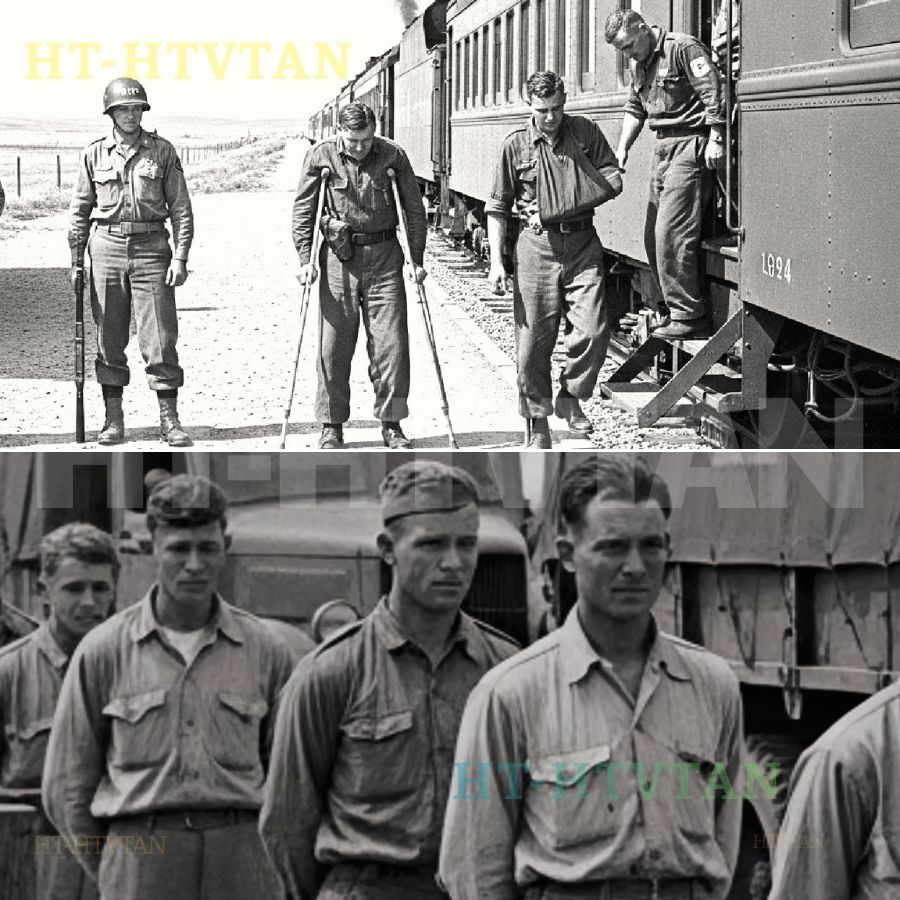
    It does not, by itself, tell us what each individual believed or what each had done.

    That distinction matters when looking at historical photographs.

    A prisoner is not a complete biography.

    A uniform is not a complete biography.

    A photograph is not a complete biography.

    The temptation to fill those gaps with invented stories should be resisted.

    We can say what the evidence supports.

    These were German soldiers.

    They had been captured.

    The war was moving toward its final stages.

    The German military was collapsing under the pressure of Allied advances.

    And the men in the photograph were now prisoners rather than combatants.

    That alone is enough to tell a story.


    There is something deeply human in the photographs of defeated soldiers.

    The propaganda of wartime often reduces enemies to symbols.

    But a photograph puts faces back onto them.

    Young men.

    Tired men.

    Men who may have been frightened.

    Men who had families somewhere.

    Men who had made choices.

    Men who had also been part of a military machine responsible for aggression and occupation.

    These realities can exist simultaneously.

    Humanizing an individual does not mean excusing a regime.

    Remembering the humanity of people caught inside history does not require forgetting the crimes committed by the institutions they served.

    In fact, understanding both is necessary.


    By 1944, the direction of the war was becoming increasingly clear.

    The Allied landings in Normandy had opened a major western front against Nazi Germany.

    Soviet forces were advancing from the east.

    Germany was being pushed back.

    Cities were being liberated.

    And in France, resistance fighters who had spent years living under occupation could finally stand openly against the symbols of the regime that had controlled their country.

    One photograph in the source material shows members of the French Resistance posing in front of a defaced portrait of Adolf Hitler in Paris after the German garrison surrendered.

    The image is almost symbolic.

    For years, Hitler’s image had represented power.

    Now it had been damaged.

    The German garrison had surrendered.

    The occupation was ending.

    The photograph does not need exaggerated narration.

    The contrast speaks for itself.

    A portrait of a dictator.

    Defaced.

    Behind it, people who had survived occupation.

    And in front of it, a city beginning to reclaim its public space.

    The war was not over yet.

    But something had changed.

    Power had shifted.


    The liberation of Paris was one of those moments when history could be felt physically.

    The occupation that had seemed permanent was suddenly temporary.

    The symbols that had dominated public life were being removed.

    People could move through streets without the same presence of German military authority.

    Resistance fighters could appear openly.

    The psychological transformation mattered almost as much as the military one.

    Occupation had been a condition of everyday life.

    Liberation changed that condition.

    But liberation also revealed the damage left behind.

    War does not end simply because soldiers stop fighting in one city.

    There are prisoners.

    Displaced people.

    Families separated.

    Destroyed homes.

    Political divisions.

    Trauma.

    And questions of responsibility.


    The end of Nazi rule also meant the exposure of crimes that had previously been hidden.

    Majdanek became one of the earliest major concentration camps liberated by Allied forces.

    The evidence found there helped demonstrate the scale and organization of Nazi crimes.

    The Soviet advance had been so rapid that the Germans had not been able to destroy the camp completely.

    That accident of military timing mattered enormously.

    The world could see.

    The photographs could be taken.

    Journalists could enter.

    Evidence could be preserved.

    The victims could no longer be reduced to rumors.

    Their suffering had left physical traces.

    And those traces became part of the historical record.


    There is a strange connection between the photograph of the young girl in Berlin in 1933 and the photograph of Majdanek in 1944.

    Eleven years separate them.

    One shows a child standing beside an instrument associated with racial measurement.

    The other shows the remains of a concentration camp where Nazi racial ideology had reached its murderous extreme.

    The photographs are not the same kind of evidence.

    They should not be treated as if one photograph directly caused the other.

    History is more complicated than that.

    But together they reveal a progression.

    First, people are classified.

    Then they are separated.

    Then rights are removed.

    Then persecution intensifies.

    Then violence becomes institutionalized.

    And eventually, in the Holocaust, mass murder is organized on an unprecedented scale.

    This is not a fictional plot.

    It is the historical process documented by archives, survivor testimony, photographs, official records, and decades of scholarship.

    The warning is therefore not hidden in the dramatic final image.

    It is visible much earlier.


    And perhaps that is why the quiet photographs are so important.

    The Mochida family waiting for a bus.

    The child standing outside a Berlin shop.

    The protesters confronting fascists in New York.

    The young German soldiers after capture.

    The French Resistance posing after liberation.

    The evidence left behind at Majdanek.

    Each image shows a different stage of a world at war.

    Fear.

    Ideology.

    Discrimination.

    Mobilization.

    Occupation.

    Resistance.

    Defeat.

    Liberation.

    Memory.

    The war can be studied through battles and generals.

    But it can also be studied through waiting families and ordinary streets.

    Sometimes the second approach tells us more about what war actually means.


    Because for most people, war does not begin when they fire a weapon.

    It begins when something familiar changes.

    A letter arrives.

    A ration is reduced.

    A school closes.

    A neighbor disappears.

    A government order is posted.

    A family is given identification tags.

    A soldier does not return.

    A newspaper carries another list of names.

    A foreign uniform appears in the street.

    A familiar flag is replaced.

    A shop closes.

    A train arrives.

    A bus takes a family away.

    These are the small movements through which enormous historical events enter private lives.


    The most disturbing lesson of these photographs is therefore not simply that World War II was violent.

    Everyone already knows that.

    The deeper lesson is how much of the road toward catastrophe can look ordinary while it is happening.

    A government form can look ordinary.

    A school lesson can look ordinary.

    A measurement can look ordinary.

    A uniform can look ordinary.

    A bus can look ordinary.

    A chemical container can look ordinary.

    But what matters is what these things are being used to accomplish.

    That is why historical context is essential.

    Without context, a photograph is only an image.

    With context, it becomes evidence.


    And yet, there is another truth worth remembering.

    People are not only victims of history.

    They are also capable of resisting it.

    The French Resistance did.

    People protested fascism in New York.

    Prisoners survived concentration camps.

    Families tried to protect one another.

    Photographers documented what they saw.

    Journalists reported what they could.

    Soldiers fought and liberated occupied territories.

    And after the war, historians, archivists, survivors, and institutions worked to preserve evidence.

    Memory itself became a form of resistance against denial.

    That is why photographs matter decades later.

    They keep the past from becoming too abstract.


    Today, it is easy to look at an old photograph and feel that the people inside it belonged to another world.

    They did not.

    They had ordinary lives.

    They had families.

    They worked.

    They studied.

    They went to shops.

    They traveled.

    They argued.

    They celebrated.

    They worried about money.

    They made plans.

    And then history interrupted them.

    That is perhaps the most human element of all.

    People rarely know when they are living through a moment that future generations will consider historic.

    The family waiting beside a bus in California probably could not know that the photograph would survive for decades.

    The people standing in Berlin in 1933 could not know where Nazi racial policy would eventually lead.

    The soldiers captured at the end of the war could not know how historians would later interpret their generation.

    The people standing in Paris after liberation could not know how many years later the photograph would still symbolize the collapse of Nazi power.

    History is only obvious in retrospect.

    For the people living through it, it is uncertainty.


    And that is where the photographs leave us.

    Not with a simple story.

    Not with the comforting belief that history is divided neatly between good people and bad people.

    But with a more difficult understanding.

    Governments make decisions.

    Institutions enforce them.

    Individuals respond to them.

    Some obey.

    Some resist.

    Some suffer.

    Some survive.

    Some remain silent.

    Some speak.

    And the consequences can last for generations.

    The photographs of World War II remind us that the distance between an ordinary day and a historic catastrophe is not always as large as it appears.

    Sometimes it is measured in a government order.

    Sometimes in a law.

    Sometimes in a classroom lesson.

    Sometimes in a train.

    Sometimes in a bus.

    Sometimes in a photograph.

    The most important thing is not simply to look at these images.

    It is to understand what they reveal.

    The false racial theories.

    The persecution that followed.

    The concentration camps.

    The machinery of murder.

    The forced incarceration of Japanese Americans.

    The resistance to fascism.

    The defeat of Nazi Germany.

    The liberation of places where terrible crimes had taken place.

    And finally, the memory left behind.

    Because the past cannot be changed.

    But the way we understand it can determine what lessons we carry into the future.

    A photograph cannot tell us everything.

    But sometimes it can tell us enough to make us stop.

    To look again.

    And to ask a question that history never allows us to escape:

    How do ordinary people and ordinary institutions respond when fear, ideology, and political power begin to redefine who is considered worthy of rights, dignity, and protection?

    Some content was generated using AI tools (including ChatGPT) and edited by the author for creativity, storytelling, and historical illustration purposes. Historical facts and key details should be verified against reliable historical sources. Any AI-generated or reconstructed visuals are intended for illustrative purposes and should not be interpreted as original historical photographs or archival evidence.

  • 🕰️ 100 RARE Vintage Photos That Take You Back in Time – Historical Photos – Ethereal Relics. VD

    On December 7, 1941, a photograph captured something that words could barely explain.

    Smoke rose from the waters of Pearl Harbor.

    The USS Arizona was burning after being struck during the Japanese attack, its dark smoke climbing into the sky above the American Pacific Fleet. More than a thousand men aboard the battleship would never leave it alive. Across Hawaii, the United States was suddenly at war.

    Yet the most haunting part of the photograph is not simply the burning ship.

    It is what the smoke represented.

    For millions of Americans, the war had suddenly become something immediate. Not a distant conflict discussed in European newspapers. Not something happening somewhere across an ocean.

    Có thể là hình ảnh đen trắng về một hoặc nhiều người

    It was now here.

    And after that morning, the war would enter places that had never looked like battlefields at all.

    Classrooms.

    Factories.

    Grocery stores.

    Newspaper offices.

    Movie studios.

    Family kitchens.

    Even the notebooks and ration books carried by ordinary people.

    The photographs left behind from those years often show no battlefield at all.

    Có thể là hình ảnh đen trắng về đài kỷ niệm

    And that is precisely what makes them so revealing.

    Because World War II was not lived only by soldiers.

    It was lived by entire societies.


    Before December 1941, the United States had already been watching the war from a distance.

    Europe had been at war since 1939.

    Germany had invaded Poland. France had fallen. Britain had endured the Blitz. The conflict had spread across North Africa, the Atlantic, and eventually into the Soviet Union.

    Americans followed the news.

    They listened to radio broadcasts.

    They read newspapers.

    Có thể là hình ảnh đen trắng


    They watched events unfold from thousands of miles away.

    But distance has a strange effect on people.

    A war can dominate the headlines and still feel remote.

    Pearl Harbor changed that.

    At 7:55 a.m. Hawaii time on December 7, Japanese aircraft attacked the American naval forces at Pearl Harbor. The surprise attack caused enormous damage and killed more than 2,400 Americans. The following day, President Franklin D. Roosevelt asked Congress for a declaration of war against Japan.

    The photograph of the burning Arizona became one of the enduring images of that transformation.

    A ship.

    A harbor.

    Có thể là hình ảnh đen trắng

    Smoke.

    And an entire country suddenly looking toward the Pacific.

    But photographs can only capture a moment.

    They cannot show what happens next.

    They cannot show how a nation changes after the first shock has passed.

    They cannot show the quiet decisions made in millions of homes.

    That story had to be lived.


    The first changes appeared in ordinary places.

    The grocery store.

    The kitchen.

    The classroom.

    The factory.

    Có thể là hình ảnh đen trắng về một hoặc nhiều người và đường phố

    The war demanded enormous quantities of fuel, rubber, metals, food, clothing, machinery, and ammunition.

    America’s industrial capacity became one of the decisive elements of the Allied war effort.

    But production was only one side of the story.

    Civilian consumption also had to change.

    Gasoline, rubber, sugar, butter, meat, and other goods were subject to wartime restrictions. The National Archives preserves wartime posters urging Americans to conserve materials and reminding civilians that resources were needed by soldiers overseas.

    For an ordinary family, this could mean something as simple as looking at a ration book before going shopping.

    The war could suddenly become visible on a kitchen table.

    A small booklet.

    A limited allowance.

    A list of goods.

    A calculation of what could be bought today and what had to wait.

    Có thể là hình ảnh đen trắng

    The scale was completely different from the enormous movements of armies overseas.

    But the principle was the same.

    Everyone was being asked to give something.

    Soldiers gave years of their lives.

    Workers gave their labor.

    Families gave up conveniences.

    Children learned that some things could not simply be bought whenever they wanted them.

    The war was far away.

    Yet it had reached the household.


    One of the most striking photographs from wartime America shows a teacher explaining the use of a war ration book to her students.

    The image is easy to overlook.

    There are no tanks.

    Có thể là hình ảnh đen trắng

    No aircraft.

    No explosions.

    Just a classroom.

    A teacher.

    Students.

    And a book that represented the restrictions of wartime life.

    But that little book carried an important lesson.

    War was not simply something adults discussed on the radio.

    It was becoming part of childhood.

    Có thể là hình ảnh đen trắng

    Children learned about shortages.

    They saw adults saving materials.

    They watched relatives leave for military service.

    They heard names announced in newspapers.

    And they began to understand that the world around them had changed.

    The children might not have understood military strategy.

    They did not need to.

    They could understand that certain foods were harder to obtain.

    That some fathers, brothers, or uncles were gone.

    That newspapers carried terrible news.

    Có thể là hình ảnh đen trắng về một hoặc nhiều người và văn bản

    That the adults spoke differently when the radio announced another battle.

    This was how a global conflict entered the lives of people who would never see a battlefield.


    But across the Atlantic, another kind of classroom was being used for an entirely different purpose.

    In Nazi Germany, education had been transformed by the regime.

    Schools were no longer simply places where children learned mathematics, literature, or history.

    They became instruments of ideology.

    The Nazi government introduced its worldview into education, youth organizations, textbooks, and everyday life. Students were taught ideas about racial hierarchy, antisemitism, obedience, militarism, and loyalty to Adolf Hitler. Jewish children faced increasing exclusion from public education, and after November 1938 they were barred from German public schools.

    Có thể là hình ảnh đen trắng về trẻ em và đường phố

    This is one of the darkest aspects of the photographs from the period.

    A classroom can look completely ordinary.

    Children sit at desks.

    A teacher stands at the front.

    Books are open.

    There may be nothing visually dramatic about the scene.

    But the ideas being taught can transform everything.

    The Nazi regime understood something that dictatorships have repeatedly understood throughout history:

    If you want to shape the future, influence the young.

    The classroom therefore became part of the political system.

    Education was not merely about knowledge.

    It was also about deciding who belonged.

    Who was considered valuable.

    Who was considered inferior.

    Who was allowed to participate.

    And eventually, who was excluded from society altogether.

    The United States Holocaust Memorial Museum documents how Nazi education promoted racial thinking and antisemitism, while teachers and schools were used to spread Nazi ideology among German youth.

    That makes photographs of Nazi-era classrooms particularly disturbing.

    The children in them were still children.

    But the world around them was teaching them to see other human beings differently.

    That distinction matters.

    Because children do not create the systems into which they are born.

    Adults do.

    Institutions do.

    Governments do.

    And those systems can teach children either to recognize human dignity—or to deny it.


    The contrast becomes even more striking when we return to the United States.

    In one country, children were being taught racial ideology.

    In another, children were being taught how to live with wartime shortages.

    Neither photograph shows a battlefield.

    Yet both reveal how deeply war and politics can penetrate ordinary life.

    That is why photographs from this period should not always be judged by how dramatic they appear.

    Sometimes the quietest photograph carries the largest warning.


    There were also people working far from the battlefield whose labor became essential to the war.

    Newspaper workers continued producing daily editions.

    Factories operated around the clock.

    Women entered jobs that had previously been dominated by men.

    Engineers developed new machines.

    Mechanics repaired vehicles.

    Railroad workers moved supplies.

    Farmers produced food.

    Clerks processed documents.

    Millions of people became parts of an enormous wartime system.

    The war could not be won by soldiers alone.

    A soldier at the front depended on an invisible network behind him.

    Food had to arrive.

    Ammunition had to be manufactured.

    Uniforms had to be produced.

    Vehicles had to be repaired.

    Orders had to be written.

    News had to be printed.

    And all of it depended on people doing ordinary jobs under extraordinary circumstances.

    This is one of the least cinematic truths about war.

    The great battles are remembered.

    The millions of small tasks that made those battles possible often disappear.


    Meanwhile, the world of culture did not completely stop.

    Even during the war, artists continued to work.

    Filmmakers continued to make films.

    Animators continued drawing.

    People continued going to theaters.

    This may seem strange when placed beside images of burning ships and ruined cities.

    But it reveals something important.

    Human beings do not stop being human during war.

    They still create.

    They still tell stories.

    They still look for beauty.

    And sometimes, those creative efforts become part of the historical record themselves.

    At Disney, animators working on Bambi studied real animals to make the movement of the animated characters more convincing. The studio brought young deer to the grounds so artists could observe their movements, and animators also studied animals through field trips, photographs, and film.

    There is something almost surreal about that fact.

    Outside the studio, the world was at war.

    Inside, artists were watching deer walk.

    They were studying the movement of legs.

    The tilt of a head.

    The way an animal moved through the forest.

    They were trying to reproduce nature faithfully on paper.

    And in 1942, Bambi reached audiences while the United States was deeply involved in World War II.

    The contrast is extraordinary.

    Outside the theater, the world was becoming more dangerous.

    Inside, audiences watched a young deer grow up.

    But perhaps that is not a contradiction at all.

    Perhaps it is part of how societies survive difficult times.

    People need more than weapons.

    They need meaning.

    They need stories.

    They need reminders that life contains more than destruction.


    Yet the war continued.

    And the images became darker.

    The photograph of the burning USS Arizona was not simply an image of destruction.

    It represented the beginning of a new phase of American history.

    The United States was now fully committed to the global conflict.

    The consequences would reach Europe, North Africa, the Pacific, and eventually nearly every aspect of American society.

    Young men would be drafted.

    Families would wait.

    Factories would expand.

    Rationing would continue.

    Newspapers would carry casualty lists.

    And the distinction between “the war” and “ordinary life” would become increasingly difficult to maintain.


    One of the most powerful ways to understand this transformation is to place several photographs side by side.

    A burning warship.

    A ration book.

    A classroom.

    A factory worker.

    A newspaper press.

    A child.

    A family.

    None of these images alone tells the story of World War II.

    Together, they begin to.

    The burning ship shows the shock.

    The ration book shows sacrifice.

    The classroom shows ideology.

    The factory shows mobilization.

    The newspaper shows information.

    The family shows what was at stake.

    And the child reminds us that every war creates consequences that continue long after the soldiers have gone home.


    But there is another side to the story.

    War also exposed the weaknesses and contradictions of the societies fighting it.

    The Allied powers presented their struggle as a fight against dictatorship and aggression.

    That was true.

    But victory did not automatically erase discrimination at home.

    The history of World War II is therefore not a simple story of good societies against bad societies.

    It is more complicated.

    The United States fought Nazi Germany while still confronting racial segregation and discrimination.

    Britain fought for survival while maintaining an empire.

    The Soviet Union fought Nazi Germany while operating under Stalin’s dictatorship.

    And across Europe, millions of civilians lived under occupation, persecution, collaboration, resistance, and fear.

    The war did not create all these contradictions.

    But it exposed them.

    Sometimes brutally.


    In Nazi Germany, racial ideology moved from propaganda into policy.

    Then from policy into exclusion.

    Then from exclusion into persecution.

    And ultimately into mass murder.

    The photographs of classrooms and students therefore cannot be separated from what followed.

    This does not mean that every German child photographed in a classroom understood what the regime was ultimately doing.

    It means something more important.

    Ideas have consequences.

    When a government repeatedly teaches that some people are inferior, dangerous, or less human, it changes the moral environment in which people make decisions.

    The Holocaust did not emerge from a single photograph or a single classroom lesson.

    It developed through a progression of radicalization, persecution, exclusion, deportation, and mass murder.

    But education was one part of the environment in which Nazi ideology was normalized.

    That is why the classroom matters.


    And then there is Pearl Harbor again.

    The smoke has become one of the most recognizable images of the war.

    But imagine looking at it without knowing what comes next.

    There is no knowledge of 1945.

    No knowledge of victory.

    No knowledge of the future.

    Only smoke.

    Only a burning ship.

    Only uncertainty.

    That is how history was experienced by the people who lived it.

    They did not know the ending.

    A young American leaving home in 1942 did not know whether he would return.

    A mother opening a letter did not know what it contained.

    A worker entering a factory did not know how long the war would last.

    A child sitting in a classroom did not know what kind of world would exist when they became an adult.

    A Jewish family facing Nazi persecution could not know whether tomorrow would be the day everything changed.

    We know the answers because we live after them.

    They did not.


    That is why old photographs can feel almost like ghosts.

    They freeze people at a moment when the future was still uncertain.

    The photograph does not tell us what the person was thinking.

    It does not give us permission to invent a private emotion.

    But it gives us something else.

    It gives us context.

    A person standing in a factory in 1942 was standing inside a world at war.

    A teacher holding a ration book was participating in a society adapting to wartime restrictions.

    A student in Nazi Germany was growing up inside an ideological dictatorship.

    A sailor standing aboard a warship before December 7, 1941, could not know what was coming.

    A Disney animator studying a deer in the early 1940s was working on a film that would reach audiences during one of the most destructive periods in modern history.

    The photographs do not need invented dialogue.

    The facts are powerful enough.


    By 1945, the world looked different.

    The war had transformed borders, governments, economies, technologies, and societies.

    Millions were dead.

    Millions more were displaced.

    Europe lay devastated.

    The United States had emerged as a global superpower.

    The Soviet Union had suffered enormous losses while becoming one of the dominant powers of the postwar world.

    Japan faced occupation and reconstruction.

    Germany was defeated and divided.

    And the world entered a new age shaped by the experience of the war.

    But the photographs remained.

    The classroom.

    The ration book.

    The burning ship.

    The factory.

    The newspaper.

    The animation studio.

    The families.

    They survived because photographs are strange things.

    They preserve a fraction of a second while allowing later generations to ask questions that the people inside the photograph could never have imagined.

    What did they know?

    What did they not know?

    What choices did they have?

    What choices were made for them?

    And what did they believe the future would look like?


    Perhaps the most important lesson is not about weapons.

    It is about how quickly history can enter ordinary life.

    A war can begin with decisions made in government offices.

    But its consequences eventually appear in grocery stores.

    In schools.

    In newspapers.

    In factories.

    In homes.

    And in the lives of children who had nothing to do with the decisions that created the conflict.

    That is why the photographs matter.

    They prevent history from becoming only a collection of dates.

    December 7, 1941, was a date.

    But it was also a morning.

    There was a sky over Hawaii.

    There were ships in the harbor.

    There were sailors beginning another day.

    There were families who had not yet heard the news.

    Then came the aircraft.

    Then the explosions.

    Then the smoke.

    Then the photographs.

    And after that, the world was different.


    When we look back today, it is tempting to think of World War II as one enormous story with a predetermined ending.

    But the people living through it did not have that luxury.

    They lived inside uncertainty.

    They waited.

    They adapted.

    They sacrificed.

    They worked.

    They feared.

    They hoped.

    Some made courageous choices.

    Others made terrible ones.

    Some resisted.

    Some collaborated.

    Some simply tried to survive.

    And millions of ordinary people found themselves inside events far larger than their own lives.

    That may be why the most powerful photographs from the era are not always the photographs of generals.

    Sometimes they are the photographs of ordinary people.

    A teacher holding a ration book.

    A worker beside a machine.

    A family waiting for someone to come home.

    A child sitting at a desk.

    A sailor standing beside a ship.

    An artist studying a deer.

    And somewhere in the distance, smoke rising into the sky.

    The photographs do not speak.

    But history does.

    And when we look closely enough, we begin to understand that the real story of World War II was never only about armies.

    It was about societies.

    It was about choices.

    It was about ideas.

    It was about fear and endurance.

    And above all, it was about ordinary human beings trying to live through extraordinary circumstances.

    The war eventually ended.

    The smoke cleared.

    The ration books disappeared.

    The factories returned to civilian production.

    Children grew older.

    Soldiers came home.

    Cities were rebuilt.

    But the world they returned to was not the same world they had left.

    And perhaps that is the final truth hidden inside these photographs.

    They do not show us the entire war.

    They show us pieces of the lives caught inside it.

    And sometimes, a single piece is enough to remind us how close history can come to an ordinary human life.

    We know what happened next.

    They did not.

    When you look at the photographs of World War II, which is more powerful to you—the image of the battlefield, or the quiet image of ordinary people trying to live while the world around them was changing?

    Some content was generated using AI tools (including ChatGPT) and edited by the author for creativity, storytelling, and historical illustration purposes. Historical facts and key details should be verified against reliable historical sources. Any AI-generated or reconstructed visuals are intended for illustrative purposes and should not be interpreted as original historical photographs or archival evidence.

  • ▶ UNBELIEVABLE Historical Images That’ll Haunt You Forever – RARE Vintage Photos – Ethereal Relics. VD

    In September 1938, London welcomed a returning politician amid applause and hopeful faces. Neville Chamberlain had just returned from Germany after meeting Adolf Hitler, carrying with him an agreement that he believed could keep Europe from another devastating war.

    The people standing along the streets that day could not see the years ahead.

    They did not know that within a year, newspapers would no longer speak primarily of peace. They would speak of mobilization, borders being crossed, armies advancing, and a continent moving toward war.

    No one in that crowd could see the six years that followed.

    Có thể là hình ảnh đen trắng về áo khoác ngoài và vùng bắc cực

    No one knew that factories would become wartime workshops, that young women would replace office clothes with work uniforms, that families would wait anxiously for letters from the front, that cities would wake to news of bombing, or that one morning in June 1944, thousands of people in New York would gather around a news ticker to read reports about the Allied invasion of Normandy.

    But history is not always best understood through battles.

    Sometimes it is found in the faces of people waiting.

    In a cup of tea offered to a soldier.

    In workers standing beside machines.

    Có thể là hình ảnh đen trắng

    In names written on pieces of paper.

    And in people who tried to live ordinary lives while the world around them had become anything but ordinary.


    Before the war truly began, Europe was already showing signs of what was coming.

    In September 1938, Neville Chamberlain returned to London after negotiations with Adolf Hitler in Munich. Images of his return would later become symbols of a moment when many people still hoped diplomacy could prevent another major European war.

    But history did not end at Munich.

    One year later, Germany invaded Poland.

    Có thể là hình ảnh đen trắng về tàu hỏa và đường sắt

    On September 1, 1939, the war in Europe began.

    Soon, borders that had once existed only on maps became front lines. Soldiers left their homes. Factories were converted to produce military supplies. Newspapers became an essential part of everyday life, carrying news from places most civilians could only imagine.

    The war did not exist only on battlefields.

    It entered kitchens, railway stations, newspaper offices, and family homes.

    It appeared in lists of missing soldiers, letters sent home, and trains carrying men and women away from places they knew, often without knowing exactly when they would return.

    By 1942, inside the offices of The New York Times in New York City, the enormous machinery of newspaper production was still operating step by step.

    Có thể là hình ảnh đen trắng về lối thoát hiểm và đường phố

    Workers using Linotype machines produced lines of metal type. Pages were arranged and proofread before being transferred through further stages of production. Molds were created from the pages, and those molds were used to produce curved printing plates. The plates were then placed on enormous presses, which printed newspapers onto huge rolls of paper before the finished papers were folded, bundled, and distributed.

    Today, most people think of news through screens.

    But during wartime, news had weight.

    It could be a freshly printed sheet of paper.

    It could be the sound of machinery running inside a crowded room.

    And sometimes, it could make an entire city stop and look.


    June 6, 1944, was one of those days.

    Có thể là hình ảnh đen trắng về một hoặc nhiều người và đường phố

    In Normandy, Allied forces launched the largest seaborne invasion in history. Thousands of soldiers came ashore in an operation that would help open the way toward the liberation of Western Europe from Nazi German occupation.

    Thousands of miles away, in Times Square, New Yorkers gathered around news displays to follow the latest reports about the invasion.

    There were no smartphones.

    No social media.

    No live video feeds from the battlefield.

    There were only reports arriving from across the Atlantic, being updated and read by crowds trying to understand what was happening.

    One person might have been reading with the hope that the war was finally beginning to turn.

    Another might have been searching for information about a particular unit.

    A family might simply have wanted to know whether their son was somewhere in Normandy.

    Có thể là hình ảnh đen trắng về một hoặc nhiều người và văn bản

    The distance between Times Square and Normandy was thousands of miles.

    Yet on that day, the two places felt closer than ever.

    Because war is not measured only in geographical distance.

    It is also measured in waiting.

    In Normandy, soldiers faced the reality of battle.

    In New York, civilians faced another kind of helplessness: they could only wait for news.

    And sometimes, waiting is part of war too.

    Có thể là hình ảnh đen trắng về một hoặc nhiều người và văn bản


    Photographs from Normandy in 1944 are especially powerful because they do not always show combat.

    One preserved image shows a French civilian woman serving a drink to a British soldier during the Normandy campaign. The Imperial War Museums identifies the photograph as showing a French civilian woman pouring a drink for a British soldier carrying a Bren gun in 1944.

    Another photograph shows British soldiers receiving tea before an attack near Evrecy on July 16, 1944.

    These images can feel almost strange at first.

    Because the war we usually imagine is made of gunfire, tanks, aircraft, explosions, and attacks.

    Yet these photographs contain tea.

    They contain civilians.

    Có thể là hình ảnh đen trắng về một hoặc nhiều người

    They contain moments that almost look ordinary.

    And that ordinary quality makes the reality of war even more powerful.

    People did not stop being human simply because war had begun.

    Soldiers still became thirsty.

    Civilians still prepared drinks.

    The wounded still needed transportation.

    And in the days following the Normandy landings, wounded soldiers were evacuated from the battlefield. One photograph from June 7, 1944, shows a wounded soldier being transported on a hospital train while drinking a cup of tea.

    It was not a moment that changed the map of Europe.

    But it helps us understand how war affected individual lives.


    While armies moved across Europe, another battle was taking place far from the front lines.

    It was the battle of the home front.

    Có thể là hình ảnh về văn bản

    Factories became part of the war effort.

    Women entered jobs that had previously been dominated by men.

    They worked in defense plants, operated machinery, produced ammunition, and performed countless tasks necessary to keep wartime economies functioning.

    In the Soviet Union, women played a major role in military production. Among the surviving images from the period are photographs of women working in defense factories near Moscow.

    Behind every shell was a chain of human labor that soldiers on the battlefield rarely saw.

    There were raw materials.

    There were machines.

    There were workers.

    There were inspectors.

    There were people packaging the finished products.

    There were long shifts.

    And there were people who continued working even though they knew that what they produced would eventually be used somewhere else, by people they might never meet.

    Modern warfare transformed entire societies into enormous systems of production.

    A soldier at the front depended on thousands of people behind him.

    And one of those people might simply have been a young woman standing beside a machine, trying to finish her shift.


    But the war also created contradictions that would remain difficult to understand even decades later.

    One of the clearest examples was the story of the 442nd Regimental Combat Team.

    The 442nd was formed in 1943 and was largely composed of second-generation Japanese Americans, known as Nisei. Some volunteers came from Hawaii, while others came from the relocation centers where Japanese Americans had been confined on the American mainland.

    They were Americans.

    Yet many people from their own community were simultaneously facing discrimination, suspicion, and incarceration inside the country they considered home.

    So why did these men fight?

    There was no single answer.

    Some fought for their country.

    Some fought for their families.

    Some wanted to demonstrate that their ancestry did not determine their loyalty.

    And some may simply have wanted to return home knowing that they had done what they believed was right.

    The 442nd entered combat in Italy in June 1944. Later, the unit moved into southern France and fought in the Vosges Mountains. During fierce fighting in the autumn of 1944, its soldiers participated in the liberation of Bruyères and Biffontaine and helped rescue a surrounded American battalion.

    By 1945, they were still fighting in Italy.

    The men who had witnessed suspicion directed toward their own community were now fighting in Europe as American soldiers.

    It was one of the profound contradictions of World War II.

    A nation could fight racism and dictatorship overseas while still struggling with discrimination within its own society.

    History is rarely neat.

    It is filled with contradictions that sometimes take generations to fully understand.


    In occupied Europe, another story unfolded quietly.

    His name was Oskar Schindler.

    He was a German industrialist who used his factories and influence to help protect Jewish workers from deportation and murder.

    But the historical reality is more complicated than the familiar image of one man sitting alone and writing a list.

    According to the United States Holocaust Memorial Museum, Schindler did not personally create the famous “Schindler’s List” in the simple way that the popular name might suggest. Several lists were associated with the transfer of workers from Plaszow to his factory in Brünnlitz, and the lists were prepared by people working within the camp system. Marcel Goldberg, among others, played an important role in preparing transport lists.

    What is firmly documented is that Schindler moved his factory from Kraków to Brünnlitz in the autumn of 1944.

    Around one thousand Jewish prisoners were transferred there to work in his factory. Being sent to Brünnlitz gave many of them a greater chance of survival than they would have had in other camps.

    The moment did not look like a scene from a film.

    There was no simple line dividing heroism from despair.

    There were lists.

    There were signatures.

    There were orders.

    There were transports.

    There were people being moved from one place to another.

    Some were protected.

    Others were not.

    Jewish women among those transferred to Brünnlitz were temporarily held at Auschwitz-Birkenau during the chaotic transportation process before eventually reaching the factory.

    That is why pieces of paper carrying people’s names became so important.

    In peacetime, a name is simply a name.

    Inside a system of persecution, a name could become a dividing line.

    Between being transferred and being left behind.

    Between another day of life and death.


    When we look back at photographs of World War II, it is easy to focus on famous figures.

    Hitler.

    Stalin.

    Churchill.

    Roosevelt.

    Generals.

    Armies.

    But history was not created only by those who stood at the top.

    It was also created by people whose names have almost disappeared.

    A factory worker.

    A nurse.

    A young soldier.

    A civilian in Normandy.

    A mother waiting for a letter.

    A newspaper employee.

    A Jewish prisoner looking at a list.

    A Japanese American soldier moving through a battlefield in Europe.

    These people rarely appeared in speeches.

    But without them, the war could not have unfolded in the way history remembers it.


    Then came 1945.

    The final battles in Europe began.

    The 442nd continued fighting in Italy. In April 1945, the unit participated in attacks around Serravezza, Carrara, and Fosdinovo. Official U.S. Army records describe how the advance broke through defensive positions that had resisted Allied forces for months.

    The war was finally approaching its end.

    But for those who had lived through it, the end of the war did not mean that everything returned to normal.

    Soldiers came home.

    Cities began rebuilding.

    Survivors searched for relatives.

    Others never returned.

    And those who survived carried memories that they could not always explain.

    Some came home with medals.

    Some returned quietly.

    Some returned carrying only a small suitcase.

    Some never returned at all.


    That is why old photographs have such power.

    A photograph cannot tell the entire story.

    It preserves only one moment.

    A soldier standing beside a civilian.

    A group of workers looking toward a camera.

    A crowd gathered around a news display.

    A woman pouring a drink for a soldier.

    A newspaper page being printed.

    A member of the 442nd fighting in a war that many people back home could never see.

    But behind every image is an entire world.

    And sometimes, the most important part of the photograph is not inside the frame.

    It is what happened before it.

    And what happened afterward.

    A photograph of the crowd in Times Square does not show the soldiers fighting in Normandy.

    But it shows a society waiting for news.

    A photograph from a factory does not show the battlefield.

    But it shows how many people were needed behind the front lines.

    A photograph of the 442nd does not tell the entire story of the discrimination faced by Japanese Americans.

    But it shows men who entered the battlefield as American soldiers.

    A photograph connected to Schindler cannot represent the Holocaust as a whole.

    But the surviving records show that, within a system organized around persecution and mass murder, individual choices could still make a profound difference to the lives of some people.

    And a photograph from Normandy cannot contain the entire war.

    It can only preserve a small fragment of a world being transformed.


    Perhaps that is the most important thing to remember about World War II.

    We know the outcome.

    We know Nazi Germany was defeated.

    We know the Allies advanced across Europe.

    We know the war ended in 1945.

    But the people living in 1939 did not know any of that.

    The people standing around the news displays on June 6, 1944, did not know exactly where the invasion would lead.

    The soldier stepping onto the beaches of Normandy did not know whether he would live to return home.

    The factory worker beginning another shift did not know whether that day would become one of hundreds of shifts contributing to the war effort.

    The Jewish prisoner whose name appeared on a transfer list did not know whether that piece of paper would truly save them.

    And the soldiers of the 442nd entering battle did not know how history would eventually remember them.

    That is what the distance of time can sometimes hide.

    Once we know the ending, we are tempted to believe that everything was inevitable.

    But history was not lived that way.

    History was lived one day at a time.

    One decision.

    One train.

    One newspaper.

    One work shift.

    One step.

    One moment of waiting.

    And sometimes, through a very small decision, an individual became part of a story far larger than their own life.


    Today, those photographs are old.

    Some have faded.

    Some survive only in archives.

    Some have been reproduced so many times online that the circumstances surrounding them have almost been forgotten.

    But they remain.

    Like small windows into a world that no longer exists.

    Through them, we can see war not only through numbers of soldiers, territories, battles, and casualties.

    We can see people.

    And perhaps that is the most important way to remember World War II.

    Not to romanticize war.

    Not to turn the dead into distant symbols.

    But to remember that before they became names in history books, they were people.

    They had families.

    They had jobs.

    They had fears.

    They had hopes.

    They had ordinary tomorrows they expected to see.

    War took away many of those tomorrows.

    But the photographs that remain allow us to look back at them.

    One more time.

    For a moment.

    Not as characters in a story whose ending was already known.

    But as human beings living inside history, at a time when they themselves did not yet know where history would lead.

    And perhaps that is what makes these old photographs so haunting.

    We know what happened next.

    They did not.

    If you could choose one moment from these World War II photographs to stop and examine more closely, which moment would you choose—and what would make it impossible for you to forget?

    Some content was generated using AI tools (including ChatGPT) and edited by the author for creativity, storytelling, and historical illustration purposes. Historical facts and key details should be verified against reliable historical sources. Any AI-generated or reconstructed visuals are intended for illustrative purposes and should not be interpreted as original historical photographs or archival evidence.

  • 📷▶ 100+ SHOCKING Rare Historical Photos That Will BLOW Your Mind!.nam

    Welcome to the Nation of History channel. Be sure to subscribe and like so you don’t miss out on more videos like this one. The photograph titled The Blind Girl was taken by Chrysler Strummolome in Hiroshima, Japan in 1963.▶

    The image became a silent symbol of pain, human resilience, and the lasting scars of nuclear conflict. The view of destruction in Dresden’s old town, seen from the city hall tower on February 15th, 1945, reveals the devastating impact of Allied bombing during World War II. King George V took part in a famous hunting expedition in the Terai region of southern Nepal in 1911.

    During the hunt, several wild animals were killed, including tigers and rhinoceroses. Lyndon B. Johnson is sworn in as President of the United States aboard Air Force One on November 22nd, 1963.

    Standing beside him is Jacqueline Kennedy, wife of President John F. Kennedy, who had been assassinated 2 hours earlier in Dallas, Texas. Fidel Castro during a meeting with Nikita Kruchab in 1963 is shown smoking a cigar and wearing two Rolex watches, a detail that stood out due to the contrast between his communist image and the luxurious accessories.

    Julius and Ethel Rosenberg kiss after being formally charged with espionage in the United States in the early 1950s. The couple was held responsible for passing confidential information about the American nuclear program to the Soviet Union. The headquarters of Mussolini’s Italian Fascist Party in 1934, located in Rome, served as a central hub for the administration and ideology of the fascist regime.

    Under Bonito Mussolini’s leadership, the party aimed to consolidate power and promote Italy’s nationalist and authoritarian agenda. Charlie Chaplan and Mahatma Gandhi meet in London in 1931 during Gandhi’s visit to the United Kingdom to attend the roundt conference on India’s independence. Manfred von Richtoen, popularly known as the Red Baron, is pictured in 1917 at the height of his fame as a fighter pilot during World War I.

    The Red Baron was feared by enemies and admired by fellow pilots until his death in combat in 1918. Japanese Lieutenant and war correspondent Dr. Sonji Sasamoto meets with Hungarian General Gorgi Rakovski on the Eastern Front during World War II in 1942.

    US Navy divers prepared to load the Apollo 15 command module CM onto the USS Okinawa after its recovery from the ocean on August 7th, 1972. Vietnam veterans protested the war in 1970 with a sign reading, “We won’t fight another rich man’s war. ” The protest reflected the growing frustration among veterans, many of whom had been sent to fight in a controversial conflict.

    A deaf man hugs a speaker to his chest in the 1970s to feel the music’s vibrations. During that decade, deaf individuals began exploring new ways to connect with music through the physical sensation of sound waves across the body. Prisoners are seen wearing wooden kangs in 1902, a traditional form of public punishment in parts of Asia, especially imperial China.

    The kongs were heavy wooden frames locked around the neck, restricting movement and serving as humiliation. A kneeling elephant receives passengers while a handler of Indian origin firmly guides it. The image was taken during the British Raj period likely in the late 19th or early 20th century.

    Native Americans perform a traditional ceremony and present a symbolic gift to a train engineer in the state of Oregon in 1940. The gesture represents a moment of respect and cultural exchange often staged for receptions or special railway events. A survivor of the Bukinvault concentration camp points and identifies a Nazi guard in 1945 shortly after the camp was liberated by Allied forces.

    The image symbolizes the direct confrontation between victims and perpetrators, marking the beginning of historical accountability. The Canadraph camera in use in 1912 represents one of the earliest filming technologies in cinematic history. It was originally developed in the 1890s by William Kennedy Lorie Dixon under the supervision of Thomas Edison.

    Finnish President Uro Kva Keinan and North Korean leader Kim IlSung stand together during an official visit to the Finnish Parliament in 1975. The meeting symbolizes cold war diplomacy between Finland and North Korea. A woman churns milk to make butter while reading a book in 1897 in a peaceful rural life scene.

    A small kitten, likely her companion, adds to the simplicity of the everyday setting. The image shows a person restrained in one of the cruel forms of punishment used in various cultures throughout history. The use of physical and public punishments was common in many civilizations where human suffering was often displayed as a warning to others.

    Soldiers and civilians pose in front of a Union field hospital in Michigan during the American Civil War in the 1860s. The US flag in the background marks the presence of the Union Army at this temporary treatment site. A young girl appears in this image taken during the Great Depression in the United States in the 1930s.

    The photo symbolizes the resilience of children during one of the hardest periods in American history. A playful forced perspective photo is captured on a beach around 1943. This kind of photography was popular among soldiers and civilians during World War II, offering light-hearted moments during difficult times.

    A woman in uniform poses during World War II, representing the thousands who served in essential roles. Many worked as nurses, drivers, radio operators, mechanics, and in auxiliary military units such as the WAC, Women’s Army Corps, in the United States or the ATS in the United Kingdom. Harry S.

    Truman served as an artillery captain during World War I. He commanded battery D of the 129th Field Artillery Regiment, part of the 35th Division of the United States Army. Clara Dear performs a daring jump from a bridge in Boston while handcuffed during a public escapism act.

    Inspired by artists like Harry Houdini, she was known for her risky stunts and spectacular escape performances. Wounded Indian soldiers are treated inside the Royal Pavilion in Brighton, Sussex in 1918. During World War I, the Royal Pavilion, originally built as a royal palace for the Prince Regent, was converted into a military hospital for injured soldiers.

    SBD Dauntless dive bombers are seen at the Douglas Aircraft Factory in Elsagundo, California in 1943. During World War II, the SBD Dauntless was one of the most important aircraft used by the US Navy. Workers take a lunch break on the St.

    John’s Bridge in Portland, Oregon in 1931 during the final stage of construction. Workers take a lunch break on the Saint John’s Bridge in Portland, Oregon in 1931 during the final stage of construction. Marlene Dietrich is lifted by soldiers in New York in 1945 in a celebratory scene shortly after the end of World War II.

    The image symbolizes her popularity among the troops and her active role in the war effort. Workers are seen hanging from the iron framework while painting the Eiffel Tower in 1932. Built in 1889, the tower required constant maintenance and was repainted regularly every 7 years.

    The early days of aviation in the 1890s were marked by pioneering experiments with gliders and flying machines powered by propellers or flapping wings. Though still lacking reliable engines, the tests of the 1890s were essential to the development of modern aviation. The world’s first deep sea exploration vehicle called the Ba’athosphere was developed in 1930 by engineers William BBE and Otis Barton.

    The baosphere marked the beginning of scientific exploration of the ocean’s depths. Wilbur Wright’s glider landed in Kittywake, North Carolina in 1901 during one of his early flight experiments. This model was an evolution of the tests conducted in 1900 and was used to study aerodynamic control during flight.

    The kites built by Lawrence Hargrave in 1893 were essential to the early advancements in aviation. Although he never flew himself, his innovations paved the way for the development of the first manned airplanes. Passengers wait to board a plane in 1929.

    During the early years of commercial aviation, air travel was gaining popularity as a fast way to move between cities and countries, marking the beginning of a new era in global mobility. A man poses in front of a Soyuse rocket during the 1980s in the middle of the Soviet Union’s space exploration era. The rocket, part of the Soviet space program launched in the 1960s, was used to transport cosminauts and cargo to Earth orbit and the space station.

    British troops depart from Hong Kong to join United Nations forces in the Korean War in September 1950. After North Korean communist forces invaded South Korea, the United Nations, led by the United States, intervened militarily in the conflict. A Japanese woman walks with a bucket balanced on her head carrying her small children inside in a scene captured in Japan in the early 1900s.

    This unusual method of child transport reflects the resourcefulness faced with the limitations of the time. Coney Island in New York appears vibrant in the 1950s with its crowded beaches, busy amusement parks, and lively boardwalk. Known as one of the top leisure destinations in the United States, the area featured iconic attractions like the Cyclone Roller Coaster and the Wonderhe.

    Students in schools like this one in Brooklyn, New York, were taught to duck and take cover under their desks in 1962. This practice known as duck and cover was part of emergency drills in preparation for a potential nuclear attack during the Cold War. Young Elizabeth II, just 3 years old, is pictured alongside her father, King George V 6, in 1929.

    The photo captures a tender and familiar moment between father and daughter before George V 6 became king in 1936 after the abdication of his brother Edward VII. Then Princess Elizabeth and the Duke of Edinburgh visit Niagara Falls during an official trip to Canada in 1951. The visit marked the beginning of a long relationship between the monarch and Canada, one of the leading members of the Commonwealth.

    Muhammad Ali, still known as Cashas Clay at the time, appears on the podium after winning the gold medal in light heavyweight boxing at the 1960 Summer Olympics in Rome. Chess prodigy Bobby Fischer plays against 50 opponents simultaneously in 1964. By this time, Fiser was already globally recognized for his extraordinary chess skills.

    Actress Heather Thomas appears in a 1983 photo taken at the peak of her television career. She became known for her role as Jodie Banks in the series The Fall Guy, which aired from 1981 to 1986. Bonnie Elizabeth Parker and Clyde Chestnut Barrow, known as Bonnie and Clyde, are pictured in 1933 at the height of their notoriety.

    The criminal couple gained fame for their bank robbery activities. Marilyn Monroe and Joe Deaggio appear together on their wedding day in 1954. Despite their intense romance, the marriage lasted only 9 months, but the image of that day remains a symbol of America’s golden age of celebrity.

    Marlene Dietrich is lifted by soldiers in New York in 1945 in a celebratory scene shortly after the end of World War II. The image symbolizes her popularity among the troops and her active role in the war effort. Argy Bam is an ancient citadel located in Bam in southeastern Iran.

    With around 1,500 years of history, its mud brick structure resembles a massive sand castle sculpted in the desert. Models display various neckline styles popular in the 1950s, a decade known for elegance and femininity in fashion. The cuts ranged from boat neck sweetheart off the shoulder to the classic V-neck enhancing the silhouette and accentuating the neckline.

    Muhammad Ali received a $5. 5 million payment for a fight in 1978, one of the highest amounts ever paid to a boxer at the time. The sum was for his bout against Leon Spinx in which Ali reclaimed the heavyweight world title for the third time.

    An unprecedented achievement. The luxurious great hall of the Breakers mansion in Newport, Rhode Island, is shown in this 1890s image. Designed by architect Richard Morris Hunt, the Breakers symbolized the power and wealth of America’s 19th century industrial elite.

    The New Hampshire Orphans Home operated on part of the former Daniel Webster farm in Franklin, United States. Founded in 1871, the orphanage was run by the state and provided shelter, food, and education for children without families or in vulnerable situations. The Statue of Liberty is shown under construction inside the workshop of sculptor Frederick Agugust Bartholi in Paris in 1882.

    Once completed, it was shipped in parts and assembled on Liberty Island in New York, where it was inaugurated in 1886. Niagara Falls appears partially frozen in an image taken during the winter of 1926. Even in extreme cold, visitors gathered to witness the natural phenomenon, showcasing the power and beauty of the falls under harsh weather conditions.

    The telephone tower in Stockholm, Sweden, appears in this historic image taken before the implementation of modern switching networks. This system soon became obsolete with the rise of automatic switching technology. Coin operated televisions were available at the Greyhound station in Los Angeles during the 1960s.

    These devices were common in terminals, hospitals, and hotels, offering temporary entertainment in public spaces. A shaving robot is shown in action during a demonstration from the 1990s, highlighting the advances in home robotics of the time. Although limited, these robots pave the way for today’s progress in automated personal care.

    Victorian women pose with extremely long hair in a photo taken in the 1860s. Some of them took part in public shows or fairs as part of groups known as fairyhaired women. During the 1940s, weight loss was promoted mainly through simple diets, regular physical activity, and more straightforward medical advice.

    The ideal body type favored a slim yet healthy silhouette reflecting the classic beauty standards of the time. A woman poses with a camera during World War II in a classic retrostyle image. Dressed in period clothing, she represents the many women who worked as photographers during the war.

    A model poses wearing a vintage 1950s bullet bra, a distinctive piece of women’s fashion from the era. With its pointed and structured shape, the bullet bra was designed to highlight and shape the bust under the tight dresses typical of the post-war period. The dressing room of the Mulan Rouge appears in this 1924 image showing dancers getting ready for the show.

    The scene reveals the backstage of one of Paris’s nightlife icons during the 1920s in the postwar years of cultural vibrancy. Miles is introduced as an actress from the 1950s, a period known as the golden age of Hollywood. Actresses of that era were known for their elegant style, sophisticated hairstyles, and strong on-screen presence.

    Betty Brosmer was one of the most famous models of the 1950s. Known as one of the top calendar girls of the golden age of pin-ups, known for her striking figure, extremely narrow waist, and elegant posture, she appeared on hundreds of magazine covers, advertisements, and promotional posters. The first known photograph of Queen Victoria with her eldest daughter, Victoria, Princess Royal, was taken in 1844 by photographer Henry Collin.

    Princess Victoria would later become Empress of Germany, marrying the future emperor Frederick III. A woman walks through the streets carrying books for rent, acting as a walking library. This unusual practice was a creative way to bring reading to areas where access to books was limited.

    Luc de Muan, a young, smiling and elegant woman, is portrayed in 1920 with the typical features of postworld war I fashion and grace. She wears refined simplicity and a short garson style haircut. A game board belonging to Pharaoh Tutenkun was found in his tomb in the Valley of the Kings, Egypt, over 3,000 years old.

    This artifact reveals the importance of games in the life and spiritual beliefs of ancient Egypt. A French model is photographed reading a fashion magazine during the 1920s, a period marked by the rise of the flapper style and the modernization of women’s clothing. Workers begin construction on Mount Rushmore in the Black Hills of South Dakota in 1927.

    The project envisioned by Guten Borglham aimed to carve the faces of four US presidents, George Washington, Thomas Jefferson, Theodore Roosevelt, and Abraham Lincoln. The Ford Model T shown in the image was one of the first mass-roduced automobiles in the world. In 1924, its price dropped to about $260 thanks to the assembly line developed by Henry Ford.

    The Crystal Palace was rebuilt in Sidenham, England in 1855 after being dismantled from its original site in Hyde Park where it had hosted the Great Exhibition of 1851. A woman curiously examines the new seat belt installed in her car during the 1950s. Initially met with skepticism, seat belts later became mandatory in many countries in the following decades.

    High school students protest against the ban on girls wearing slacks in 1940. At the time, many schools enforced strict dress codes requiring girls to wear skirts or dresses. Parents take their baby ice skating during the 1930s in a scene typical of the time.

    Ice skating was a popular winter activity in many parts of the world with families often enjoying outdoor fun together. A man operates a large astronomical telescope, carefully adjusting its gears and levers. Telescopes like this were found in major observatories around the world and played a significant role in the advancement of modern astronomy.

    The Hot Wheels assembly line in the 1960s shows the manufacturing process of the famous toy cars that became cultural icons. They were launched by Mattel in 1968. Central Park in 1942 offers an iconic view of New York’s green space with pedestrians and families enjoying the open areas, especially meaningful during wartime.

    A group of people plays chess on the sidewalks of Broadway at the corner of West 49th Street in Midtown Manhattan in August 1986. The scene is a great example of New York City’s vibrant and eclectic urban atmosphere where cultural and social activities often took place right on the streets. Pedestrians look through the window of a New York City restaurant in 1937 as a cook prepares a pot of spaghetti.

    The scene captures the charm and urban life of the city where Italian food was becoming increasingly popular. The annual New Year’s festivities in Times Square, New York in 1938 show a crowd gathered to ring in the new year. The tradition of celebrating New Year’s Eve in the famous Manhattan Square was already in full swing.

    A military parade in Moscow, Soviet Union in 1940 shows the Soviet armed forces displaying their power and discipline. The image captures soldiers marching in precision in front of key government buildings along with tanks. A military parade in Moscow, Soviet Union in 1940 shows the Soviet armed forces displaying their power and discipline.

    The image captures soldiers marching in precision in front of key government buildings along with tanks. The entrance to Goa Gajaja cave, also known as the elephant cave, is located near the city of Ubud in Bali, Indonesia. Carved into the rock and dating back to the 9th century, the facade features a menacing figure with an open mouth serving as the gateway.

    A helmet with a built-in communication device used by motorcyclists in the 1960s was a technological innovation of the time. This system allowed riders to communicate with each other while on the move. A police officer takes part in a judging contest in London, likely related to a dog competition, as was common at the time.

    The event reflects the urban lifestyle and culture of London during the 1930s. Workers take a smoking break at a bridge construction site in 1950. The cigarette break was a common and almost symbolic habit among workers of the time.

    The Golden Gate Bridge under construction in the 1930s during one of the biggest engineering projects of the time. Started in 1933 and completed in 1937, the bridge connected San Francisco to Marane County and became an icon of architecture and innovation. A thermal facial mask is used as a beauty accessory in the early 1940s.

    Designed to gently warm the skin, it promised to improve circulation, reduce facial tension, and prepare the face for cosmetic treatments. Contestants take part in a beauty pageant in England in 1967, wearing outfits typical of the era and walking before the audience and judges. The scene represents a classic moment in British popular culture of the time.

    The image shows a boy being cared for by soldiers, possibly in a wartime or conflict setting. The act of protection reflects human compassion, even in times of great adversity. The installation of a K6 phone booth in London in the 1930s marks a milestone in the UK’s telecommunications history.

    Designed by architect Sir Giles Gilbert Scott, the K6 became an iconic design installed throughout the city. The 1900 Exposition Universal, also known as the Paris World’s Fair, was a grand event marking the end of the 19th century and the beginning of the 20th. Among the attractions were early versions of the subway train, the automobile, and the Lumiere brothers first cinema.

  • 📷 These 100 Forgotten Photos Expose What Was Never Meant to Be Seen! – Ethereal Relics.nam

    This is an advertisement for a piano company. It’s from California in the 1930s. Angelina Jolie as a child in the 1970s.

    Có thể là hình ảnh về văn bản

    Zeppelin 3 and Parcal are over the city hall of Frankfurt on the main Germany around 1890. A young girl is with her pet cat in a pram and a dog. They’re sunbathing.

    This was in Cleveland, Ohio, USA around the early 1900s. The 1960s and 1970s were the most romantic periods for men’s hairstyles. Wedding rings were found by United States Army soldiers near the Bukinvald concentration camp in Germany in May 1945.

    All right, we’re talking about an injured dog. It’s in an animal ambulance. This was used during World War II.

    Oh, really? They had ice cold whiskey dispensers. You know, the kind you’d see in offices back in the 1950s.

    Có thể là hình ảnh đen trắng về một hoặc nhiều người

    Albert Einstein, 1941. Winston Churchill and German Emperor Wilhelm II during a military autumn maneuver near Brelau Cisia, Germany in 196. July 17th, 1938, Vienna police lifeboats competed on the Danube Canal in races.

    During World War I, this church in France had sandbags stacked throughout the entire structure to protect it. A young man is on a dance floor. He looks to be about 18 or 19 years old.

    He’s wearing a suit and tie. He has a big smile on his face. He is dancing with a young woman.

    The woman appears to be about the same age as the man. She’s wearing a beautiful dress. Both seem very happy.

    Có thể là hình ảnh đen trắng

    It looks like it’s their first dance. Nuns are on a ride. It’s the Chicago Fair, Illinois, 1962.

    the Transworld Terminal at the JFK airport in New York City around 1956. Native Americans present ceremonial salmon to a train engineer. Oregon, United States, 1940.

    It’s Jimmy Carter with his sons on his peanut farm in 1960. Soviet peasant women are learning how to read and write in Soviet Russia in 1931. Circus strongwoman Kate Brumach, also known as the Great Sanduina, born in 1884 and passed away in 1952, lifts her husband overhead.

    Elvis Presley is signing autographs for fans outside the CBS TV studio 50stage door in New York. 1956. The singer was there for a performance on the Dorsy Brothers stage show program.

    A sailor leans over a picket fence and lifts his girlfriend up for a kiss. 1945. A father and son are taking silly photos.

    This happened in the 1910s. St. Augustine, Florida had a bathing pool in the casino around 1880 to 1897.

    Có thể là hình ảnh về văn bản cho biết 'CUL'

    Monopod seats designed to be easily transported. These 1953 monopod seats could provide a quick and easy place to sit when on the go. An Austin 7 driven by Bp Sparrow lost control at Donington Park on May 13th, 1933.

    The world’s longest manned flight was 64 days, 22 hours, and 19 minutes in this Cessna 172. During this period, it was refueled over 128 times by the pictured truck, 1958, training at Prescidio Barracks in San Francisco, California in June 1918. Shan Connory teaches handstands during breaks of shooting a James Bond film.

    Imagine women in wooden bathing suits designed to help them float back in 1929. During the Christmas retail season, a young white boy kisses a black Santa Claus on the cheek in an unidentified department store in 1970. There are children at a dump in Ptucket, Rhode Island in 1912.

    This is about an airconditioned luxury lawn mower from the 1950s. Muhammad Ali walks from the courtroom after being sentenced to 5 years as a conscientious objector to the war in Vietnam in 1967. A one-legged German veteran from the First World War is begging on the streets of Berlin, Germany in 1923.

    Có thể là hình ảnh đen trắng

    In July 1921, a crowd reportedly consisting of approximately 10,000 men gathered outside the New York Times building in order to receive updates on the boxing match between Jack Dempsey and George Carpontier. A pearl catcher on the Mississippi gets ready for another dive to the bottom in 1938. The helmet is an old fuel tank from an automobile.

    In this gear, he could dive to a depth of 21 m. It looks like some captured Chinese soldiers are begging for their lives in Korea 1951. Bonnie and Clyde’s bullet riddled 1934 Ford Deluxe Sedan just minutes after they were ambushed on a narrow stretch of Highway 154 in Benville Parish, Louisiana on May 23rd, 1934.

    During the Cold War, a fallout shelter The construction of the Statue of Liberty happened in Paris in 1881. The commandant of the Civil Defense Technical Training Center in Quebec demonstrates the effect of an atomic bomb exploding over a city. In 1929, Vivian Bales embarked on a remarkable journey that would cement her place in history.

    Over the course of 78 days, she rode her 1929 Harley-Davidson across the country, covering a staggering 5,000 miles. Weldon and Sleepy. February 1942, Weldon and Jasper Sleepy Drake performing at a barn dance in Weso, Texas.

    A model is trying on a spiral electric bra at the 20th International Show of Inventions in Brussels on March 13th, 1971. Sority Sisters, University of Texas, 1944. Baseball fans are lining up for World Series tickets in the 1920s.

    Không có mô tả ảnh.

    Glo is the world’s only underwater clown. The Vostto and the Mir. The Vostto was the flagship, meaning the most important ship, captained by Bellingshausen.

    The Miren was captained by Lazarf. They first reached the Antarctic continent in January of 1821. They charted and explored the coastline, making several important discoveries.

    They also collected a lot of data on the region’s climate, geology, and wildlife. The expedition lasted for over 2 years. During this time, they faced many challenges like harsh weather and ice conditions.

    There’s a couple roller skating. They’re in Berlin, Germany. It was around 1905.

    There’s a Street magazine stand. This is in Southington, Connecticut. It’s May 1942.

    The recycling logo was created by G. Anderson, who was 23 years old at the time. This was in 1970.

    Barbara Liieber, a 9-year-old sugarbeat worker, is hoing with her 11-year-old sister on a Wisconsin farm near St. John in 1915. Foia Fouad, Princess of Egypt and Queen of Iran, 1939.

    Không có mô tả ảnh.

    Soldiers of the Illinois National Guard during the race riots in Chicago, 1919. Bubbles, Michael Jackson’s former pet chimpanzee, was born in 1983 and is now 42 years old. He lived with Jackson during the 1980s and became a pop culture figure, often appearing alongside him at events and even on tour.

    They were constructing Lincoln’s Head at Mount Rushmore, South Dakota in 1937. TA Petrus, a crew member, is standing behind the snow cruiser on September 20th, 1940. Prisoners are sweeping a street in Washington, USA in 199.

    Bruce Lee teaching his son Brandon martial arts at an early age, the 1960s. A fire engine pulled by running horses. Silver Springs underwater telephone.

    It was 1908 and a race was on between New York and Paris. New York around 1905, there’s a police parade, specifically a squad of mounted police. It was a meeting of Robert Wadllo with some workers from the Ringling Brothers Barnum and Bailey Circus in 1936.

    Có thể là hình ảnh đen trắng về một hoặc nhiều người và văn bản

    He toured with them for a year. Carolyn Jones, who lived from 1930 to 1983, is in a promotional still for the 1957 noir crime film Babyface Nelson. Shelves filled with forgotten umbrellas.

    This is in Rome at the Lost Property Office back in 1964. The University of Chicago Archery Team, 1935. A Soviet soldier takes a German soldier prisoner during the Battle of Moscow, December 1st, 1941.

    Half car at strip mall by acclaimed American photographer Burke Uzel at the Trade Center, Washington, 1961. A blond, green-eyed girl from South Africa was denied status as white. This was in Jet magazine on November 26th, 1953.

    Elizabeth Montgomery, Sam doing the laundry. Wow, what a picture. There’s an enormously happy little girl with an enormous dog.

    It looks like it’s from the 1950s. A mother and her children did a practice run for their $5,000 steel backyard fallout shelter in Sacramento, California in 1961. Stallh helm.

    The stages of the helmet making process of stallms for the Imperial German Army. 1916. Paul McCartney is buying a newspaper from St.

    John’s Wood Station the day after John Lennon was killed. Linda took the photo from their car. New York around 1921.

    Stage actress Marilyn Miller is in the driver’s seat. The columns of the Hoover Dam were being filled with concrete in February 1934. This is a picture of Mahatma Gandhi with a spinning wheel in 1946.

    Có thể là hình ảnh về văn bản

    James Collins Johnson on the left was born a slave in Maryland in 1816. In 1839, he escaped to Princeton. He lived and worked there for 63 years, even though his master found him, and a jury said the law required him to return around 1890.

    Algeria, 1940 to 1960. There’s a Muslim couple and a European couple. Two stories about civilization and religion, but all in one country.

    During World War II, babies in England were fitted with babysized gas masks that were comically large. Students yell curses outside of Tuskegee High School after it had been integrated. Montgomery, Alabama, the 10th of September, 1963.

    The 49th star was added to the American flag when Alaska joined the Union in 1958. Queen Jenniple, the last queen of Mongolia in 1920. Two boys are playing a makeshift game of golf in an empty lot in 1930.

    A car bomb exploded outside the old Bailey in London on the 8th of March 1973. There’s a tumor on a person’s head that has swollen up very much. It’s from 1889.

    German boys watch a Russian signalman working on a Berlin street sometime between April and May of 1945. Mother and Child and It’s a Typical Day in San Francisco 1952 by Dorothia Lang. Traffic Squad parade, November 5th, 1908.

    Không có mô tả ảnh.

    Mayor George Mlen is getting out of a car on the plaza at Union Square. Shaolin monks are training in China. 1971.

    A race between three rocket bicycles took place on the Olympia bond track in Berlin Plutens in the autumn of 1929. There’s a one-man band in London. It’s the early 1950s.

    For sale, a charming 1950s home located in beautiful Arizona. It features three bedrooms and one bathroom. The house has a spacious living room, perfect for entertaining.

    The kitchen includes all the appliances you’ll need. Outside, you’ll find a nices-ized backyard, ideal for relaxing. The home is priced to sell at $15,000.

    Contact name at phone number for a showing. August 20th, 1934. A couple of 9-year-old boxers, Bob Beavenon and Harry Hutchinson, are being cooled off before the seconds out call.

    This is in their back garden boxing ring in Popler, East London. The big three met at Yaltta to finalized plans for the defeat of Germany in 1945. This is a disused German trench digging machine from 1918.

    Có thể là hình ảnh về văn bản

    The flying captain dreams up a date with a dream girl. Personnel of B24 squadrons in the Darwin area are only allowed four to five raids a month. In between times, they lead a humdrum existence in Darwin, Australia in 1943.

    Wounded veterans of the First Division American Expeditionary Forces get ready to watch the Washington DC victory parade. This was on September 17th, 1919. Future Princess Diana worked at a school with two kids in her care.

    This was in September of 1980. A gravediggers’s got a shovel and a pickaxe. This is in England in 1918.

    A boat taxi. Paris, 1910.

  • I prigionieri di guerra tedeschi disabili non potevano credere a come gli americani li trattavano. NI

    I prigionieri di guerra tedeschi disabili non potevano credere a come gli americani li trattavano. NI

    Il treno espirò come se si fosse liberato di combattere in avanti. Il vapore eruppe dai suoi alvei e si riversò verso l’esterno, rotolando basso attraverso la valle del Kansas come qualcosa di vivo, inghiottendo i binari, i lattanti, le guardie in attesa. La pelle metallica del motore ticchettava e scoppiettava mentre si raffreddava, un suono simile a spari lontani che finalmente si affievoliva dopo un lungo viaggio. Per i passeggeri all’interno delle carrozze, quel suono trasportava peso. Significava che il viaggio era finito. Significava anche che tutto ciò che sarebbe accaduto dopo non poteva più essere rimandato.

    La stazione in sé non era niente di eccezionale, solo gru inchiodate su terra battuta, una torre dell’acqua, una bandiera che sventolava pigramente nel vento d’agosto. Eppure il treno tremava mentre coppie di treni si staccavano una dopo l’altra lungo la linea, ogni clangore echeggiava attraverso i vagoni merci come un martello che colpisce il coperchio di una bara. Quando l’ultima eco si spense, il silenzio piombò, rotto solo dalla tosse, dallo stridio delle stampelle e dal tonfo sordo degli stivali che non battevano più a ritmo.

    Le porte si aprirono. La luce si diffuse in modo aspro e implacabile. Guardie americane si fecero avanti, con le armi stese ma non sollevate. Le loro voci risuonarono attraverso la porta, calme e controllate. “Calma ora. Procedi con calma.” Le parole suonarono sbagliate a chi le ascoltava, pronunciate con toni più vicini a quelli dei reparti ospedalieri che a quelli dei tamburi. Dalle carrozze in ombra uscirono figure che somigliavano a malapena a soldati. Erano uomini che avevano attraversato continenti per combattere, e ora emergevano curvi, bendati e scavati dalla perdita.

    Le uniformi pendevano libere, macchiate di sale durante la traversata atlantica. Le insegne erano state strappate via. Le teste erano avvolte in garze ingiallite dal tempo e dal sudore. Alcuni salivano goffamente, appoggiandosi a bastoni di legno induriti. Altri venivano guidati giù da gruppi che tremavano per la stanchezza. Alcuni non riuscivano a sollevare le proprie spalle. Venivano invece sollevate, delicatamente, come se il terreno stesso potesse frantumarle.

    Il sergente Otto Voss si fermò sulla soglia. La sua mano sinistra stringeva il ferro freddo sul dolore. Dove un tempo c’era stata la sua gamba destra, ora c’era solo un breve tronco avvolto in un panno, quasi invisibile, che gli irradiava il corpo con un lampo di dolore. Aveva trent’anni, era un meccanico esperto affiliato all’Afka Koros, un uomo che un tempo si era distinto per decisione e disciplina. Ora l’equilibrio era una battaglia quotidiana. Aveva trascorso settimane a pregare per ciò che credeva lo aspettasse sul suolo americano: urla, umiliazioni, la soddisfazione condivisa dei nemici desiderosi di sopportare anni di spargimento di sangue.

    Invece, la prima voce che udì proveniva dal basso, ferma e tranquilla. “Hai bisogno di una mano, amico?” Un ufficiale americano era in piedi con entrambe le mani aperte, rilassato e gli occhi bassi. Per un attimo, Voss pensò di aver capito. Poi sentì il sorriso dell’ufficiale: forte, imponente, inconfondibilmente umano. La voce lo precedeva più del comandante. Dopo il freddo pungente delle navi da crociera, l’aria del Kansas era densa e pesante, portatrice di polvere, fieno e la debole dolcezza del grano cotto al sole.

    Le cicale volteggiavano invisibili tra gli alberi oltre i sentieri. La luce era cupa, rivelando tutto. Paura, arti tremanti, mani tremanti. Oltre una bassa staccionata di legno attendeva una fila di sentieri verde oliva, ognuno contrassegnato da una larga croce bianca. All’interno, le istruzioni mediche scorrevano rapide, efficienti, senza interruzione. Accompagnavano i soldati in marcia, indicando panchine e tribune. Le loro voci contenevano semplici istruzioni. “Prossimo. Fai attenzione. Ti aiuteremo a sistemarti.”

    I tedeschi si scambiarono occhiate piene di sospetto. Perché offrire acqua al nemico? Perché sprecare medicine? Voss si aspettava di essere ridotto a un numero, messo da parte, convinto della sconfitta a ogni turno. Invece, un giovane tenente medico americano prese il suo nome con cura, scrivendolo come se fosse un errore. “Non preoccuparti per la guerra”, disse l’ufficiale senza guardarlo. “Dobbiamo solo sapere come aiutarti.” Il traduttore lo pronunciò in un tedesco esitante. Voss annuì, incapace di respirare.

    Fu sollevato e caricato su un camion già mezzo pieno di soldati feriti. Lattine d’acqua attendevano sulla panca accanto a lui, intatte, come se fossero state versate lì deliberatamente, senza ironia. Un ufficiale di artiglieria, con entrambe le gambe piegate, si sporse verso di lui e sussurrò, con voce tesa per l’incredulità: “Stanno riempiendo questo per sembrare pericolosi”.

    Il treno espirò come se si fosse sentito costretto a smettere di combattere in avanti. Il vapore usciva dalle vie e rotolava attraverso la ferrovia del Kansas come latte freddo trasportato dal vento. La stazione, poco più che binari inchiodati sulla terra, tremava sotto il sibilo dei freni e il rumore delle coppie che si lanciavano una dopo l’altra lungo la linea.

     Quando il rumore si attenuò, l’unico suono rimasto fu il ticchettio del metallo che si raffreddava e il rumore incessante di bastoni e stampelle. Le porte si aprirono con un clangore. Le guardie armate gridarono: “Calma, ora, andate piano”. Con un tono più adatto agli ordini ospedalieri che ai soldati. Dall’oscurità uscirono otto carri merci che un tempo erano stati strumenti di guerra, ma ora sembravano più pazienti di una civiltà in frantumi.

     Le loro uniformi erano macchiate di sale proveniente dalla navigazione atlantica, i colletti slacciati, le insegne sfigurate. Alcuni avevano la testa fasciata, altri erano immobili, in equilibrio su bastoni di legno improvvisati. Alcuni non avevano mani per reggere l’equipaggiamento e venivano aiutati goffamente a scendere i gradini da cavalletti altrettanto instabili. Il sergente Otto Voss si irrigidì e esitò prima di scendere.

     Dove prima c’era la sua gamba destra, un piccolo moncone di osso e garza, colpito da ogni scossa. Aveva 30 anni, un artigiano, meccanico di Pilot e soldato di guerra dell’Africa, ridotto all’instabilità. Si era preparato alle urla, alla rabbia, al disprezzo accusatorio del nemico. Invece, le prime parole che sentì furono pronunciate con un chiaro accento del Midwest.

     Hai bisogno di una mano, amico? Un poliziotto americano era in piedi sotto, con entrambe le mani aperte, quasi disinvolto. Voss fissò, poi lasciò che il marito si facesse carico del suo peso. Il caldo lo soffocava. Dopo settimane nel freddo pungente delle coste atlantiche, l’aria del Kansas sembrava solida, densa di polvere, fieno e del debole aroma dolce delle stoppie di grano che cuocevano sotto il sole di agosto.

    Le cicale volavano invisibili tra gli alberi oltre il sentiero. La luce era fioca. Trasformava ogni pezzo di metallo in un arcobaleno, ogni spavento in un sollievo. In fila oltre la staccionata di legno attendeva un flusso di sentieri verde oliva, punteggiati da ampie croci bianche. All’interno, le cicale si muovevano con rapida efficienza. Ognuna accoglieva i visitatori con voci calme, indicando loro strade e panchine.

     Chiamarono in inglese: “Prossimo. Badate al vostro passo. Vi sistemeremo”. I tedeschi si scambiarono sguardi di sospetto e incredulità. Perché sprecare medicina sul nemico? Voss si aspettava di essere ascoltato, urlato, ridotto a un numero. Invece, trovò il suo nome scritto con cura su una scrivania da un tenente medico poco più che ventenne, il cui unico commento fu: “Non preoccuparti per il carro armato.

     Dobbiamo solo sapere come aiutarti.” Il traduttore pronunciò la frase in tedesco esitante. Voss annuì, incapace di rispondere. Lo caricarono su un camion già mezzo pieno di altri feriti. Lattine d’acqua erano pronte sulle panche. Un uomo, un impiegato di agricoltore che si muoveva con entrambe le gambe, sussurrò: “Stanno riempiendo questo per sembrare seri.

    Un altro, fissando il paesaggio infinito, mentì: “Allora sono dei bravi attori”. Il convoglio si mosse in avanti. La polvere si alzava alta dietro di loro, arricciandosi nel bagliore. All’orizzonte, una piccola bandiera si muoveva pigramente sopra un gruppo di banchi bianchi. Il Concorsia, Dipartimento Medico dell’Esercito degli Stati Uniti. Le torri di guardia in legno sembravano stranamente sbilenche, come silos di legno.

    Mentre varcavano il cancello, una guardia salutò, non di sbieco, ma per abitudine. Nessuno la salutò. Nessuno sapeva se fossero stati fermati. Quando i camion si fermarono e le auto si fermarono, il personale dell’ospedale era già schierato con infermiere in gonne color cachi e medici che spingevano le loro sedie a rotelle in avanti sul terreno smosso. Un soldato tedesco commentò: “Ci hanno salutati come se fossimo i loro”.

    Il pensiero suonava traditore, anche a lui. All’interno del primo corridoio, la luce del sole filtrava attraverso le tende sbiancate. Lenzuola pulite, coperte piegate, persino bicchieri di latte attendevano su ogni tavolo. L’odore era di iodio e sapone, non di paura. Per chi aveva trasportato dalle foreste della Norvegia alle palizzate francesi e poi attraversato l’Atlantico, una tale calma sembrava impossibile, come tornare indietro in una pace che apparteneva a un altro pianeta.

    Il convoglio abbandonò l’autostrada e si diresse verso la geografia. Direttissime direttrici verdi, baracche di guardia agli incroci perfetti, flussi di bandiere bianche allineate secondo ritmi militari. Dall’alto, la Confederazione avrebbe potuto essere una qualsiasi base di addestramento dell’Esercito degli Stati Uniti, con le recinzioni che cucivano bandiere strette proprio al centro.

     Ma dietro quelle recinzioni vivevano gli sconfitti, più di 4.000 tedeschi, una frazione delle centinaia di migliaia, sparsi per l’ampia terraferma americana. Questo complesso, situato tra i campi di grano del Kansas centro-settentrionale, conteneva le ossa più fragili della nave, i suoi corpi spezzati. Nel 1944, la maggior parte dei prigionieri catturati sul fronte occidentale aveva attraversato l’Atlantico attraverso discreti convogli navali che li proteggevano più pesantemente del carico stesso.

    Politica ufficiale. La Convenzione di Ginevra del 1929 richiedeva un trattamento umano e cure mediche pari a quelle riservate alle truppe americane. Il Dipartimento di Guerra degli Stati Uniti andò oltre. Non vide nella guerra una debolezza, ma un punto debole della civiltà. Ogni impiego degli addetti al lavoro nei reparti ospedalieri doveva dimostrare la differenza tra conformità e crudeltà.

     Quell’inciρle divenne architettura fisica. All’interno di ogni cabina, il Dipartimento Medico dell’Army costruì un’infermeria con una croce svasata sufficientemente grande per il riconoscimento ad alta quota. Le pareti ventilate catturavano il vento. Le pareti inclinate consentivano alle sedie a rotelle di attraversare l’erba. Le officine erano adiacenti alle cabine, i loro banchi erano ricoperti di raccordi, fusioni, barre, fogli di cera.

    Nessuna delle missioni della Confederazione nazista aveva mai creato un’installazione americana come questa, metà clinica e metà cittadina. La vita quotidiana a Confederazione era rigida ma non dura. All’alba, la tromba svegliava guardie e prigionieri. La colazione seguiva uova strapazzate, pane e caffè denso di cioccolata. I lavoratori abili uscivano sotto scorta per recarsi alle fattorie locali, sostituendo il lavoro civile perso in guerra.

     Quelli considerati gravemente disabili venivano tenuti in camera e venivano assegnati compiti che corrispondevano alla forza che avevano. Un uomo con un occhio cadente si mise a lavorare per il gruppo. Un altro, che aveva perso un occhio, teneva la biblioteca della camera. Il tempo assegnò compiti, dando forza laddove l’ideologia aveva fallito. Il sito di riferimento, tuttavia, era il laboratorio estetico.

     Entrare era come entrare in un inno industriale alla guerra. Metà degli operai erano tedeschi, metà americani meccanici, carpentieri e medici. Le seghe a nastro ronzavano, le lime sibilavano sul legno. Dalle scaglie di alluminio si staccavano le articolazioni del ginocchio. Dalle gomme scartate, alle suole per i piedi artificiali. I tecnici misuravano ogni arto in pollici e in poltiglia.

     Ridevano quando il raccordo scricchiolava, si aggiustava, ricominciava. L’ira colpiva ogni nuovo arrivato. Il nemico che aveva bombardato le fabbriche ora stava ricostruendo la mobilità con i materiali del nemico. La riabilitazione mondiale acquisì un peso personale che nessuno osava nominare. Lettere di persone, scritte sotto censura ma comunque personali, descrivevano la dissonanza.

     Ci è stato detto che gli americani conoscono la letteratura solo attraverso le macchine. Uno scriveva, ma anche le loro macchine servivano a insegnare a un altro come stare in piedi. Non si trattava di considerazioni politiche, ma di confessioni di confusione. La dottrina aveva a lungo equiparato la salute al valore sociale. Eppure, qui, la comunicazione ignorava sia l’uniforme che l’accento.

     Fuori dal recinto, la gente del posto obbediva più alla curiosità che alla rabbia. I contadini del Kansas osservavano centinaia di soldati tedeschi che mietevano grano accanto alla casa del figlio in fuga. Notarono gli ammaestrati che facevano i trattamenti. Le protesi dentarie erano ferme come la carne. Alcuni contadini li incitavano a supplicare. Non potevano rinunciare ai nomi, ma l’ospitalità non richiedeva traduzione.

     Quando gli studenti hanno saputo che i pazienti ricevevano cure ospedaliere a spese delle tasse, i giornalisti hanno risposto senza mezzi termini. L’America combatte la crudeltà rifiutandosi di imporla. Nel frattempo, all’interno dello stesso campo, i veterani americani si riprendevano dalle proprie ferite, a volte si asciugavano per consegnare le medicine o insegnare la cura. Accoglievano i tedeschi senza allegria, occasionalmente con battute tradotte in italiano.

    I prigionieri studiarono questi eroi come se fossero testimoni. Come la società trattava i suoi eroi feriti. In Germania, i prigionieri erano stati nascosti dalle carovane, resi invisibili dalla politica. Qui, le sedie a rotelle venivano spesso trasportate lungo Main Street durante le festività, con le bandiere legate alle maniglie, per vedere che l’accettazione sconvolgeva anni di condizionamento più a fondo di quanto avrebbero mai potuto fare i soldati.

    Achiνes ργeseγνe una voce di registro di un’infermiera della Croce Rossa assegnata alla Concoγdia alla fine del 1944. Molte delle ργisonγ …

     Dentro la casa, l’odore del pane trasportava dalla cucina ai bagni, dove imparai a camminare su gambe di legno e volontà. In quella luce, per metà polvere e per metà tenerezza, la sconfitta perse lentamente il suo splendore. Le paure un tempo temute di un’umanità crollata si ritrovarono studenti di civiltà. L’inverno si abbatté all’improvviso. I lampioni del Kansas si irrigidirono, trasformando i fiocchi di neve in brina sotto il gelo.

     All’interno di Camí Concogdia, la campana del mattino risuonava attraverso il respiro bianco e il rumore delle stampelle sulla neve ghiacciata. Ogni gradino scricchiolava contro il legno freddo. Il lavoro nell’estetico zoccolo continuava comunque, scosso dalle stufe, esalando un debole odore di olio e sudore. Il mentore scherzava sul fatto che il vento stesso fosse un’istruzione di perforazione, che forzava l’equilibrio con ogni raffica.

    Il sergente Voss si era abituato al ritmo. Ogni settimana portava piccole novità. Un nuovo allineamento, un adattamento corretto. La lenta scoperta della simmetria. Un macchinista americano dai capelli neri di nome Earl Stevens assistette alle prove. Aveva perso tre dita a Bastonia e si era confrontato con i movimenti rapidi e precisi delle due rimanenti.

    Quando batteva una chiave inglese sul tavolo per protesta, sembrava un battito cardiaco. “Non si saluta con una gamba”, diceva. “Ci si cammina sopra.” “Allora, assicuriamoci che cammini bene.” All’inizio, i presenti risero di scherno. Poi, gradualmente, capirono che lo stava dicendo.

     Si è schierato con loro come se fossero la sua stessa compagnia. Ha corretto i giocatori, li ha allenati durante la gara, ha elogiato ogni passo sul pavimento di segatura. Quando Voss ha gestito tre passi impeccabili senza problemi, Stevens ha applaudito una volta, condividendo il rumore di una sigaretta. Ecco fatto, amico. Questo è il suono della fine della guerra, proprio qui. Quella notte, nei bar bui pieni di stufe a carbone, la concentrazione si spostò da casa a scuola.

     Uno chiese: “Perché restituirci le gambe se eravamo nemici?”. Un altro rispose: “Forse hanno bisogno di bravi lavoratori”. Un terzo disse a bassa voce: “Forse possono e basta”. Nessuno di loro aveva una carriera senza strategia. Si accumulavano piccoli pezzi di equipaggiamento. Le guardie fuori servizio condividevano le partite di baseball con i giocatori di baseball, esultando allo stesso modo per le prese.

     Il dottore in chiesa organizzò un concerto di Natale che comprendeva sia melodie popolari tedesche che inni americani. Quando gli arti estetici scricchiolavano sul palco durante l’apocalisse, la folla si limitava ad applaudire più forte. Il suono assomigliava al perdono, se il perdono avesse un ritmo. Nel febbraio del 1945, un’ispezione fu condotta dall’ufficio del chirurgo generale dell’Army.

    Accanto a loro c’era il colonnello Hagiis, un chirurgo neozelandese che aveva prestato servizio a Baton e portava il pesante cedimento della stanchezza nelle spalle. Prese appunti, si rivolse brevemente ai medici, poi chiese ai volontari di dimostrare gli ostacoli al cancello. Voss si fece avanti accanto ad altri due. Attraversarono la sala uno dopo l’altro, con le loro prese di legno che ticchettavano perfettamente a ogni passo.

     Una volta terminato, Hagiis alzò lo sguardo e disse solo: “Signori, questi uomini possono tornare in vita”. Intese la frase letteralmente, ma tra gli osservatori, si rivelò una reazione. Più tardi quel pomeriggio, una piccola delegazione di militari americani arrivò da un ospedale psichiatrico di Denye. Si riunirono nell’officina, con le maniche arrotolate, le cicatrici e le stampelle decorate con le insegne dell’unità.

     L’anziano accanto a loro lanciò una palla da baseball in aria, prendendola con un gancio. “Avrai questa angolazione tra circa 6 mesi”, scherzò. La risata scoppiò, non forzata, ma genuina. Oltre i confini nazionali, lo stesso umorismo si diffuse. La sconfitta era accettabile e la risata il suo inno. Gli americani presenti si aggiravano tra i tavoli, chiacchierando attraverso le traduzioni.

     Uno si fermò al banco di Voss, ammirando la decisione del suo avvocato. Il cittadino annuì indicando la sua gamba e disse: “Anche la mia è una questione di Armenia. La tengono meglio degli stivali”. Poi gli porse una sigaretta, si mise una mano estetica e la condivise. Per un minuto, si scambiarono un bacio in perfetta e incondizionata uguaglianza.

     Nel corso dei mesi, la trasformazione divenne più radicata che medica. Ai tedeschi era stato insegnato che la forza era una dominazione, un difetto, una malattia nascosta. Ora osservavano i veterani che pugnalavano i loro feriti con la forza. Vedevano i veterani in città che mostravano veterani disabili che lavoravano accanto alle macchine delle fabbriche sotto slogan di economia nazionale.

     L’idea che la dignità potesse sopportare danni minacciò la loro comprensione di tutto ciò per cui avevano combattuto. Nel suo taccuino, Voss scrisse una nota che traduceva in parole semplici: “Qui vedo che un uomo che non può camminare appartiene ancora al suo paese. Forse la nazione più forte è quella che si rifiuta di abbandonare chi è distrutto”. Sottolineò la frase due volte.

    Ma la cospirazione portò un’altra conseguenza. La mal di casa divenne condivisione. Se il nemico potesse tornare in patria, che ne sarebbe stato della patria che si era lasciato alle spalle? Richieste dalla Germania. Tagli alle razioni, ospedali bombardati, feriti, abbandonati nei negozi, fatti circolare dagli umani. La contraddizione era lì. La libertà esisteva dietro la rete metallica, mentre la desolazione attendeva oltre.

     Mentre il gelo scongelava la caotica, l’aria si riempiva di umidità e possibilità. Ogni giorno, nuove persone venivano rilasciate per curare i dettagli. Le loro gambe estetiche, lasciando linee dritte e dritte nel terreno appena smosso. La vita all’interno della recinzione aveva iniziato a riecheggiare il lavoro quotidiano. Alcune guardie dimenticavano persino di chiudere a chiave i capanni degli attrezzi, e nulla era andato storto.

     La fiducia era diventata un gesto ordinario. Un giorno, un anziano contadino di una cittadina scavalcò la recinzione portando un cesto di arachidi. Le gettò una a una attraverso la rete, dicendo solo: “Per chi costruisce”. I tedeschi le afferrarono di nascosto, incerti se sentirsi insultati o benedetti. La dolcezza scosse la lingua, proprio come la meretrice aveva scosso l’anima.

     La pioggia risuonò di nuovo, le locuste stridevano con la loro musica costante nel calore. La guerra in Europa era finita. La Germania era in fiamme. I notiziari lo confermarono con titoli brevi e cauti. All’interno di Camro Concodia, i giornalisti seguivano le riunioni in silenzio. Nessun applauso, nessuna lacrima, solo il lungo, lento respiro di quando erano vivi.

     I soldati disabili che avevano imparato di nuovo a camminare scoprirono che le loro capacità erano improvvisamente migliorate. Ogni giorno, camion di fortuna venivano portati dai campi vicini, e i lavoratori venivano mandati a lavorare. Uomini con gambe meccaniche raccoglievano il fieno, altri con gambe metalliche lavoravano alle recinzioni. Si muovevano goffamente, ma si muovevano. La gente del posto osservava dai campi e dalle fattorie, stupita dalla rapidità con cui i soldati ingoiavano la paura.

    Il sergente Otto Voss si innamorò di uno di questi equipaggi. Si recò in campagna con altri tre soldati con una gamba sola e una guardia che era più un autista che un semplice guardiano. A un certo punto, la moglie di un fattorino americano portò una limonata piena di ghiaccio, una vista così insolita per Voss che la fissò finché non scoppiò a ridere.

     “Bevi prima che si sciolga, amico”, disse. Lui sentiva il sapore dello zucchero per la prima volta dopo mesi, e non aveva parole. “Atti che esprimevano l’assenza di odio e ospitalità sembravano più grandi di qualsiasi trattato”. Nel settembre del 1945, gli ordini per la guerra erano stati emessi. Una divisione del Dipartimento di Guerra degli Stati Uniti voleva che i disabili fossero ricoverati per primi.

     Un altro sosteneva che fossero troppo fragili per un trasporto immediato. Alla fine, la decisione si è basata sulla praticità. Il successo è stato ripagato con i trasporti immediati, e i pazienti che avevano subito interruzioni sono stati dimessi. Ognuno ha ricevuto una piccola assicurazione, ma è stato dimesso. Dimissioni mediche per il paziente. Una nuova gamba o un nuovo tutore estetico e due pacchi di sigarette erano composti da componenti della Croce Rossa Americana.

     L’ultima sera prima della partenza si fece silenziosa. Guardie e guardie si radunarono presso la recinzione, cercando qualsiasi oggetto potessero trovare, uccelli di legno intagliati, coltelli a serramanico, lettere scritte, ma mai truccate. Il conte Steñens, il meccanico, porse a Voss una piccola chiave inglese incisa con le sue iniziali. Per stringere i bulloni allentati, disse: “Anche le gambe buone hanno bisogno di manutenzione.

    Voss lo prese come un metallo. Il mattino dopo, i camion si rimisero in moto. Ogni camion si fermò al cancello abbastanza a lungo per un’ispezione e un ultimo saluto. Nessun grido, solo la luce del sole che rifletteva il filo, stivali che risuonavano sui metalli e motori che si avviavano come battiti cardiaci che davano il via al mondo. Quando il medico della clinica si avvicinò per salutarlo, Voss si equilibrava perfettamente sulla sua nuova gamba, pronunciò semplicemente in inglese: “Cammino grazie a te”.

     Il dottore si aggiustò il berretto, socchiudendo gli occhi sotto il bagliore. Era questa l’idea. Di ritorno dall’Atlantico, la Germania odorava di polvere e carbone. Le città sembravano inespugnabili. I cartelli stradali lampeggiavano, i muri erano tempestati di proiettili. I funzionari degli aiuti umanitari si scambiavano sorrisi e silenzio. Gli arti estetici brillavano quasi indefinitamente contro il grigiore.

    I bambini fissavano. Qualcuno sussurrò: “Gambe americane, americane”. Il dolore inizialmente punse, poi si spense. Camminare senza aiuto in una campagna che ancora strisciava fuori dalle nuvole sembrava una tortura. Nel giro di un anno, Voss trovò lavoro in una cooperativa di costruzioni meccaniche finanziata dai dollari delle costruzioni alleate.

    La sua chiave inglese americana gli pendeva dalla cintura. Quando gli fu chiesto se fosse riuscito a tenere un souvenir lontano dal nemico, rispose: “È un errore che il nemico creda in un mondo più oscuro che in un mondo libero”. Non parlò più di ideologia, ma solo di adattamento, del fatto che due mondi diseguali potessero funzionare come uno solo. Per gli americani, l’esperienza cambiò politica molto tempo dopo la caduta del filo spinato.

     I registri di Camρ che descrivevano una riabilitazione efficiente e umana venivano fatti circolare come casi di studio negli ospedali militari. Quando il Congresso dibatteva sui finanziamenti per l’assistenza ai malati terminali, i testimoni citavano i Pρgogam come persone viventi che lavoravano in una squadra strutturata. Alcuni di questi laboratori erano destinati a fornire assistenza ai civili disabili, non più nemici, ma semplicemente cittadini che imparavano a stare in piedi.

     Oggi, solo poche fondamenta di Caмρ Concoгdia, гммг … Hanno imparato che quando la forza può ancora offrire cura, la sconfitta inizia a guarire da sola.

     La silenziosa sfida dell’umanità non è il diritto di conquistare, ma il coraggio di porre fine. E a volte, tra le mani che leccano la ferita di uno sconosciuto, la vera pace inizia prima ancora che la guerra sia finita.

    Nota: alcuni contenuti sono stati generati utilizzando strumenti di intelligenza artificiale (ChatGPT) e modificati dall’autore per motivi creativi e per adattarli a scopi di illustrazione storica.

  • Come il trucco “impossibile” di un artigliere ha trasformato l’M4 Sherman in un killer di tigri. NI

    Come il trucco “impossibile” di un artigliere ha trasformato l’M4 Sherman in un killer di tigri. NI

    Il 26 luglio 1944, a tre miglia a sud di St. Lô, in Francia, il sergente maggiore Frank Novak era in piedi accanto al suo carro armato M4 Sherman, con lo sguardo fisso su un foglio informativo che sembrava più un avviso di esecuzione che un’informazione. I numeri da soli erano sufficienti a far sanguinare il volto di qualsiasi carrista. Un Tiger tedesco poteva distruggere uno Sherman da ben oltre un miglio di distanza, il suo enorme cannone che perforava la corazza americana molto prima che l’equipaggio si rendesse conto di essere osservato. Il cannone da 75 mm di Novak, al contrario, doveva avvicinarsi a meno di 300 metri solo per avere una possibilità, tre campi da calcio di terreno aperto dove un equipaggio del Tiger poteva mirare, sparare e annientare con calma un carro armato in pochi secondi.

    Gli ultimi due giorni avevano già dimostrato quanto fosse spietata quella matematica. Un singolo Tiger aveva travolto 11 carri armati alleati. Undici equipaggi. Cinquantacinque uomini che si erano infilati in scatole d’acciaio convinti che l’addestramento e il numero li avrebbero protetti. La dottrina americana diceva di avanzare in linea, concentrare il fuoco, fidarsi del manuale. Ma Novak aveva contribuito a costruire gli Sherman a Detroit. Conosceva ogni saldatura, ogni limite, ogni compromesso nascosto dietro le parole rassicuranti dell’esercito. E mentre sedeva da solo la sera prima, a disegnare angoli e archi su un quaderno macchiato di grasso, si rese conto che i manuali erano ciechi a qualcosa di semplice, qualcosa di pericoloso. Non si trattava di cannoni più grandi o di corazze più spesse. Era geometria. E se aveva ragione, il più grande vantaggio del Tiger stava per tradirlo.

    24 luglio 1944, ore 06:00. L’area di assemblaggio, tre miglia a sud di St. Lô, odorava di terra bagnata, gasolio e metallo che non si raffreddava mai del tutto. La nebbia mattutina aleggiava bassa sulle siepi mentre Frank si appoggiava allo scafo del suo Sherman M4A1. Il nome del carro armato, Lucky Strike , era dipinto a mano in bianco sulla canna del cannone da 75 mm, una battuta del caricatore che ormai non faceva più ridere nessuno. Frank non si sentiva fortunato. Si sentiva logorato fino al midollo.

    Aveva cercato di scrivere una lettera a Rose per quasi venti minuti, cancellando le stesse frasi, ricominciando da capo, fallendo di nuovo. Dopo settimane in Normandia, la verità più strana era che combattere non era la parte peggiore. Era l’attesa, il silenzio prima che i motori ruggissero e l’acciaio stridesse. Avevano già affrontato due volte i semicingolati tedeschi, e avevano distrutto un Panzer IV vicino alle siepi la settimana precedente. Lo Sherman aveva fatto esattamente ciò per cui era stato progettato. Affidabile. Veloce. Quanto bastava. “Li abbiamo in inferiorità numerica”, scrisse finalmente, perché era vero, e perché Rose aveva bisogno di qualcosa di solido a cui aggrapparsi.

    Intorno a lui, l’equipaggio si muoveva secondo il suo rituale come uomini che seguono un copione scritto a memoria muscolare. Jaime Walsh puliva la culatta del cannone con una precisione attenta, quasi reverente, strofinando ogni superficie come se si stesse preparando per un’ispezione in chiesa invece che per un altro giorno in una fornace sul campo di battaglia. Canticchiava dolcemente, un inno di casa in Iowa. Canticchiava sempre quando aveva paura. “Sergente, pensi che vedremo l’azione oggi?” chiese Jaime, con gli occhi fissi sul suo lavoro.

    Frank ripiegò la lettera incompiuta e se la infilò nel taschino della giacca, accanto all’ultima risposta di Rose. “Le informazioni dicono che i tedeschi si stanno ritirando”, disse con voce calma. “Potremmo essere tranquilli”. Mentre parlava, sapeva che era una bugia. Lo percepiva dal modo in cui il Capitano Morrison camminava avanti e indietro nella tenda del comando da prima dell’alba, dal modo in cui il traffico radio era diventato innaturalmente silenzioso.

    Alle 7:00, i servizi segreti del battaglione convocarono i comandanti dei carri armati. Frank attraversò il campo fangoso con altri undici sergenti e tenenti, uomini che ora riuscivano a leggere la paura l’uno sulle spalle dell’altro, non sui loro volti. Nessuno scherzava. Il Capitano Morrison era in piedi accanto a un tabellone con una mappa, la stanchezza impressa nell’espressione grigia. Aveva visto da vicino i mezzi corazzati tedeschi in Nord Africa. Quando parlò, non fu drammatico. Fu una decisione definitiva.

    “Signori, abbiamo la conferma di un Tiger in azione nei pressi di Hill 192. Nominativo di chiamata: Iron Ghost.”

    Morrison tirò fuori uno schema tecnico, schemi affiancati dell’M4 Sherman e del Tiger. Frank aveva già visto quei disegni, nelle aule di Detroit piene di polvere di gesso e ottimismo. Ma lì, a tre miglia da dove attendeva il Tiger, i numeri sembravano più pesanti, più freddi e molto più personali.

    Il 26 luglio 1944, a tre miglia a sud di St. Low, in Francia, il sergente maggiore Frank Novak era in piedi accanto al suo carro armato Sherman, con gli occhi fissi su un briefing che sembrava una condanna a morte. I calcoli erano brutali e semplici. Un Tiger tedesco poteva annientare il suo Sherman da oltre un miglio di distanza. Ma il cannone da 75 mm di Novak doveva arrivare a meno di 300 metri, tre campi da calcio, per anche solo scalfire la corazza frontale del Tiger.

     In due giorni, un Tiger aveva distrutto 11 carri armati alleati, 11 equipaggi e 55 uomini. La dottrina americana diceva: “Avanzare in linea, concentrare il fuoco, seguire il manuale”. Ma Novak aveva costruito quegli Sherman a Detroit. Sapeva cosa potevano fare. E mentre quella notte disegnava gli angoli sul suo taccuino, vide qualcosa che gli autori del manuale non avrebbero mai immaginato.

     Non un cannone migliore, non una corazza più spessa, ma un problema di geometria, uno che avrebbe trasformato una probabilità di 5 a 1 in qualcosa che il Vermacht non avrebbe mai previsto. Il punto di forza più grande del Tiger stava per trasformarsi nella sua fatale debolezza.

    24 luglio 1944. Ore 06:00. L’area di raduno, 5 km a sud di St. Low, odorava di gasolio e terra bagnata. L’aria del mattino, ancora abbastanza fresca da far sì che il respiro di Frank Novak formasse piccole nuvole mentre era appoggiato allo scafo del suo Sherman M4A1. Il nome del carro armato, Lucky Strike, era stampigliato con vernice bianca sulla canna del cannone da 75 mm, una battuta del suo caricatore sulle loro possibilità. Frank non si sentiva fortunato. Si sentiva stanco.

     Aveva scritto la stessa lettera a Rose per 20 minuti, cancellando le righe, ricominciando da capo. Le parole non gli uscivano bene. Come hai fatto a dire a tua moglie che dopo tre settimane in Normandia, la parte peggiore non era stata combattere, ma aspettare? Avevano affrontato due volte i semicingolati tedeschi, e la settimana prima avevano distrutto un Panzer 4 vicino alla siepe.

    Lo Sherman si era comportato esattamente come promesso. Affidabile, veloce, abbastanza buono. “Li abbiamo superati in numero”, scrisse infine, perché era vero, e perché Rose aveva bisogno di credere che sarebbe tornato a casa. Intorno a lui. Il suo equipaggio si muoveva secondo il suo rituale mattutino.

     Jaime Walsh stava pulendo la culatta del cannone con la stessa paziente precisione che aveva usato in Iowa, pulendo ogni superficie come se si stesse preparando per l’ispezione domenicale piuttosto che per un altro giorno di morte. Il ragazzo canticchiava qualcosa tra sé e sé, probabilmente un inno. Jaime canticchiava sempre inni quando era nervoso. “Sergente, pensi che vedremo azione oggi?” chiese Jaime senza alzare lo sguardo dal suo lavoro.

     Frank ripiegò la lettera e se la infilò nel taschino della giacca, accanto all’ultima che Rose aveva spedito. Le informazioni dicono che i tedeschi stanno arretrando. Potrebbe essere una giornata tranquilla. Non sarebbe stata una giornata tranquilla. Frank lo percepiva dal modo in cui il Capitano Morrison camminava avanti e indietro nella tenda del comando dall’alba, dal modo in cui le comunicazioni radio si erano zittite nell’ultima ora. Stava arrivando qualcosa.

     Alle 7:00, il Battaglione S2 chiamò i comandanti dei carri armati per il briefing. Frank attraversò il campo fangoso con altri 11 sergenti e tenenti, uomini che avevano imparato a leggere i volti degli altri meglio delle parole. Nessuno scherzava quella mattina. Il Capitano Morrison era in piedi accanto a un tabellone con una mappa, il volto pallido per la stanchezza.

     Era stato in Nord Africa, aveva visto cosa potevano fare i mezzi corazzati tedeschi quando avevano un buon terreno e cannoni migliori. Quando parlò, la sua voce aveva il tono piatto di un uomo che comunica notizie che avrebbe preferito non condividere. Signori, abbiamo la conferma di una tigre. Sto operando nella siepe vicino a Collina 192. Indicativo di chiamata: Fantasma di Ferro.

     L’intelligence indica che è comandato dall’Oberloitant Carl Brandt, che ha totalizzato 47 abbattimenti confermati dalla Tunisia. Nelle ultime 48 ore, questo singolo carro armato ha distrutto 11 veicoli alleati. Tre di questi erano Sherman. La tenda piombò nel silenzio, fatta eccezione per il rumore della pioggia che iniziava a tamburellare contro il tetto di tela. Morrison tirò giù uno schema tecnico, con gli schemi affiancati dell’M4 Sherman e dei Tiger Bars.

    Frank li aveva già visti a Detroit, quando addestravano le squadre appena uscite dalla catena di montaggio. Ma vederli lì, in una tenda a 5 km da dove aspettava il Tiger, faceva sembrare i numeri diversi. Il cannone da 75 mm dell’M4 può penetrare 68 mm di corazza a 460 metri. Morrison continuò: “La corazza frontale del Tiger è di 100 mm.

     “Il cannone da 88 mm del Tiger può perforare la nostra corazza frontale a 1.800 metri.” Lasciò che la cosa si sedimentasse. “Bisogna avvicinarsi a distanza ravvicinata sotto i 270 metri, e anche in quel caso è necessario un tiro perfetto alla torretta o alla parte inferiore dello scafo. Frank fece i calcoli a mente, nello stesso modo in cui calcolava le quote di produzione al Detroit Arsenal.

     Il Tiger poteva ucciderli da oltre un miglio di distanza. Dovevano arrivare a tre campi da football, e anche in quel caso, ci voleva fortuna. Pensò alla fabbrica, a guardare gli Sherman uscire dalla catena di montaggio ogni ora. Cinque Sherman per ogni carro armato tedesco. 10 Sherman, 20. Il caposquadra lo aveva detto chiaramente. Non possiamo costruirli bene come i carri armati tedeschi, figliolo. Ma possiamo costruirne cinque per ognuno dei loro. Quantità prima della qualità.

     La potenza industriale americana contro l’ingegneria tedesca. Suonava bene in un discorso. Suonava meno bene quando eri seduto dentro uno di quei cinque carri armati, sapendo di essere stato progettato per essere sacrificabile. Jaime Walsh alzò la mano. Signore, e se non andiamo a testa alta? Morrison serrò la mascella. Segua la dottrina, caporale.

     La dottrina dice di sopprimere con il fumo, avanzare in linea e concentrare il fuoco. Congedato. I comandanti dei carri armati uscirono in fila sotto la pioggia. Nessuno parlò. Frank radunò il suo equipaggio e li guardò in faccia. Jaime con la Bibbia sottobraccio. Rodriguez che controllava l’orologio, Chen che già calcolava gli angoli mentalmente.

     “Se lo facciamo secondo le regole”, disse Frank a bassa voce. “Siamo morti. Ma se non lo facciamo, saremo processati.” “Toccò la lettera nel taschino della giacca, la calligrafia di Rose attraverso il tessuto. Le aveva promesso che sarebbe tornato a casa, ma la dottrina li avrebbe fatti uccidere. E da qualche parte tra le siepi, un comandante di carri armati tedeschi con 47 vittorie lo stava aspettando. 25 luglio, ore 08:15.

     La colonna americana avanzava attraverso le siepi in formazione perfetta. Cinque Sherman distanziati di 50 metri l’uno dall’altro, esattamente come prescritto dalla dottrina. Il carro armato di Frank, il Rawhidede 2, occupava la seconda posizione nella linea. Attraverso gli oblò, la Normandia appariva come un labirinto verde. Ogni filare di siepi era alto due metri e mezzo e abbastanza spesso da fermare un camion. La visibilità era di massimo 50 metri.

     Un crepitio radiofonico crepitò nelle cuffie di Frank mentre la voce del comandante di colonna si faceva sentire. Rawhidede 2. Qui è Rawhide uno. Mantenere intervalli di 50 metri. Passo. Frank premette il microfono. Rawhide uno. Rawhide 2. Ricevuto. All’interno dello Sherman, l’aria odorava di olio e sudore, e del tanfo metallico delle munizioni.

     L’M4 A1 trasportava 89 colpi per il cannone da 75 mm, impilati in rastrelliere attorno alla torretta e allo scafo. L’equipaggio di cinque persone si muoveva con un ritmo collaudato. Pilota e assistente pilota nella parte anteriore dello scafo, Frank al posto di comandante, Jaime alla postazione del mitragliere e il loro caricatore posizionato per alimentare il cannone. 48 km/h su strada, 20 km/h in fuoristrada, 51 millimetri di corazza frontale, 38 sui lati.

    Numeri che Frank aveva imparato a memoria a Detroit. Specifiche che sembravano adeguate finché non scoprivi contro cosa lo erano. Lo Sherman di testa, Rawhidede 1, svoltò un angolo nel vialetto tra le siepi alle 08:22. Il suono arrivò per primo. Crack. Non come l’artiglieria. Più netto, più veloce.

     La fisica dell’ingegneria tedesca ad alta velocità che viaggia a 820 metri al secondo. Poi l’esplosione. Il Rawhidede 1 cessò semplicemente di esistere come veicolo funzionale. Il proiettile da 88 mm perforò la piastra frontale come se fosse cartone. Lo Sherman si incendiò all’istante, con fiamme che si innalzarono per 9 metri mentre le munizioni si consumavano al suo interno. La gola di Frank si seccò. Stop, retromarcia.

     Ma Rawhidede 3 stava già avanzando. Il comandante cercava di individuare il nemico, seguendo la dottrina che imponeva di avanzare e concentrare il fuoco. Frank non vide nemmeno dove fosse posizionato il Tiger. Solo il risultato: un altro schianto. Un altro Sherman colpì la torretta a 1.600 metri. L’esplosione staccò completamente la torretta dal suo anello.

     Tre membri dell’equipaggio morirono all’istante. Altri due si lanciarono con il paracadute. Le uniformi in fiamme urlavano: “Indietro! Fateci tornare indietro!”. Frank colpì la spalla del conducente con un pugno. Lo Sherman ingranò la retromarcia, con il motore che rombava mentre si infilavano in una corsia sprofondata. Attraverso l’oblò, Frank cercò il Tiger. Niente, solo fumo, siepi e i relitti in fiamme di due carri armati americani.

     La voce di Jaime tremava. “Sergente, non riesco a vederlo. Dov’è?” “Non lo so.” Le mani di Frank tremavano sulla radio. Non potevano vedere il Tiger, non potevano colpire ciò che non potevano vedere, e correre avrebbe solo esposto la loro corazza laterale più sottile. A 800 metri di distanza, in una posizione accuratamente scelta per sovrapporre i campi di fuoco e garantire un occultamento naturale, Carl Brandt, illuminato, osservava attraverso la cupola del suo comandante. L’ottica Zeiss era cristallina, anche a quella distanza.

    Ingegneria di precisione tedesca che trasformava bersagli distanti in anatre da tiro. Aveva posizionato il Tiger all’ombra di una fitta siepe, abbassato in modo che solo la torretta fosse esposta, con linee di mira sgombre lungo tre diverse corsie di avvicinamento.

     Obiettivo: Panzer ha trovato 1.600 m, disse Carl con calma, a bassa voce. Mike, riconobbe il suo mitragliere, stava già regolando la gittata e la deriva. Il cannone KWK36 L-56 da 88 mm era un capolavoro. Velocità alla volata di quasi 3.000 piedi al secondo. Traiettoria piatta, penetrazione devastante. Il tempo di raggiungere il bersaglio a questa distanza era di 1,8 secondi. Gli equipaggi americani probabilmente non hanno mai saputo cosa li avesse colpiti. Carl premette il pulsante di fuoco.

    Attraverso il suo mirino ottico, osservò il Tracer percorrere l’arco in lontananza. Vide l’impatto. Vide un altro Sherman esplodere in fiamme. Un’uccisione pulita. Un professionista, esattamente come era stato addestrato alla Scuola Panzer. Ricarica, ordinò. Il suo caricatore Schmidt stava già eseguendo la precisione meccanica tipica delle esercitazioni militari tedesche. Ma Carl stava contando nella sua testa.

     Due abbattimenti, quattro colpi sparati, 32 rimanenti. Ogni colpo era prezioso, ora che le linee di rifornimento erano al collasso e gli americani si spingevano sempre più in profondità in Francia. La voce di Schmidt arrivò dall’interfono, giovane e impaziente. I capelli arruffati. È vero quello che dicono? Che un Tiger equivale a 10 Sherman. Carl osservò il terzo Sherman in fiamme attraverso il suo mirino ottico. Tre equipaggi americani morti in quattro minuti.

     15 uomini che si erano svegliati quella mattina pensando di vedere il domani. Pensò ai manifesti di propaganda in Germania, ai cinegiornali che mostravano tigri invincibili che schiacciavano i carri armati alleati, ai discorsi sulla superiorità ingegneristica ariana. La propaganda dice che una tigre è invincibile, rispose Carl a bassa voce. La verità è più semplice. Ingegneria tedesca più terreno fertile equivalgono a un vantaggio, ma i vantaggi si esauriscono.

     Toccò l’indicatore del carburante. Meno di mezzo serbatoio rimanente. E Schmidt, continuano ad arrivare. Continuano sempre ad arrivare. Nella corsia ribassata, Frank premette la schiena contro la parete della torretta, respirando affannosamente. Il suo equipaggio era in silenzio. Le mani di Jaime tremavano sui comandi del cannone.

     Attraverso la radio, Frank sentiva altre unità chiedere supporto, segnalare contatti, chiedere il permesso di ritirarsi. “Non possiamo opporci”, sussurrò Jaime. Frank tirò fuori la mappa, studiò la geometria delle siepi, gli angoli, le distanze e le vie di accesso. La sua mente stava già elaborando il problema come faceva prima con la produzione. Colli di bottiglia a Detroit. Doveva esserci una soluzione. C’era sempre una soluzione. Bisognava solo cambiare i calcoli.

     26 luglio, ore 02:00. Frank non riusciva a dormire. Era seduto nella sua tenda con un quaderno aperto sulle ginocchia, e disegnava alla luce della torcia. Non era la dottrina dell’attacco frontale che richiedeva, ma qualcosa di completamente diverso. Il Tiger era forte frontalmente, ma era anche fermo. Gli Sherman erano veloci. E se tre carri armati fossero arrivati ​​contemporaneamente da angolazioni diverse? E se invece di alimentare i bersagli del Tiger uno alla volta, lo avessero costretto a scegliere? Tracciò delle linee sul foglio, calcolando velocità e distanze. L’M4 poteva percorrere 30 metri su strada. Il Tiger…

    La rotazione della torretta era lenta. 60 secondi per una rotazione completa di 360° manualmente. 30 secondi con la rotazione motorizzata. Se tre Sherman si avvicinavano da direzioni diverse contemporaneamente, il Tiger non poteva affrontarli tutti contemporaneamente. Era geometria, semplice matematica. Il tipo di problema che Frank era solito risolvere in fabbrica quando le linee di produzione si bloccavano.

     Alle 03:00, rinunciò completamente al sonno e si diresse verso il Quartier Generale del Battaglione. Il Capitano Morrison era ancora sveglio, seduto a una scrivania da campo con i rapporti delle vittime sparsi davanti a lui. La lampada a olio proiettava ombre sul suo viso, facendolo sembrare 10 anni più vecchio di quanto non fosse in realtà. “Signore, ho bisogno di 5 minuti.” Morrison alzò lo sguardo, esausto. “Sergente Novak, sono le 3:00 del mattino.

    “Lo so, signore, ma credo di sapere come uccidere quella tigre.” Morrison indicò la sedia vuota. Frank si sedette e stese i suoi schizzi sulla scrivania. Rotte di avvicinamento, indicatori di temporizzazione, sequenze di coordinamento radio. Parlò velocemente, spiegando il concetto. Uno Sherman colpisce frontalmente con il fumo mentre altri due fiancheggiano da angolazioni diverse. Cambiare la geometria.

     Trasformare la forza del Tiger in un punto debole. Signore, la corazza laterale del Tiger è spessa solo 80 mm. Il nostro 75 può penetrarla a 800 metri. Se lo attacchiamo da tre direzioni contemporaneamente, non può ruotare abbastanza velocemente da ingaggiarci tutti. Dobbiamo solo cambiare il calcolo da “un Tiger spara a cinque Sherman uno alla volta” a “un Tiger viene circondato”. Morrison studiò gli schizzi, con un’espressione indecifrabile.

    Questa non è dottrina, Sergente. Se rompi la formazione, perdi il coordinamento. Ti perderai tra le siepi, ti colpirai a vicenda con il fuoco incrociato. Frank tirò fuori diagrammi più dettagliati, posizioni stradali, sequenze di temporizzazione, procedure di chiamata radio. Signore, ho costruito queste cose a Detroit. So cosa possono fare. La M4 fa 30 m sulle strade.

     Possiamo riposizionarci più velocemente di quanto lui possa ruotare quella torretta da 56 tonnellate. Ci servono solo velocità e angolazioni. E se si sbaglia, se uno di quegli Sherman si perde nel nulla o se i tempi sono sbagliati di 30 secondi, allora non siamo messi peggio di adesso, signore. In questo momento, la dottrina dice che avanziamo in linea e moriamo in linea. In questo modo, almeno lo stiamo costringendo a scegliere in che direzione guardare.

    Morrison si appoggiò allo schienale della sedia, strofinandosi gli occhi. Frank lo vedeva. Calcolava non solo le probabilità tattiche, ma anche quelle politiche, decisioni che avrebbero messo fine alla sua carriera. Il peso del comando. Questo significava che ogni scelta avrebbe potuto far comparire nomi sui rapporti delle vittime. Finalmente, Morrison parlò. Hai una sola possibilità. Tre carri armati. Rawhide 2. Rawhide 4. Rawhide 5.

     Attacco sincronizzato alle 06:00 di domani. Se ti sbagli, sergente, quei nove uomini ti sono addosso. Frank trovò il tenente Chen e il sergente maggiore Rodriguez nelle loro tende un’ora prima dell’alba. Chen era già sveglio, stava pulendo la sua arma alla luce di una candela. Rodriguez stava scrivendo una lettera a casa, probabilmente alla moglie e alle quattro figlie in Texas.

     Frank stese i suoi schizzi sul baule di Rodriguez e gli spiegò il piano. Lo chiameremo “Texas twostep”. Frank disse: “Miguel, tu avanzi frontalmente, posiziona il fumogeno a 180 metri. David e io ci aggiriamo da percorsi paralleli a tutta velocità. Lo colpiamo da tre direzioni a 60 secondi di distanza l’uno dall’altro. Può guardare solo in una direzione alla volta.

     Chen studiò gli schizzi, tracciando con il dito le rotte di avvicinamento. Il tempismo deve essere perfetto. Se uno di noi arriva in anticipo, la tigre ci elimina prima che arrivino gli altri. Ecco perché sincronizziamo gli orologi e usiamo segnali orari via radio ogni 30 secondi. Restiamo coordinati. Rodriguez guardò Frank con la calma e la fermezza di un uomo sopravvissuto a tre sbarchi sulla spiaggia.

     E se Morrison ha ragione, se ci impigliamo nella siepe e perdiamo la coordinazione, allora improvvisiamo. Ma Miguel, hai quattro figlie che ti aspettano. Vuoi davvero guidare dritto su quella 88 e sperare che la dottrina funzioni questa volta? Rodriguez ripiegò la lettera e se la infilò nel taschino della giacca. No, no, non lo voglio. Hanno pianificato per il resto della serata.

     Frequenze radio, indicatori di tempo, posizioni di ripiego, campi di tiro. Jaime sedeva in silenzio in un angolo, abbozzando il piano a margine della sua Bibbia. Tre piccoli Sherman che circondavano un carro armato più grande. La geometria impossibile che avrebbe potuto salvare loro la vita. A 800 metri di distanza, Carl Brandt era in piedi nella cupola del suo comandante, osservando l’oscurità che precedeva l’alba attraverso il binocolo.

     Aveva notato qualcosa il giorno prima. Le pattuglie americane stavano esplorando tre diverse rotte di avvicinamento invece di una. Stavano imparando, adattandosi. Disse a Schmidt: “Stanno diventando più intelligenti. Questo li rende più pericolosi”. Ma il Tiger era ormai a corto di carburante. Ne rimanevano 150 litri, appena sufficienti per 20 metri di movimento. Carl avrebbe potuto cambiare posizione una volta, forse altre due, prima di ritrovarsi bloccato in posizione. Il vantaggio si stava riducendo.

    La trappola stava diventando una gabbia. 26 luglio, ore 05:55. Frank era in piedi accanto a Lucky Strike, a guardare il suo equipaggio caricare il cannone da 75 mm. 89 colpi pronti. Il motore al minimo. Jaime era pallido ma fermo, le sue mani non tremavano più. Frank azionò la radio. Rawhidede 4. Rawhide 5. Questo è rawhide 2. Ricordate velocità e angoli. Colpitelo dove non sta guardando. Eseguite.

    Ore 06:00. Tre Sherman avanzavano su tre. Diverse corsie di sorvolo, con i motori rombanti, convergendo sulla posizione sospetta del Tiger come i vertici di un triangolo che si chiudeva. Frank si aggrappò al parapetto della torretta mentre la Lucky Strike rimbalzava su strade di campagna dissestate a 28 miglia nautiche di Parch, più velocemente di quanto la dottrina raccomandasse mai attraverso il terreno accidentato.

     L’intero piano dipendeva dalla velocità e dalla tempistica. Arriva troppo presto e la tigre ti elimina da sola. Arriva troppo tardi e il tuo amico è già in fiamme. La voce di Rodriguez gracchiò attraverso la radio alle 06:00. Esattamente. Rawhidede 2, Rawhidede 4. Qui Rawhidede 5. Iniziando l’avvicinamento frontale, con il fumo che ora attraversava la cupola del suo comandante, Frank non riusciva a vedere lo Sherman di Rodriguez, ma poteva immaginarlo, avanzare dritto lungo la corsia principale mentre il mitragliere sparava colpi al fosforo bianco a 200 iarde. Un fumo denso sarebbe…

    Ora si stava sollevando sulla posizione del Tiger, oscurando quelle perfette ottiche Zeiss su cui Carl Brandt faceva affidamento. 06:02. Frank sentì il Tiger sparare, quel caratteristico schiocco dell’88, seguito dalla voce calma di Rodriguez. Il Rawhide 5 mancò il bersaglio di 4,5 metri. Continuava ad avanzare. Carl ora sparava alla cieca attraverso il fumo.

    Il suo più grande vantaggio era stato neutralizzato. Frank controllò l’orologio. Mancavano 45 secondi al raggiungimento della posizione di fiancheggiamento. Pilota, mantieni la velocità. Mitragliere, preparati per il bersaglio a sinistra, 600 metri. La voce di Jaimes tornò ferma. Pronti, sergente. 06:03. La voce di Carl risuonò nell’interfono del Tiger, netta nel riconoscere. Stanno fiancheggiando. Pilota, gira a destra.

     Ma il Tiger pesava 56 tonnellate, e il morbido terreno normanno non era cemento da piazza d’armi. L’enorme carro armato iniziò la sua virata lentamente, i cingoli che masticavano fango, la torretta che ruotava per affrontare la nuova minaccia. 06:04. Il Lucky Strike irruppe attraverso un varco nella siepe a 550 metri. Angolo laterale perfetto sullo scafo del Tiger. Frank lo vide chiaramente ora per la prima volta.

     La corazza spigolosa, la lunga canna calibro 88 che oscillava verso di loro, la croce tedesca dipinta sulla torretta. Per un istante cristallino, capì cosa i suoi calcoli in fabbrica avevano trascurato. Non era solo una macchina. Erano 56 tonnellate di intenzioni predatorie. “Obiettivo panzer side 600”, urlò Jaime. “Fuoco”.

     Il cannone da 75 mm sobbalzò, la culatta sbatté all’indietro mentre il proiettile perforante sibilava a distanza ravvicinata. Frank osservò attraverso il suo mirino ottico il proiettile colpire lo scafo laterale del Tiger, esattamente dove si trovava il deposito munizioni. Boom! Scoppiarono scintille. Il metallo stridette, ma il fumo si diradò e il Tiger continuò a muoversi, a combattere. Gli 80 mm di corazza laterale avevano retto. Ricaricare.

    Ricarica. Ma la torretta di Carl stava puntando verso di loro. Quell’enorme 88 con tracciamento a sorpresa colpì come l’occhio di un predatore. Frank aveva forse 3 secondi prima del crack, ma il rumore proveniva dalla direzione sbagliata. Lo Sherman Rawhidede 4 di Chen si era materializzato a 450 metri dal fianco opposto, esattamente come previsto.

     Il suo proiettile da 75 mm colpì il Tiger all’altezza dell’anello della torretta, dove la corazza si assottigliava a 60 mm. L’impatto fece rimbalzare le schegge all’interno della torretta. Attraverso il suo sistema ottico, Frank vide il cannone principale del Tiger fermarsi a metà rotazione. Inceppata. Carl capì immediatamente cosa era successo. Avevano modificato la geometria del suo equipaggiamento, trasformando la sua forza in debolezza.

     Non riusciva a ruotare la pistola per ingaggiare Frank, non riusciva a ruotare la sala abbastanza velocemente per affrontare Chen, e Rodriguez stava avanzando nel fumo a 360 metri. Un terzo angolo di attacco. Un carro armato abbandonato. L’ordine di Carl risuonò nell’interfono tedesco con la decisione definitiva di un uomo che sapeva quando la matematica gli si era rivoltata contro.

     Rodriguez, Chen e Frank scaricarono il fuoco sulla corazza posteriore del Tiger. Tre Sherman, nove colpi e 15 secondi, travolgendo il carro armato tedesco con il loro volume e la loro angolazione. Un colpo perforò il ponte motore. Il carburante prese fuoco. Fiamme eruttarono dal vano motore del Tiger, un fumo nero che ribolliva nel cielo mattutino.

     L’equipaggio tedesco si lanciò fuori dai boccaporti, con le mani alzate, le uniformi sporche di olio e fumo. Carl fu l’ultimo a uscire, in piedi accanto al suo carro armato in fiamme, a guardare tre Sherman circondare la macchina che la propaganda aveva definito invincibile. Aveva le mani alzate, ma il suo volto era calmo. Un ingegnere che osservava un’elegante soluzione a un problema che credeva senza risposta. Frank ordinò al suo autista di avanzare, puntando il cannone contro l’equipaggio tedesco.

    Ora li separavano 50 metri, abbastanza vicini da vedere Carl Brandt, chiaramente più vecchio di quanto Frank si aspettasse, forse 32 anni, con il portamento di un uomo che aveva capito esattamente cosa era appena successo. Cinque anni di propaganda avevano detto a Carl che un Tiger equivaleva a 10 Sherman, ma tre avevano appena ucciso la sua macchina invincibile, non perché fossero migliori, ma perché più intelligenti.

     Frank stava per ordinare al suo equipaggio di smontare e mettere in salvo i prigionieri quando la radio del battaglione gracchiò con la voce del Capitano Morrison. Urgente e tesa. Tutte le unità Rawhide, contatto Tiger alla Griglia Quebec 74, richiedono supporto immediato. Rawhidede 6 e Rawhidede 7 distrutte. Numerose vittime. Rawhidede 2, siete l’unità più vicina. Ricevuto? La mano di Frank si bloccò sulla radio.

     Un altro Tiger 2 miglia a est. Altri Sherman in fiamme. Altri equipaggi che morivano. Guardò l’indicatore del carburante. Mezzo serbatoio rimanente. Contatore delle munizioni. 71 colpi. Il suo equipaggio era esausto, le mani ancora tremanti per l’adrenalina. Ma le petroliere americane stavano morendo mentre lui era seduto lì. Guardò ancora una volta Carl Brandt, l’ingegnere nemico che aveva costruito macchine di morte, ma che ora capiva la matematica della sconfitta.

     E in quel momento, Frank fece una scelta che avrebbe cambiato tutto. Frank prese la decisione in tre secondi. Scese dalla torretta, si diresse verso Carl Brandt con la pistola in pugno, ma puntata verso terra, e chiese in un tedesco stentato: “Sentiamo una tigre. Quante tigri?”. Carl lo guardò, lo guardò davvero, e rispose con un inglese con accento. “Ancora due, forse tre. Non puoi affrontarle da solo”.

     Frank rinfoderò la pistola e si rivolse a Rodriguez. Miguel, metti al sicuro questi prigionieri con il tuo supporto di fanteria. David, sei con me. Poi guardò di nuovo Carl. Verrai con noi. Ci dirai come ucciderli. Jaime spalancò gli occhi. Sergente, non possiamo. Possiamo, e lo faremo. Quelli sono equipaggi americani che stanno morendo in questo momento. Se conosce i punti deboli dei Tigers, useremo quelle informazioni.

    Frank tirò fuori le fascette dal suo equipaggiamento da campo. Mani tese. Overberloitant. Carl allungò i polsi senza protestare. Mentre Frank li stringeva, Carl parlò a bassa voce. Capisci cosa stai chiedendo? Che io tradisca le mie tattiche. Capisco che ho forse 15 minuti prima che altri dei miei ragazzi muoiano bruciati in macchine che non possono proteggerli.

     Frank incontrò lo sguardo di Carl. “Hai una scelta. Puoi stare qui e fare il prigioniero oppure puoi aiutarci a combattere in modo intelligente invece che stupido. La decisione spetta a te.” Carl guardò la sua tigre in fiamme, Schmidt e gli altri membri dell’equipaggio sorvegliati dalla fanteria americana, i tre Sherman che avevano appena eseguito una manovra di aggiramento che non aveva mai previsto.

    Poi annuì una volta. “Aiuterò, ma non perché tradisco la Germania. Perché guardare uomini coraggiosi morire per colpa di una cattiva dottrina, americana o tedesca, non è ingegneria. È omicidio”. Corsero verso la griglia Quebec 74 a 25 miglia orarie. Carl era seduto al posto di comandante del carro armato accanto a Frank, con le mani legate con la cerniera lampo e l’arma di Jaime puntata contro di lui dal sedile del mitragliere.

     Lo Sherman di Chen lo seguiva a 50 metri di distanza. Il viaggio era rumoroso, il motore rombava, i cingoli sferragliavano, le comunicazioni radio crepitavano di frenetici rapporti di contatto dallo scontro più avanti. Carl si chinò sulla mappa di Frank, studiando il terreno. Il Tiger si posizionerà con lo scafo abbassato e campi di fuoco sovrapposti. La corazza laterale è di soli 80 mm.

     Puoi penetrare a 800 metri se colpisci in modo pulito. La rotazione della torretta è il nostro punto debole. 30 secondi per la rotazione completa con potenza, 60 senza. Batté le coordinate sulla mappa. Se fossi al comando di quel Tiger, sarei qui. Terreno elevato, tre corsie di avvicinamento, occultamento edro. Perché ci stai aiutando? chiese Frank, senza distogliere lo sguardo dalla mappa.

     Carl rimase in silenzio per un attimo, osservando la campagna normanna sfuocare attraverso l’oblò. Per questo motivo, indicò i campi in fiamme, i carri armati distrutti che avevano superato, il fumo che si levava da una dozzina di incendi diversi. Non è per questo che ho studiato ingegneria. Volevo costruire ponti, gru, cose che sollevassero la civiltà.

     Invece, ho costruito questa guerra. E la tua dottrina, mandare uomini coraggiosi direttamente contro i cannoni da 88 mm perché lo dice un manuale, è tanto un fallimento ingegneristico quanto un difetto meccanico. Alle 07:15 raggiunsero la zona di ingaggio. Il Rawhidede 6 era un relitto fumante in un campo. La torretta era saltata in aria. Il Rawhidede 7 era danneggiato ma mobile.

     Allontanandosi da una posizione nemica invisibile, Frank afferrò la radio. Rawhidede 7. Qui Rawhidede 2. Eseguire Texas. Twostep. Ti inchioderò frontalmente con il fumogeno. Tu fiancheggi dalla strada di accesso est. Come ricevi? La risposta arrivò tremolante ma decisa. Rawhidede 2, Rawhidede 7, ricevo Texas twostep pronto.

     Carl forniva gittata e angolazioni man mano che avanzavano. La sua voce era calma e precisa, come se stesse tenendo una lezione universitaria invece di aiutare a distruggere l’equipaggiamento dei suoi connazionali. 1.200 m. Caricate il fumogeno. Quando sparate, ruoterà verso la minaccia. Questo dà al vostro fiancheggiatore 45 secondi prima che la torretta possa ingaggiare la nuova angolazione. Frank ordinò i colpi fumogeni.

     Il fosforo bianco si diffuse sulla posizione del Tiger, oscurando la visuale proprio come era successo con il carro armato di Carl un’ora prima. Poi Frank spinse in avanti il ​​Lucky Strike con aggressività, attirando l’attenzione del Tiger mentre Chen e Rawhidede 7 sfrecciavano lungo percorsi paralleli alla massima velocità. L’attacco si svolse esattamente come previsto. Frank fu bloccato frontalmente.

     Rawhide 7, fiancheggiato da est a 48 km/h, colpì la corazza posteriore del Tiger a 500 metri. Tre colpi rapidi, il motore distrutto. L’equipaggio tedesco si ritirò immediatamente, con le mani alzate, riconoscendo la stessa sconfitta tattica subita da Carl. Mentre i militari arrivavano per mettere in sicurezza l’equipaggio del secondo Tiger, un nuovo carro armato entrò nella radura, con una sagoma diversa e una canna del cannone più lunga. Uno Sherman Firefly della 7ª Divisione Corazzata britannica.

     Il comandante, il tenente Powell, smontò da cavallo e osservò la scena con un sorriso. Strattone di fianco brillante e maledettamente brillante. Powell diede una pacca sul suo Firefly da 17 libbre. Ma la prossima settimana non avrai più bisogno di quel gioco di gambe sofisticato. Questo cannone può uccidere un Tiger frontalmente a 1.000 metri. Un colpo dritto. Ora li stiamo producendo in serie. Frank guardò il lungo cannone da 17 libbre, poi Carl.

     Carl annuì lentamente, capendo immediatamente. Così il trucco diventa standard. È così che si vincono le guerre. Le buone idee diventano dottrina. Mentre i parlamentari portavano via Carl, l’ufficiale tedesco si voltò. Sergente Novak, la sua fabbrica, ha detto Detroit. Sì. La mia fabbrica era Henchel a Castle. Entrambi costruivamo macchine da guerra. Forse dopo questo non finì, ma Frank capì.

     Frank gli tese la mano. Si strinsero brevemente, formalmente come due ingegneri che avevano passato la mattinata a riscrivere la matematica della sopravvivenza. Jaime osservava, con la Bibbia ancora sottobraccio, consapevole che a volte la dignità contava più della propaganda, anche nella sconfitta. Tre mesi dopo, la tattica di accerchiamento in due fasi di Frank in Texas apparve nella dottrina ufficiale delle forze corazzate statunitensi.

     La produzione dello Sherman Firefly raggiunse le 600 unità a settembre. I Tiger non erano più invincibili, ma solo bersagli con vulnerabilità note. E a novembre, Frank ricevette una lettera dalla Croce Rossa. Carl Brandt era vivo e vegeto in un campo di prigionia in Inghilterra, impegnato a insegnare agli inquirenti alleati la progettazione dei carri armati tedeschi, incluso uno schizzo di due ingegneri intenti a costruire qualcosa di diverso dalle armi. Un ponte, una gru, tutto tranne la morte.

     Quella sera Frank era seduto nella sua tenda e scrisse a Rose: “Oggi ho imparato qualcosa. La propaganda non ha mai insegnato. Le guerre non si vincono con le macchine migliori, ma con il pensiero migliore. E a volte anche i nemici possono insegnarti come vincere. Guardò lo schizzo biblico di Jaime con tre Sherman che circondavano una tigre, la geometria impossibile che aveva cambiato tutto, e finalmente sentì che la matematica aveva senso.

    Nota: alcuni contenuti sono stati generati utilizzando strumenti di intelligenza artificiale (ChatGPT) e modificati dall’autore per motivi creativi e per adattarli a scopi di illustrazione storica.