Blog

  • 📷 100 Rare Vintage Photos They Tried to Hide from the Public. VD

    The photograph appeared quietly, almost like a forgotten page pulled from an old archive.

    There was no dramatic announcement, no official ceremony, and no explanation for why the image had remained unseen for so long. Only a frame from another era: people caught in ordinary moments, surrounded by circumstances that history would later describe in much larger words—war, censorship, protest, displacement, fear, and survival.

    That is what makes rare historical photographs so unsettling. They do not simply show us what happened. They show us what people looked like while it was happening.

    For generations, the past has often reached us through carefully selected images: generals standing beside maps, politicians addressing crowds, soldiers marching in formation, leaders shaking hands, cities celebrating victory. Such photographs have enormous historical value. But they are only part of the record.

    Behind them existed another history.

    Có thể là hình ảnh đen trắng về đường phố

    It lived in factories, bomb shelters, railway stations, prisons, orphanages, hospitals, streets filled with protesters, and homes where families waited for someone who might never return. Some of those photographs were never published. Others disappeared into private collections, newspaper archives, government storage rooms, or family albums.

    And when they eventually resurfaced, they offered something official records could not always provide.

    A human face.

    The idea of a collection containing photographs that authorities, editors, institutions, or private owners once kept from public view is powerful. But it also demands caution. A photograph being unpublished does not automatically mean it was deliberately “hidden.” Some images were withheld for privacy, security, editorial reasons, technical limitations, or simply because thousands of photographs were produced and only a handful could ever appear in newspapers.

    That distinction matters.

    Because the real story is not necessarily that someone constructed a vast conspiracy to erase these images.

    The deeper story is that historical memory has always been selective.

    And sometimes, decades later, an image that seemed insignificant suddenly becomes one of the clearest windows into an age.

    Consider the photographs associated with periods of war.

    Có thể là hình ảnh đen trắng về văn bản

    The twentieth century produced images on an unprecedented scale. Cameras followed armies across continents. Photographers documented battlefields, military hospitals, refugee columns, ruined cities, prisoners, factories, and civilians attempting to maintain some resemblance of ordinary life.

    But not every photograph was allowed to reach the public.

    Military censorship existed for practical reasons. Governments feared that photographs could reveal troop movements, defensive positions, military weaknesses, or information useful to an enemy. Editors also made choices based on what their audiences were permitted—or expected—to see.

    As a result, the public image of war could be very different from the experience of those who lived through it.

    Official photographs often emphasized determination, courage, sacrifice, and victory.

    Other photographs showed exhaustion.

    They showed soldiers whose expressions no longer resembled the confident faces of recruitment posters. They showed civilians surrounded by damaged buildings and displaced families carrying what possessions they could save. They showed the uncomfortable spaces between major historical events—the waiting, uncertainty, boredom, fear, and confusion that rarely fit neatly into a newspaper headline.

    These images are difficult not because they necessarily contain spectacular scenes, but because they make war personal.

    A history book can tell us that a city was bombed.

    Có thể là hình ảnh đen trắng về sông Tiber

    A photograph can show us the street afterward.

    And suddenly the word “bombing” is no longer an abstract event.

    It becomes a row of buildings, broken windows, displaced families, and ordinary objects left behind.

    Yet even here, photographs require interpretation.

    A single frame cannot explain an entire war. It cannot tell us everything that happened before or after the shutter closed. It cannot automatically identify who was responsible, what motivated the people in the frame, or what happened to them later.

    This is one of the most important lessons hidden inside collections of rare photographs.

    Seeing is not the same as understanding.

    The camera records a moment.

    History must reconstruct the world surrounding that moment.

    Có thể là hình ảnh về đường phố, Cổng Brandenburg và văn bản

    That is why archivists and historians spend so much time examining dates, captions, negatives, provenance, photographer records, newspaper files, military documents, personal papers, and other sources. An apparently extraordinary photograph can become far more meaningful when its context is established.

    And sometimes the context changes everything.

    A photograph of women working in a factory, for example, can initially appear to be a simple picture of wartime labor.

    But placed within the broader history of the Second World War, it can reveal the enormous transformation of civilian society.

    As millions of men entered military service, women took on roles that had previously been dominated by male workers. They operated machinery, assembled aircraft components, produced ammunition, transported goods, worked in offices, farms, hospitals, and countless other occupations.

    The famous image of the wartime female worker became a symbol of this transformation.

    But another part of the story came after the war.

    As servicemen returned, many women were expected to leave industrial positions and return to more traditional roles.

    Có thể là hình ảnh đen trắng về đường phố và văn bản

    That transition could easily disappear behind the larger narrative of victory.

    Photographs preserve evidence of the change.

    They show that wartime society was not simply a story of armies moving across maps. It was also a transformation of work, family life, expectations, and identity.

    The camera could therefore preserve changes that political speeches did not always emphasize.

    The same is true of photographs depicting minority communities living under segregation and discrimination.

    Historical narratives have sometimes reduced such communities to statistics: populations counted, laws recorded, protests documented.

    But photographs can restore individuality.

    They show people going to work, attending school, gathering with friends, raising children, attending religious services, celebrating important occasions, or simply looking into a camera.

    This matters because discrimination does not erase ordinary human life.

    People continued to build families, friendships, communities, and hopes even when the societies around them imposed severe restrictions.

    Có thể là hình ảnh đen trắng về trẻ em và Bức tường Than Khóc

    A photograph can capture that contradiction in a single frame.

    Oppression may define the legal circumstances surrounding a person.

    It does not necessarily define the entirety of that person’s life.

    Some of the most difficult photographs in historical archives come from institutions.

    Mental hospitals.

    Orphanages.

    Prisons.

    These images can reveal conditions that institutions preferred not to display publicly. But again, context is essential.

    Institutional photography could serve many purposes. Some photographs were created for medical documentation. Others were produced for administrative records, journalism, reform campaigns, or propaganda. Some were taken by visitors or investigators. Others were kept within institutional archives.

    Có thể là hình ảnh đen trắng về Santorini

    The photograph itself does not tell us why it was created.

    That question belongs to the historian.

    And sometimes those images became evidence in broader debates about how societies treated vulnerable people.

    This is where historical photography becomes more than nostalgia.

    An old photograph is not valuable merely because it is old.

    It becomes valuable when it allows us to ask better questions.

    Who took it?

    Why?

    Who was the intended audience?

    Who was absent?

    Who controlled the caption?

    Who decided whether it would be published?

    Có thể là hình ảnh đen trắng về York Minster

    And perhaps most importantly:

    What does the photograph show that written records failed to preserve?

    The journey of an image through history can be almost as fascinating as the image itself.

    A negative might sit for decades in a newspaper archive.

    A print might remain inside a family album.

    A photographer might preserve unpublished material in a private collection.

    A box might be moved from one storage room to another until the institution itself changes ownership.

    Sometimes photographs survive simply because someone refused to throw them away.

    A journalist keeps them.

    A relative stores them.

    An archivist recognizes their importance.

    Có thể là hình ảnh đen trắng về đường phố

    A collector notices something unusual.

    Decades later, someone opens the box.

    And the past returns.

    The rediscovery of historical photographs has been transformed by digitization.

    Images that once required a visit to a physical archive can now be scanned, catalogued, and shared with researchers around the world. Museum collections, libraries, newspapers, universities, and private archives have increasingly made historical material accessible online.

    This has changed the relationship between ordinary people and history.

    Someone sitting thousands of miles from an archive can now encounter a photograph taken before their grandparents were born.

    A researcher can compare images from different collections.

    A family can discover photographs of relatives whose stories had almost disappeared.

    A forgotten negative can suddenly become part of a global conversation.

    But the digital world also introduces a new danger.

    Context can disappear faster online than it ever did in a physical archive.

    An image is copied.

    Its original caption disappears.

    Có thể là hình ảnh đen trắng

    A new date is attached.

    A dramatic story is added.

    The photograph is reposted thousands of times.

    Soon, the image may remain authentic while the story surrounding it becomes false.

    This is why claims that a photograph was “banned,” “suppressed,” or “hidden from the public” should be examined carefully.

    Sometimes the claim is supported by evidence.

    Sometimes it is simply a dramatic description added decades later.

    And sometimes the truth is more complicated.

    Perhaps the image was never censored at all. Perhaps it was simply unpublished.

    Perhaps it was available in a local newspaper but never widely circulated.

    Có thể là hình ảnh về văn bản

    Perhaps it was kept private because the people pictured had not consented to publication.

    Perhaps editors considered it unsuitable for their audience.

    Or perhaps nobody at the time realized that future generations would consider the image historically important.

    History is full of such accidents.

    The photograph that seemed insignificant in 1945 may become invaluable in 2026.

    The famous photograph that appeared on every front page may tell us less about everyday life than a forgotten image sitting in a box for seventy years.

    That is one reason rare photographs can feel almost uncanny.

    They interrupt the version of the past we have become accustomed to seeing.

    Instead of famous leaders, we encounter ordinary workers.

    Instead of military formations, we see exhausted families.

    Instead of official ceremonies, we see people waiting.

    Instead of polished public figures, we sometimes see politicians and celebrities between the carefully managed moments that made them famous.

    Có thể là hình ảnh đen trắng về văn bản

    The effect can be surprisingly intimate.

    A political leader may appear tired.

    A celebrity may look young and uncertain before fame.

    A future historical figure may appear completely ordinary.

    Someone who would later become famous may be standing in a classroom, walking down a street, or sitting among friends without any indication of what the future holds.

    That is perhaps one of photography’s strangest powers.

    The camera knows what the people inside the frame do not.

    We know what comes next.

    They did not.

    A photograph of civilians during wartime can therefore carry an emotional weight that has little to do with dramatic composition.

    The people in the image might simply be standing together.

    But we know that the world around them is changing.

    We know that borders will move.

    Governments will fall.

    Cities will be destroyed and rebuilt.

    Millions will be displaced.

    Some people will return home.

    Others will not.

    The photograph freezes the moment before those outcomes become history.

    This is especially powerful when looking at photographs from the Second World War.

    The war was not experienced as one continuous event by the people who lived through it.

    For a civilian, it might have been a sequence of ordinary days interrupted by extraordinary danger.

    For a soldier, it could involve long periods of waiting punctuated by moments of intense uncertainty.

    For a child, the war might be remembered through sounds, rationing, uniforms, evacuation, school changes, or the absence of a parent.

    For a factory worker, it could mean longer hours and unfamiliar responsibilities.

    For a refugee, it could mean a road, a train station, a temporary shelter, and the uncertainty of not knowing when—or whether—home would become reachable again.

    Rare photographs can preserve fragments of these experiences.

    Not the entire story.

    Fragments.

    And sometimes fragments are enough to make us reconsider what we thought we knew.

    One of the most revealing aspects of historical photography is how often extraordinary events coexist with ordinary behavior.

    People still laughed.

    They still posed for cameras.

    Children still played.

    Families still celebrated.

    Workers still complained about long hours.

    Friends still gathered.

    People still fell in love.

    This does not make the surrounding historical circumstances less serious.

    It makes the people more recognizable.

    War did not turn human beings into symbols.

    They remained human beings.

    That distinction is important.

    When we study history only through battles, treaties, casualty figures, and political decisions, it is easy to imagine the past as a machine driven by governments and armies.

    Photographs remind us that history was also experienced at street level.

    The great events of the twentieth century entered kitchens, factories, schools, train stations, hospitals, and family conversations.

    They changed what people ate.

    Where they worked.

    Where they lived.

    Who they feared.

    Who they trusted.

    Whom they missed.

    What they hoped would happen next.

    A photograph can sometimes reveal this without saying a single word.

    And perhaps that is why the most compelling historical images are not always the most dramatic.

    A child standing beside a damaged building can say something about war.

    A worker looking toward a camera during a strike can say something about labor.

    A woman operating machinery can say something about social change.

    A family gathered around a table can say something about continuity.

    A crowd waiting for news can say something about uncertainty.

    None of these images explains history by itself.

    But each one adds another piece to the record.

    The idea of “100 rare vintage photographs” therefore matters less as a number than as a reminder.

    There are countless images of the past still waiting to be properly identified, preserved, and understood.

    Some may be hidden in archives.

    Others may already be online but incorrectly captioned.

    Some may be sitting in private homes.

    Others may exist only as deteriorating negatives.

    Every year, photographs are lost through neglect, deterioration, poor storage, or simple accidents.

    Preservation is therefore not merely about saving pictures.

    It is about saving evidence of human experience.

    But preservation must be accompanied by responsibility.

    An authentic photograph can still be misleading when separated from its context.

    A photograph can be real while its caption is false.

    A genuine image can be used to support a story that never happened.

    A photograph taken in one country can be falsely attributed to another.

    A picture from one year can be repeatedly reposted with a different date.

    And modern editing technology makes these problems even more complicated.

    This is why the rediscovery of historical photography should never be reduced to the thrill of finding something “forbidden.”

    The greater value lies in verification.

    In asking questions.

    In comparing sources.

    In resisting the temptation to believe the most dramatic explanation.

    The archive does not become more truthful simply because the photograph is rare.

    Its value comes from evidence.

    And evidence becomes meaningful through context.

    There is something quietly powerful about that principle.

    History does not need to be exaggerated to be fascinating.

    The real past is already strange enough.

    People once lived without technologies that now seem indispensable.

    They crossed cities by transport systems that have disappeared.

    They worked in industries that no longer exist.

    They followed fashions that now look extraordinary.

    They experienced wars whose consequences still shape international borders and political institutions.

    They watched famous figures before those figures became famous.

    They stood in places that no longer look the same.

    And sometimes, without knowing it, they looked directly into a camera and left us a record of their existence.

    That may be the most important thing these photographs preserve.

    Not merely events.

    People.

    When we look at an old photograph, we are not looking at “the past” as some distant, lifeless country.

    We are looking at a moment when the past was someone’s present.

    The person standing in the frame did not know that decades later a stranger might examine their face.

    They did not know that their clothes, workplace, neighborhood, expression, or surroundings might become evidence for future historians.

    They were simply living.

    And that is why rediscovered photographs can feel so immediate.

    They collapse distance.

    For a moment, 1905, 1939, 1945, or 1956 no longer feels impossibly far away.

    The people become visible.

    The world becomes tangible.

    The distance between “then” and “now” becomes thinner.

    Yet there is another lesson hidden in these photographs.

    Not everything that disappears from public memory was deliberately erased.

    Sometimes history forgets because there are too many stories.

    There are too many photographs.

    Too many people.

    Too many events competing for attention.

    Archives are selections.

    Museums are selections.

    Newspapers were selections.

    Even memory itself is selective.

    That means recovering forgotten photographs is not necessarily about exposing a single hidden truth.

    It can be about widening the frame.

    Adding voices.

    Restoring context.

    Allowing the historical record to become more complicated—and therefore, perhaps, more honest.

    The most valuable photograph may not confirm what we already believe.

    It may force us to ask a better question.

    Why was this person absent from the story?

    Why did this event receive so little attention?

    Why was this image never published?

    Who made that decision?

    Was the reason political, practical, ethical, financial, or simply accidental?

    And what else might still be waiting in the archive?

    Those questions matter because history is never only what survived in famous textbooks.

    It is also what survived in boxes.

    In envelopes.

    In private albums.

    In damaged negatives.

    In forgotten newspaper files.

    In photographs whose captions were almost lost.

    The rediscovery of those images does not give us a perfect window into the past.

    Nothing can.

    But it can give us another window.

    And sometimes another window is enough to change the way we see the entire building.

    Perhaps that is why rare vintage photographs continue to fascinate people across generations.

    They do not simply show us how different the past was.

    They show us how familiar it could be.

    The clothes change.

    The buildings change.

    The technology changes.

    The political systems change.

    But people remain recognizable.

    They worry.

    They hope.

    They work.

    They celebrate.

    They protest.

    They endure.

    They make mistakes.

    They love.

    They wait for tomorrow.

    And sometimes, they leave behind a photograph.

    Decades later, someone finds it.

    The dust is brushed away.

    The image is scanned.

    The date is investigated.

    The names are identified.

    The context is restored.

    And suddenly, a moment that nearly disappeared from history becomes visible again.

    That is the quiet power of the archive.

    Not every forgotten photograph reveals a secret.

    Not every unpublished image was censored.

    Not every missing record hides a conspiracy.

    But every authentic historical photograph has the potential to ask us something.

    It asks us to look more carefully.

    To doubt easy explanations.

    To distinguish evidence from interpretation.

    And above all, to remember that the people who appear in old photographs were not characters from a distant world.

    They were living through their own present.

    We are simply fortunate enough to see it now.

    Perhaps the greatest mystery is not why some photographs disappeared.

    It is how much of ordinary human experience may still be waiting to be rediscovered.

    If another forgotten archive were opened tomorrow, what part of the past would we finally see differently?

    Some content was generated using AI tools (including ChatGPT) and edited by the author for creativity, storytelling, and historical illustration purposes. Historical facts and key details should be verified against reliable historical sources. Any AI-generated or reconstructed visuals are intended for illustrative purposes and should not be interpreted as original historical photographs or archival evidence.

  • 🪞 Unbelievable Vintage Images That’ll Make You Rethink the Past!. VD

    The Past Was Never Black and White: The Vintage Images That Changed How We See History

    The past is often introduced to us through a narrow window.

    A grainy photograph. A faded uniform. A serious face staring into the camera. Streets washed in gray. Buildings covered in smoke and dust. People standing stiffly because someone told them to remain still.

    For generations, this is how history has been presented.

    But then, occasionally, an old photograph appears that seems to break the rules.

    A woman in a vivid dress walks through a European street. Workers sit casually on enormous steel structures hundreds of feet above the ground. Young people laugh at a beach. Someone poses beside a strange machine that looks as though it belongs in a science-fiction film. Families gather for ordinary meals. Children play. Soldiers wait. Crowds celebrate. People experiment with technology, fashion, music, and new ideas.

    Suddenly, the distance between us and them begins to disappear.

    These photographs do not simply show what people looked like.

    Có thể là hình ảnh đen trắng về tàu hỏa và đường sắt

    They show how people lived.

    And that may be the most surprising thing about them.

    Because history was never actually black and white.

    It was full of color, noise, humor, ambition, fear, curiosity, mistakes, and ordinary moments that no textbook could completely capture.

    Some of the most fascinating photographs from the late nineteenth and early twentieth centuries are remarkable precisely because nothing extraordinary appears to be happening. There is no famous battle. No historic speech. No president standing at a podium.

    There is simply life.

    A woman walking down a street.

    A family gathered together.

    Workers taking a break.

    Children playing.

    Có thể là hình ảnh đen trắng

    A crowd waiting.

    A machine being tested.

    A soldier looking toward the camera.

    And yet, when we look closely, these ordinary scenes reveal something that official histories often leave behind: the people who lived through history were not thinking of themselves as historical figures.

    They were simply living in their own present.

    That distinction matters.

    When we look backward, everything appears inevitable. We know which wars will begin. We know which empires will collapse. We know which technologies will transform society. We know which political movements will succeed and which will disappear.

    The people inside those photographs knew none of that.

    For them, the future was still uncertain.

    Có thể là hình ảnh đen trắng

    That is what makes these images so powerful.

    Consider the strange effect produced by early color photography.

    For much of the twentieth century, popular representations of the past were dominated by monochrome images. Black-and-white photographs became so closely associated with history that we sometimes unconsciously confuse the medium with the period itself.

    But people in 1900 did not experience a black-and-white world.

    The streets were colorful.

    Clothing had color.

    Flowers had color.

    Buildings had color.

    The sky had color.

    People saw the same world of reds, blues, greens, yellows, and shadows that we see today.

    Early photographic processes such as Autochrome helped preserve fragments of that reality. These images can feel almost unsettling because they suddenly make a distant century look contemporary.

    Có thể là hình ảnh đen trắng về một hoặc nhiều người, đường phố và văn bản

    A person from 1910 no longer appears as a character from an old film.

    They begin to look like a person.

    That difference is enormous.

    A woman in an elaborate dress is no longer simply “a woman from the Edwardian era.” She becomes someone who once walked through a real street, perhaps thinking about where she was going, what she would eat that evening, whom she would meet, or what tomorrow might bring.

    A man standing beside a machine is no longer merely “an inventor.”

    He becomes a person attempting to understand a rapidly changing world.

    And that world was changing extraordinarily quickly.

    The late nineteenth and early twentieth centuries were filled with experiments.

    Electricity was transforming cities. Automobiles were beginning to alter transportation. Telephones connected people across distances that previous generations could scarcely imagine. Aviation was moving from fantasy toward reality.

    Có thể là hình ảnh đen trắng về quần tây dài

    The photographs of early flying experiments are especially revealing.

    Some inventors built machines that look strange to modern eyes. Large wings, experimental frames, primitive propellers, and contraptions that seem more appropriate for a fictional film than an engineering workshop.

    Yet behind those awkward machines was something profoundly modern.

    A refusal to accept the limits of the present.

    The dream of flight was not new, but technology was finally making it possible to test that dream.

    Some experiments failed.

    Others produced unexpected results.

    Eventually, aviation became one of the defining technologies of the modern age.

    But photographs preserve the uncertainty that existed before success.

    Có thể là hình ảnh đen trắng về một hoặc nhiều người và thuyền

    That uncertainty is something modern images often hide.

    When we see a finished aircraft, we know that it can fly.

    When we see an experimental machine, we see the question itself.

    Will this work?

    Can human beings actually leave the ground?

    Can this machine survive?

    Can an idea that seems ridiculous today become normal tomorrow?

    History is full of moments like that.

    And perhaps nowhere is the transformation more visible than in the construction of modern cities.

    Photographs from major construction projects show workers suspended high above streets, standing on enormous steel structures, eating, resting, and performing tasks at heights that would make most modern viewers uncomfortable.

    Images associated with the construction of landmarks such as the Golden Gate Bridge or the Empire State Building have become symbols of an earlier industrial age.

    They show extraordinary physical courage.

    Không có mô tả ảnh.

    But they also reveal something less romantic.

    Workplace safety standards were very different.

    Risks that would be treated as unacceptable today could be part of everyday employment.

    That does not necessarily mean workers considered themselves fearless. More often, it means that the boundaries of acceptable danger were different.

    The past was not automatically simpler.

    It was frequently harsher.

    People worked with fewer protections. Medical knowledge was more limited. Industrial accidents could have devastating consequences. Diseases that are treatable today could once transform entire families.

    And photographs sometimes capture this reality without saying a single word.

    A medical image of a smallpox survivor, for example, could communicate more about the permanence of disease than pages of explanation. The scars remained long after the illness had passed.

    Other historical photographs show doctors experimenting with increasingly advanced medical technologies.

    Có thể là hình ảnh đen trắng về một hoặc nhiều người, mọi người đang chơi bóng rổ và đường phố

    In the 1950s, images of X-ray equipment being used in the fight against cancer reveal another side of the twentieth century: the belief that scientific progress could push back against diseases that had once seemed almost impossible to treat.

    Machines became larger and more sophisticated.

    Radiation technology developed.

    Medical researchers learned more about the human body.

    The struggle against disease was rarely dramatic in the cinematic sense.

    There was no single moment when humanity suddenly “defeated” illness.

    Instead, progress came through thousands of experiments, discoveries, failures, treatments, and incremental improvements.

    A photograph of a doctor adjusting a machine can therefore represent something larger than the machine itself.

    It represents a society learning how to fight problems it once barely understood.

    But the past was not only about machines and medicine.

    It was also about changing social rules.

    Photographs from the 1920s and 1930s frequently surprise modern viewers because they contradict assumptions about how people behaved.

    Young women in fashionable dresses posed confidently for cameras. Some smoked cigarettes. Others attended dances, social gatherings, and entertainment venues that challenged older expectations about respectable behavior.

    Có thể là hình ảnh đen trắng về tàu hỏa và đường sắt

    The image of the modern woman was beginning to change.

    Yet it would be misleading to imagine that society had suddenly become liberated.

    The transformation was uneven.

    Public rules could remain restrictive while private life became more experimental.

    Different generations disagreed about clothing, music, relationships, gender roles, and personal freedom.

    Photography preserved some of these contradictions.

    One generation could see a particular fashion as scandalous.

    Another could see it as ordinary.

    What looks rebellious to us may once have been revolutionary.

    What looks normal today may once have required considerable courage.

    The same pattern appears in photographs connected with music and popular culture.

    The rise of rock music created cultural conflicts that now seem distant, even though they were intensely real at the time.

    Có thể là hình ảnh đen trắng về một hoặc nhiều người, đường phố, Sông Arno và Quảng trường Piazza di Spagna

    Young people embraced new sounds.

    Older generations sometimes feared them.

    Public debates developed around music, youth culture, morality, and social change.

    By the 1960s, popular music had become much more than entertainment.

    It had become part of identity.

    Photographs of enormous crowds waiting to see famous performers reveal the scale of this transformation.

    People stood in lines for hours.

    Some brought chairs.

    Others brought blankets.

    Some sang or played cards while waiting.

    The excitement was not only about a concert.

    It was about belonging to a cultural moment.

    The Beatles, for example, became symbols of a rapidly changing generation. Their popularity was so enormous that ordinary ticket sales could become events in themselves.

    Looking at photographs of those crowds today, it is easy to focus on the celebrities.

    Có thể là hình ảnh đen trắng về một hoặc nhiều người, cáp treo, tàu hỏa và văn bản

    But the crowd may actually be more historically revealing.

    The people waiting outside were the ones experiencing the cultural change directly.

    They were young.

    They were excited.

    They were impatient.

    They were participating in something they could not yet know would become part of twentieth-century cultural history.

    And that is one of the recurring themes hidden inside vintage photography.

    The people photographed rarely understood what their moment would eventually mean.

    This becomes even more powerful when the photographs involve war.

    The twentieth century was shaped by two world wars, countless political conflicts, revolutions, occupations, migrations, and ideological struggles.

    Yet even during those periods, ordinary life continued.

    People still ate.

    Có thể là hình ảnh về bãi để gỗ

    Children still played.

    Workers still reported for duty.

    Families still waited for loved ones.

    Photographs from wartime can therefore be unsettling because they often contain both ordinary life and extraordinary danger in the same frame.

    A wartime market may show shortages.

    A sign may reveal which foods were unavailable.

    A soldier may be carrying equipment while another person nearby performs an ordinary task.

    A medical worker may provide first aid to someone who, only moments earlier, had been considered an enemy.

    That final detail carries particular weight.

    During the Second World War, millions of people were placed into categories: Allied, Axis, soldier, civilian, prisoner, resistance fighter, enemy.

    Those labels were politically and militarily significant.

    But a photograph of a medic treating a wounded enemy reveals another reality.

    Có thể là hình ảnh đen trắng về một hoặc nhiều người, tàu hỏa, mũ và cửa xoay an ninh

    Medical care could cross the boundaries created by war.

    A wounded person could become, for a moment, simply a human being in need of assistance.

    That does not erase the conflict.

    It does not erase responsibility for actions committed during war.

    But it reminds us that war is experienced by human beings on every side.

    The photographs surrounding the final years of the Second World War carry another kind of weight.

    In 1944, photographs from France recorded liberation, resistance, soldiers, civilians, and the collapse of German occupation.

    In 1945, images from the Pacific captured the final stages of the war.

    And on September 2, 1945, Japan formally surrendered aboard USS Missouri in Tokyo Bay.

    That ceremony marked the official end of the Second World War.

    The photographs of that moment have become some of the most recognizable images of the twentieth century.

    Có thể là hình ảnh về Stone Henge và văn bản

    But even that historic ceremony was only one moment.

    For millions of people, the war did not end emotionally or materially when the documents were signed.

    There were prisoners to return.

    Families to reunite.

    Cities to rebuild.

    Refugees to relocate.

    Children who had lost years of ordinary childhood.

    Across Europe, the consequences continued long after the fighting stopped.

    Photographs of displaced people and refugees are among the quietest and most painful historical records.

    They do not require dramatic scenes.

    A child wearing the same worn clothing for years can say enough.

    A family walking along a road can say enough.

    A person who no longer knows where their parents are can say enough.

    These images remind us that the end of a war is not necessarily the end of its consequences.

    The battlefield may become silent.

    The human aftermath does not.

    There are also photographs that capture the strange psychological landscape of postwar Europe.

    German women cleaning streets after the collapse of the Nazi regime.

    Refugees moving across borders.

    Communities attempting to reconstruct ordinary life.

    Có thể là hình ảnh đen trắng về một hoặc nhiều người

    Former enemies suddenly living under entirely different political realities.

    The photographs are not merely about destruction.

    They are about reconstruction.

    History often gives more attention to the moment of collapse than to the years required to rebuild.

    Yet rebuilding may be one of the greatest human achievements after war.

    The same principle applies beyond Europe.

    In Asia, the Pacific, and other regions affected by the Second World War, people faced displacement, political transformation, and the difficult task of rebuilding communities.

    Japan’s surrender did not instantly create peace in every part of the world.

    Political struggles continued.

    Empires weakened.

    Independence movements accelerated.

    New borders were created.

    The twentieth century entered another chapter.

    Photography followed all of it.

    And sometimes, the most powerful historical images are not the famous ones.

    They are the photographs that show what happened around the famous event.

    A crowd waiting.

    A child watching.

    A soldier standing quietly.

    A family sitting together.

    A worker repairing something.

    A woman walking through a damaged street.

    These are the images that restore scale to history.

    Because history can become dangerously abstract when reduced to dates.

    The numbers are important.

    But numbers alone cannot show what those years felt like.

    A photograph can.

    Not perfectly.

    A photograph is never the whole truth.

    It has a frame.

    Someone chose where to point the camera.

    Someone chose when to press the shutter.

    Sometimes the photograph was staged.

    Sometimes the context has been lost.

    Sometimes captions added decades later contain mistakes.

    That is why old photographs must be treated carefully.

    The internet has made historical images more accessible than ever before. Digitized archives, museums, libraries, historians, and online communities have allowed millions of people to encounter photographs that once remained hidden inside physical collections.

    But accessibility creates another responsibility.

    Not every viral photograph has an accurate caption.

    Not every dramatic story attached to an old image is true.

    A photograph can be authentic while its description is completely wrong.

    That distinction is crucial.

    Historical photographs should therefore be examined alongside reliable records whenever possible.

    Archives matter.

    Museum collections matter.

    Contemporary documents matter.

    Academic research matters.

    And uncertainty matters too.

    Sometimes the honest historical answer is not “this definitely happened.”

    Sometimes it is:

    “The photograph appears to show this, but the exact circumstances are uncertain.”

    That may sound less dramatic.

    In reality, it is more respectful to history.

    Because the power of an old photograph does not depend on exaggeration.

    The truth is often enough.

    Consider again the ordinary family photograph.

    A mother laughing.

    Children standing nearby.

    A pet looking toward the camera.

    A group of friends gathered for a celebration.

    There is something almost startling about seeing people from a century ago behave in ways that feel completely familiar.

    They smiled.

    They joked.

    They dressed carefully.

    They cared about appearance.

    They loved music.

    They enjoyed holidays.

    They experimented with new technology.

    They worried about money.

    They fell in love.

    They argued.

    They worked.

    They grew old.

    And then, eventually, they disappeared.

    The photograph remained.

    This may be the most haunting quality of historical photography.

    A photograph freezes a moment while the world continues moving.

    The person in the image knew that the moment was temporary.

    But they could not have known that decades later, perhaps a century later, someone would look at their face and wonder who they were.

    The image creates a strange meeting across time.

    We look at them.

    They cannot look back.

    And yet, for a fraction of a second, the distance between centuries seems to disappear.

    That is why vintage photography matters.

    It is not simply nostalgia.

    It is evidence of human existence.

    It shows us that people in the past were not merely participants in events we already understand.

    They were living through uncertainty.

    They were making decisions without knowing the outcome.

    They were adapting to technologies that seemed strange.

    They were challenging social expectations.

    They were experiencing wars whose endings they could not predict.

    They were raising children during periods of enormous political change.

    And sometimes, they were simply trying to have a good afternoon.

    That last point may be the most important.

    History is often remembered through its great events.

    Wars.

    Presidents.

    Revolutions.

    Inventions.

    Disasters.

    Treaties.

    But people did not live their entire lives inside those headlines.

    Even during the most turbulent decades of the twentieth century, ordinary moments continued to exist.

    A meal.

    A conversation.

    A walk.

    A game.

    A photograph.

    A smile.

    The world could be changing around them, but for a few minutes, life could still feel ordinary.

    That is why a collection of vintage photographs can sometimes tell us more than a single dramatic image.

    Together, they reveal a world in motion.

    A world moving from horse-drawn transportation toward automobiles.

    From early flight experiments toward aviation.

    From primitive medical technology toward modern medicine.

    From rigid social structures toward new cultural freedoms.

    From devastating global wars toward a radically transformed international order.

    And through all of these changes, the human being remained remarkably recognizable.

    The clothes changed.

    The machines changed.

    The cities changed.

    The borders changed.

    The music changed.

    But people still wanted many of the same things.

    Security.

    Family.

    Love.

    Recognition.

    Freedom.

    A better future.

    Perhaps this is why the most unbelievable vintage photographs are not necessarily the strangest ones.

    They are the ones that make us stop and realize how close those people actually were to us.

    The past was never a distant planet.

    It was the present of people who lived before us.

    They woke up without knowing what the day would bring.

    They watched new inventions arrive.

    They witnessed political upheaval.

    Some endured war.

    Some escaped it.

    Some fought.

    Some resisted.

    Some simply tried to protect their families.

    And many never imagined that their ordinary lives would one day become part of the historical record.

    Today, we can look at those fragments.

    A face.

    A street.

    A machine.

    A crowd.

    A uniform.

    A family.

    A child.

    A moment.

    And together, they form something larger than nostalgia.

    They form a reminder.

    History is not only made by famous people.

    It is also made by everyone who lived through it.

    The workers who built bridges.

    The doctors who tested new machines.

    The children who played in streets.

    The soldiers who returned home.

    The refugees who crossed borders.

    The musicians who changed culture.

    The families who preserved photographs.

    And the anonymous people whose names have been forgotten but whose faces survived.

    That may be the true value of rediscovered photographs.

    They do not allow us to change history.

    They allow us to see it more completely.

    They remind us that behind every date was a human life.

    Behind every war was a generation.

    Behind every technological breakthrough were people willing to experiment.

    Behind every social transformation were individuals who challenged, accepted, resisted, or simply adapted to change.

    And behind every photograph was a moment that once felt like the present.

    The past does not need to be made more dramatic.

    It is already extraordinary.

    All we have to do is look closely enough.

    Perhaps that is the question these photographs leave behind: when we look into the faces of people who lived through a world so different from ours, are we really seeing strangers from another time—or are we seeing versions of ourselves, separated only by the accident of when we were born?

    Some content was generated using AI tools (including ChatGPT) and edited by the author for creativity, storytelling, and historical illustration purposes. Historical facts and key details should be verified against reliable historical sources. Any AI-generated or reconstructed visuals are intended for illustrative purposes and should not be interpreted as original historical photographs or archival evidence.

  • 🕰️ These 100 Lost Photos Reveal What Was Never Meant to Be Seen. VD

    The Photographs History Almost Lost

    Imagine opening a forgotten box after decades of silence.

    Inside are photographs that have survived not because someone carefully preserved them in an archive, but because they were simply left behind. The paper has aged. Some frames are imperfect. A few are scratched, others slightly blurred. There are no grand captions explaining who the people were or why the camera was there.

    Only faces.

    A child. A soldier. A woman looking away. A family gathered together. People waiting, working, laughing, grieving, or simply existing in an ordinary moment.

    According to the account accompanying the collection, the photographs were discovered in a sealed box hidden behind a wall during renovation of an old building. The claim has not been independently established here, and the original photographer remains unidentified. Yet the idea behind the collection raises a question that reaches far beyond one box of photographs:

    What happens when ordinary people, who never expected to become part of history, suddenly become its witnesses?

    That question becomes especially powerful when the photographs cross the years surrounding the Second World War.

    Có thể là hình ảnh đen trắng về trẻ em và đường phố

    History is usually remembered through its largest images.

    Armies advancing across Europe.

    Ships burning at sea.

    Cities damaged by bombing.

    Generals standing beside maps.

    Flags being raised.

    Treaties being signed.

    Those images matter. They allow us to see the scale of events that changed the twentieth century.

    But war was never lived only on battlefields.

    It was lived in railway stations, kitchens, hospitals, streets, churches, workshops, ports, and family homes. It was lived by people who did not know whether the next letter would arrive, whether a son would return, whether a husband would come home, or whether the world they had known before the war would still exist when the fighting ended.

    Có thể là hình ảnh về đường phố

    That is where photographs become different from written history.

    A document can tell us that a war lasted years.

    A photograph can show us what waiting looked like.

    A military report can record the movement of an army.

    A photograph can show the human face standing beside the road.

    A political speech can describe sacrifice.

    A single frame can reveal the quietness that existed between two moments of catastrophe.

    This is why a forgotten photograph can sometimes feel more intimate than a famous one.

    It does not necessarily show the event everyone remembers.

    It shows the people who had to live through it.

    The photographs described in the collection reportedly span several decades, from the late 1940s into the early 1970s. If that dating is correct, they would cover one of the most dramatic transitions of the modern age: the difficult years after the Second World War, the rebuilding of societies, the emergence of new political tensions, and the transformation of everyday life.

    The war had ended.

    Có thể là hình ảnh đen trắng về một hoặc nhiều người, tàu hỏa và đường sắt

    But the world it left behind was not immediately peaceful in any simple sense.

    Europe was physically damaged. Millions of people had been displaced. Families had been separated. Political borders had changed. Old empires had weakened or disappeared. New ideological divisions were emerging.

    For many people, peace did not feel like the sudden beginning of a new life.

    It felt like learning how to live with what remained.

    That distinction is easy to lose when history is compressed into dates.

    The war ends.

    The flags change.

    The photographs of surrender are taken.

    And then the story continues.

    But for ordinary people, there was no clean dividing line between wartime and postwar life.

    Có thể là hình ảnh đen trắng về trẻ em, học tập và điện thoại

    A person who had spent years in uniform could return home and discover that home itself had changed.

    A child who had grown up during wartime could enter adulthood carrying memories that were never recorded in official documents.

    A family could celebrate peace while still waiting for someone who would never return.

    And millions had to rebuild ordinary routines in circumstances that were anything but ordinary.

    This is where the supposed photographs become compelling—not because they prove a hidden historical conspiracy, but because they represent something much more familiar and much more fragile.

    The private world.

    The world outside the official record.

    One described image shows a young man in military uniform standing beside a suitcase on a railway platform. Without reliable identification, we cannot know who he was, where he was going, or what happened to him afterward.

    That uncertainty matters.

    It would be tempting to invent a story around his face.

    Có thể là hình ảnh đen trắng về chim biển

    Perhaps he was leaving for war.

    Perhaps he was returning.

    Perhaps he was waiting for someone.

    Perhaps the suitcase contained everything he owned.

    But we do not know.

    And historical storytelling has a responsibility to stop at that boundary.

    The photograph can show us the man.

    It cannot tell us his thoughts.

    That is one of the most important differences between history and fiction.

    Có thể là hình ảnh đen trắng về một hoặc nhiều người, đám đông và văn bản

    A historian may interpret evidence.

    A storyteller may give the evidence emotional shape.

    But neither should manufacture a memory for someone who left no record.

    The same caution applies to another described image: a woman apparently wiping tears from her face in a kitchen.

    The photograph may be authentic.

    The emotion visible in her expression may be genuine.

    But the reason for her tears remains unknown.

    Was it grief?

    Exhaustion?

    Relief?

    A private argument?

    News from a distant relative?

    Or something completely unrelated to the war?

    Không có mô tả ảnh.

    We cannot know.

    Yet the uncertainty itself says something profound about photographs.

    A camera freezes an instant, but it does not preserve the entire story.

    It gives us a door.

    It does not give us the key.

    And perhaps that is why these images can feel so haunting.

    They show enough to make us curious, but not enough to satisfy the curiosity.

    During the Second World War, photography became an essential part of how societies understood the conflict. Images of soldiers, civilians, aircraft, ships, destruction, liberation, and political leaders circulated widely. Photographs became evidence, propaganda, journalism, memory, and sometimes symbols.

    But millions of moments were never photographed.

    And among the moments that were photographed, countless images never became famous.

    Có thể là hình ảnh về văn bản

    They remained in family albums.

    In envelopes.

    In drawers.

    In boxes.

    Sometimes they disappeared completely.

    The famous photographs became part of history.

    The ordinary ones became part of families.

    And occasionally, those categories overlap.

    A photograph that once meant everything to one family can become mysterious to everyone else.

    A child’s face may remain recognizable only to descendants.

    A uniform may indicate an army but not an identity.

    Có thể là hình ảnh đen trắng về Stari Most, Sông Arno và đường phố

    A street may still exist, but the people standing on it may have vanished from public memory.

    That is the strange power of an unidentified photograph.

    It can preserve a person while erasing the explanation for why the person mattered.

    The described collection reportedly contains both black-and-white and early color photographs. Their technical imperfections are part of their character.

    Soft focus.

    Uneven exposure.

    Dust.

    Scratches.

    Aging paper.

    These imperfections remind us that photography once required physical materials and patience.

    There was no instant preview.

    No digital correction.

    Có thể là hình ảnh đen trắng về trẻ em, đường phố, quầy báo và văn bản

    No ability to take hundreds of identical frames.

    A photograph was a physical object.

    Light entered a camera.

    Film recorded an instant.

    The negative was developed.

    The print was made.

    Then someone had to decide whether it was worth keeping.

    That final decision is important.

    Every surviving photograph passed through a chain of human choices.

    Someone took it.

    Someone developed it.

    Someone kept it.

    Có thể là hình ảnh đen trắng về chim biển và đại dương

    Someone stored it.

    And eventually, someone forgot where it was.

    For decades, the photograph might have existed without being seen by anyone outside a family.

    That gives old photographs a different emotional quality from the endless stream of digital images surrounding modern life.

    Today, an image can cross the world in seconds.

    A photograph from the middle of the twentieth century could spend half a century inside an envelope.

    Its audience might have been three people.

    Perhaps a husband.

    A wife.

    A child.

    Perhaps no one.

    And yet that photograph could survive longer than the people who originally looked at it.

    Có thể là hình ảnh đen trắng về đường

    That is one of the quiet paradoxes of photography.

    We create images to preserve the present.

    Eventually, those images become evidence of a past we can no longer enter.

    The wartime photographs described in the source are especially important when viewed alongside the ordinary scenes surrounding them.

    A military image might appear beside a photograph of children.

    A soldier beside a family.

    A railway station beside a kitchen.

    A hospital beside a street.

    That contrast reflects the reality of total war.

    War does not completely replace ordinary life.

    Có thể là hình ảnh đen trắng về một hoặc nhiều người

    It invades ordinary life.

    People still eat.

    Children still play.

    Workers still work.

    Families still gather.

    People still fall in love.

    They still laugh at jokes.

    They still wait for trains.

    They still worry about money.

    They still look into cameras.

    And at the same time, history can be moving beneath their feet.

    That is why some of the most powerful historical photographs are not photographs of destruction.

    They are photographs of normality existing beside uncertainty.

    A child playing while adults discuss the war.

    A woman shopping while rationing shapes what is available.

    A soldier standing quietly rather than firing a weapon.

    Có thể là hình ảnh đen trắng về ngựa và văn bản

    A family posing for a camera before one member disappears into military service.

    None of these scenes requires invented drama.

    The historical circumstances already provide it.

    The Second World War transformed the relationship between civilians and history.

    Millions of people who would never have considered themselves political figures suddenly found themselves affected by decisions made in distant capitals.

    A border changed.

    An army mobilized.

    A ship was sunk.

    A city was attacked.

    A government surrendered.

    A population was displaced.

    A family waited.

    History entered the lives of people who had never asked to become historical subjects.

    That is perhaps the central lesson hidden inside a collection of ordinary photographs.

    History is not something that happens only to famous people.

    It happens to everyone.

    The unknown man on the railway platform is part of history even if his name has disappeared.

    The woman in the kitchen is part of history even if no newspaper recorded her life.

    The children running through water are part of history even if no textbook mentions their names.

    Their lives may not have changed the course of nations.

    But nations changed the course of their lives.

    That distinction is essential.

    The photograph does not need to show a famous event to have historical value.

    Sometimes its value lies in documenting what life looked like around the event.

    Clothing.

    Architecture.

    Transportation.

    Furniture.

    Workplaces.

    Street signs.

    Household objects.

    Children’s toys.

    The way people stood.

    The way families gathered.

    The distance between strangers.

    Even these small details can help historians understand how societies changed.

    The photographs described as dating from the late 1940s through the early 1970s would therefore span a period of enormous transformation.

    The postwar world gradually became the modern world.

    Old styles disappeared.

    New technologies appeared.

    Cities changed.

    Television entered homes.

    Popular music transformed youth culture.

    Transportation became faster.

    Consumer culture expanded.

    Political tensions shifted.

    The memory of the war remained, but a younger generation was beginning to grow up in a different world.

    Yet the people inside these photographs would not necessarily have experienced that transformation as a clean historical progression.

    For them, change was personal.

    A new car could mean opportunity.

    A new television could mean modernity.

    A new building could mean reconstruction.

    A new political movement could mean hope—or fear.

    History books often describe such transitions using broad terms.

    The photographs bring the scale back down.

    One person.

    One family.

    One street.

    One afternoon.

    One moment.

    That is why the idea of an exhibition containing such photographs has an intriguing appeal.

    The proposed title, The Hundred, would be simple.

    No elaborate explanation.

    No dramatic captions.

    Just the images.

    But there is also an argument for keeping the photographs together.

    If they truly came from a single collection, separating them could destroy part of their meaning.

    The relationship between photographs can itself become evidence.

    One picture may explain another.

    A building appearing in the background of one frame may reappear decades later.

    A child in an early photograph may become an adult in a later one.

    A uniform may establish a period.

    A street may reveal a city.

    A family may slowly change.

    The photographs could form a visual record not because they were intentionally created as history, but because time turned them into history.

    That transformation is fascinating.

    When the shutter clicked, the photographer may have been thinking about nothing more complicated than preserving a moment.

    Decades later, viewers might study the same image as evidence of an era.

    The meaning changed.

    The photograph did not.

    And perhaps that is the deepest reason old photographs continue to affect us.

    They allow two different moments in time to touch.

    The person in the photograph existed in one world.

    The person looking at it exists in another.

    Between them lies everything that happened afterward.

    Wars.

    Elections.

    Technological revolutions.

    Economic crises.

    Deaths.

    Births.

    New borders.

    New generations.

    And yet the face remains.

    That is the unsettling part.

    People who appear completely ordinary to us once stood at the center of their own lives.

    They had plans.

    They had worries.

    They had people they loved.

    They had places they wanted to visit.

    They had mornings when they were late.

    They had evenings when they were tired.

    They had private jokes that disappeared with them.

    The camera captured only a fraction of that existence.

    But even that fraction survived.

    The unknown photographer, if the collection is authentic as described, may have been remarkably good at observing without becoming the center of the scene.

    There are no grand compositions required.

    Sometimes the strongest image is simply someone unaware that the shutter has opened.

    That lack of performance can make a photograph feel unusually honest.

    People behave differently when they know they are being photographed.

    They straighten their backs.

    They smile.

    They look directly into the lens.

    But an unguarded image can reveal something else: posture, hesitation, fatigue, concentration, distraction.

    Not necessarily a secret.

    Simply a moment before the person remembered the camera.

    And that is perhaps what gives the collection its emotional weight.

    Not that it reveals scandal.

    Not that it exposes some hidden historical conspiracy.

    But that it reminds us how much of human life disappears without leaving a record.

    Most people who lived through the twentieth century left behind very little visual evidence of themselves.

    Their photographs may have been lost.

    Their letters discarded.

    Their homes demolished.

    Their voices forgotten.

    The photograph becomes one of the few surviving traces.

    That makes preservation important—but so does interpretation.

    A photograph should not automatically be treated as proof of everything we imagine.

    It should be treated as evidence of what it actually shows.

    If the identity is unknown, we should say it is unknown.

    If the date is uncertain, we should say it is approximate.

    If the story behind the image has not been documented, we should not manufacture one.

    This restraint does not make historical storytelling weaker.

    It makes it more trustworthy.

    The truth is often powerful enough without embellishment.

    A young soldier beside a suitcase is already a striking image.

    A family photographed during a period of war and uncertainty needs no invented dialogue.

    A damaged photograph surviving for decades needs no fictional mystery.

    Its survival is mystery enough.

    And if these images truly remained unseen for generations, perhaps the most moving thing about them is not what they reveal, but what they cannot tell us.

    We may never know the name of the photographer.

    We may never identify every face.

    We may never discover why a particular photograph was taken.

    We may never learn what happened immediately after the shutter closed.

    But we can still recognize something familiar.

    The desire to preserve a moment.

    The instinct to remember.

    The human need to say, in one form or another:

    This happened.

    I was here.

    We were together.

    This was our life.

    The Second World War and its aftermath are often remembered through enormous historical forces.

    Nations.

    Armies.

    Ideologies.

    Leaders.

    Weapons.

    Borders.

    But behind every one of those words were individuals.

    People whose names might never appear in a history book.

    People who carried suitcases.

    People who waited at stations.

    People who worked in kitchens.

    People who raised children.

    People who watched loved ones leave.

    People who returned.

    People who did not.

    And when the war ended, those people continued living.

    That continuation is one of the most overlooked parts of history.

    The end of fighting did not mean the end of memory.

    It did not erase absence.

    It did not instantly repair families.

    It did not restore every home.

    Peace was real, but so were the consequences of the years that came before it.

    A photograph can hold both truths at once.

    It can show an ordinary afternoon while reminding us that the world surrounding that afternoon had been transformed.

    Perhaps that is why forgotten photographs can feel almost archaeological.

    They are not merely pictures.

    They are physical remains of human experience.

    A scratch across the surface is not necessarily a flaw.

    It can be evidence of survival.

    A faded corner can tell us that someone handled the print.

    A crease can suggest that it was folded, carried, or stored.

    Dust can remind us how long the image remained unseen.

    And when the photograph is finally placed beneath a modern light, the past appears again.

    Not perfectly.

    Not completely.

    But enough.

    Enough to make us pause.

    Enough to make us wonder.

    Enough to remind us that history is not made only of monumental moments.

    It is made of thousands of ordinary moments that continue long after the people who experienced them are gone.

    The most important question, then, may not be whether these photographs contain some sensational secret.

    It may be something much simpler.

    What would we see if we could look through the photographs of people who lived through our own time, seventy or eighty years from now?

    Would our ordinary mornings look important?

    Would our family gatherings become historical evidence?

    Would someone study the clothes we wore, the cars we drove, the buildings we passed, and the expressions on our faces?

    Would they wonder what we were thinking?

    And would they understand how little we knew about the future when the photograph was taken?

    That is the quiet power of the lost photograph.

    It freezes a person before history has revealed what will happen next.

    We know the future.

    They did not.

    We know how the century unfolded.

    They were living one day at a time.

    We know which wars ended, which governments fell, which technologies transformed society, and which famous people eventually became famous.

    They knew none of that.

    For them, the future was still hidden.

    That may be the most human thing these photographs preserve.

    Uncertainty.

    Not the dramatic uncertainty of a fictional story, but the ordinary uncertainty of being alive.

    A soldier beside a suitcase did not know what the future would bring.

    A family gathered around a camera did not know which member would outlive the others.

    A child running through a street did not know that one day the photograph might become the only surviving trace of that childhood.

    The photographer pressed the shutter.

    For a fraction of a second, everything stopped.

    Then life continued.

    Decades passed.

    People disappeared.

    Buildings changed.

    Wars became memories.

    The photographs remained.

    Whether every detail of the reported collection can ultimately be verified or not, the historical principle behind such images remains true: some of the most meaningful records of the past were never created with history in mind.

    They were created for families.

    For friends.

    For memories.

    For no reason more complicated than wanting to keep a moment.

    And sometimes, that is exactly what makes them valuable.

    The past does not always announce itself.

    Sometimes it waits quietly inside a box.

    Sometimes it is hidden behind a wall.

    Sometimes it survives in an envelope with no name written on it.

    And sometimes, after decades of darkness, someone opens the box.

    A face appears.

    Then another.

    And suddenly, a world that seemed to have disappeared is looking back.

    Not asking to be turned into fiction.

    Not asking to be made more dramatic.

    Only asking to be remembered accurately.

    That may be the real lesson of forgotten photographs: history does not belong only to the people whose names became famous. It also belongs to those who stood outside the frame of official history—the unknown families, workers, children, soldiers, parents, and strangers whose lives passed quietly through the same decades.

    Their photographs remind us that the past was not made of dates alone.

    It was made of people.

    And every photograph is, in its own way, a small argument against forgetting.

    The most haunting images are not necessarily the ones that show us something terrible.

    Sometimes they are the ones that show us something ordinary and make us realize that the person in front of the camera had an entire life beyond the frame.

    We see only a second.

    They lived years.

    We see a face.

    They carried memories.

    We see a photograph.

    They experienced history.

    And perhaps that is why a forgotten photograph can survive longer than anyone expected.

    Because when everything else has disappeared, a single frame can still whisper the simplest truth:

    Someone was here.

    Someone lived.

    Someone remembered enough to press the shutter.

    And now, decades later, we are looking back.

    If you could uncover one forgotten photograph from the Second World War and learn the complete story behind it, whose story would you want to know—and why?

    Some content was generated using AI tools (including ChatGPT) and edited by the author for creativity, storytelling, and historical illustration purposes. Historical facts and key details should be verified against reliable historical sources. Any AI-generated or reconstructed visuals are intended for illustrative purposes and should not be interpreted as original historical photographs or archival evidence.

  • Ces 100 photos oubliées révèlent un passé que la plupart des gens ne voient jamais ! – Ethereal Relics .P2

    During the Mexican Revolution back in 1913, soldiers were up to some tactical tricks. It was a Yale University pipe smoking competition back in 1959. Lieutenant Walter Tuning, catapult officer on the USS Enterprise, leaped onto a burning plane.

    It was to save the pilot. This all happened back in 1943. Makeup tests were underway for The Exorcist back in 1973.

    They were busy with the makeup for Linda Blair. It’s the 1920s and you’re at a bustling railway station in Emporia, Kansas. You see a classic motorb parked nearby, probably waiting to ferry folks to town or maybe just picking up passengers.

    Picture background

    Right next to it is a delivery van ready to haul goods. It’s a scene straight out of a history book, a snapshot of life in America almost a hundred years ago. Up on the Eiffel Tower, there’s a man standing at the very top.

    Someone’s curled up in a sleeping bag made of animal skin. Cozy, right? Way back in the early 1900s, imagine this.

    A fellow and his goat powered vehicle. Can you picture it? The very first Harley-Davidson factory dates all the way back to 1903.

    A car just rolled up to a subway station in Boston. This happened way back in the 1930s, so you can imagine the scene. Back in 1955, an American amateur inventor named Russell Oaks had a pretty neat idea.

    Picture background

    He came up with a special fork, one that could actually twist your spaghetti for you. This is a rather creepy Victorian take on Humpty Dumpty. You know, like something out of Alice Through the Looking Glass.

    It’s from around 1873. Elvis Presley and Priscilla Bolio are saying their vows during their wedding ceremony. It’s happening at the Aladdin Hotel in Las Vegas.

    The date is May 1st, 1967. It was the village of Volandam in the Netherlands. The year was 1947.

    Picture background

    It was April of 1960 and a terrible scene unfolded. Imagine Dr. King with his young son working together.

    They were removing a charred cross from his front lawn in Atlanta. It was a grim reminder of the hatred they faced, a symbol of the violence that threatened their lives and the cause they believed in. Imagine a little one room schoolhouse tucked away in rural Florida back in the 1870s.

    It’s a simple place, maybe with a porch out front and likely filled with students of all ages learning together. A baby ran popular sports events in New Jersey from 1946 to 1955. Around 1930, there was this tenor Enrico Mertzio.

    Picture background

    He was getting ready for a performance, I imagine, because he was practicing his singing. And where do you think he chose to do it? In the bathtub.

    Can you imagine trying to hit those high notes while taking a bath? It looks like someone set up camp right by the road. Must have been a fun trip.

    This was back in 1920, and they had this incredible auto tent. Imagine that. Looks like a fun group.

    There’s a bicycle club gathered together, the Kendall Green Bicycle Club in Washington DC way back in 1884. And I don’t spot any of that stretchy Lycra stuff anywhere. A young mother’s got her little one with her somewhere on Hong Kong Island.

    It must have been back in 1946. Back in 1942, the FBI’s fingerprint files were something else. Imagine huge, organized cabinets packed with information.

    It was all a really laborintensive process, you know, back before they had digital systems. Just think about all the work that went into keeping those records. Excuse me, sir.

    My apparatives, please. from 1975. Back in 1969 during a shoot in Durango, Mexico, seems like there was a bit of a break in filming.

    Picture background

    Looks like Clint Eastwood and Shirley Mlan were taking a moment. Wonder what they were chatting about. Maybe the story of two mules for Sister Sarah.

    Back in 1900 in Chicago, imagine this. A large lecture auditorium at Rush Medical College. You could practically feel the weight of history there.

    In 1936, the New South Wales police in Australia decided to have a bit of fun. They turned their motorcycles into these makeshift chariots and had a race. Can you imagine the sight?

    Back in 1973, a photographer named Ron Galella would wear a football helmet around actor Marlon Brando. Apparently, Brando had once punched him, breaking his jaw and knocking out five teeth. The ruins of Poland after World War II.

    Picture background

    It’s November of 1946, and he’s in Warsaw trying to capture a moment amidst all the destruction. It looks like this was taken of Bonito Mussolini back in 1942. The Bowery is just teeming with life.

    You can see a super busy sidewalk and street scene happening right under the elevated railroad in New York City. This was back in 1905. Private first class.

    Mickey Rooney is putting on a show for some infantry men of the 44th Division. He’s doing some impersonations of Hollywood actors, which seems to be going over well with the crowd. He’s part of a threeperson team traveling around in a jeep to bring some entertainment to the troops.

    This was back in 1945. Back in 1955, Playboy magazine ran a story. It painted a picture of a future where being gay was totally normal.

    Picture background

    Straight people, on the other hand, were breaking the law. And there were even anti-straight mobs marching right through the streets. From a theater production of Alice in Wonderland way back in 1910, there’s a scene straight from Wonderland.

    It’s the Mad Hatter’s tea party, of course. It’s around 193 in New York City. You’re strolling down the street and there on the sidewalk is the classic news stand.

    You know, the kind with all the papers and magazines piled high. They were a staple back then. You could grab your headlines, a quick read, and probably a bit of local gossip all in one place.

    The worst flood in American history caused a whopping $580 million in damages. This devastation happened in Pennsylvania back in 1889. The parade was almost over, nearing the very end.

    You could see a giant fish balloon bobbing and weaving as it floated along Broadway. It was a sight. This all happened back in 1929.

    It’s a tough scene really. A family traveling. Looks like they’ve set up camp.

    Picture background

    They’re at one of those automobile camps, you know, the ones folks relied on during the Great Depression. Seems they’re in California. This was back in November of 1936, so it was a while ago.

    I imagine they were hoping for a better life, just like so many others. It’s 1930. A true icon of the era, Marlene Dietrich, is making her mark.

    She’s a real trailblazer. especially when it comes to the LGBTQ community. It was December of 1940.

    You could feel the energy buzzing in the air, especially on this street corner in Stark, Florida. It was a real boom town back then, right in the middle of a defense district. It was 1914 and a young Grand Duchess was in the air.

    The whole building was completed in just over a year. They even managed to stay under budget, coming in at $40 million and finished well ahead of schedule. The Fountain of Time sculpture created by Lorado Taft is set in Chicago’s Washington Park.

    Picture background

    You can really picture it taking shape back in the 1920s. The scene is filled with women soldiers all wearing gas masks. It looks like it’s October the 28th, 1942.

    There’s a little kid, maybe around 5 years old, standing right in front of a refrigerator. They’re reaching up, trying to open the door. The kid is determined.

    You can tell they’re probably after something cold and refreshing, like a carton of milk. It looks like everyone’s having a blast. They’re out sledding.

    And from the looks of it, a bunch of them are hanging onto the back of the sled as it goes down the hill. It seems like a lot of people were really enjoying themselves. An artist is hard at work, probably in the 1960s, meticulously recreating the surface of the moon.

    Picture background

    They’re using a combination of paint brushes and airbrushes to achieve the effect. It looks like they’re really focused on their task. This must be for some kind of project.

    It’s great to see the detail they’re putting into it. Walking on stilts is already impressive enough, but this man took it one step further and skated on them. Fritz Dedle was photographed practicing his skills with 4-year-old Pat Kemp at the Empire Pool in Wembley.

    This happened in 1937. Here’s a pretty unusual picture. There’s a Victorian woman laughing, and it’s believed to be from the 1880s.

    It’s not every day you come across a shot like this. There was this little kid, maybe 6 years old, all geared up. It must have been a blast zipping around Buenosire back in 1936.

    It’s a group of air crew and they’ve got a mascot with them. This was all taken back in 1943 at the Cresy Royal Air Force Flying School. It looks like quite the scene.

    Picture background

    Back in 1925 during Prohibition, you had folks scrambling for any drop of liquor they could get. There was a bystander, probably eager for a taste, trying to catch a cup of moonshine that the police were pouring out. What a wild time it must have been.

    Believe it or not, there were folks trying to make swimming easier. Way back in 1929, someone came up with the bright idea of swimsuits made entirely out of wood. The creators claimed these suits would somehow help you in the water.

    There were two young girls, all smiles, perched in a goat cart. This must have been back in the 1930s. Judging by their clothes, they look so carefree, probably enjoying a sunny afternoon out for a ride.

    Picture background

    The scene is pretty innocent, really. Just a couple of young guys, maybe teenagers, huddled together. They’re engrossed in something, leaning in close.

    Seems like they’re sharing something pretty interesting, maybe a bit naughty. It’s one of those moments, you know, secretive and full of shared giggles, probably fueled by something like a copy of Playboy. It looks like we’re back in Berlin in the year 1925.

    A doctor named Hines is giving someone an injection. The fluids are coming from a live hair and the doctor hopes it will lead to some kind of rejuvenation. Apparently, this is coupled with ultraviolet radiation and a bit of gymnastics to help things along.

    The man was facing away. You know, this was in 1947, a couple of years after the bomb. You could just see the shape of his back, and you got the sense of everything he’d been through.

    He was a survivor. That much was clear. You couldn’t help but wonder about his story, the things he’d witnessed in Hiroshima.

    Picture background

    Around 1956, Gracie Fields, that amazing comedian and singer, is taking a break. Looks like she’s enjoying a nice cup of tea with Bud Flanigan, the vaudeville entertainer. I bet they had some stories to share.

    It’s a scene from 1944. The artist’s name was Bernard Cole. I imagine this shoemaker taking a break.

    Maybe it’s lunchtime and he’s enjoying a moment to himself. The story takes place in Normandy, France back in 1944. A tank crewman badly burned is the subject of the scene.

    It was 1958 and a pretty special meeting was happening. Alfred Hitchcock was there and he was alongside MGM’s famous Leo the Lion. That’s a pairing you don’t see every day.

    It’s a scene of pure white. It’s like looking into a blank canvas, a pristine expanse of color. Back in the 1930s, this is how they used to check condoms.

    It was New York City back in 1957. You wouldn’t believe it, but there was a llama right there in Time Square. Can you imagine that?

    Picture background

    Dazzle camouflage was incredibly popular during World War I. Here’s a photo of Albert Einstein and his wife Elsa hanging out with Charlie Chaplan. They’re at the premiere of Chaplan’s film City Lights.

    It was held at the Los Angeles Theater in Los Angeles back in 1931. Over in Paris, France, there was a Red Cross club called the Rainbow Corner, and things were really lively. A bunch of GIs were going wild after they got their hands on a special edition of the Paris Post.

    The headline blared, “Japs quit. ” It was 1945, and you could feel the relief and excitement buzzing in the air. The flood waters in Elmmyra, New York, were a disaster.

    It all started just days before when Hurricane Agnes hit the Florida panhandle back in June of 1972. It’s a scene from 1898 and a woman from the Apache tribe stands with her child. A young clock maker is hard at work at his desk.

    Picture background

    It looks like he’s in the 1860s. Here’s a cool photo. It’s of an extendable caravan built by a French engineer.

    This was back in France, but we don’t know exactly where. It was made way back in 1934. Back in 1933.

    Picture a drive-in movie theater. Can you imagine it? The Nuremberg trials.

    It was around 1945 to 1946. Looking down, you could see the defendant’s dock. It looks like we’re stepping back in time to 1940, specifically to a scene at the Republican.


    I imagine it was a bustling place. These telegraph stations were set up for all the political writers. Can you picture it?

    Typewriters clacking, the air buzzing with energy, and the urgency of getting news out. It must have been quite a scene. The hands of a watch frozen forever at 8:15 in the morning.

    This was in Hiroshima back in August of 1945.

    Note: Some content was generated using AI tools (ChatGPT) and edited by the author for creativity and suitability for historical illustration purposes.

  • Ces 100 photos n’étaient pas destinées au regard du public ! .P2

    Lorsque la Seconde Guerre mondiale prit fin, les photographies avaient encore une histoire à raconter.

    Il existe des photographies de la Seconde Guerre mondiale qui, sans aucun coup de feu, nous interpellent. Un groupe de prisonniers posant devant un objectif après la libération. Des représentants japonais montant à bord d’un cuirassé pour signer les documents de capitulation. Une longue colonne de prisonniers italiens quittant Bardia. Des enfants à Berlin en 1945, debout près des armes abandonnées dans les rues. Ces images, issues de lieux et d’époques différents, soulèvent pourtant une même question : quand une guerre prend fin sur le papier, que reste-t-il vraiment ?

    Au début de 1941, la guerre ne montrait aucun signe de fin prochaine. En Afrique du Nord, le port de Bardia, sur la côte méditerranéenne, devint un point névralgique de l’affrontement entre les forces britanniques et l’armée italienne. Bardia avait été aménagée en position fortifiée, avec des ouvrages défensifs s’étendant tout autour de la ville.

    Le 4 janvier 1941, les troupes australiennes de la 6e division lancèrent leur attaque sur Bardia. Les combats furent acharnés. Les forces italiennes opposèrent une résistance farouche, notamment dans le secteur sud. Mais à la fin de l’après-midi, une grande partie de Bardia était aux mains des Australiens. La résistance au sud cessa définitivement le lendemain matin.

    Ce qui s’est passé ensuite a fait de Bardia l’une des images les plus mémorables de la campagne d’Afrique du Nord.

    Des milliers de soldats italiens furent capturés.

    Có thể là hình ảnh về văn bản

    Le Mémorial australien de la guerre indique que les forces australiennes ont capturé environ 40 000 prisonniers italiens lors de l’opération Bardia, tandis qu’une autre source muséale estime le nombre de prisonniers à environ 36 000 et les pertes italiennes à environ 1 000 morts. Ces différences s’expliquent par des méthodes de comptage différentes, mais l’ampleur de la reddition est incontestable.

    Les photographies de prisonniers italiens quittant Bardia offrent une image presque totalement différente de celle que l’on imagine habituellement lorsqu’on pense à un champ de bataille.

    Il n’y avait pas de formations d’attaque.

    Aucun coup de feu n’est tiré.

    Seules de longues colonnes de personnes avançaient sur la route.

    Le 5 février 1941, une photographie immortalisa des prisonniers italiens après la chute de Bardia. Ils avançaient en longues files. Des soldats qui avaient appartenu à une armée encore au combat étaient désormais prisonniers de guerre.

    Une bataille peut se résumer en quelques chiffres.

    Mais une photographie peut révéler quelque chose que les chiffres ont du mal à exprimer : la guerre peut transformer des personnes en individus dont le destin est soudainement contrôlé par d’autres.

    Bardia n’était qu’une bataille parmi tant d’autres. Pourtant, ses conséquences furent considérables. La défaite contribua à l’affaiblissement du moral italien en Afrique du Nord. Le Mémorial australien de la guerre souligne que la défaite de Bardia, faisant suite à celle de Sidi Barrani, eut un impact majeur sur le moral des Italiens.

    Et la guerre continua.

    En Europe, un autre conflit devenait de plus en plus brutal.

    Tous ceux qui ont été pris dans la guerre ne portaient pas d’arme.

    Dans le système concentrationnaire mis en place par l’Allemagne nazie, des millions de personnes furent emprisonnées pour diverses raisons. Les camps servaient à la répression politique, au travail forcé, à l’incarcération et aux massacres. Le Musée mémorial de l’Holocauste des États-Unis indique que l’Allemagne nazie et ses alliés ont établi des dizaines de milliers de camps et de lieux de détention entre 1933 et 1945.

    Parmi les personnes persécutées figuraient les Témoins de Jéhovah.

    Ils furent pris pour cible par le régime nazi car ils refusaient de se soumettre à certaines exigences de l’État, notamment celles relatives au service militaire et aux questions de conscience religieuse. Dans les camps, ils étaient identifiés par un triangle violet. Selon le Musée mémorial de l’Holocauste des États-Unis, au moins 3 000 Témoins de Jéhovah furent emprisonnés dans des camps de concentration.

    Il s’agit d’un pan de l’histoire facilement négligé.

    La Seconde Guerre mondiale n’était pas simplement une confrontation entre armées sur des cartes.

    C’était aussi une guerre dans laquelle les gouvernements pouvaient déterminer qui était une personne, comment elle était autorisée à vivre, ce qu’elle était autorisée à croire et si elle était autorisée à exister librement.

    En 1944 et 1945, à mesure que les forces alliées pénétraient plus profondément en territoire contrôlé par l’Allemagne, elles commencèrent à prendre conscience de l’ampleur réelle du système concentrationnaire.

    En juillet 1944, les forces soviétiques atteignirent Majdanek.

    En janvier 1945, Auschwitz fut libéré.

    Le 27 janvier, les soldats soviétiques pénétrèrent dans le complexe d’Auschwitz, où se trouvaient encore environ 7 000 prisonniers. Nombre d’entre eux étaient trop faibles pour participer aux marches d’évacuation qui avaient eu lieu peu de temps auparavant.

    Les soldats qui entraient dans le camp ne voyaient pas que des gens.

    Ils ont également vu des preuves.

    Vêtements.

    Effets personnels.

    Objets du quotidien.

    Documents et autres traces.

    À plusieurs endroits, les autorités allemandes ont tenté de détruire les installations et les preuves avant de se retirer. Mais elles n’ont pas pu tout effacer.

    Parfois, l’histoire survit non pas parce que les gens ont voulu la préserver, mais parce que les traces laissées derrière eux n’ont pas pu être complètement détruites.

    L’une des images mentionnées dans le document original montre des Témoins de Jéhovah après la libération.

    L’identification précise de chaque personne, lieu et date figurant sur les photographies diffusées en ligne exige de la prudence. Une légende partagée des milliers de fois ne constitue pas automatiquement une preuve des détails qui y sont associés. Cependant, l’événement historique dans son ensemble est solidement documenté : les forces alliées ont bien libéré des prisonniers du système concentrationnaire nazi en 1945.

    Et la libération ne signifiait pas que toutes les souffrances prenaient fin subitement.

    De nombreux prisonniers avaient survécu à des années de faim, de maladies, de travaux forcés et de conditions de détention brutales. Certains étaient si affaiblis qu’ils moururent peu après leur libération.

    C’est là l’une des contradictions les plus douloureuses de 1945.

    La guerre touchait à sa fin.

    Mais pour beaucoup, la vie après la guerre ne faisait que commencer.

    À Buchenwald, le 11 avril 1945, des prisonniers avaient pris le contrôle de certaines parties du camp avant l’arrivée des forces américaines. Lorsque les troupes américaines y pénétrèrent, plus de 21 000 personnes s’y trouvaient encore.

    Ailleurs, des soldats alliés ont croisé des prisonniers emmenés de force durant les derniers jours du régime nazi.

    C’est pourquoi les photographies de 1945 revêtent une importance si particulière.

    Ils ne se contentent pas de montrer la fin de la guerre.

    Elles témoignent des ravages de la guerre.

    Mais tandis que l’Europe approchait des derniers jours du conflit, la guerre se poursuivait en Asie.

    Le Japon n’avait pas encore capitulé.

    En août 1945, des événements décisifs se succédèrent rapidement. Après les bombardements atomiques d’Hiroshima et de Nagasaki, l’Union soviétique déclara la guerre au Japon et envahit la Mandchourie. Le 15 août, le Japon annonça son acceptation des conditions de capitulation. Mais le document officiel devait encore être signé.

    Puis vint le 2 septembre 1945.

    Ce matin-là, à bord de l’USS Missouri dans la baie de Tokyo, une cérémonie fut préparée.

    C’était différent de Bardia.

    Différent des champs de bataille d’Europe.

    Aucune armée n’avançait à travers une ligne de défense.

    À la place, il y avait une table.

    Un document.

    Et des signatures qui marqueraient la fin officielle de la guerre.

    Le ministre japonais des Affaires étrangères, Mamoru Shigemitsu, et le général Yoshijiro Umezu représentèrent le Japon. Ils signèrent l’acte de capitulation. Ce document officialisait la capitulation sans condition du Japon impérial et de ses forces armées.

    L’heure a été enregistrée avec précision.

    Có thể là hình ảnh về văn bản

    9h04 du matin.

    Une guerre qui avait duré des années fut condensée en une cérémonie qui ne dura que peu de temps.

    Mais ce moment n’avait rien de simple.

    Une signature ne peut pas ramener les morts.

    Un document ne pouvait pas reconstruire les villes détruites.

    Une déclaration de paix ne pouvait pas immédiatement guérir ceux qui avaient vécu la guerre.

    Cela ne pouvait que confirmer la fin d’une ère.

    Không có mô tả ảnh.

    Et à partir de ce moment, le monde fut confronté à une tâche plus difficile : vivre avec les séquelles de la guerre.

    Parmi les images associées à l’année 1945 figurent des photographies d’enfants allemands debout dans des villes dévastées par la guerre.

    Des enfants ont été photographiés près d’armes abandonnées dans les rues de Berlin.

    Ce détail est saisissant, non pas parce qu’il représente une bataille.

    C’est bouleversant car cela montre à quel point la guerre s’était profondément immiscée dans la vie des enfants.

    Pour un enfant, une arme gisant dans la rue pouvait simplement être un objet étrange.

    Pour un adulte qui comprenait ce qui s’était passé, c’était la preuve d’une société qui s’était effondrée.

    Ces enfants n’avaient pas déclenché la guerre.

    Et pourtant, ils ont dû grandir entourés par ses conséquences.

    C’est aussi pourquoi des photographies ordinaires peuvent devenir de puissants témoignages historiques.

    Un soldat.

    Un enfant.

    Có thể là hình ảnh đen trắng

    Un prisonnier.

    Un survivant.

    Un cheval blessé.

    Une route recouverte de gravats.

    De telles images ne racontent pas toujours une histoire de victoire.

    Ils racontent une histoire sur le prix de l’histoire.

    Le document original comprend également une image décrite comme représentant un hôpital vétérinaire de campagne allemand datant d’environ 1917-1918, où un cheval blessé par des éclats d’obus était préparé pour une intervention chirurgicale. Cette photographie appartient à la Première Guerre mondiale et non à la Seconde, mais elle reflète une vérité plus générale sur la guerre au XXe siècle : la guerre n’a pas seulement modifié les frontières et les destins nationaux. Elle a engendré des scènes de souffrance que les populations vivant en temps de paix pouvaient difficilement imaginer.

    Et c’est là qu’il faut distinguer l’histoire de la manière dont les photographies sont assemblées.

    La liste originale contient de nombreuses images provenant de périodes complètement différentes : le début du XXe siècle, la Première Guerre mondiale, la Seconde Guerre mondiale, la Guerre froide, et les années 1970, 1980 et 1990.

    Une belle photographie ne devient pas automatiquement une preuve pour étayer une histoire.

    Une légende partagée des milliers de fois ne devient pas automatiquement un fait historique.

    Certaines images sont correctement identifiées.

    Certaines sont authentiques, mais la date indiquée est erronée.

    Certains noms ont été mal orthographiés.

    Certains événements ont été placés dans des contextes qui ne leur correspondent pas.

    Et parfois, une vraie photographie est utilisée pour raconter une fausse histoire.

    C’est pourquoi raconter l’histoire exige quelque chose de plus difficile que de trouver une image émotionnelle.

    Cela nécessite une vérification.

    Par exemple, le document original décrit la signature de la capitulation par des représentants japonais à bord de l’USS Missouri. Ce détail est corroboré par un document officiel des Archives nationales. L’acte de capitulation a été signé le 2 septembre 1945 et est toujours conservé dans le système d’archives des États-Unis.

    Bardia possède également un dossier historique bien documenté grâce au Mémorial australien de la guerre, qui comprend la date de la bataille, son issue et le grand nombre de prisonniers italiens capturés.

    L’histoire des camps de concentration et de leur libération en 1945 est également abondamment documentée par le Musée mémorial de l’Holocauste des États-Unis. Ces sources montrent que la libération ne fut pas un événement ponctuel. Ce fut un processus qui se déroula sur différents champs de bataille et pendant de nombreuses semaines, impliquant des milliers de survivants souvent en très mauvaise santé.

    Et c’est là que les photographies commencent à revêtir une signification plus profonde.

    Bardia montre comment une armée pouvait se transformer en une longue colonne de prisonniers après une défaite.

    Les camps libérés témoignent de ce qu’un régime peut laisser derrière lui.

    Berlin en 1945 témoigne de la manière dont les enfants ont dû vivre au milieu des vestiges d’une guerre qu’ils n’avaient pas choisie.

    Et l’USS Missouri montre comment, en fin de compte, une guerre doit aussi se terminer par des décisions politiques et juridiques concrètes.

    Avec le recul de plus de huit décennies, il est facile de penser que l’histoire a été créée par de grandes figures.

    Généraux.

    Dirigeants.

    Gouvernements.

    Armées.

    Mais les photographies racontent souvent une autre histoire.

    L’histoire a aussi été créée par des gens ordinaires pris au piège de décisions qui les dépassaient largement.

    Un soldat italien marchant dans une colonne de prisonniers.

    Le survivant sort d’un camp.

    L’enfant debout au milieu des ruines de Berlin.

    Le soldat entre dans une ville libérée.

    Les civils regardent passer les armées.

    Et les familles qui attendent le retour d’un être cher.

    Le 2 septembre 1945 est généralement reconnu comme la fin officielle de la Seconde Guerre mondiale. L’acte de capitulation du Japon a consigné cette conclusion dans un document officiel conservé aux Archives nationales.

    Mais dire simplement que « la guerre est finie » ne suffit pas à raconter toute l’histoire.

    La guerre s’est terminée sur le papier.

    Ses conséquences se sont prolongées dans les mémoires, dans les villes détruites, dans les familles qui avaient perdu des êtres chers, chez les survivants, chez les personnes contraintes de reconstruire leur vie et dans les sociétés qui ont dû décider quoi faire du souvenir de ces années.

    C’est peut-être pour cela qu’une vieille photographie peut encore interpeller quelqu’un après plus de quatre-vingts ans.

    Non pas parce que la photographie peut parler.

    Có thể là hình ảnh đen trắng về một hoặc nhiều người et đám đông

    Mais parce que cela nous oblige à nous poser des questions.

    Qu’avaient vécu les personnes sur la photo ?

    Que savaient-ils de ce qui allait arriver ?

    Se rendaient-ils compte que l’instant immortalisé deviendrait un jour une partie de l’histoire ?

    Et sans ces photographies, que nous resterait-il à retenir ?

    L’histoire n’existe pas seulement dans les dates imprimées dans les livres.

    Elle existe sur les routes où défilaient autrefois des colonnes de prisonniers.

    Sur les ponts des navires où une signature a mis fin à une guerre.

    Dans des pièces où les survivants étaient enfin libres.

    Et parmi les enfants qui ont dû apprendre à grandir après que les adultes aient détruit le monde qu’ils connaissaient.

    Se remémorer la Seconde Guerre mondiale aujourd’hui ne devrait pas se limiter à la recherche de moments de triomphe.

    Ce qui compte peut-être davantage, c’est de voir les êtres humains derrière les chiffres.

    Les milliers de prisonniers n’étaient pas qu’une simple statistique.

    Có thể là hình ảnh về một hoặc nhiều người et chim

    Les milliers de survivants n’étaient pas qu’une simple statistique.

    Des millions de morts, ce n’était pas simplement une ligne dans un livre d’histoire.

    Chaque chiffre représentait autrefois une vie.

    Et c’est ce qui rend l’histoire si difficile à oublier.

    La guerre peut commencer par des décisions prises par les gouvernements, mais ses conséquences retombent toujours sur les individus.

    C’est ce que les vieilles photographies, qu’elles proviennent de Bardia, de Berlin, des camps ou du pont de l’USS Missouri, ne cessent de nous rappeler.

    Une ère s’était achevée.

    Mais le souvenir en est resté.

    Et la question la plus importante n’est peut-être pas de savoir si nous nous souvenons de ces années, mais ce que nous choisissons de comprendre des personnes qui les ont vécues.

    Certains contenus ont été générés à l’aide d’outils d’IA (dont ChatGPT) et modifiés par l’auteur à des fins créatives, narratives et d’illustration historique. Les faits historiques et les détails importants doivent être vérifiés auprès de sources historiques fiables. Les visuels générés ou reconstitués par IA sont fournis à titre illustratif et ne doivent pas être interprétés comme des photographies historiques originales ou des documents d’archives.

  • Exposed: The 100+ Photos They Tried to Hide – Ethereal Relics. VD

    On September 2, 1945, Tokyo Bay was unusually still.

    Aboard the battleship USS Missouri, representatives of a defeated Japan stood before Allied officers. The war that had consumed continents was being reduced to several documents, a table, a handful of signatures, and a ceremony watched by people across the world.

    For six years, history had been measured in invasions, bombings, retreats, ships lost at sea, cities liberated and armies pushed backward.

    Now, it was being measured in ink.

    The formal Japanese surrender was signed aboard Missouri at 9:08 in the morning. General Douglas MacArthur signed for the Allied powers. Fleet Admiral Chester Nimitz signed for the United States. Japanese Foreign Minister Mamoru Shigemitsu and General Yoshijiro Umezu signed for Japan. The ceremony itself was brief, but its meaning was immense: the Second World War had reached its formal conclusion.

    Có thể là hình ảnh đen trắng về hòn tuyết, vùng bắc cực và đường phố

    There are photographs of that morning.

    They show uniforms, flags, officers and the surrender table.

    But photographs taken around the world tell a much larger story.

    They show children.

    Refugees.

    Doctors.

    Soldiers.

    Women rebuilding streets.

    Families waiting.

    People returning home.

    And people who no longer had a home to return to.

    The most powerful photographs of war are not always photographs of battle.

    Sometimes they show what remained when the battle was over.

    Có thể là hình ảnh về văn bản

    That is where this collection begins to reveal something deeper.

    Because September 1945 was not simply the end of a war.

    It was the beginning of the difficult question that follows every war:

    What happens to the people left behind?

    The answer could be found thousands of miles from Tokyo Bay.

    In Europe, cities had been shattered.

    Millions had been displaced.

    Governments had collapsed.

    Borders had changed.

    And ordinary people were trying to understand what kind of world they had awakened into.

    One photograph from Berlin shows German women sweeping the streets after Germany’s capitulation.

    At first glance, the image appears almost ordinary.

    Có thể là hình ảnh đen trắng về văn bản

    Women with brooms.

    A street.

    A ruined city.

    But the context changes everything.

    The war had ended, yet the work had not.

    There were streets to clear.

    Buildings to inspect.

    Families to feed.

    Bodies to identify.

    Refugees to process.

    And a defeated society that now had to confront the consequences of years of war and dictatorship.

    One woman in the photograph is identified in the supplied material as Marushia Knitsovva, a former forced laborer who had spent more than two years working in Germany.

    If that identification is correct, the photograph carries another layer of meaning.

    Có thể là hình ảnh về kèn clarinet, kèn saxophone và kèn trumpet

    The person helping clear the streets of Berlin was herself among those who had been forced into the wartime labor system.

    The same city that had once been the center of Nazi power was now a city where people from very different sides of the conflict were attempting to survive its aftermath.

    The image contains no battlefield.

    Yet the war is everywhere.

    It is in the damaged streets.

    In the expressions of the people.

    In the simple act of sweeping.

    And perhaps that is why such photographs can be more difficult to look at than scenes of military victory.

    There is no dramatic moment.

    Only consequences.

    Elsewhere in Europe, the aftermath was even more complicated.

    Có thể là hình ảnh đen trắng về lối thoát hiểm

    The supplied collection includes an image described as showing German women and children being expelled from Poland in December 1945, walking from Łódź toward Berlin.

    The precise circumstances of individual expulsions varied, and wartime and postwar population transfers in Central and Eastern Europe were enormously complex.

    But the broader historical reality is well established.

    Millions of ethnic Germans were expelled or displaced from territories east of Germany after the war.

    For many, the war had ended without producing anything that felt like a return to normal life.

    Instead, the road home became a road into an uncertain future.

    A child could carry a coat.

    A mother could carry a small bag.

    A family could carry whatever possessions they had managed to save.

    But no one could carry the house they had left behind.

    This is one of the paradoxes of victory.

    A war can end with one side victorious and another defeated, but ordinary people do not necessarily experience that conclusion as a clean ending.

    For some, victory meant liberation.

    Có thể là hình ảnh đen trắng về một hoặc nhiều người, tàu hỏa, đường sắt và văn bản

    For others, it meant displacement.

    For millions, it meant both the relief that the fighting had stopped and the realization that the world they knew had disappeared.

    And that distinction matters.

    Because photographs can tempt us to simplify history.

    One side.

    One enemy.

    One victory.

    One defeat.

    Human experience was rarely so neat.

    The supplied collection contains another image that captures this complexity: a United States medic giving first aid to a wounded German SS soldier in France in 1944.

    The identity of the individual soldier is not the important part.

    Có thể là hình ảnh về văn bản

    The important part is the action.

    A medic treats a wounded enemy because the role of medical care exists within a different moral framework from the battlefield itself.

    The uniform identifies the soldier as belonging to an enemy organization.

    The medical treatment recognizes that there is a human being underneath it.

    The photograph does not erase the crimes of the Nazi regime.

    Nor does it transform the SS into something it was not.

    It simply records a moment in which medical duty crossed the boundary between opposing armies.

    That distinction is important when looking back at war.

    Humanity does not excuse atrocities.

    Compassion does not erase responsibility.

    Có thể là hình ảnh đen trắng về đường sắt và văn bản

    But the existence of an enemy does not make every individual human interaction meaningless.

    Sometimes the smallest act in a photograph is the one that survives the longest.

    A hand applying first aid.

    A blanket placed around someone.

    A cup of water.

    A road cleared of rubble.

    A child being carried.

    These moments rarely appear in lists of military victories.

    But they tell us what war actually does to human beings.

    It forces ordinary people into extraordinary circumstances.

    And when the shooting stops, those same people must somehow become ordinary again.

    That transition is never simple.

    Có thể là hình ảnh đen trắng

    Consider the photographs of children.

    One image in the collection shows two young Japanese girls training to defend the Japanese mainland in 1945 as an American invasion appeared increasingly possible.

    They were children living inside a military crisis.

    By that point, Japan was facing an increasingly desperate strategic situation.

    The island of Okinawa had fallen into Allied hands.

    The Japanese fleet and air force had been devastated.

    American forces were preparing for the possibility of invading the Japanese home islands.

    And the Japanese government was still struggling with how to end the war.

    The two girls in the photograph therefore represent something much larger than military preparation.

    They represent a generation that had been drawn into a conflict created by adults and governments.

    They were young.

    Yet the world around them was teaching them how to defend their homeland.

    That image becomes even more haunting when placed beside the photograph from September 2.

    On one side, children preparing for a possible invasion.

    Có thể là hình ảnh đen trắng về một hoặc nhiều người và đường phố

    On the other, representatives signing surrender documents.

    Between those two images lies one of the most extraordinary transitions in modern history.

    A country that had been preparing for a final defense was instead moving toward surrender.

    And the difference was not simply military.

    It was human.

    The surrender of Japan did not instantly erase the destruction that had come before it.

    The United States Navy’s historical records emphasize that even after Japan announced its acceptance of Allied terms, enormous work remained: mines had to be cleared, prisoners of war evacuated, millions of Japanese personnel demobilized, and displaced people repatriated.

    The war had ended.

    The aftermath had only begun.

    Có thể là hình ảnh đen trắng

    This is one of the details that can disappear when history is reduced to a date.

    September 2, 1945, looks final on a timeline.

    But for the people alive that morning, it was not the end of everything.

    It was the beginning of another phase.

    The soldiers still had to come home.

    The prisoners still had to be released.

    The wounded still had to recover.

    The displaced still had to find somewhere to live.

    And families still had to learn which names would never return.

    The photograph of the surrender ceremony is therefore more than an image of defeat.

    It is an image of transition.

    The Japanese delegation had arrived aboard the American destroyer Lansdowne and transferred to Missouri. The formal ceremony followed shortly afterward. Official records preserve the details of the event, including the signatures of the Japanese and Allied representatives.

    There was no dramatic battlefield scene.

    No charge.

    Có thể là hình ảnh đen trắng về lối thoát hiểm và hiệu giặt tự động

    No explosion.

    No advancing army.

    Just a table.

    Documents.

    Pens.

    And men signing away the continuation of a war.

    That is one of the strange things about history.

    The moments that change the world are not always visually spectacular.

    Sometimes they are almost quiet.

    But the silence can be heavier than the noise that came before.

    By the time those signatures were placed on the surrender document, the world had already been transformed.

    Europe had experienced years of occupation and destruction.

    Asia had endured years of invasion and war.

    Cities had been bombed.

    Entire populations had been displaced.

    The political map of the world was changing.

    And the age that followed would be defined not only by peace, but also by the new rivalry between the United States and Soviet Union.

    The photographs of 1945 therefore stand at a doorway.

    Behind them is the Second World War.

    Ahead lies the Cold War.

    But between those two worlds were ordinary people trying to rebuild.

    That human transition appears throughout the collection.

    There is the seven-year-old Mavis Hughes arriving for Thanksgiving service at St. Mary Magdalene Church on Old Kent Road in London in 1951.

    The war was over.

    Yet London was still living with its memory.

    For a child, a church service could be simply a family occasion.

    For adults who had lived through the war, the same street might carry memories of nights spent in shelters, rationing, air raids and uncertainty.

    The photograph itself does not tell us what Mavis was thinking.

    We should not invent that.

    But the date matters.

    1951 was only six years after the end of the war.

    The world was moving forward, but the memory of wartime Britain was still close.

    Other photographs from the collection show the same tension between hardship and progress.

    In New York in 1956, doctors were working with X-ray technology capable of producing two million electron volts, representing advanced technology of the period in the treatment of cancer.

    It is a very different image from a photograph of a battlefield.

    Yet it belongs to the same century.

    The century that produced machines capable of destroying cities also produced machines designed to diagnose and treat disease.

    The same scientific revolution that made modern warfare more destructive also expanded medicine, aviation, communications and industry.

    That contradiction is one of the defining features of modern history.

    Technology itself has no simple moral direction.

    Human beings decide how it is used.

    The collection also includes a photograph of a smallpox survivor whose scars remained permanently visible.

    The image belongs to another chapter of history, but it reminds us that long before modern medicine transformed public health, disease could shape a person’s entire life.

    War and disease have often traveled together through history.

    So have displacement, poverty, technological change and social upheaval.

    The twentieth century compressed all of these forces into a remarkably short period.

    The people living through it did not experience “the twentieth century” as historians describe it.

    They experienced Tuesday.

    A train journey.

    A ration queue.

    A school day.

    A hospital appointment.

    A family meal.

    A newspaper headline.

    A funeral.

    A celebration.

    History only later connected those moments into a larger story.

    That is why photographs matter.

    They preserve moments before we know what those moments will mean.

    Consider the photograph of the last known image of Tupac Shakur included in the collection.

    It belongs to 1996, decades after the Second World War.

    Its historical meaning is entirely different.

    Yet it illustrates the same power of photography.

    A camera can freeze a moment just before an event that nobody standing there can fully understand.

    That quality makes historical photography both powerful and dangerous.

    The image shows what was visible.

    It does not automatically explain what was happening outside the frame.

    The same principle applies to wartime photography.

    A photograph of a surrender ceremony does not show the years that led to surrender.

    A photograph of a refugee does not show the entire story of displacement.

    A photograph of a soldier receiving medical treatment does not explain every decision that brought him to that moment.

    The frame has boundaries.

    History does not.

    This is why the captions beneath old photographs matter so much.

    A date can change the meaning.

    A location can change the meaning.

    The identity of the photographer can change the meaning.

    And sometimes a single incorrect caption can create an entirely false story.

    The supplied collection contains many images spanning more than a century: Carl Marx in nineteenth-century England, Queen Victoria, early aviation, workers, entertainers, civil rights demonstrations, political leaders, refugees, soldiers and families.

    They should not be treated as one continuous event.

    But together they reveal something about the world in which the two world wars occurred.

    This was a world changing at extraordinary speed.

    In one generation, people moved from horse-drawn transportation to aircraft.

    From handwritten communication to radio.

    From primitive medical equipment to increasingly sophisticated imaging.

    From early cinema to television.

    From isolated communities to a world connected by mass media.

    And with every technological advance came new possibilities—and new dangers.

    The Wright brothers’ generation saw the first powered flights.

    By the 1940s, aircraft were carrying bombs across continents.

    The same human imagination that created aviation had become part of industrialized warfare.

    Yet aviation also became a tool of rescue, transportation, medicine and exploration.

    That contradiction should not be hidden.

    It should be understood.

    History is rarely a story of pure progress or pure destruction.

    It is a story of choices.

    The Second World War made those choices brutally visible.

    Governments chose military expansion.

    Nations chose alliances.

    Commanders made strategic decisions.

    Soldiers followed orders.

    Civilians endured consequences.

    Resistance movements fought occupations.

    Medical personnel treated the wounded.

    Families waited.

    And eventually, governments had to choose whether to continue or end the war.

    By August 1945, Japan had accepted the Allied terms of surrender.

    On September 2, the formal surrender was signed.

    The United States Navy records describe the ceremony as the official surrender of the Japanese government, Imperial General Headquarters, and Japanese and Japanese-controlled forces.

    It was the moment when the largest global conflict of its time formally came to an end.

    But history does not stop when the signature dries.

    That may be the most important lesson hidden inside these photographs.

    A German woman sweeping a Berlin street.

    A displaced family walking west.

    A medic treating a wounded enemy.

    Two Japanese girls preparing for a war that was almost over.

    A child attending church in postwar London.

    A doctor adjusting an X-ray machine.

    These images appear unrelated.

    Yet they are connected by time.

    They show what happens when history moves from battlefield decisions into ordinary lives.

    And perhaps that is where the true weight of war becomes visible.

    Not in the number of ships.

    Not in the size of armies.

    Not even in the maps showing how far one side advanced.

    But in what happens to a child.

    To a family.

    To a city.

    To a person standing in a street with a broom after everything they knew has collapsed.

    The photographs do not tell us that every person experienced the aftermath in the same way.

    They did not.

    Some felt liberation.

    Some felt defeat.

    Some felt fear.

    Some felt relief.

    Some lost everything.

    Others gained opportunities they had never imagined.

    History contains all of these experiences simultaneously.

    That is why the past cannot be reduced to a single emotion.

    The Second World War was neither one photograph nor one story.

    It was millions of individual stories occurring at the same time.

    Some were recorded by professional photographers.

    Others survived only in family albums.

    Many disappeared completely.

    The photographs that remain are therefore fragments.

    They are not the entire past.

    They are windows into it.

    And sometimes, through one of those windows, we can see something that statistics cannot show.

    We can see a child.

    A medic.

    A refugee.

    A soldier.

    A woman sweeping a street.

    A group of officials gathered around a surrender document.

    And suddenly, the distance between 1945 and the present becomes smaller.

    The people in those photographs stop looking like figures from another planet.

    They look like people.

    People who worried.

    People who hoped.

    People who waited.

    People who did not know what tomorrow would bring.

    On September 2, 1945, the war finally fell silent in the formal sense.

    The signatures were complete.

    The ceremony ended.

    The aircraft passed over Tokyo Bay.

    And the men aboard Missouri began to leave the deck.

    But around the world, the consequences of the war continued.

    The work of peace had begun.

    The work of rebuilding had begun.

    The work of remembering had begun.

    And so had the difficult work of deciding what lessons should survive.

    The official record preserves the facts: Japan formally surrendered aboard USS Missouri in Tokyo Bay on September 2, 1945.

    The photographs preserve something else.

    They preserve the human scale.

    They remind us that history does not happen only in conference rooms.

    It happens in streets.

    Hospitals.

    Homes.

    Ships.

    Schools.

    Fields.

    Train stations.

    And in the quiet moments when ordinary people realize that the world around them has changed.

    That is why these old photographs continue to matter.

    They are not simply pictures of the past.

    They are evidence that the past was once someone’s present.

    Someone woke up that morning.

    Someone was afraid.

    Someone was hopeful.

    Someone did not know that a camera was about to preserve their image for generations.

    And someone, somewhere, was waiting for the war to end.

    Perhaps that is the question these photographs leave us with.

    Not simply how did the war end?

    But what did the end of the war mean for the people who had to live with everything that came after it?

    Some content was generated using AI tools (including ChatGPT) and edited by the author for creativity, storytelling, and historical illustration purposes. Historical facts and key details should be verified against reliable historical sources. Any AI-generated or reconstructed visuals are intended for illustrative purposes and should not be interpreted as original historical photographs or archival evidence.

  • ▶ FORBIDDEN Old Photos Too SHOCKING for the Public – RARE Historical Pictures – Ethereal Relic. VD

    There are photographs of war that do not show a battle.

    There are no tanks advancing across a field, no generals standing before their troops, no maps covered with arrows and military objectives.

    They show only a person.

    A Dutch woman standing beside her husband, a German soldier, in 1944.

    A car bearing the symbol of the Free French Forces moving through the streets of Paris during the city’s liberation.

    German prisoners of war digging graves for their fallen comrades in Normandy.

    A B-17 returning from a mission with the scars of anti-aircraft fire across its fuselage.

    And in the Pacific, an American aircraft carrier burning after being struck by two kamikaze aircraft off Okinawa.

    These photographs do not tell the same story.

    But when placed beside one another, they create something else: a glimpse of a world that passed through war.

    And the most important thing is not always at the center of the photograph.

    Có thể là hình ảnh đen trắng về trẻ em, xe đạp và đường phố

    Sometimes it is the person standing behind it.

    Someone watching.

    Someone waiting.

    Someone simply trying to live another day in a world that war had changed almost beyond recognition.

    In 1918, while the First World War was still being fought, American soldiers at Camp Dix were photographed in an unusual scene: they formed the shape of a Liberty Bell using their own bodies.

    The image was partly a performance, but it also carried an unmistakable symbolism.

    An army formed in wartime was standing in the shape of an emblem of freedom.

    Only a few months later, the war would end.

    But the world those soldiers returned to was no longer the world they had left.

    Có thể là hình ảnh đen trắng về trẻ em

    Industrial warfare had delivered a lesson that later generations would continue to confront: technology could transform the speed and scale of warfare far faster than human beings could adapt to its consequences.

    Two decades later, the world would enter an even larger conflict.

    This time, aircraft could fly farther.

    Ships were larger.

    Cities became targets.

    And ordinary people once again had to learn how to live in an age when war was no longer something happening somewhere far away.

    In 1941, in New York, a photograph taken at Washington Market shows customers waiting at a meat counter.

    The sign lists what was unavailable: ham, bacon, pork, and lamb.

    It was not a battlefield.

    Có thể là hình ảnh đen trắng về chó

    But it was war.

    Because war does not exist only at the front.

    It appears in smaller things: food, fuel, clothing, transportation, working hours, and the things an ordinary family can afford to buy at the end of the day.

    Behind military campaigns, political decisions, and newspaper headlines from Europe, everyday life was being altered one small adjustment at a time.

    This is one of the easiest things to forget when looking back at the Second World War.

    History tends to remember the great days.

    But most people experienced war through ordinary days.

    They stood in line.

    They waited.

    They repaired old things instead of buying new ones.

    They rationed.

    They read the newspapers.

    Có thể là hình ảnh đen trắng về đường phố

    And they tried not to think too much about where their loved ones were.

    In Europe, the war had another face.

    In 1944, as Allied forces advanced into France following the Normandy landings, photographs began recording the collapse of the German occupation.

    But liberation was not a simple moment.

    On August 26, 1944, Paris witnessed images of the Free French forces moving through the city.

    One photograph shows a woman carrying a handgun associated with the French Interior Forces, speaking with another resistance fighter.

    Nearby, a vehicle bears the Cross of Lorraine, a symbol associated with Free France.

    Only days earlier, the future of the city had still been uncertain.

    Now the streets were filled with symbols of a French authority returning to the capital.

    But such photographs raise another question.

    What happened to the people who had lived inside the occupied city throughout those years?

    History can make it easy to divide the world into opposing sides.

    Có thể là hình ảnh đen trắng về kèn trumpet và kèn saxophone

    Human beings, however, are rarely so simple.

    Another photograph from 1944 shows a Dutch woman entering captivity alongside her husband, a German soldier.

    One frame.

    We cannot know her entire life from a photograph.

    We cannot know how their marriage began, how they had lived, or how the people around them viewed them.

    And for that reason, the photograph should not be turned into a story that the evidence does not support.

    But it does reveal something larger.

    War does not only divide nations.

    It passes through families.

    Through marriages.

    Through friendships.

    Through relationships that existed before politics and armies decided where people were supposed to stand.

    In 1944, in Normandy, another photograph presents an entirely different scene.

    German prisoners of war are digging graves for their fallen comrades.

    American soldiers are watching.

    Có thể là hình ảnh đen trắng về lối thoát hiểm

    No dialogue is necessary.

    The photograph says enough.

    Men who had recently fought one another were now standing before a reality that war could not change:

    The dead no longer belonged to one side or the other.

    They were simply human beings who needed to be buried.

    Historical records of Normandy document the enormous logistical and military effort that continued after the Allied landings.

    Behind the liberation of a city were thousands of smaller operations: transportation, repairs, medical work, supplies, security, cleanup, and burial.

    A major victory was never created by a single moment.

    It was built from countless tasks that history rarely has enough room to describe.

    And high above the ground, airmen lived through another version of the same war.

    A B-17 Flying Fortress could look like an enormous machine from the ground.

    But inside it was a crew whose lives depended upon one another.

    Pilot.

    Co-pilot.

    Navigator.

    Có thể là hình ảnh đen trắng

    Gunners.

    Engineer.

    Each man had a different position, but once the aircraft entered a zone of anti-aircraft fire, those distinctions became dangerously fragile.

    One of the memorable images associated with the 100th Bomb Group shows the B-17 known as “Humpty Dumpty,” carrying the scars of anti-aircraft fire.

    The name sounds almost playful.

    But the aircraft was no toy.

    It was a combat machine required to fly into heavily defended airspace protected by anti-aircraft guns and fighter aircraft.

    Records of the 100th Bomb Group show that “Humpty Dumpty” continued to fly missions during 1944 before eventually being lost during a mission to Hamburg on December 31, 1944.

    A detail like that changes the way we look at photographs of aircraft.

    A hole in metal is not merely a dent.

    It is the trace of a moment in which the men inside that aircraft were trying to survive.

    Those records also reveal the intensity of anti-aircraft fire encountered during many missions in 1944.

    Some aircraft returned with numerous holes in their fuselages.

    Không có mô tả ảnh.

    Others came back heavily damaged after passing through dense defensive fire.

    That is war from the perspective of those in the sky.

    Not arrows on a map.

    Not numbers in a report.

    But a vibrating aircraft.

    An engine under strain.

    A damaged system.

    And a group of men trying to bring their machine home.

    But the Second World War was not fought only on the ground and in the skies over Europe.

    In the Pacific, the war took on another character.

    Có thể là hình ảnh đen trắng về một hoặc nhiều người, Cổng Brandenburg, Quảng trường Piazza di Spagna và văn bản

    On December 18, 1944, a powerful typhoon struck the United States Third Fleet east of the Philippines.

    It was not a battle.

    The enemy that day was the weather.

    But the consequences were devastating.

    According to the official history of the United States Navy, Typhoon Cobra caused three destroyers to sink and approximately 790 Navy personnel to lose their lives, making it one of the worst natural disasters in the history of the United States Navy.

    USS Santa Fe was among the ships affected by the storm, and photographs show the cruiser rolling heavily in the enormous seas.

    The image of the ship leaning violently in the water carries a particular meaning.

    The vessel had been designed to withstand war.

    But steel could not always defeat the ocean.

    Several months later, the Pacific war appeared in another form.

    Có thể là hình ảnh đen trắng về em bé

    On May 11, 1945, off Okinawa, USS Bunker Hill was struck by two kamikaze aircraft.

    Images of the burning carrier became some of the most recognizable photographs from the final stages of the Okinawa campaign.

    Official U.S. Navy records confirm that Bunker Hill was struck twice during the May 10–11 attack, while Navy photographs documented the ship surrounded by smoke after the assault.

    From a distance, it was simply a large ship in the middle of the ocean.

    But an aircraft carrier is an entire system.

    It carries aircraft.

    Fuel.

    Ammunition.

    And thousands of human beings.

    When a ship like that burns, the loss cannot be measured only in damaged steel.

    And just as in Normandy, photographs usually capture only a moment.

    The rest survives in the records of those who lived, those who were rescued, those who returned, and those who never did.

    Then the war moved toward its final days.

    Berlin.

    A city that had once stood at the center of German power became one of the great symbols of collapse.

    One photograph in the original collection is described as having been taken inside Hitler’s bunker in Berlin in 1945.

    But photographs associated with the Führerbunker must be identified carefully according to their archival provenance and captions.

    Not every image circulated online under the label “Hitler’s bunker” can be authenticated simply by looking at the picture itself.

    And this reminds us of something important about viewing history through photographs.

    A photograph does not automatically tell the entire truth.

    It needs a caption.

    A date.

    A location.

    A source.

    A chain of verification.

    Without those things, a genuine photograph can be attached to a false story.

    And when that happens often enough, historical memory begins to be replaced by whichever story is shared the most.

    That is why wartime photographs matter not only because they are dramatic or visually powerful.

    They are fragments of evidence that must be placed in the correct context.

    A photograph of a B-17 does not explain the entire mission.

    A photograph of Bunker Hill does not tell the whole story of the attack.

    A photograph in Paris cannot explain the entire liberation of France.

    And a photograph of a woman walking beside a German soldier cannot tell us her entire life.

    But when combined with documents, military records, memoirs, and historical research, these images can open a door.

    Beyond that door, war is no longer only about famous names.

    Not only Hitler, Roosevelt, Churchill, Stalin, or Eisenhower.

    It becomes about ordinary people.

    The soldier standing on a deck.

    The mechanic repairing an aircraft.

    The woman in a city that has just been liberated.

    The prisoner digging a grave.

    The customer standing behind a rationed meat counter.

    The mother waiting for a letter.

    The airman looking down at anti-aircraft fire beneath his aircraft.

    The sailor watching another ship struggle against the sea.

    That is why a collection of historical photographs can sometimes tell us more than a list of battles.

    History was not created only when leaders signed documents.

    It was also created in moments that nobody expected would become historical.

    A person standing outside a shop.

    A vehicle moving through Paris.

    A group of prisoners digging into the earth.

    A bomber returning with holes in its fuselage.

    A cruiser rolling in a storm.

    An aircraft carrier burning off Okinawa.

    These moments may not have seemed important when they happened.

    Decades later, however, they became fragments through which we can imagine what that world looked like.

    And perhaps that is the most important thing to remember.

    War is often remembered through victories.

    But for the people who lived through it, war was largely experienced through waiting.

    Waiting for a train.

    Waiting for a letter.

    Waiting for an aircraft to return.

    Waiting for an attack to end.

    Waiting for a city to be liberated.

    Waiting for news about someone they loved.

    And sometimes, simply waiting for the day when everything would become normal again.

    But “normal” after war is never completely the same as “normal” before it.

    A generation returned carrying memories that were not always easy to describe.

    A city could be rebuilt, but the people who had died could not return.

    Ships could be repaired.

    Aircraft could be replaced.

    Bridges could be rebuilt.

    But human memory does not work like machinery.

    It preserves small things.

    A face.

    A piece of clothing.

    A room.

    A street.

    A sound.

    A photograph.

    And sometimes, a single line beneath an old photograph is enough to make an entire era appear before us.

    The collection also contains images that do not belong to the Second World War: soldiers from the First World War, everyday life in London before the war, cultural figures, social changes in America and Europe, the Vietnam War, Chernobyl, and countless ordinary moments from across the twentieth century.

    They should not be merged into one historical event.

    But that diversity reveals something important.

    The twentieth century was not only a century of war.

    It was also a century of cinema, music, aviation, television, civil rights, sports, popular culture, and profound social change.

    Photographs of Ronald Reagan, Albert Einstein, Charlie Chaplin, Audrey Hepburn, David Bowie, Muhammad Ali, or Michael Jordan appearing alongside photographs of war do not mean that they belong to the same story.

    They remind us that war existed within a much larger world.

    While one soldier was fighting in Europe, somewhere else someone was watching a movie.

    While a ship was crossing an ocean during wartime, a family was still trying to maintain an ordinary life.

    While cities were being bombed, new generations were still growing up.

    History, therefore, is not a straight line.

    It is countless lives moving in parallel.

    Some were recorded.

    Most were not.

    And the photographs that survive today represent only a tiny fraction of everything that happened.

    Perhaps that is precisely why we must be careful when looking at them.

    A photograph can astonish us.

    But the more important questions are:

    Who took it?

    When?

    Where?

    Why?

    What source confirms it?

    And what remains unknown?

    That does not make history dry.

    It makes the story more trustworthy.

    Because real history does not need invented details to become memorable.

    It is already extraordinary.

    An army forming the shape of a Liberty Bell in 1918.

    A society living under wartime shortages.

    A liberated Paris.

    Prisoners digging graves for the dead.

    B-17s flying through anti-aircraft fire.

    A fleet battered by a typhoon.

    An aircraft carrier burning off Okinawa.

    And finally, a world emerging from the largest war humanity had yet experienced.

    These photographs do not ask us to admire war.

    They ask us to understand its cost.

    And perhaps that is the greatest value of looking back at history.

    Not to relive war.

    But to understand why people entered it, why millions were forced to live through circumstances they had never chosen, and why the memory of those years remains long after the guns have fallen silent.

    When we look at an old photograph, the easiest thing is to see the past.

    The harder thing is to recognize that the people inside it once thought about the future much like we do today.

    They had families.

    Plans.

    Fears.

    Hopes.

    Days when they believed tomorrow might be better.

    Then history passed through their lives.

    Some survived.

    Some did not.

    But the photographs that remain have preserved something that numbers in history books sometimes cannot:

    Behind every war are human beings.

    And behind every human being is a life that a single photograph can never completely tell.

    Perhaps that is why, whenever we open an old historical archive, we should not ask only:

    “What happened?”

    We should also ask:

    “What did the people in these photographs have to pay for history to reach the world we live in today?”

    Some content was generated using AI tools (including ChatGPT) and edited by the author for creativity, storytelling, and historical illustration purposes. Historical facts and key details should be verified against reliable historical sources. Any AI-generated or reconstructed visuals are intended for illustrative purposes and should not be interpreted as original historical photographs or archival evidence.

  • ▶ HIDDEN Old Images That’ll Expose the Secrets of the Past – FORBIDDEN Vintage Photos – Ethereal Relics. VD

    There are photographs from World War II that do not show a battle.

    There are no tanks charging across a battlefield, no aircraft diving through the sky, and no military maps covered with red and blue arrows showing the direction of an advance.

    Instead, there is a newly built wall in the heart of Warsaw.

    A soldier standing beside a damaged aircraft.

    A child looking from behind a barrier.

    A woman waiting aboard a repatriation ship.

    A man replacing a street sign bearing Hitler’s name with another.

    Yet these images can tell us something that military maps sometimes cannot: war did not exist only on the front lines. It entered streets, schools, churches, families, ports, and the lives of people who had never chosen to become part of history.

    Có thể là hình ảnh về văn bản

    Perhaps that is why old photographs make us stop and look a little longer.

    Because behind every frame lies a question:

    How did these people live through the war—and what remained with them after the fighting was over?

    In late 1940, a wall was being constructed through Warsaw.

    It was not merely a structure made of brick and stone.

    It was a boundary.

    On one side was an area where Nazi Germany had forcibly concentrated the city’s Jewish population. Warsaw had once been one of Europe’s major centers of Jewish life. After Germany occupied Poland, the structure of the city began to change step by step. By November 1940, the Warsaw Ghetto had been sealed off. Hundreds of thousands of people were confined within a severely restricted area, while living conditions became increasingly desperate.

    Today, the numbers can be overwhelming.

    Không có mô tả ảnh.

    But a photograph of the wall offers another way of understanding what happened.

    Do not look at it as a statistic.

    Look at it as an object.

    A wall.

    A road divided in two.

    People on one side no longer free to cross into the other.

    A city that had once been a shared space for different communities was being separated by bricks and mortar.

    That was one of the most frightening characteristics of modern war: transformation did not always begin with gunfire.

    Sometimes it began with regulations, stamps, lists, signs, and walls.

    And once everything had been constructed, human beings could begin to disappear into lines on a piece of paper.

    Inside the Warsaw Ghetto, overcrowding, shortages of food, and catastrophic sanitary conditions contributed to thousands of deaths each month. But history does not record only despair. It also records attempts to preserve life and dignity.

    Some people tried to document what was happening.

    Có thể là hình ảnh đen trắng về văn bản

    Some attempted to smuggle food.

    Some worked to get children out.

    Others joined the resistance.

    And in 1943, the Warsaw Ghetto Uprising became one of the most powerful symbols of Jewish resistance against Nazi persecution.

    Yet a photograph cannot give us every sound from those days.

    It can preserve only a fragment.

    A wall.

    A street.

    A face.

    The rest has to be found in the historical record.

    That is why wartime photographs must be read alongside documents rather than treated as self-explanatory evidence.

    A photograph may be authentic, but the caption attached to it is not necessarily accurate.

    Có thể là hình ảnh đen trắng

    And this matters enormously when looking back at the Second World War.

    Not every story attached to an old photograph has been proven.

    Not every repeated claim is true.

    History requires curiosity, but it also requires caution.

    Elsewhere in Europe, the war left its mark in a very different way.

    In 1943, Princess Mafalda of Savoy, the daughter of King Victor Emmanuel III of Italy, was arrested by Nazi Germany and deported to the Buchenwald concentration camp. She died there in 1944.

    A woman born into royalty.

    Someone who had lived among ceremonies and palaces.

    And yet she ultimately became a prisoner within the concentration-camp system of Nazi Germany.

    The story demonstrates how completely war could destroy boundaries that once seemed permanent.

    Không có mô tả ảnh.

    But it also reminds us that a person’s circumstances cannot be understood simply through their social position.

    Within the concentration camps and the broader system of Nazi persecution, millions of people were imprisoned and murdered because of their origins, religion, political beliefs, or other characteristics targeted by the regime.

    Behind every number was a life.

    A family.

    A profession.

    A memory.

    Plans for the future.

    And in the middle of that darkness, there were individuals who chose to act differently from what the system around them demanded.

    One of the most famous names was Oskar Schindler.

    Schindler did not enter the war as a perfect moral hero.

    He was a German businessman, a member of the Nazi Party, and initially came to occupied Poland with the intention of making money.

    But during the war, he gradually used his position to protect Jewish forced laborers employed in his factories.

    Có thể là hình ảnh về văn bản

    By the final stages of the war, Schindler had helped more than a thousand Jews survive.

    His story later became known around the world, particularly through the film Schindler’s List.

    But if we remember Schindler only as a flawless hero, we lose an important part of history.

    People are rarely that simple.

    Someone may carry selfish motives, make mistakes, or hold deeply troubling beliefs, and yet at a particular moment still choose to use their power to save other human beings.

    History does not need to turn someone into a saint for their actions to matter.

    Sometimes that complexity makes the story more meaningful.

    In 1944 and 1945, the war entered its final and most intense phase.

    In the West, Allied forces had landed in Normandy.

    Landing ships and transport vessels carried men, equipment, supplies, and vehicles toward the French coast. Beaches that had once been ordinary stretches of coastline became some of the most important battlefields of the war in Europe.

    Có thể là hình ảnh về văn bản

    Some surviving photographs show ships unloading supplies.

    They do not necessarily show combat.

    But logistics were what allowed a campaign of such enormous scale to continue.

    Behind every soldier on the beach was a vast system of ships, fuel, ammunition, food, medical supplies, vehicles, mechanics, and thousands of people working far from the front.

    War is often remembered through the names of generals.

    But a military campaign is also built by people whose names rarely appear in history books.

    A sailor.

    A mechanic.

    A medic.

    A driver.

    A shipyard worker.

    A dockworker loading cargo.

    These people do not always appear in the most famous photographs.

    Không có mô tả ảnh.

    But without them, those famous moments could hardly have happened.

    And then came March 19, 1945.

    In the Pacific, the aircraft carrier USS Franklin was operating during the final months of the war against Japan.

    That morning, a Japanese aircraft approached the carrier.

    Two bombs struck the Franklin.

    Fire spread across the ship.

    Aircraft carrying fuel and weapons were on the deck, making the situation rapidly more dangerous. Secondary explosions followed.

    The ship suffered catastrophic damage.

    More than 800 men aboard the Franklin were killed, while more than 400 were wounded.

    Có thể là hình ảnh đen trắng

    Yet the ship did not sink.

    The crew fought to control the fires and keep the vessel afloat.

    It became one of the most devastating episodes in the history of the U.S. Navy.

    But the significance of the photograph is not only the destructive power of the attack.

    It is also the question of the people aboard that ship.

    In wartime photographs, we often see steel, aircraft, smoke, and flames.

    But inside a ship like the Franklin, every compartment contained human beings.

    Someone was on duty.

    Someone was preparing an aircraft.

    Someone was handling supplies.

    Someone was simply standing where their assignment had placed them when the bombs struck.

    War could transform those ordinary working spaces into places where a human life could change within seconds.

    Có thể là hình ảnh đen trắng

    That is why wartime photographs carry such unusual weight.

    We see the object.

    But history forces us to remember the people inside it.

    A ship is not merely steel.

    A tank is not merely machinery.

    A wall is not merely brick.

    A road is not merely pavement.

    All of them once formed part of someone’s life.

    On Okinawa, the war left behind another kind of image.

    The source material includes photographs of very young Japanese soldiers captured in 1945. These young men belonged to a generation that had been drawn into the war before they had much opportunity to determine the course of their own lives.

    That does not change the nature of the war or erase the actions of governments and military forces.

    Không có mô tả ảnh.

    But it reminds us of something fundamental:

    War is not fought only by the people who design its policies.

    It is also carried out by countless young people placed inside systems larger than themselves.

    A photograph of a young prisoner cannot tell us the entire story.

    But it raises an uncomfortable question:

    How many people of that generation truly understood where they were being sent?

    And how many were simply trying to survive?

    During the final months of the war, tanks, artillery, and infantry continued moving across Europe.

    One photograph in the source material shows French children standing near an abandoned Panther tank in Normandy in August 1944.

    Look at the contrast.

    On one side is a massive machine of war, designed for combat.

    Có thể là hình ảnh đen trắng về đài kỷ niệm và đường phố

    On the other are children.

    From the perspective of military history, it is a simple scene.

    From the perspective of a child, it is something entirely different.

    Because for children, war is not a campaign with a name.

    It is noise.

    It is convoys.

    It is houses changing.

    It is adults speaking in lowered voices.

    It is military vehicles appearing where civilians once walked.

    And then, one day, those vehicles are gone.

    In 1945, the war moved toward its conclusion.

    On April 25, American and Soviet forces met near the Elbe River in Germany.

    The encounter quickly became a symbol of the collapse of Nazi Germany.

    But what makes the moment particularly striking is the timing.

    Less than a decade earlier, Europe had been dragged into the largest war the world had yet experienced.

    Now Allied forces advancing from opposite directions had finally met.

    The war was not completely over.

    Berlin still remained.

    Fighting continued.

    But the strategic outcome was increasingly clear.

    Nazi Germany was collapsing.

    Days later, Berlin became the center of some of the final images of the European war.

    Buildings lay damaged.

    Streets carried the marks of battle.

    Flags were raised.

    And among those images was a particularly striking scene: an American soldier replacing a street sign bearing Adolf Hitler’s name with a Roosevelt Boulevard sign.

    A street sign.

    A name.

    A small action.

    Yet it revealed how quickly political power could change.

    A name that had once been used to symbolize the authority of a regime was being removed from a wall.

    History sometimes changes through enormous events.

    But sometimes it changes when a street sign is taken down.

    In Berlin, another photograph carries a very different meaning.

    A Soviet soldier is shown carrying the head of a statue of Hitler.

    It became one of the images associated with the collapse of Nazi Germany.

    But even when looking at such a powerful symbol, it is important to remember that it does not represent the entire experience of 1945.

    Behind victory were devastated cities.

    Behind the flags were families who had lost loved ones.

    Behind the celebrations were people who did not know what their lives would look like the next morning.

    And behind the end of the war in Europe were millions who never had the chance to see that day.

    Elsewhere, history was captured in a much smaller image.

    An American serviceman stands beside a kitten reportedly found near Mount Suribachi on Iwo Jima.

    That mountain had become one of the most recognizable locations of the Pacific War.

    Yet amid stories of landings, artillery, and fighting, the image of a small animal beside a soldier creates an unexpected contrast.

    War could turn people into numbers on reports.

    But moments like this return them to the realm of human beings.

    A soldier could be fighting in one of the most brutal campaigns of the war and still pause before a small creature.

    Such a moment does not change the outcome of the war.

    But it changes the way we see the person in the photograph.

    And perhaps that is the real power of historical images.

    They do not simply tell us what happened.

    They allow us to see people inside what happened.

    After Berlin fell, a new Europe began to emerge.

    But peace did not immediately erase the consequences of war.

    Refugees had to return.

    Families had to search for one another.

    Cities had to be rebuilt.

    People who had been forced into labor had to find ways to begin their lives again.

    Soldiers returned from battle carrying memories that would remain with them for decades.

    One of the photographs mentioned in the source shows Oskar Schindler meeting Jewish survivors in 1962.

    Seventeen years separated that moment from the end of the war in 1945.

    But for the people in that photograph, perhaps the war had never completely become the past.

    Because history does not truly end when a treaty is signed.

    For survivors, history can continue to exist inside memory.

    It can live in a name.

    An address.

    A family photograph.

    An old piece of clothing.

    A story passed from one generation to another.

    Or sometimes, in the silence of someone who does not wish to speak.

    That is easy to overlook when viewing wartime photographs from a distance of many decades.

    We see the past.

    But the people in those photographs once saw the future.

    A child in Warsaw did not know that decades later people would stand before the remaining walls and study the history of the ghetto.

    A sailor aboard the Franklin did not know that the story of the ship would survive in U.S. Navy records.

    A soldier in Europe did not know that the moment he stood beside a comrade might one day become part of a historical collection.

    They were simply living in their present.

    And that is what makes old photographs so difficult to forget.

    We know what happened afterward.

    They did not.

    That is the distance between someone who studies history and someone who is living inside it.

    In 1945, the war in Europe ended.

    But the world did not return to what it had been in 1939.

    Borders changed.

    Governments collapsed.

    Societies were divided.

    Survivors had to rebuild.

    And the memory of war became part of politics, culture, and everyday life for generations.

    The photographs preserved in historical collections are therefore more than remnants of the past.

    They are fragments.

    A wall in Warsaw shows how exclusion can become physical.

    A factory associated with Schindler shows how individual choices could sometimes save lives even within a system of persecution.

    A ship such as the Franklin reveals the enormous scale of the Pacific War.

    The landing ships at Normandy show that warfare was built not only with weapons, but with logistics.

    The meeting along the Elbe demonstrates how Allied forces eventually closed in on Nazi Germany from opposite directions.

    The streets of Berlin in 1945 reveal how quickly a regime that had once dominated much of Europe could collapse.

    And the survivors of the war remind us that military victory did not mean that suffering simply disappeared.

    There is another lesson worth remembering.

    In collections of old photographs circulating through websites, social media, and videos, captions can sometimes become mixed up. Years, locations, and identities may be incorrectly attached to images.

    That is particularly dangerous when dealing with World War II.

    History is not a puzzle in which captions can be changed simply to make a story more dramatic.

    A photograph can be beautiful.

    A moment can be moving.

    But if the location, year, or identity is wrong, the historical story has also been changed.

    So when we look back at these photographs, the important question is not only:

    “Is this image moving?”

    We must also ask:

    “What do we actually know about it?”

    Who took the photograph?

    When?

    Where?

    Who are the people in it?

    Where did the caption come from?

    Which details have been verified?

    Which are merely repeated claims?

    That is not a dry way of studying history.

    It is a way of protecting the memory of the people who actually lived through it.

    Because if we want to remember them, we should also try to tell their stories accurately.

    World War II is often remembered through enormous numbers.

    Millions killed.

    Millions displaced.

    Cities destroyed.

    Armies moving across continents.

    But history was not lived as millions of people at once.

    It was lived one person at a time.

    A mother.

    A child.

    A soldier.

    A worker.

    A prisoner.

    A refugee.

    A survivor.

    Someone who returned.

    And sometimes, someone who never did.

    That is why a single photograph can contain an entire era.

    It does not need to show the whole battlefield.

    It may need only one face.

    One street.

    One wall.

    One abandoned tank.

    One ship.

    One sign.

    One hand.

    One pair of eyes.

    The rest lies within the historical record.

    Looking back at these images today, what stays with me most is not the scale of the weapons or the power of the armies.

    It is the ordinariness of the people who were placed inside an extraordinary age.

    They still had to eat.

    They still had to work.

    They still had to care for children.

    They still had to wait.

    They still had to hope.

    Even while the world around them was collapsing.

    Perhaps that is why old photographs still carry such weight after all these decades.

    They remind us that history did not happen to strangers in a textbook.

    History happened to people who once believed tomorrow would look like today.

    Until it didn’t.

    And if there is one lesson worth carrying from these images of World War II, perhaps it is not admiration for war.

    It is an understanding of the price war demands from human beings.

    Because when the guns fall silent, the walls remain.

    The cities still have to be rebuilt.

    The survivors still have to continue living.

    And the photographs remain there, quietly waiting for another generation to open the old files and ask:

    If we understood how profoundly war once changed the lives of ordinary people, would we look at history—and the choices human beings make today—any differently?

    “Some content was generated using AI tools (including ChatGPT) and edited by the author for creativity, storytelling, and historical illustration purposes. Historical facts and key details should be verified against reliable historical sources. Any AI-generated or reconstructed visuals are intended for illustrative purposes and should not be interpreted as original historical photographs or archival evidence.”

  • ▶ LOST Historical Photos That Expose the Dark Side of the Past – RARE Vintage Images – Ethereal Relics. VD

    On May 4, 1945, somewhere off Okinawa, a Japanese aircraft came down toward the American escort carrier USS Sangamon. The ship’s guns opened fire. The aircraft missed by roughly 25 feet. For a fraction of a second, the distance between survival and destruction was little more than the width of a street. Yet that photograph, blurred by darkness and preserved in American naval archives, would become one of the many frozen moments through which the Second World War can still be seen today.

    But photographs of war rarely tell the whole story. Sometimes the most important detail is not the aircraft in the sky, the tank in the street, or the ruined building in the background. It is the person standing beside it. A prisoner carrying another prisoner. A family waiting with luggage. A child caught inside a city divided by walls. A soldier sharing food. A crowd celebrating the end of a war that had already taken years from their lives.

    The photographs left behind from the 1930s and 1940s can look strangely quiet today. They are black and white. The people rarely move. The streets seem distant. Yet behind many of those images lies a world being transformed by a conflict on a scale few generations had ever experienced.

    Không có mô tả ảnh.

    And sometimes, to understand what the war meant, we have to stop looking at the battlefield itself.

    We have to look at the people who were forced to live through it.

    In the Philippines, the road became a place of suffering long before the war there was over. On April 9, 1942, American and Filipino forces on the Bataan Peninsula surrendered after months of fighting under terrible conditions. Their supplies had been exhausted, disease was widespread, and the soldiers had survived on severely reduced rations. After the surrender, prisoners were forced to march for miles under brutal conditions with little food, water, or rest.

    One photograph from May 1942 shows American prisoners using improvised litters to carry fellow soldiers who had collapsed along the road. The image is remarkably simple. There is no dramatic battlefield in the background. No aircraft. No tanks. Just exhausted men carrying other exhausted men.

    That simplicity is precisely what makes it difficult to forget.

    Có thể là hình ảnh về vùng bắc cực và văn bản

    The Bataan Death March is remembered for the suffering endured by prisoners, but photographs like this also reveal another dimension of captivity: the instinct to continue helping another person even when one’s own strength was disappearing.

    The men carrying the improvised litters were themselves prisoners. They had little control over where they were going or what would happen next. Yet the photograph captures an act that required no military order and no political ideology.

    One person had fallen.

    Others carried him.

    The war had reduced them to prisoners, but it had not completely erased their humanity.

    Thousands would die during and after the march. The historical record makes clear that the disaster was not simply the consequence of combat. Hunger, disease, exhaustion, lack of water, and brutal treatment all contributed to the deaths. The march became one of the most notorious episodes of the Pacific War.

    And yet the photograph of the makeshift litter does not show an abstract number.

    Có thể là hình ảnh về vùng bắc cực

    It shows people.

    That distinction matters.

    Because as the war expanded, millions of human beings would increasingly appear in official records as numbers, categories, prisoners, refugees, civilians, soldiers, or populations. Photographs sometimes returned those numbers to human form.

    Nowhere is that transformation more painful than Warsaw.

    In 1940, German authorities established the Warsaw Ghetto and forced Jewish residents of the city into a confined area. By November, the ghetto was sealed. A wall separated it from the rest of Warsaw. At its height, the population approached half a million people, crowded into an extraordinarily small area.

    Photographs of the wall can appear almost ordinary at first glance.

    Brick.

    Streets.

    People walking past.

    Buildings.

    Có thể là hình ảnh về văn bản

    But the wall was not simply architecture. It was an instrument of separation and confinement. German authorities forced Jewish residents into the ghetto and guarded the boundaries to prevent movement between the enclosed district and the rest of Warsaw.

    The significance of such photographs becomes clearer when we remember what was happening beyond the frame.

    Inside the ghetto, overcrowding, inadequate food, disease, and starvation became part of daily life. The ghetto was eventually transformed into a place from which mass deportations were carried out. From July to September 1942, German SS and police units, assisted by auxiliaries, deported Jews from Warsaw to the Treblinka killing center.

    So a photograph of a wall is never merely a photograph of a wall.

    It is a record of a political decision made physical.

    A boundary became a prison.

    A neighborhood became a confined population.

    Có thể là hình ảnh về vùng bắc cực và văn bản

    And eventually, the photographs and documents left behind would become evidence of crimes committed on a scale that was difficult for the outside world to comprehend.

    This is one of the reasons historical photographs require caution. A photograph can show what existed. It cannot always explain everything that happened outside its frame.

    That is where historical records become essential.

    The wall can be seen.

    The documents explain why it was there.

    The testimonies explain what life inside meant.

    And the photographs preserve fragments of a world that no longer exists.

    Across the Atlantic, the war was changing civilian life in a different way.

    In the United States, people of Japanese ancestry were forcibly removed from their homes and sent first to temporary assembly centers and then to incarceration camps. The National Archives records that approximately 122,000 men, women, and children were forcibly moved to assembly centers during 1942.

    A photograph of a young evacuee waiting with family baggage can therefore look deceptively ordinary.

    A child.

    Có thể là hình ảnh đen trắng về vùng bắc cực

    A suitcase.

    A bus.

    A family waiting.

    Nothing about the objects themselves explains the historical weight behind them.

    But the luggage represented something larger than travel. Families were being ordered to leave their homes, often with severely limited time to prepare. They did not know exactly what the future would look like. Many had to leave behind homes, businesses, possessions, communities, and ordinary routines.

    The image is quiet because forced removal does not always look dramatic.

    Sometimes it looks like a family waiting beside its luggage.

    The contrast is unsettling.

    The same country fighting a global war against authoritarian powers was also imprisoning large numbers of its own residents because of ancestry.

    That contradiction remains an important part of the historical record.

    The photographs do not require us to invent emotions for the people in them. We do not need to claim that a particular child was thinking one specific thought. We can simply recognize the circumstances documented around the image.

    A family was being removed.

    Không có mô tả ảnh.

    A war had changed what citizenship, suspicion, and security meant in everyday life.

    And the consequences would last long after the fighting ended.

    By 1944 and 1945, the war had entered its final and most violent phase.

    In Europe, Allied forces pushed across France and toward Germany. In the Pacific, American forces moved toward the Japanese home islands through increasingly intense fighting.

    The photograph of a damaged Panther tank surrounded by French children belongs to this moment. In the source material, three boys are shown looking at a knocked-out German Panzer V Panther in Normandy on August 25, 1944.

    The scene carries a strange mixture of destruction and curiosity.

    The children are not shown operating the tank.

    They are looking at it.

    For them, a machine designed for war had become part of the landscape.

    That is another recurring feature of historical photographs: objects built for destruction eventually become objects of curiosity.

    A tank becomes a landmark.

    Có thể là hình ảnh về bàn cờ

    A helmet becomes a memorial.

    A ruined building becomes a photograph.

    A weapon becomes an artifact.

    The people who originally encountered these things as instruments of war could hardly have known how different their meaning would become decades later.

    But in 1945, there was still fighting.

    On May 4, 1945, the USS Sangamon was operating off Okinawa when Japanese aircraft attacked. One Kawasaki Ki-61 “Tony” fighter made a kamikaze attack and narrowly missed the carrier. Official U.S. Navy photographs preserve the moment. Another aircraft later struck the ship, causing serious damage and fires. The Sangamon suffered casualties and was ultimately repaired, but the attack demonstrated how dangerous the waters around Okinawa had become during the final months of the Pacific War.

    The photograph is almost surreal.

    The aircraft appears suspended in the air.

    Không có mô tả ảnh.

    The ship below is enormous.

    Yet the distance between them is almost nothing.

    The Navy’s archival caption records that the aircraft missed by 25 feet or less. Another official image shows the resulting damage to the carrier.

    There is no need to embellish that scene.

    The documented facts are already dramatic enough.

    A warplane approached.

    Anti-aircraft fire answered.

    The aircraft missed.

    Another attack followed.

    The carrier survived.

    And men aboard the ship had to fight the consequences.

    Có thể là hình ảnh về chó

    That was how the final months of the Pacific War often looked: not as a single climactic moment, but as a sequence of attacks, alarms, damage-control efforts, evacuations, repairs, and attempts to keep ships and aircraft operating.

    At the same time, thousands of miles away, the war in Europe was approaching its final days.

    On April 25, 1945, American and Soviet forces met along the Elbe River near Strehla in Germany. The meeting was not the end of the war by itself, but it became one of the defining images of the final collapse of Nazi Germany.

    For years, Germany had fought on multiple fronts.

    Now its territory was being crossed from opposite directions.

    The meeting at the Elbe had enormous symbolic meaning because two Allied armies that had advanced from opposite sides of Europe had finally reached one another.

    The war in Europe was nearing its end.

    Berlin would fall.

    Nazi Germany would surrender.

    Có thể là hình ảnh về thuyền và vùng bắc cực

    But the photographs of the final days are not photographs of a clean transition from war to peace.

    The cities were damaged.

    Millions were displaced.

    Prisoners were being liberated.

    Civilians were searching for relatives.

    Soldiers were exhausted.

    And the political map of Europe was about to change.

    A photograph taken in Berlin in May 1945 could therefore contain two histories at once.

    One was the end of Nazi Germany.

    The other was the beginning of a new division of Europe.

    That contradiction would become increasingly visible in the years that followed.

    The source material includes an image described as a newly constructed wall dividing Warsaw in 1940. Historically, that wall belongs to the Warsaw Ghetto and should not be confused with the later Berlin Wall, which was constructed in 1961. The distinction matters because photographs from different decades are often mixed together in popular collections. Historical memory becomes distorted when captions are treated as interchangeable with evidence.

    Có thể là hình ảnh đen trắng về một hoặc nhiều người

    The same caution applies to many other photographs in collections like these.

    Some captions are accurate.

    Some are incomplete.

    Some contain uncertain identifications.

    Others combine correct images with incorrect dates, names, or locations.

    That is why the photograph alone cannot always be the final authority.

    The archival record must remain the foundation.

    And sometimes the most moving images are not the most famous ones.

    One such image from the Pacific concerns an American officer and a kitten found near Mount Suribachi on Iwo Jima. The source material describes Marine Captain Edward Burkhard finding the kitten at the foot of Mount Suribachi in 1945, a place associated with some of the fiercest fighting of the Pacific War.

    The small animal is almost painfully out of place in the surrounding history.

    Mount Suribachi had become a symbol of battle.

    Yet a kitten could still appear there.

    That contrast is part of the strange visual language of wartime photography.

    A battlefield does not stop being a battlefield because something innocent enters the frame.

    Nor does innocence erase what happened there.

    It simply reminds us that war takes place in a world that continues to contain ordinary life.

    Animals.

    Children.

    Meals.

    Letters.

    Clothing.

    Homes.

    Music.

    Families.

    All of them continue to exist beside military operations.

    That is perhaps why photographs of soldiers sharing food with children are so powerful.

    One image in the source material shows a soldier sharing food with two Dutch children in 1945.

    The act itself is simple.

    Food.

    Two children.

    A soldier.

    But after years of occupation, hunger, displacement, and military conflict, an ordinary meal could carry meaning far beyond the food itself.

    The war was ending.

    The relationship between occupier and occupied was changing.

    The future was beginning to open.

    And yet the photograph does not tell us everything about what happened before or after it.

    It simply freezes one moment.

    That is the strength—and the limitation—of photography.

    A photograph gives us a door.

    History tells us what lies behind it.

    In Europe, another image from 1945 captures the same transition in a different form: crowds celebrating the end of the war.

    On August 14, 1945, people filled the streets of New York City after Japan’s surrender became known. Confetti covered the ground. Strangers gathered together.

    For many, the war had finally become something that could be celebrated as finished.

    But even this celebration carried an invisible weight.

    Millions were dead.

    Cities had been destroyed.

    Entire communities had disappeared.

    The Holocaust had devastated Jewish communities across Europe.

    The war in Asia had left enormous destruction.

    The atomic bombings of Hiroshima and Nagasaki had introduced a terrifying new age.

    And countless families were still waiting for soldiers who would never return.

    Victory did not erase loss.

    It simply created the possibility of beginning again.

    That distinction becomes particularly important when we look at the photographs taken immediately after the war.

    One month after the atomic bombing of Hiroshima, Japan, photographs recorded a city transformed by destruction.

    There is no need to make the image more horrifying than it already is.

    The historical event speaks for itself.

    The atomic bombings became one of the most consequential decisions of the twentieth century. They brought the war in the Pacific to its final stage, but they also introduced the world to the unprecedented destructive potential of nuclear weapons.

    The photographs from Hiroshima are therefore not simply records of a wartime event.

    They are warnings from the beginning of the nuclear age.

    And then there is Berlin.

    The war in Europe was over, but the struggle between the former Allies was already beginning to harden.

    Germany had been divided into occupation zones, and Berlin itself, despite lying within the Soviet occupation zone, had also been divided among the four victorious powers.

    In June 1948, the Soviet Union imposed a blockade on land routes into West Berlin. The Western Allies responded with an enormous airlift. From June 26, 1948, to September 30, 1949, aircraft delivered food, coal, medicine, and other supplies to the isolated city.

    This was no longer World War II.

    It was the Cold War.

    But it was born directly from the aftermath of World War II.

    The images of Berliners looking toward aircraft carrying supplies are therefore part of the same larger historical story.

    The war had ended.

    The consequences had not.

    The Berlin Airlift became an enormous logistical operation. More than two million tons of supplies were delivered during the airlift, with hundreds of thousands of flights supporting the city.

    The most remarkable detail may not be the aircraft themselves.

    It is the people on the ground.

    German civilians helped construct and expand airfields. At Tegel, thousands of German workers, many of them women, helped build a new runway using rubble from the destroyed city.

    A city that had been devastated by war was literally using its own ruins to build the infrastructure that would keep it alive.

    That is an extraordinary historical image even when no photograph is present.

    Brick that once belonged to destroyed buildings became part of a runway.

    Rubble became a foundation.

    Destruction became material for reconstruction.

    And the people who had survived the war now had to build a life after it.

    The Soviet blockade eventually ended on May 12, 1949, although the airlift continued until September as the Western Allies built up reserves.

    The photograph collection from which these stories emerge contains many other images: famous actors, unusual inventions, strange advertisements, ordinary families, soldiers, animals, streets, machines, political figures, and people caught in moments that seemed insignificant at the time.

    But the World War II photographs have something in common.

    They show a world in transition.

    A prisoner carrying another prisoner.

    A wall dividing a city.

    A family waiting with luggage.

    A tank abandoned on a road.

    An aircraft attacking a carrier.

    A soldier beside a child.

    A kitten near a battlefield.

    Crowds celebrating liberation.

    Aircraft carrying food into a divided city.

    None of these images, by themselves, explains the whole war.

    Together, however, they reveal something that statistics often struggle to communicate.

    War does not exist only on maps.

    It exists on roads.

    In railway stations.

    At kitchen tables.

    At ports.

    In hospitals.

    Inside crowded apartments.

    On ships.

    In aircraft.

    At checkpoints.

    In the faces of children.

    And eventually, in the memories of those who survived.

    That may be the most important lesson hidden inside old photographs.

    The past does not always announce itself.

    Sometimes it looks ordinary.

    A family carrying luggage.

    A soldier holding an animal.

    A group of children looking at a tank.

    A crowd standing in the street.

    A plane approaching a ship.

    A wall being built through a city.

    Only when we understand the circumstances surrounding the photograph does its meaning become visible.

    The Second World War ended in 1945, but its consequences did not disappear with the surrender documents.

    Europe had to rebuild.

    Asia had to rebuild.

    Millions of displaced people had to find somewhere to live.

    Former prisoners had to return home.

    Families had to learn how to live with absence.

    Nations had to confront the crimes committed during the war.

    And the victorious Allies themselves soon became divided by a new ideological conflict.

    The images therefore belong not only to the story of war.

    They belong to the story of what humans did afterward.

    Some photographs show destruction.

    Others show survival.

    Some record cruelty.

    Others preserve small acts of kindness.

    Some show political power.

    Others show ordinary people simply trying to continue living.

    And perhaps that is why these old photographs remain so compelling.

    They do not allow history to remain entirely abstract.

    A number in a military report cannot look back at us.

    A date on a map cannot carry a suitcase.

    A statistic cannot share food with a child.

    But a photograph can make the distance between then and now feel surprisingly small.

    The people in these images lived in a world that seemed permanent to them.

    They could not know what historians would later write.

    They could not know which photographs would survive.

    They could not know which moments would become symbols.

    They were simply living through their own present.

    And that is what makes the photographs so haunting.

    The future was invisible to them.

    Just as ours is invisible to us.

    History often appears inevitable when viewed backward.

    But it never felt inevitable to the people living through it.

    For a prisoner on a road in the Philippines, the next mile mattered.

    For a family carrying luggage in 1942, the next destination mattered.

    For a sailor aboard the Sangamon, the next few seconds mattered.

    For civilians trapped inside Warsaw, the next day mattered.

    For Berliners during the blockade, the next delivery mattered.

    And for millions of people in 1945, the possibility of seeing another ordinary morning mattered.

    That is why the old photographs deserve more than a quick glance.

    They are not merely curiosities from another century.

    They are fragments of human experience.

    Some show courage.

    Some show fear.

    Some show injustice.

    Some show survival.

    And some simply show people being people at a time when the world around them had become extraordinarily difficult.

    Looking at them today, we know how the story ended.

    They did not.

    Perhaps that is the most important distance between us and them.

    We have history.

    They had uncertainty.

    And somewhere between those two things lies the real meaning of these photographs.

    The Second World War is remembered through battles, generals, weapons, borders, and dates. Those things matter. But the photographs remind us that history was ultimately experienced by individual human beings.

    People who carried one another.

    People who waited.

    People who lost homes.

    People who survived.

    People who rebuilt.

    And people who, even in the middle of a world being torn apart, still found moments to share food, protect a child, care for an animal, or simply continue moving forward.

    The photographs cannot tell us everything.

    But they can remind us of something essential:

    History is not made only by the people whose names appear in textbooks.

    It is also made by the countless ordinary people whose lives were caught inside events much larger than themselves.

    And when we look at their photographs decades later, perhaps the question is not simply what happened to them.

    Perhaps the deeper question is what we are willing to remember.

    When you look at these fragments of the Second World War, which detail reminds you most strongly that behind every historical event were ordinary human lives?

    Some content was generated using AI tools (including ChatGPT) and edited by the author for creativity, storytelling, and historical illustration purposes. Historical facts and key details should be verified against reliable historical sources. Any AI-generated or reconstructed visuals are intended for illustrative purposes and should not be interpreted as original historical photographs or archival evidence.

  • Unbelievable Vintage Photos You’ve Never Seen Before | Hidden Historical Moments – Ethereal Relics. VD

    When the World Went to War, These Photographs Captured What History Books Often Leave Behind

    There are photographs in which war appears exactly as we expect it to: soldiers moving toward a battlefield, aircraft overhead, ruined buildings, military equipment, and crowds celebrating victory. But some of the most revealing images from the era of the Second World War show something quieter. A soldier sharing food with children. A young evacuee waiting beside a suitcase. A puppy held in the arms of a serviceman. A grave marked by a simple wooden cross. A boy rescued from a city under bombardment. And, far from the battlefields, ancient monuments being protected so that another generation might still see them.

    These images do not tell one single battle. They do not follow one army from one front to another. Instead, taken together, they reveal something larger: how completely the war entered ordinary life. It reached railway stations, streets, farms, factories, homes, schools and families. And when the guns finally fell silent, its consequences remained visible in the people who survived, the places that had been destroyed, and the memories that had to be carried forward.

    The story begins not with a battlefield, but with a simple truth.

    By the early 1940s, the war had become too large to remain confined to soldiers.

    It had become a war of societies.

    Có thể là hình ảnh đen trắng về một hoặc nhiều người

    In Europe, the sky itself became dangerous.

    In Asia, entire populations were displaced.

    In the Pacific, soldiers fought across islands thousands of miles from home.

    And in the United States and other Allied countries, civilians reorganized their lives around rationing, military production, evacuation, training and the constant awareness that events happening on distant continents could determine their own future.

    One photograph from the supplied collection captures this transformation in a particularly human way: a young American soldier holding a small animal during the war years.

    It is an almost insignificant image when compared with photographs of armies and battles.

    But that is precisely why it matters.

    The Second World War produced millions of images of destruction. Far fewer remind us that the people inside those uniforms were still capable of ordinary tenderness.

    A soldier could carry weapons and still stop to feed an animal.

    Có thể là hình ảnh đen trắng về trẻ em và bơi

    A military convoy could move toward combat while someone worried about a child left behind.

    A man could spend his day preparing for battle and still think about something as simple as food.

    War did not erase ordinary human behavior.

    It placed ordinary human behavior under extraordinary pressure.

    And nowhere was that pressure more visible than in the photographs of civilians.

    In Britain, the war arrived early and directly.

    The Blitz transformed British cities between 1940 and 1941. German bombing raids struck London and other urban areas, forcing civilians to adapt to nights of darkness, sirens and shelters.

    One photograph described in the original material shows a young boy named Teddy being rescued during the Blitz in Liverpool in 1941.

    The exact circumstances surrounding the photograph should be treated cautiously without the original archival identification, but the broader setting is unmistakable: children were among those who experienced the war not as a military campaign, but as a disruption of childhood itself.

    Có thể là hình ảnh đen trắng về chim biển và đại dương

    For a child, the vocabulary of war was different.

    There were no strategic maps.

    No discussion of operational objectives.

    There was only the sound of aircraft, the movement of adults, the disappearance of familiar streets and the possibility that the people who were supposed to make the world feel safe could no longer guarantee safety.

    That is one of the great contradictions visible in wartime photographs.

    Children appear small.

    The war appears enormous.

    Yet the fate of those children was one of the reasons societies fought.

    The camera could capture a child being carried away from danger, but it could not capture everything that child might remember decades later.

    Across Britain, another kind of photograph appeared: troops arriving at railway stations while children and other civilians were evacuated.

    Railway stations became temporary crossroads of wartime Britain.

    Không có mô tả ảnh.

    Soldiers arrived carrying equipment and uncertainty.

    Civilians departed carrying suitcases and whatever possessions they could take with them.

    The same platforms could therefore represent two opposite movements.

    Men going toward the war.

    Families moving away from it.

    That contrast is one of the quietest images of the entire conflict.

    A railway timetable might look ordinary.

    A platform might look ordinary.

    But in wartime, movement itself became a historical event.

    The people boarding a train did not always know what their next destination would feel like. The soldiers arriving did not know when they would return.

    And sometimes, neither group would ever see the world exactly as it had been before.

    Có thể là hình ảnh đen trắng về đám đông

    The war also changed the meaning of work.

    Factories became part of the battlefield.

    Shipyards expanded.

    Aircraft production accelerated.

    Workers who had never imagined themselves connected to military strategy suddenly found themselves producing ships, aircraft, vehicles, weapons and supplies on a scale that would have been almost unimaginable only a few years earlier.

    The photograph described in the source of a welder working on ship components in California in 1942 belongs to this larger story.

    The person in such an image may not appear to be a soldier.

    But the work was part of the machinery of war.

    Every ship required thousands of hands.

    Every aircraft required mechanics, engineers, technicians and factory workers.

    Every military operation depended upon people whose names rarely appeared in history books.

    Có thể là hình ảnh đen trắng về tia chớp và văn bản

    This is one reason photographs are so valuable.

    They sometimes preserve the faces of people whom official histories mention only as statistics.

    The war was fought by generals and privates, pilots and sailors, but also by welders, machinists, nurses, drivers, farmers, clerks and factory workers.

    History often remembers the person who gave the order.

    The photograph sometimes remembers the person who made the order possible.

    And then there were the men who actually had to cross the battlefield.

    One of the most disturbing images described in the collection shows American prisoners using makeshift litters to carry fellow soldiers during the Bataan campaign in the Philippines in 1942.

    The original caption states that the men had fallen along the road during the march because of inadequate food and water.

    The larger historical context is the Bataan Death March, during which thousands of Filipino and American prisoners of war suffered under brutal conditions after the surrender of Allied forces on the Bataan Peninsula.

    The photograph is powerful precisely because it does not need exaggeration.

    There is no need to invent dialogue.

    Có thể là hình ảnh đen trắng về đường

    No need to describe every detail.

    The image of one prisoner carrying another already tells the essential story.

    A military formation has become a procession of exhausted human beings.

    The men carrying their comrades were themselves prisoners.

    They had little control over their circumstances.

    Yet they still attempted to help one another.

    That detail deserves attention.

    Wars are often remembered through victories and defeats.

    But survival frequently depended on much smaller acts.

    One person supporting another.

    One soldier sharing water.

    One prisoner helping someone who could no longer walk.

    Có thể là hình ảnh đen trắng về một hoặc nhiều người

    One human being refusing to leave another behind.

    These actions rarely changed the outcome of a campaign.

    But they could change the fate of an individual.

    And sometimes that is the only scale on which history can truly be understood.

    Thousands of miles away, another kind of wartime image was emerging in the United States.

    African-American men were training to become military aviators at Tuskegee, Alabama.

    The Tuskegee program began during an era of racial segregation. The U.S. Army Air Corps established the 99th Pursuit Squadron in 1941, and the first class of five African-American pilots graduated from Tuskegee on March 7, 1942.

    The photograph described in the source of cadets preparing for what would become the Tuskegee Airmen therefore represents more than military training.

    It represents a contradiction within American society.

    Có thể là hình ảnh đen trắng về ngựa và văn bản

    The United States was preparing to fight regimes abroad while racial discrimination remained a powerful reality at home.

    The men training at Tuskegee were being asked to prove themselves in an institution that had not previously given African-American pilots equal opportunity.

    They had to master aviation.

    But they also had to confront prejudice.

    The U.S. Air Force’s own historical account notes that racial prejudice was among the greatest challenges faced by the trainees.

    Their story eventually became part of the larger transformation of the American military.

    But in the early photographs, that future was not yet guaranteed.

    There were simply young men standing beside aircraft, learning, preparing and waiting to discover whether they would be allowed to demonstrate what they could do.

    That is another recurring feature of wartime photographs.

    The future is invisible.

    A picture taken in 1942 cannot tell the people inside it how history will judge them.

    It can only capture them before the outcome is known.

    Có thể là hình ảnh đen trắng

    The same uncertainty appears in photographs of soldiers preparing for deployment.

    A German soldier photographed helping a child near the Berlin Wall belongs to a much later period and should not be confused with World War II. The source contains many such images from different decades.

    That distinction matters.

    A collection of historical photographs can create an illusion that every image belongs to one continuous story.

    It does not.

    Some images belong to the First World War.

    Others to the Second.

    Others to the Cold War, civil rights movement, postwar reconstruction or entirely different chapters of modern history.

    Yet when the images are placed side by side, something becomes visible.

    The twentieth century was an age in which ordinary life and global conflict repeatedly collided.

    The Second World War was the central rupture.

    And nowhere was that rupture more visible than in Europe.

    The supplied collection includes a photograph associated with the ruined Reichstag in Berlin after the war.

    By 1945, Berlin had become a physical symbol of the destruction produced by the conflict. Buildings that had represented political power stood damaged amid a city transformed by years of war.

    The photograph is not merely about architecture.

    It is about consequences.

    Có thể là hình ảnh đen trắng về quần tây dài

    Political systems can appear permanent until war demonstrates how quickly institutions, cities and governments can collapse.

    The Reichstag had once represented the German state.

    By 1945, its damaged walls stood amid a defeated capital.

    The transformation was almost impossible to miss.

    And yet the war was ending.

    Across Europe, soldiers who had spent years moving toward battle were beginning to move in another direction.

    Home.

    The source includes a photograph of an American gunner returning home in 1945.

    Again, the caption alone cannot tell us everything about the man’s experience.
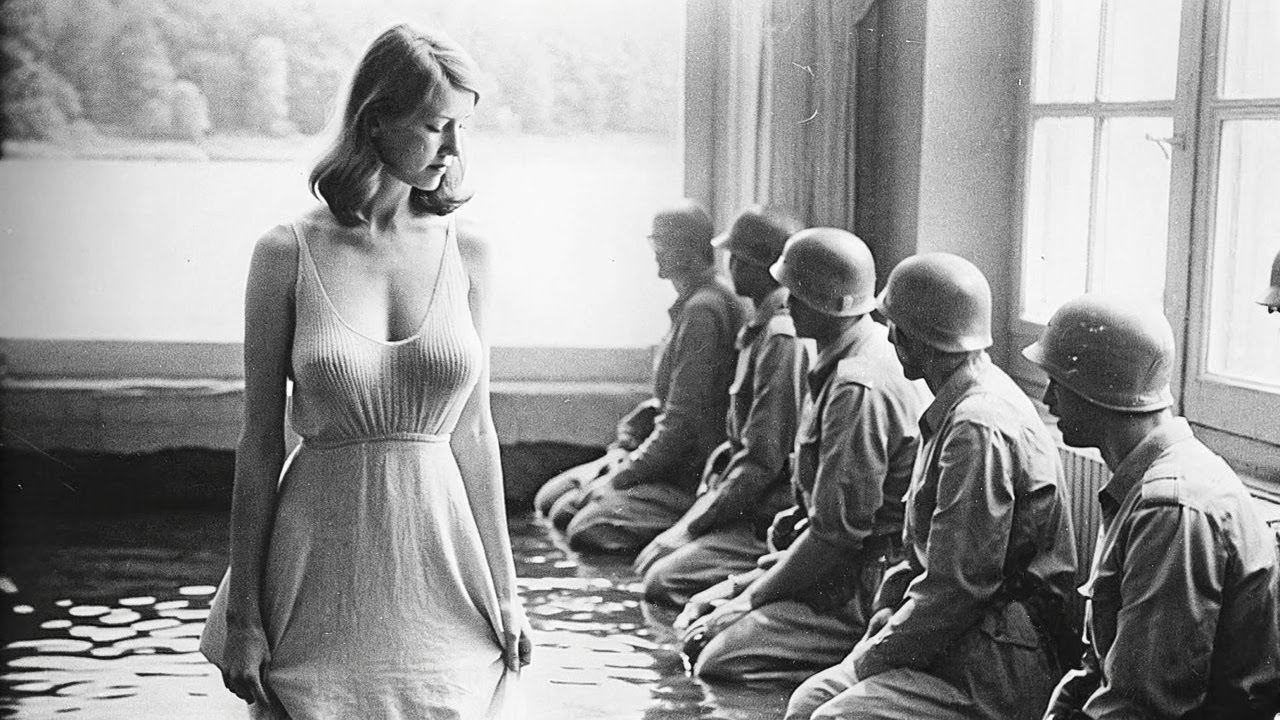
    But the phrase “returning home” carries a weight that photographs of wartime departure cannot.

    Leaving for war is an uncertain journey.

    Returning is different.

    The soldier comes back to a country that continued without him.

    Cities have changed.

    Families have changed.

    People have grown older.

    Children have become teenagers.

    Some houses no longer have the people who once lived in them.

    And some soldiers returned carrying memories that could not easily be explained to those who had remained behind.

    For some, the hardest part of the war was not surviving combat.

    Có thể là hình ảnh về trẻ em và văn bản

    It was learning how to live after combat.

    The collection also describes two enlisted men from the USS Liscome Bay being buried at sea after the carrier was torpedoed in the Pacific in 1943.

    The USS Liscome Bay was sunk during the Battle of Makin in the Gilbert Islands. More than 600 men were killed.

    A burial at sea is a ceremony shaped by necessity.

    There may be no cemetery nearby.

    No family present.

    No familiar ground.

    Only the ocean.

    For those who remained, the sea became the final resting place of people with whom they had shared cramped ships, long voyages, danger and uncertainty.

    That image represents another uncomfortable truth about the war.

    The battlefield did not always end when the fighting stopped.

    For those who lost friends, the absence continued.

    For families waiting at home, there could be no photograph that adequately explained what had happened.

    For nations, casualty lists became numbers.

    For individuals, they remained names.

    The distinction between the two is essential.

    A statistic can describe the scale of war.

    It cannot describe the space left at a dinner table.

    The war also transformed the landscape of Europe.

    One photograph in the collection describes the aftermath of Allied bombing and fighting in Berlin.

    Another shows crowds celebrating the end of the war in New York City on August 14, 1945.

    The contrast is extraordinary.

    In one place, buildings stood damaged.

    In another, people poured into the streets.

    Confetti covered the ground.

    Crowds gathered.

    The war in Europe had already ended months earlier, but the defeat of Japan brought another enormous wave of relief and celebration.

    For those celebrating, August 14 was a moment of release.

    For those who had lost relatives, it could be more complicated.

    Victory did not restore the dead.

    It did not erase memories.

    It did not rebuild every destroyed home.

    It simply meant the fighting was ending.

    That distinction is important.

    Victory and recovery are not the same thing.

    And perhaps the most unexpected photograph in the collection takes us away from battlefields entirely.

    In 1968, workers were reassembling the temples of Abu Simbel in Egypt.

    At first glance, this seems unrelated to the Second World War.

    It happened more than two decades after the conflict ended.

    But it belongs to the story of what the postwar world was trying to become.

    The Abu Simbel temples were threatened not by an army, but by the rising waters associated with the Aswan High Dam.

    UNESCO coordinated an international campaign to save monuments threatened by flooding. The temples were dismantled, moved and reconstructed at a higher location. The Abu Simbel temples were officially inaugurated at their new site on September 22, 1968.

    More than a thousand blocks were numbered and moved, with some individual blocks weighing around 30 tons. The temples were reconstructed about 64 meters above their original location and farther inland.

    This was not a wartime operation.

    But it offers a powerful epilogue to the photographs of war.

    During the Second World War, humanity had demonstrated its capacity to destroy cities and cultural treasures on an enormous scale.

    Afterward, international cooperation increasingly demonstrated another possibility: preserving what could be saved.

    The rescue of Abu Simbel was part of a much larger campaign that ultimately saved 22 monuments and architectural complexes in Nubia.

    That effort is significant because it shows history moving in another direction.

    From destruction toward preservation.

    From national conflict toward international cooperation.

    From the question of what could be conquered to the question of what could be protected.

    The connection between the war photographs and Abu Simbel is therefore not that the temple was part of World War II.

    It was not.

    The connection is chronological and human.

    The people who rebuilt Abu Simbel belonged to a generation that had seen what modern technology could do when placed in the service of destruction.

    They were now using extraordinary engineering to prevent the loss of something inherited from thousands of years earlier.

    That contrast is difficult to ignore.

    A civilization can use machines to destroy.

    It can also use machines to preserve.

    The choice matters.

    Look again at the photographs from the war years.

    The soldier carrying a wounded comrade.

    The child being evacuated.

    The worker in a factory.

    The African-American cadet preparing to fly.

    The sailor standing beside the ship.

    The soldier returning home.

    The men buried at sea.

    The ruined buildings.

    The celebrations.

    None of these photographs, by itself, explains the Second World War.

    Together, however, they reveal something that statistics cannot.

    The war was not one experience.

    It was millions of experiences happening simultaneously.

    For some people, it meant fear.

    For others, duty.

    For others, displacement.

    For others, loss.

    For some, an opportunity to prove that the prejudices of their own society were wrong.

    For others, years of waiting.

    And for millions of civilians, it meant discovering that the boundary between “home” and “the battlefield” could disappear almost overnight.

    This is why photographs remain so powerful.

    They freeze a fraction of a second.

    But history lives between those seconds.

    We see the soldier carrying another man.

    We do not see everything that happened before the photograph.

    We see the child waiting with luggage.

    We do not know everything that child remembered afterward.

    We see the ruined building.

    We cannot hear the sounds that once filled the street.

    We see the returning soldier.

    We cannot know every memory he carried home.

    The camera records an instant.

    History asks us to understand the years surrounding it.

    And there is another lesson hidden in these images.

    The people living through the Second World War did not know they were creating history.

    The factory worker did not know that decades later someone might study the photograph.

    The young cadet at Tuskegee could not know how significant the program would become.

    The civilian boarding an evacuation train could not know what historians would eventually say about the Blitz.

    The soldier walking home in 1945 could not know that his generation would later be described as one that had survived the most destructive conflict the world had yet experienced.

    They were simply living through their present.

    That is what makes old photographs so haunting.

    We know the ending.

    They did not.

    We know that the war would eventually end in 1945.

    They did not know which day would bring it.

    We know that Berlin would fall.

    They did not know when.

    We know that the surviving soldiers would eventually return.

    They did not know who would make it home.

    We know that generations later, monuments such as Abu Simbel would still stand.

    The people working to save them in the 1960s were still living with the consequences of a century defined by war, technological change and political upheaval.

    And perhaps that is why the quiet photographs deserve to stand beside the famous ones.

    The iconic images of World War II tell us where history turned.

    The ordinary images tell us what it felt like for people to live through that turning.

    There is no single photograph that can explain a war.

    But a collection of photographs can reveal its human scale.

    A child.

    A soldier.

    A worker.

    A prisoner.

    A pilot.

    A widow.

    A family.

    A city.

    A grave.

    A ruined building.

    And, eventually, a monument lifted from the path of destruction and rebuilt for another generation.

    The Second World War is often described through dates: 1939, 1941, 1944, 1945.

    But people did not live in dates.

    They lived in mornings and nights.

    They waited for trains.

    They wrote letters.

    They worked in factories.

    They carried wounded friends.

    They said goodbye.

    They listened for aircraft.

    They waited for news.

    They celebrated when the news finally came.

    And then they tried to build a life after the world they had known had changed.

    That may be the most important thing these photographs can still tell us.

    History is not only made by the famous.

    It is also made by ordinary people caught inside extraordinary events.

    And when we look at their photographs today, we are not simply looking backward.

    We are being reminded of how fragile ordinary life can be—and how much courage can exist inside seemingly ordinary acts of human care.

    The photographs cannot bring the dead back.

    They cannot rebuild every destroyed city.

    They cannot erase the suffering of prisoners or civilians.

    But they can preserve something else.

    Memory.

    And memory is one of the few things war cannot completely destroy.

    Perhaps that is why an old photograph can still stop us decades later.

    It asks no grand question.

    It simply shows us a human being who once stood exactly where we are standing now in time.

    And leaves us to wonder what we would have done if history had placed us there.

    If these photographs could preserve only one lesson from the generation that lived through World War II, perhaps it would be this:

    When history becomes enormous, never forget the individual people standing inside it.

    What do you think these photographs reveal about the human side of the Second World War that statistics and battlefield maps can never fully capture?

    Some content was generated using AI tools (including ChatGPT) and edited by the author for creativity, storytelling, and historical illustration purposes. Historical facts and key details should be verified against reliable historical sources. Any AI-generated or reconstructed visuals are intended for illustrative purposes and should not be interpreted as original historical photographs or archival evidence.