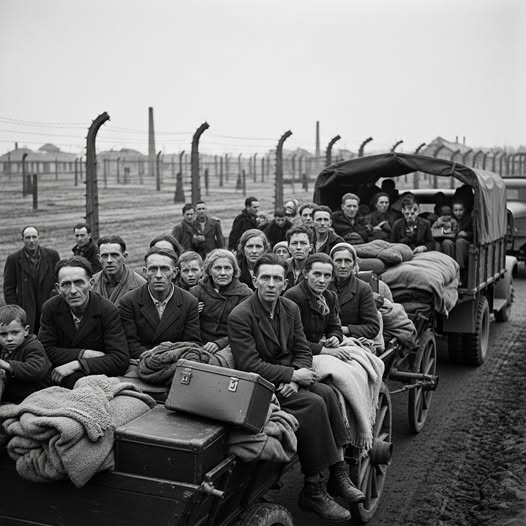
In May 1945: leaving the barbed wire, facing the unimaginable
In May 1945, Europe held its breath. The guns fell silent, armies advanced, and the camps finally opened. But the moment survivors were offered physical freedom, another struggle began: the struggle for memory, pain, and inner reconstruction. Behind the rusty barbed wire and silent watchtowers lies a reality the world is still struggling to grasp: millions of people vanished in the shadow of the Holocaust, leaving behind survivors, alive and haunted by their absence. It is this tension, between the fragile joy of liberation and the yawning chasm of trauma, that shapes the narrative of May 1945.
The contrast is striking. Those who enter the camp gates breathe fresh air for the first time in years, but their lungs still carry the dust of death. The liberators, often young soldiers, are greeted by dull gazes and broken bodies. They offer bread, milk, and medicine, sometimes clumsily, not always understanding that feeding and caring for someone are not enough to mend a soul that has experienced horror on an unimaginable scale. Yet this gesture, however simple, opens a breach in the night.
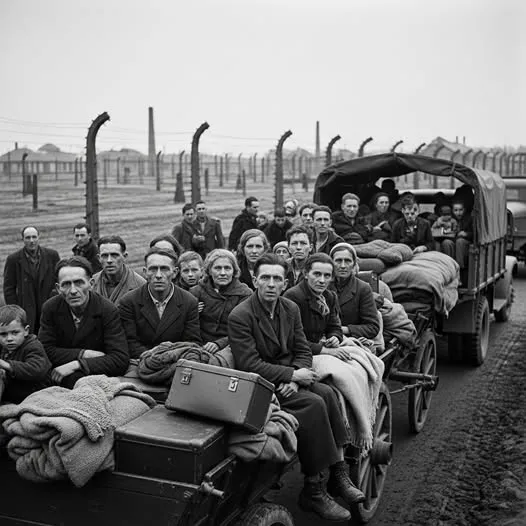
Silence, broken by sobs, reigns in the camps. Survivors slowly approach the lined wagons and trucks. They carry almost nothing, sometimes a rough blanket, a bundle of worn-out clothes, or a few items distributed by Allied relief efforts. Some clutch a small suitcase, a paltry treasure compared to the infinite losses: the extermination of families, the confiscation of homes, the erasure of communities from maps and memories. Every step outside the camp is a step into the unknown, into an uncertain future that terrifies as much as it allures.
The convoys set off. Faces remain serious, almost impassive, in the dust. Bodies, still weakened, sway to the rhythm of the wheels, but minds wander elsewhere. Some mutter names as if to stave off oblivion. Others, younger, barely dare raise their eyes to the horizon. Is it worth hoping for a return home? But what is “home” when the house has burned down, when neighbors have vanished, when the city itself seems alien? Survivors know that return isn’t always possible. For many, home, family, or roots are gone.
Yet, amidst this silent procession, a fragile ray of light emerges. Liberation, though incomplete, breathes new energy. It’s a faint breath, barely perceptible, but it exists. The survivors, amidst exhaustion, carry within themselves an invisible seed: the will to continue, to imagine a future, however uncertain. In their weary eyes, one senses a silent promise: not to allow barbarism to completely erase life.
In May 1945, Europe was a vast field of ruins. Bombed cities were slowly being reborn, nations were being reborn, and in this chaos, Holocaust survivors were searching for their place. Some dreamed of returning to their homeland, of rediscovering the streets of their childhood, even if they were now only memories. Others understood that all was lost and chose exile, often to Sweden, Switzerland, Palestine, or even America. Every path was marked by the agonizing question: how to rebuild after the Holocaust?
This story highlights a cruel contrast: though the barbed wire has fallen, the trauma remains intact. Freedom doesn’t erase the visions of gas chambers, locked wagons, or lost friends. It merely offers a space where pain can coexist with hope. This is the ambiguity of this period: the joy of life mingles with the guilt of survival. Why me and not them? This question torments the hearts, etched in every glance, in every silence. It will accompany these women and men for the rest of their lives.
Despite the weight of grief, a subtle transformation is taking place. In the liberated camps, some children begin to play clumsily again with pebbles or pieces of wood. Adults swap stories, share memories from before the war, as if to revive a drowned world. And in this sharing, resilience is confirmed. Humanity, so brutally denied, is reborn through simple gestures: a shy smile, a whispered song, a shared piece of bread. This is the beginning of a journey deeper than liberation: a journey that leads to the will to live.
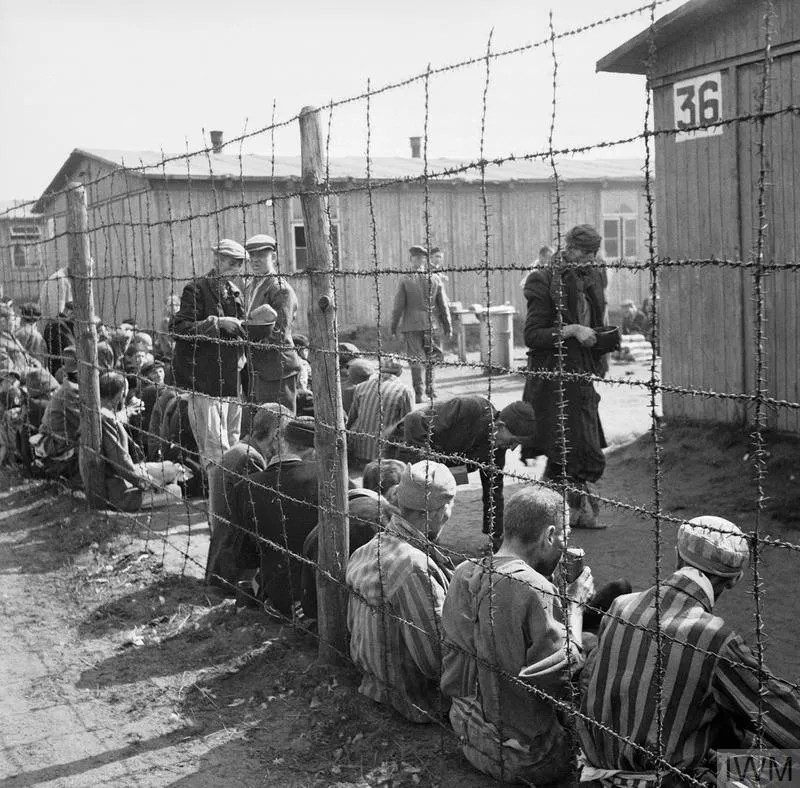
Photographs from the period bear witness to this: wagons loaded with survivors emerging from the barbed wire, their faces frozen between shock and anticipation. They convey both the pain of a past too heavy and the fragility of a future yet to be invented. These photographs have become icons of memory, reminding us that liberation was only the first step. History does not end at the camp gates: it continues in every village rebuilt, in every school reopened, in every family rising from the ashes.
Decades later, testimonies confirm this dual truth: the joy of survival doesn’t erase the shadow of regret. One woman describes hugging a blanket given to her by the Red Cross, as if this simple fabric symbolized the beginning of a new life. Another recalls the first apple given to her by an American soldier, a taste he hadn’t experienced in years, yet admits that each bite was accompanied by memories of comrades no longer with him. These stories, told with emotion, carry a universal lesson: freedom is precious, but it only makes sense when we find the strength to fill it with life.
Even today, as we remember May 1945, we understand that the liberation of the camps was not an end, but a beginning. It marked the entry into a new era, one in which the entire world had to grapple with the enormity of the Holocaust and ask itself how to continue living after the unimaginable. The Nuremberg trials, commemorative ceremonies, museums, and memorials were born from this vital need not to forget. But behind these grand historical gestures lie, above all, individual stories, fragile voices that brought hope in silence.
In May 1945, newfound freedom brought with it a heavy burden: the rebuilding not only of cities and nations but also of shattered inner lives. The road was long and fraught with obstacles, but it bore witness to a devastating truth: even in the face of absolute horror, a person can choose life. This resilience, this almost inhuman courage, remains a lesson for us all. It reminds us that every freedom won must be cherished, every memory passed on, and that the future, however uncertain, is worth dreaming about.
Thus, the image of the wagons leaving the barbed wire in May 1945 is not just a frozen snapshot of the past. It is an invitation to reflect, to feel the weight of history, and to pay tribute to those who had the strength to move on. For behind the fences, behind the losses, a spark remained: a fragile yet vital faith in life. And it is this spark that continues to ignite our collective memory, encouraging us never to forget and to defend human dignity every day.
Note: Some content was generated using AI tools (ChatGPT) and edited by the author for creativity and suitability for historical illustration purposes.
Leave a Reply