Author: adminus1

  • The Liberation of Bergen-Belsen: Hell on Earth Revealed to the World .US

    The Liberation of Bergen-Belsen: Hell on Earth Revealed to the World .US

    The Liberation of Bergen-Belsen: Hell on Earth Revealed to the World

    On April 15, 1945, in the final days of World War II, a detachment of British soldiers entered the Bergen-Belsen concentration camp in Lower Saxony, northern Germany. What they discovered that day remains one of the most horrific visions of the Holocaust and, for many of these young men, the most horrific memory of their lives. Unlike Auschwitz-Birkenau or Majdanek, there were no gas chambers or industrial killing plants. Yet the result was equally horrific: death from hunger, disease, thirst, and abandonment. Bergen-Belsen became an open-air morgue. More than 10,000 corpses littered the ground, piled high among the survivors too weak to stand. The smell of decay hung heavy in the air, and the silence was not one of peace but of collective agony.

    The British soldiers, hardened by months of fighting across Europe, thought they were ready for the horror. But nothing could shield them from what they saw. One of them later wrote that the camp “smelled of death for miles, a smell that seeped into the skin and never left.” As they entered the gates, some soldiers immediately vomited. Others froze, unable to comprehend what awaited them. Before them, barely human figures stretched trembling arms, seeking help. A young woman, emaciated, her eyes burning with despair, grabbed a British soldier’s sleeve and whispered, “Don’t leave us…” This simple plea resonated with all of humanity, refusing to be abandoned to oblivion.

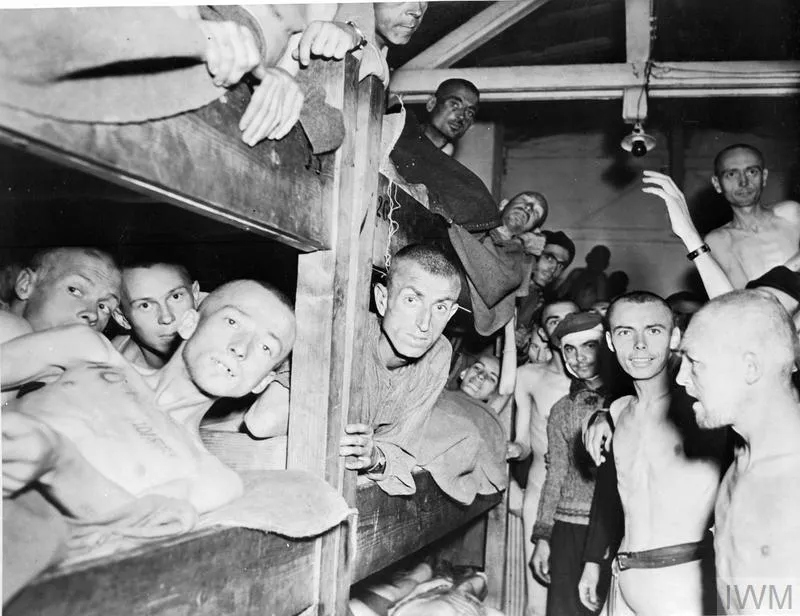
    Bergen-Belsen was founded in 1940 as a prisoner-of-war camp. In 1943, it became a concentration camp run by the SS. Tens of thousands of Jews were imprisoned there, including prisoners transferred from other camps as the Soviet army advanced through Eastern Europe. In March and April 1945, “death marches” brought columns of exhausted prisoners to Bergen-Belsen. The camp, originally designed for a few thousand people, now housed over 60,000 people crammed into unsanitary barracks.

    Hunger, epidemics of typhus, tuberculosis, and dysentery decimated the population. Every day, hundreds of bodies piled up unburied. The SS guards, themselves overwhelmed by the collapse of the Reich, allowed the situation to deteriorate to the point that Bergen-Belsen became a living cemetery. The Holocaust, in all its horror, was revealed not only through industrial planning of death but also through icy indifference, a conscious choice to let thousands perish slowly.

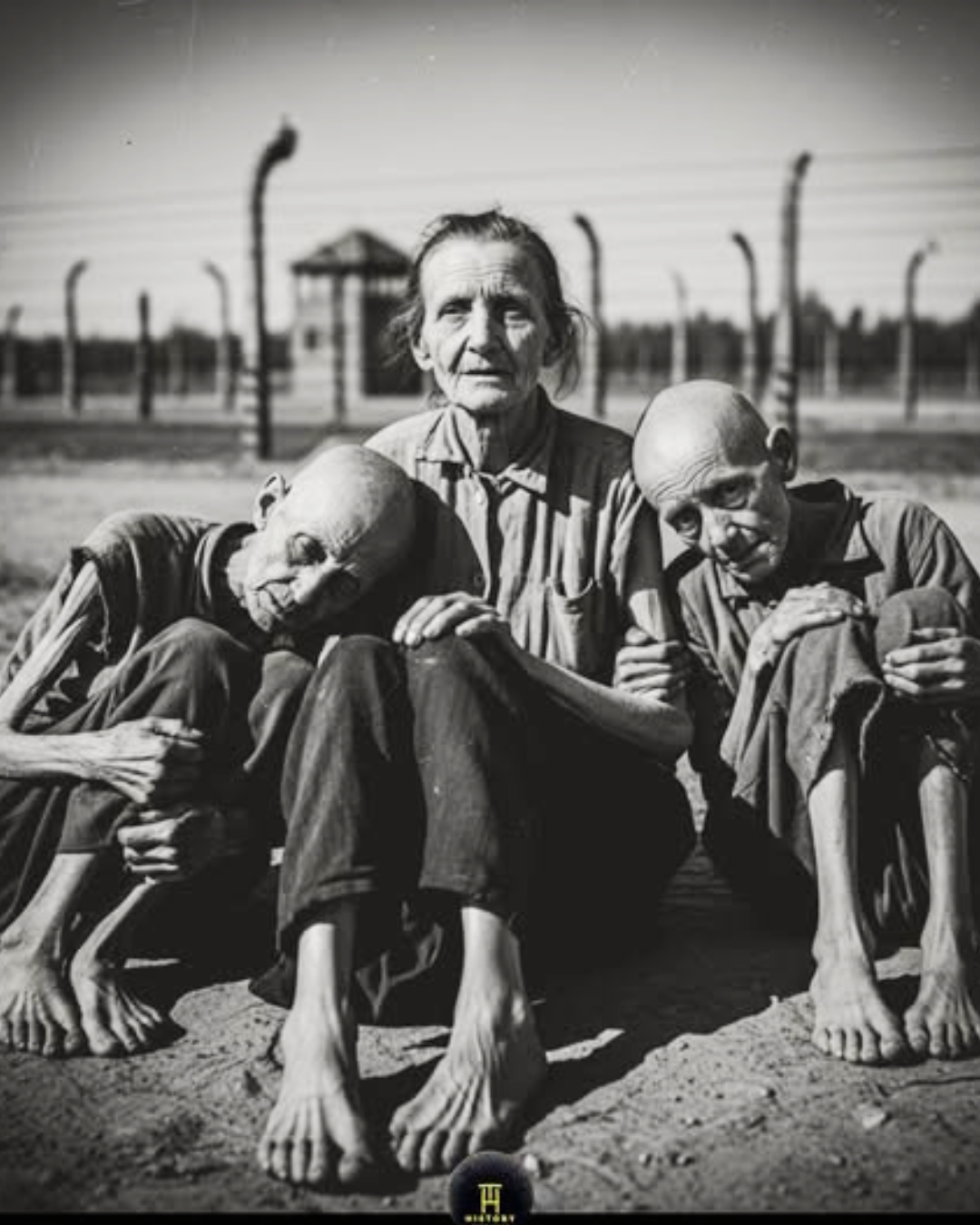
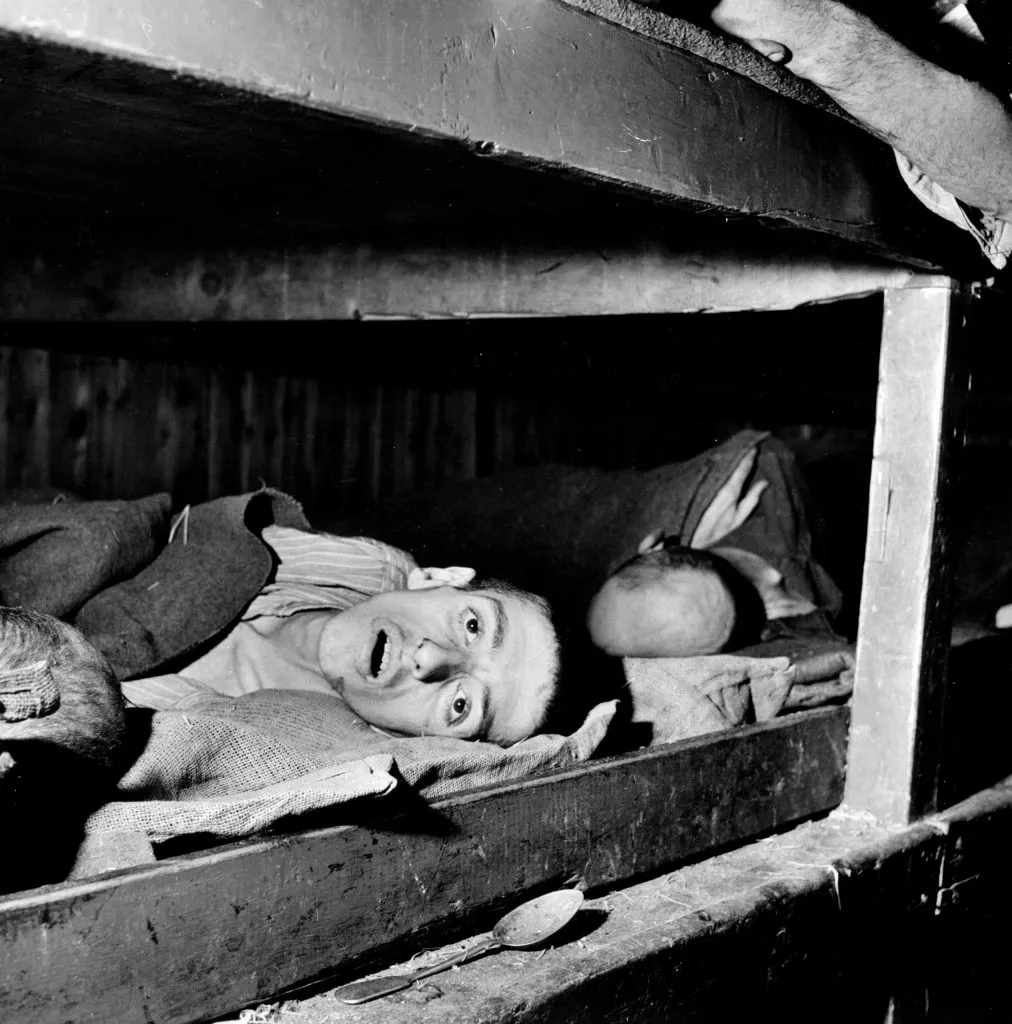
    When British soldiers crossed the barbed wire, they discovered “a vision of hell on earth.” The ground was strewn with corpses in every position: some curled up, others frozen with open eyes, many reduced to translucent skin stretched over bone. In the center of this mass grave, survivors, too weak to stand, crawled among the dead, searching for something to eat: a crust of bread, a drop of water, or even an abandoned shoe that could serve as a pillow.

    A British officer later reported: “It was not a normal silence, but a silence of exhaustion. Even the birds seemed to have fallen silent. Only the sound of the bulldozers and their groans could be heard.”

    Bulldozers were indeed immediately requisitioned. Not for military purposes, but to accomplish the unthinkable: pushing thousands of corpses into mass graves. A typhus epidemic threatened to spread far beyond the camp, risking reaching the soldiers themselves and the surrounding civilian population. Every cleanup operation was a nightmare. The bulldozer drivers, some barely twenty years old, will never forget the sensation of bodies colliding, the dull thud of humanity reduced to nameless masses. A few burst into tears behind the wheel, but the work had to continue, as the health threat took precedence.

    Of the 60,000 prisoners still in the camp, many were too weak to move. Some died within hours of liberation, unable to tolerate even a small amount of food or water. British doctors set up makeshift hospitals, providing milk, broth, and basic medical care. However, the health catastrophe surpassed all expectations. It is estimated that nearly 14,000 more survivors died in the following weeks, stricken by disease and malnutrition.

    Yet amidst this despair, there were also moments of light. British soldiers recounted how some survivors, despite their weakness, managed to smile as their liberators approached. This smile, fragile yet radiant, was a victory over barbarity. It was proof that even after being stripped of everything, including their strength, these men retained a glimmer of dignity.

    The liberation of Bergen-Belsen had a profound impact on British soldiers. Many never managed to shake the images etched in their minds. Some suffered nightmares for the rest of their lives, haunted by the faces of the dying. Military archives are filled with letters sent to families, describing the horror in halting words. “Mother,” wrote one soldier, “I have seen things I will never be able to tell. If there is a hell, it is here.”

    For war correspondents present, such as the BBC’s Richard Dimbleby, the difficulty lay in finding the words. In his radio report, he described “corpses piled like logs,” a sight so unbearable that the BBC initially hesitated to broadcast the account, considering it too incredible to be true. Yet it was one of the first reports to open the world’s eyes to the reality of the Nazi camps.

    Today, Bergen-Belsen is a place of remembrance. Mass graves, marked by simple headstones, commemorate the deaths of tens of thousands. Visitors walk in silence over a land that still holds so much suffering. This silence is not one of fear, but of contemplation—the same silence felt by survivors during their first free meal after liberation.

    The history of Bergen-Belsen teaches us that the Holocaust was not only a planned process of death but also a series of abandonment, deliberate neglect, and prolonged suffering. Survivors testified that for them, liberation was a thin line between life and death. For the liberators, it was a brutal collision with the abyss of human suffering.

    Over the decades, the story of Bergen-Belsen retains its undiminished power. It reminds us that barbarity can arise when humanity turns its back, when indifference prevails over compassion. Each anonymous body buried in these mass graves is a voice calling out to us: “Do not forget.”

    Even today, amid the resurgence of anti-Semitism, Holocaust denial, and hate speech, the memory of Bergen-Belsen must be defended. The words “never again” are not a formula, but a duty.

    The liberation of Bergen-Belsen on April 15, 1945, was not merely a military act; it was an encounter with the unspeakable, an unveiling of the Holocaust in all its horror. Survivors, brought to the brink of existence, found fragile dignity in the eyes of those who came to save them. The British soldiers, for their part, bore the mark of what they had seen forever, unwitting witnesses to an earthly hell.

    Bergen-Belsen remains a symbol not only of human suffering, but also of resilience and remembrance. Every story, every image, every testimony helps prevent the disappearance of this past. Because remembering Bergen-Belsen is an affirmation of our shared responsibility to protect humanity from the darkness that always threatens to return.
  • A Cart of Empty Bottles: The Story of a Hungarian Worker Who Rescued Jewish Children in 1944 .US

    A Cart of Empty Bottles: The Story of a Hungarian Worker Who Rescued Jewish Children in 1944 .US

    A Cart of Empty Bottles: The Story of a Hungarian Worker Who Rescued Jewish Children in 1944

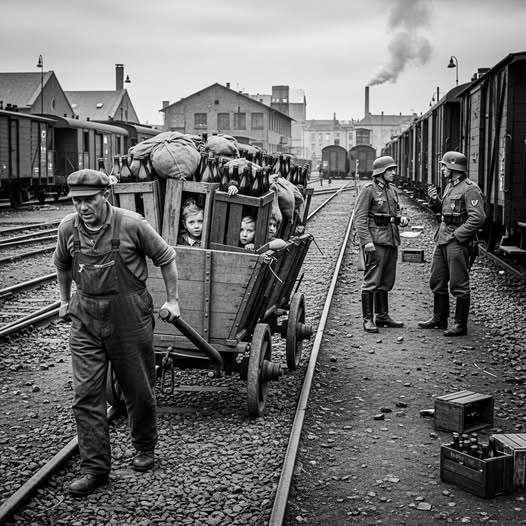
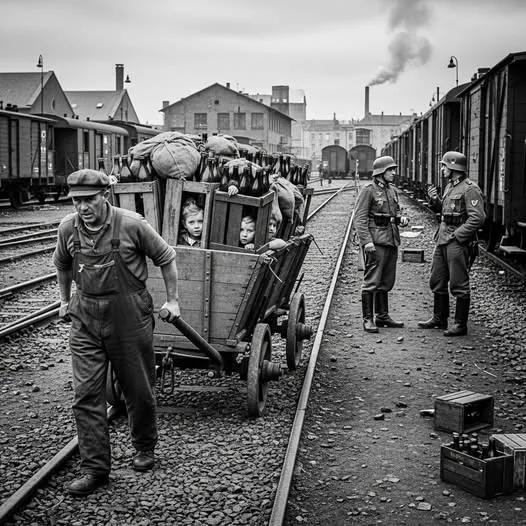
    In 1944, Budapest hovered between fear and resignation. The German occupation transformed the Hungarian capital into a theater of tragedy, where every street could become a death corridor. From March of that year, the forces of the Reich took complete control of the country, shattering the last illusions of sovereignty and imposing their inexorable plan: the extermination of Hungary’s Jews. In this climate of oppression, where the Holocaust accelerated and convoys to Auschwitz multiplied, a simple worker found the courage to defy fate. His weapon was neither a rifle nor a bomb, but a wooden cart filled with empty bottles. His goal was to save children sentenced to deportation.

    To understand the scale of this story, we must return to the context of Budapest in 1944. Hungary, an ally of the Reich since 1940, had long steered between forced loyalty and the desire to maintain relative autonomy. However, in March 1944, Hitler decided to militarily occupy the country, fearing a possible shift toward the Allies. Operation Margarita transformed Budapest into the center of German operations. With it came Adolf Eichmann, the architect of the deportations, tasked with implementing the “Final Solution” in Hungary.

    In just a few weeks, the unthinkable occurred: Hungary’s Jewish community, one of the largest in Central Europe, was systematically hunted down, herded into ghettos, and then deported by train to Auschwitz-Birkenau. Between May and July 1944, nearly 440,000 Hungarian Jews were sent to extermination camps. Every train station became a nightmare, every cattle car a promise of extinction.

    It was here that a Hungarian worker, whose name has not always been remembered by history, decided to take any risk. His act was part of a silent, almost invisible, yet oh-so-decisive struggle: the struggle of ordinary people who, in the face of terror, refuse to look away.

    Little is known about this man, except that he worked in a factory near the Budapest railway tracks. His daily duties consisted of pushing loads, transporting materials, and moving crates of bottles and glass. Nothing predestined him to make history. Yet, it was precisely his ordinary circumstances that allowed him to act.

    Knowing the transport routes, the rhythm of inspections, and the habits of the German guards, he devised a daring plan. In a wagon designed for transporting empty bottles and wooden crates, he hid several Jewish children destined for deportation. The tiny bodies were squeezed between the crates, their faces covered with rough fabric, and their presence masked only by a pile of industrial waste.

    To the casual observer, the wagon was just another ordinary convoy, an insignificant burden in the constant logistics of war. But to the worker, it was a fragile ark, a slim chance of survival.

    Every detail of the operation carried mortal danger. The clinking of bottles could betray the stowaways. Terrified children were forced to hold their breath and suppress coughs. The clinking of glassware sounded like a constant alarm, and any jerk threatened to expose them.

    Still, the worker moved forward with calculated confidence. His gestures, feigning routine, concealed an inner turmoil. His hands gripped the cart’s handles as if to anchor all his strength. At each checkpoint, his heart pounded, but his face remained impassive. The German soldiers, accustomed to the sight of such loads, paid no attention. Some chuckled at the sound of clinking glass, convinced it was nothing more than useless waste.

    This contempt became the perfect cover. The guards’ arrogance was the worker’s unwitting ally. Where greater vigilance would have led to death, their inattention opened the door to life.

    The children hidden in the stroller experienced a moment of suspense, torn between terror and hope. Their eyes, wide in the darkness of the crates, tried to understand. They didn’t always know what awaited them, but they saw danger in the tension of every second. Some clutched a rag doll, others held hands in the shadows.

    Silence was imposed upon them, but it also became a weapon. Not a cry escaped them, not a moan. Their survival depended on this almost inhuman silence. With a discreet gesture, the worker signaled them to be patient and resist for a few more minutes. But those minutes dragged on like hours. Every pause, every soldier’s voice echoed like the threat of imminent danger.

    The most critical moment came when the guard, intrigued by the sound of the bottles, approached the cart. He tapped the crate with his toe, causing the glass to clink. Then, satisfied with what he considered trash, he sneered and walked away. The worker, his nerves taut as a string, held his breath. The children also froze, their fear transforming into a kind of silent prayer.

    This was the moment when everything could have changed. But chance, or perhaps Providence, chose life. The wagon moved on, crossing barrier after barrier, until it finally moved away from the field of observation. As the soldiers’ silhouettes disappeared behind them, the living cargo froze in a deep breath, as if held for hours. They had succeeded.

    That day, a simple worker in Budapest succeeded where so many others had failed: he saved children from the clutches of deportation. He had no weapons, no army, no elaborate plan. Only his wits, courage, and a deep conviction that every life is worth saving.

    His act reminds us of an essential truth: the story of the Holocaust is not limited to the barbarity of the executioners, but also to the quiet heroism of the rescuers. Where most chose indifference, some, risking their lives, chose humanity.

    The cart of empty bottles became a universal symbol. It illustrated how ordinary objects—glass, wood, a cart—could be transformed into instruments of salvation. The banality of factory work held the seeds of resistance.

    Historically, these isolated acts were unable to halt the vast machinery of death set in motion by the Nazi regime. But they saved lives, and every life saved creates a world saved. As the Talmudic maxim, often quoted after the Holocaust, reminds us: “Whoever saves one life saves an entire universe.” This man, through his courage, saved many universes.

    Today, the testimonies of survivors remind us of the importance of these gestures. The children hidden in that wagon grew up, started families, and passed on their stories. Thanks to them, the memory of this event has not faded.

    Thanks to Holocaust museums, World War II documentaries, and survivors’ stories, this history continues to resonate. It teaches us that resistance can take a thousand forms, sometimes invisible but always decisive. It also reminds us that the Holocaust was not only an act of death but also a constant confrontation between inhumanity and human courage.

    In 1944, in a dark Hungary, an anonymous man risked his life to save the lives of others. His cart of empty bottles became a vehicle of hope, a fragile ark carrying innocence across the lines of death.

    This story, beyond its historical significance, still resonates with us. It encourages us to reflect on our choices and the responsibility each of us bears in the face of injustice. It proves that even in the darkest hours, there is always a chance for light.

    The memory of this courageous worker now belongs to all of humanity. And as long as his story is told, as long as we remember that children were saved by a simple tram, the Holocaust will be not only a story of extermination, but also a story of survival, courage, and restored dignity.

  • First free meal in Bergen-Belsen .US

    First free meal in Bergen-Belsen .US

    First free meal in Bergen-Belsen

    In April 1945, at Bergen-Belsen, the world rediscovered the importance of survival. The liberation of the camp by British troops revealed an apocalyptic scene: thousands of people, reduced to shadows, wandering among corpses, still breathing amidst death. It was a sight impossible to forget, a scar etched in European memory. But at the heart of this tragedy, one moment, both simple and solemn, was etched in history: the survivors’ first meal.

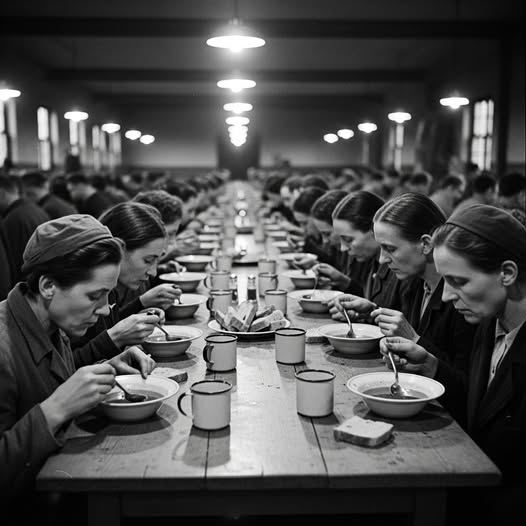
    Photographs from the period show us these long wooden tables, lined up as if for a silent ceremony. Women and men, sometimes still dressed in striped rags, bowed their heads over a steaming bowl, next to which sat a slice of thick bread. The soup was merely a clear liquid, sometimes garnished with a few grains of oat, but it symbolized much more: promise. Those who for years had known only hunger, humiliating rationing, and the fear of another choice sat down to this meal as if for communion.

    The silence filling the hall was no longer one of terror, but a silence of choice. Each spoon, each piece of bread, was eaten slowly, almost with reverence. The clink of spoons against bowls created a delicate music, a kind of improvised liturgy. No one spoke, for words failed to express the pain of the missing, nor the immense gratitude of those who still had the strength to raise their hands. This meal, though so humble, became an act of redemption: to eat freely, without the cruel gaze of the guards, meant rebirth.

    Some witnesses later recounted that this was the most important moment of their liberation, far more important than the initial medical care or the clothing they received. Food wasn’t just a matter of physical survival: it was the very symbol of restored dignity. In Bergen-Belsen, where hunger was a weapon, where any piece of bread could spark a desperate struggle, this silent sharing was tantamount to victory.

    This meal was also a lesson in humanity. In the harsh light of the hanging lamps, emaciated faces were visible, illuminated by a new spark. These men and women had been reduced to a number, to suffering bodies. Yet, sitting together around this clear soup, they learned anew to be a community, human beings capable of sharing something other than suffering. The wooden table became an altar, and each bite an act of resistance against oblivion.

    It’s important to remember that Bergen-Belsen was not only a concentration camp but also a place of remembrance, where the limits of cruelty and the inexhaustible strength of the human spirit were measured. The image of survivors eating in silence is now part of the iconography of World War II, as are images of liberation and testimonies from the trials. It reminds us that reconstruction sometimes begins with a humble gesture: eating together, sharing a meal, rediscovering the rhythm of ordinary life after the abyss.

    In this context, this simple bowl of soup became a universal symbol. It represented the thin line between death and life, between dehumanization and restored dignity. It demonstrated that survival was not just a matter of body but also of soul. These survivors, raising a spoon to their lips, affirmed that humanity can endure, that even after the most unspeakable darkness, there is room for contemplation, gratitude, and hope.

    Even today, historians and survivors who witnessed the events at Bergen-Belsen recall this meal with unwavering emotion. It holds the key to understanding the depth of the tragedy, but also the power of human resilience. This moment reminds us that the memory of the Holocaust must be not only the memory of the dead, but also the memory of the survivors, who found in a simple meal the strength to persevere and pay tribute to those who have passed away.

    So in April 1945, not only bodies were nourished. It was wounded souls who regained their dignity. In the silence of the large tables at Bergen-Belsen, in the discreet clatter of spoons, in the fragile warmth of clear soup, a drama at once intimate and universal unfolded. A drama in which humanity, fragile yet resilient, demanded its right to continue living.

  • Brothers on Omaha Beach – Normandy, 1944 .US

    Brothers on Omaha Beach – Normandy, 1944 .US

    Brothers on Omaha Beach – Normandy, 1944

    Omaha Beach, June 6, 1944. The sea was kicking up foaming waves, and the air was filled with the sound of gunfire, screams, and bullets whistling overhead. For many young American soldiers, it was their first step onto German-occupied European soil, and also the last day of their lives. Among those who landed on the bloody sands of Normandy were two brothers. They arrived together, in a landing craft, clutching their weapons, trying to quell the fear that grew with each passing second.

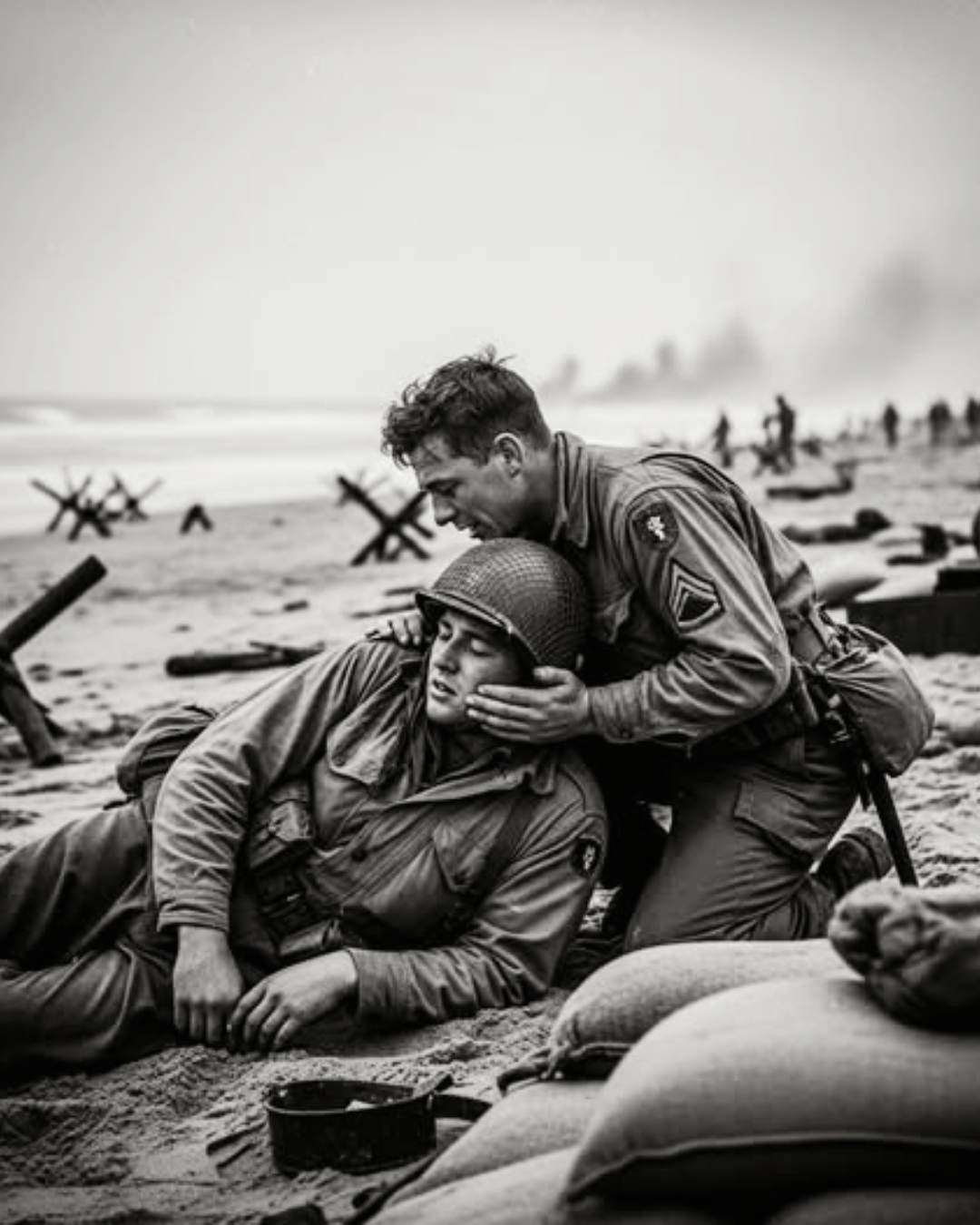
    Waves crashed against the metal barriers known as “Czech Hedgehogs,” and the sand mingled with blood and smoke. As the barge’s ramp lowered, the soldiers ran straight into the fire of MG 42 machine guns, which cut through the ranks from the German bunkers like a scythe through grass. The brothers clung close together, as if their bond could protect them from bullets. But the chaos of war knows no mercy. At one point, one of the bursts pierced the younger of the two. He collapsed onto the sand, his body twisting in pain as blood instantly soaked his uniform.

    The older brother froze for a second, then, ignoring the enemy fire, rushed toward him. He crawled across the wet sand, hiding among the bodies of the fallen and the shell holes. When he reached it, he placed a hand on the wounded man’s helmet and leaned forward, allowing his words to carry above the din of battle. “I’ll carry you home,” he whispered, his voice trembling, though he knew no amount of strength would allow him to lift his brother and survive the rain of bullets.

    He held him, trying to stop the bleeding, praying the paramedics would arrive in time. But seconds turned to minutes, and the life in the wounded man’s eyes slowly faded, like a candle burning out in the wind. His brother wouldn’t let go of him for a moment. He felt that if he removed his hands even for a moment, if he looked away even for a moment, his brother would pass away sooner. In this hell of war, amidst the explosions and groans, two young men found a moment of silence—a moment where one heart beat for the other.

    His older brother survived. He was pushed away from the body by the paramedics who carried his brother from Omaha Beach, but he knew even then that this would not be the way “home.” The coffin, wrapped in a flag, would never replace the warmth of his voice, fading in his arms. He himself returned to America, but never truly returned.

    Every year on Remembrance Day, he stood at the military cemetery. He folded two flags: one for his country, the other for his brother, who had never left the Normandy beaches. Looking at the rows of white crosses in Colleville-sur-Mer, he saw not only thousands of fallen soldiers, but above all, one face—the face of his brother, who remained forever young, forever on the sands of Omaha.

    The story of the brothers from Omaha Beach is not only a family drama but also a fragment of the larger narrative of D-Day, the largest amphibious operation in history – Operation Overlord. On June 6, 1944, the Allies opened the way to the liberation of Europe from German occupation. The cost was terrible: thousands of dead and wounded who gave their lives for freedom. Among them were soldiers of the 1st and 29th Infantry Divisions, who faced German bunkers, artillery fire, and the rigors of the landing itself.

    Omaha Beach has gone down in history as a symbol of courage, sacrifice, and suffering. But for those who lost loved ones there, it was above all a place of personal tragedy. The older brother who survived carried the burden of guilt throughout his life—the question of why he had survived and not his brother. No decoration, no medal could ease this pain. Every waft of the American flag reminded him that somewhere in Normandy, beneath a white cross, rested the one he loved most.

    Today, when tourists visit Omaha Beach, they see a calm sea and quiet sand where children play. It’s hard to believe that in this place, the earth was soaked with the blood of thousands of young men. But that’s precisely why such stories must be told. Because history lives not in textbooks, but in the emotions we pass on—about brothers, about promises whispered in the heat of battle, about flags laid annually at a grave.

    It is personal memories that give meaning to great historical events. D-Day is not just a date. It is a collection of individual stories – of fear, brotherly love, pain, and hope. “Brothers on Omaha Beach” is one of them. A story that shows that war, though it takes lives, cannot rob a person of their capacity for love and faithfulness to the end.

  • The Woman Who Shared Her Shadow – Poland, 1944 .US

    The Woman Who Shared Her Shadow – Poland, 1944 .US

    The Woman Who Shared Her Shadow – Poland, 1944


    On the frozen plains of Poland in the winter of 1944, the nights seemed endless. The wind whipped through the barbed wire, as if to remind the prisoners that no breath of freedom could cross the walls of this camp. Auschwitz was no longer just a name, but an abyss where lives, identities, and dreams dissolved. It was a place of forced silence, muffled screams, human dust mingled with ash. Yet even in this abyss, one woman found the strength to share her shadow.

    Her name was Zofia. No one knew her exact age. Short hair, sunken cheeks, and eyes sparkling with suppressed fever gave her a timeless appearance. She might have been thirty or fifty. In this camp, where each day took a fraction of existence, the centuries blurred together and faces faded prematurely. But there was something about her that refused to fade: a stubborn glow, like an ember that refused to fade in the darkness.

    Zofia was arrested in Krakow for helping Jewish children escape the ghetto. She never considered herself a hero. “It wasn’t courage, it was humanity,” she sometimes whispered when asked why she risked her life. But here, in Auschwitz, that word—humanity—seemed erased from the dictionary. Everything was order: the beatings, the hunger, the cold, the terror.

    And yet, in this hell, Zofia shared what she called her shadow .

    Her shadow was a part of herself that she offered to others: a fleeting smile, a hidden morsel of bread, a word of comfort. She believed that as long as a person had a shadow, they continued to exist. And that sharing that shadow prolonged life for those who were wavering.

    One January evening, as prisoners were returning from a grueling snowy day, a young girl collapsed in the icy mud. The kapos walked past her without a glance. Everyone knew that stopping to help her meant receiving a clubbing blow, perhaps worse. But Zofia knelt down, picked the girl up, and whispered in her ear:

    —Wait , look, even your shadow is still walking beside you.

    The girl followed her as if hypnotized. That night, Zofia didn’t sleep. She stayed awake to sing her old Polish lullabies, very softly, as if trying to deceive the darkness. The other women, huddled in the icy hut, listened in silence. This song didn’t promise victory, didn’t speak of a happy tomorrow, but it reminded them that they were still alive.

    Gradually, Zofia became a near-legendary figure in the camp. She owned nothing, yet she gave everything. She shared her soup ration, whispered prayers to those who had lost faith, and placed her hand on the shoulders of those who wept silently. It was said of her: “Where Zofia passes, the shadows gain color.”

    One day, in the endless roll call, an SS man noticed her. Perhaps he saw that invisible thread connecting her to the others, that life force he couldn’t break. He stared at her for a long time, but said nothing. She continued to ignore death in her silence.

    Months passed, and with them rumours of Allied advances circulated. The camp trembled with uncertainty. The Germans destroyed evidence of their crimes, and death marches began to form. Amidst this chaos, Zofia continued her invisible work: sharing her shadow.

    One evening, she made a strange decision. She cut a piece of cloth from her striped jacket and gave it to her dying companion. “Please keep it. As long as you hold it, it will be as if a part of me remains with you,” she said. Too weak to react, the woman pressed the piece of cloth to her heart.

    Zofia knew she likely wouldn’t survive. But that wasn’t the point. She understood that in a place built to annihilate humanity, the greatest act of resistance wasn’t survival, but remaining human until the end.

    When the Red Army liberated Auschwitz on January 27, 1945, survivors found this small, bloody scrap of cloth. The woman Zofia gave it to did not survive. But the item circulated like a relic. And in the icy breath of newfound freedom, some whispered:

    — It was Zofia’s shadow that guided us.


    Today, when we think of Auschwitz, we think of numbers, millions of victims, archives, ruins. But Zofia’s story reminds us of another truth: even in the darkest abyss, the shadow of one woman can become light.

    She had no weapons, no power, no hope of victory. She had only her shadow, fragile and unyielding. And by sharing it, she saved what no executioner could destroy: human dignity.

    Because the memory of the Holocaust isn’t just made up of names carved on stones or numbers in textbooks. It’s made up of those fragments of humanity passed down orally, from survivor to survivor. Small gestures that, in the abyss, take on a dimension of eternity.

    Zofia has no grave. Her name does not appear in any official register. But her story lives on in the accounts of women who knew her, in oral archives of memory, and in Holocaust museums that collect these fragments of truth.

    And as long as we tell her story, she will continue to walk by our side. Like a shadow that refuses to fade.

  • Mauthausen, May 1945 – The Bridge of Naked Souls .US

    Mauthausen, May 1945 – The Bridge of Naked Souls .US

    Mauthausen, May 1945 – The Bridge of Naked Souls

    A May morning in 1945 arrived over Mauthausen like a breath snatched from the suffocating air. Mist hung over the Austrian hills, blurring the outlines of the camp, which for so many years had been nothing but an abyss of stone and suffering. The iron gate still bore the cynical inscription “Arbeit macht frei ,” but in May, the sentence was merely an empty shell, a grotesque echo as the emaciated survivors crossed the borders of their captivity. World War II was drawing to a close, and in this Nazi concentration camp, the time of horror was finally drawing to a close.

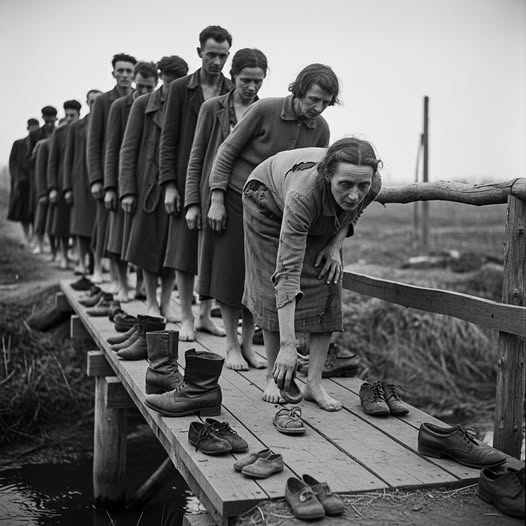
    A small wooden bridge, as fragile as a scar, hung over a marshy stream. It was here that a scene no witness could forget unfolded: the liberated deportees crossed one by one, barefoot, the wood creaking under their uncertain steps. Their bodies were nothing more than shadows, their faces sunken from hunger and sleepless nights. Yet, every step across that bridge was an affirmation of life, a refusal to sink despite the death machine that sought to annihilate them.

    As far as the eye could see, rows of shoes lined the sidewalk. Abandoned combat boots, worn-out shoes, the sandals of orphaned children. Each one told a story. The man who wore them might no longer exist, the woman who laced them might lie somewhere in an unmarked grave. But these shoes still spoke. They formed an improvised museum, a silent altar to the memory of those the camp had swallowed.

    A woman stopped in the middle of the line. Her eyes were empty, but they burned with a new intensity, as if liberation had rekindled buried embers. Before her was a pair of tiny sandals. She leaned forward slowly, her hands trembling as if every movement required immense effort. Instead of putting them on, she picked them up and tucked them under her shawl. They were too small for her chafed feet, but big enough to remember them. She didn’t want those sandals to be forgotten. Wearing them meant carrying the child she had lost, or perhaps all the children devoured by Mauthausen.

    Behind her, the column moved silently. Some deportees lifted their shoes to momentarily shield themselves from the stones, others walked barefoot, as if to feel the earth, that land forbidden for so many years. The bridge thus became an archive of footsteps, a procession in which pain transformed into testimony. Each crossing was a fragile victory: life, though shattered, still rolled forward.

    To understand the symbolic significance of this bridge in May 1945, we must return to Mauthausen. Located in Austria, about twenty kilometers from Linz, this concentration camp was designed by the Nazi regime in 1938. It was sometimes called the “staircase camp” because of the granite quarry where thousands of prisoners were sent to certain death. Deportees, once brought into captivity, had to climb 186 steps, carrying stone blocks weighing several dozen kilograms each. Many collapsed, and those who fell pulled dozens of others with them, creating a human avalanche.

    The Nazis classified Mauthausen as a “Category III” camp, meaning it was intended for extermination through forced labor. Conditions there were inhumane: minimal food rations, daily beatings, incurable diseases, and arbitrary executions. Among the prisoners were French resistance fighters, Poles, Spanish Republicans, Soviets, and, of course, thousands of Jews deported as part of the Holocaust.

    The numbers speak with unrelenting cruelty: of the 190,000 people deported to Mauthausen and its subcamps, nearly half did not survive. The gas chambers installed in recent months completed the mechanism of death.

    When American soldiers from the 11th Armored Division arrived at the camp on May 5, 1945, they encountered a sight that would haunt them forever. Dead bodies still lay beside the barbed wire, and barely alive prisoners raised their hands in greeting to their liberators. Most of the SS fled in haste, leaving the survivors to fend for themselves.

    This bridge, immortalized by witnesses and etched in narratives, became a striking metaphor for this journey: from darkness to light, from death to survival, from captivity to freedom. But freedom was not easy. Many survivors no longer had a home to return to, a family to identify with, or a certain future. Their bodies were destroyed, their minds haunted. Yet that moment in May 1945 remained an indisputable victory over the Nazi plan.

    Images of Mauthausen, like those of Auschwitz or Bergen-Belsen, are often marked by a poignant detail: shoes. These everyday objects, so banal, become incriminating evidence in the context of the camps. They are a material trace of the absent, proof that behind each pair of shoes lay a life, a story, a voice that someone wanted silenced.

    The woman who picked up those sandals that May morning knew this instinctively. She needed no historical explanations or formal speeches. She carried in her hands the memory of a child, and through him, the memory of all the innocent. The survivors of Mauthausen, later scattered across Europe, carried this burden with them: to bear witness, so that the world might know.

    After the camp was liberated, survivors were evacuated to makeshift hospitals. Some died in the following days, too weak to even endure freedom. Others tried to find loved ones, but for many, the only answer was the silence of the destroyed cities and empty homes.

    The memory of Mauthausen has not faded. Postwar trials, especially those at Nuremberg, revealed the horrors of the camp. Former deportees such as Jorge Semprún and Simon Wiesenthal transformed their suffering into testimony for future generations. Today, the Mauthausen memorial site is a place of remembrance and education.

    The image of this bridge, with its worn planks and rows of shoes, remains one of the most powerful metaphors of liberation. It reminds us that history is not just about great battles or political speeches, but also about small gestures, silent glances, and sandals held up like a relic.

    Everyone who visits Mauthausen today feels this weight. The silence of this place, the granite walls, the quarry steps speak to those who are willing to listen. The bridge no longer exists as it once did, but it remains in stories, photographs, and collective memory.

    Mauthausen in May 1945 was both an end and a beginning. The end of a system of terror, but also the beginning of a long journey for those who survived. The wooden bridge, crossed barefoot, was not only a geographical crossing but also an inner journey, from inhumane treatment to the difficult restoration of dignity.

    Today, more than seventy years later, it’s up to us to tell these stories again and again. Every written word, every remembered image, every shoe preserved in a museum is a bulwark against oblivion. Because to forget would mean allowing barbarism to triumph once again.

    Mauthausen, May 1945: a fragile bridge, abandoned shoes, faltering footsteps. And yet, at the end of this road, the fragile yet indestructible glow of newfound freedom.

  • The Story of the Dog at the Fence – Mauthausen, May 1945 .US

    The Story of the Dog at the Fence – Mauthausen, May 1945 .US

    The Story of the Dog at the Fence – Mauthausen, May 1945

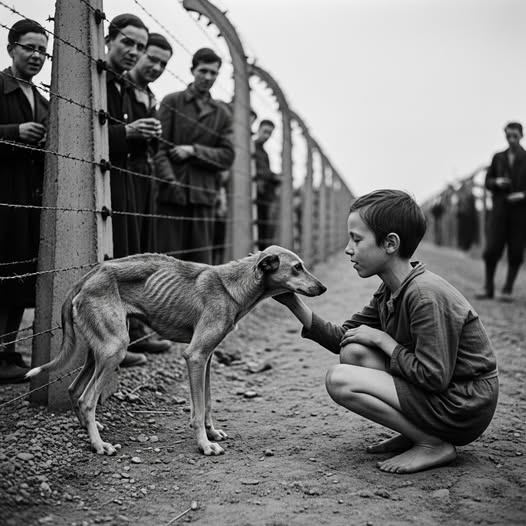
    There are images that mark history not for the violence they depict, but for the fragile tenderness they reveal. Among the thousands of photographs captured after World War II, there is one that still moves us today: a young boy, a survivor of the Mauthausen concentration camp, crouching barefoot in the dust, extending his thin hand toward a stray dog ​​as hungry as he was. Behind the barbed wire, the survivors silently observe this improbable encounter, as if frozen in a moment of rediscovered humanity. This scene, immortalized in May 1945, is not just an anecdote; it is a metaphor, a silent cry amid the ruins of barbarism.

    Mauthausen concentration camp, located near Linz, Austria, was one of the harshest camps in the entire Nazi concentration camp system. Built in 1938, it initially housed political prisoners and then became a site of extermination through forced labor, where tens of thousands of deportees from across occupied Europe were sent: Spanish Republicans, Poles, Jews, French resistance fighters, and Soviet prisoners of war. The nearby granite quarries, with their endless staircases that prisoners had to climb under overwhelming weight, became a symbol of this methodical mechanism of extermination.

    Hunger, beatings, disease, and summary executions turned Mauthausen into an open-air hell. It is estimated that over 90,000 people perished there. Despite the ubiquitous death, despite the organized terror, moments of solidarity survived: a piece of bread, a gesture of comfort, a word whispered in the darkness of the barracks. It was in this desolate place in May 1945 that the unexpected image of a child and a dog appeared.

    When American soldiers arrived at Mauthausen on May 5, 1945, they found starving figures, empty stares, and bodies barely alive. Accustomed to war, the soldiers were nonetheless shocked by the scale of the barbarity revealed. The gates opened, the barbed wire ceased to be a deadly boundary, and in the chaos, a new breath was born: freedom.

    The survivors, too weak to cry out for joy, greeted their liberators with silent tears. Some lay on the ground, as if basking in the light, others searched for a familiar face, a hand to shake. Then a dog, an ordinary stray dog, from nowhere, slipped through the fence and slipped among the survivors.

    He wore neither collar nor medal. His skin clung to his bones, a testament to the privations experienced by the men around him. But his eyes still held a spark of life, a confidence. His tail twitched delicately, like a fragile flag raised amidst the ruins.

    Amid the silent crowd, the boy stepped forward. His legs trembled under the weight of hunger and years of suffering. His bare feet ground against the hard earth of the camp. Yet he crouched slowly, as if not wanting to frighten the animal. He reached out a hesitant hand, his thin fingers trembling with a forgotten emotion.

    The dog approached, sniffed, and then gently rested his head on the child’s hand. The boy smiled back. And—a miracle even greater than liberation—he laughed. A pure, almost brittle laugh escaped his lips. This sound, which neither hunger nor fear could completely suppress, rang out like a challenge to death, a promise that life would reclaim its rights.

    For those who witnessed this scene, it was a moment of grace. In this camp marked by screams and tears, the moment of silence was filled with a simple contact: a hand on rough fur, a damp muzzle on bony skin. The dog demanded nothing, judged nothing. It offered what the executioners sought to annihilate: selfless, selfless, unpredictable affection.

    What this dog represented went far beyond its animal presence. For the survivors, it embodied a return to normalcy, a reminder that simple gestures and pure connections still exist. In that moment, the dog became a silent messenger of hope.

    In the accounts of Mauthausen survivors, many speak of the moment of liberation as a rebirth. Some remember the first pieces of chocolate offered to them by American soldiers, others the feeling of the sun on their skin. But this boy and this dog presented a different image: an innocent, wordless encounter capable of expressing what was most important.

    The Holocaust dehumanized millions of people, reducing them to tattooed numbers, to starving bodies. The sight of a child petting a dog signified that humanity was not dead, that it could be reborn even from the ashes of the crematoria.

    Today, the Mauthausen site has become a place of remembrance. Visitors from around the world come there to understand, remember, and share their experiences. The cold stones of the quarries, the still-standing barracks, and the barbed-wire walls are reminders of the cruelty of a system that sought to crush humanity to the core. But alongside these material traces, individual stories also shape memory.

    The story of the boy and the dog is one such story. It doesn’t appear in the statistics, nor does it change the horrific death toll. But it sheds light on the human face of this tragedy. It suggests that even in the hell of the Holocaust, glimmers of life and tenderness could remain.

    Many of those who experienced Mauthausen forever bore the physical and psychological scars of their imprisonment. Some witnesses recounted that such moments—a smile, a gesture, a touch—kept them confident in the future. The laughter of a child petting a stray dog ​​stuck in their minds as a sign that another life was possible after the barbarism.

    The photograph of this scene has circulated in books, exhibitions, and articles. It remains controversial, and some question its authenticity, but that’s beside the point: whether it’s a raw document or a symbolic reconstruction, it became a turning point in the collective imagination. It embodies what the liberation of the camps signified: not only an end to immediate suffering, but also a rebirth of hope, an opening to a future where love and innocence could blossom anew.

    The story of “Dog at the Fence” at Mauthausen in May 1945 is more than a moving image. It is a lesson in memory. In this context of death and devastation, an ordinary animal and a starving child managed, for a moment, to redefine the concept of humanity. Their encounter reminds us that human dignity can survive anything, even the merciless machinery of a concentration camp.

    In the face of constant violence, wars and discrimination in the contemporary world, this memory calls us to protect innocence, cultivate tenderness and never forget that the history of the Holocaust is not only numbers and facts, but also small gestures that gave new life.

    The dog and the child from Mauthausen are therefore not just silhouettes of the past: they still look at us from behind the barbed wire of time to remind us that even after horror, hope can be reborn from a caress and laughter.

  • The Story of the “Returned Shoes” – Mauthausen, May 1945 .us

    The Story of the “Returned Shoes” – Mauthausen, May 1945 .us

    The Story of the “Returned Shoes” – Mauthausen, May 1945

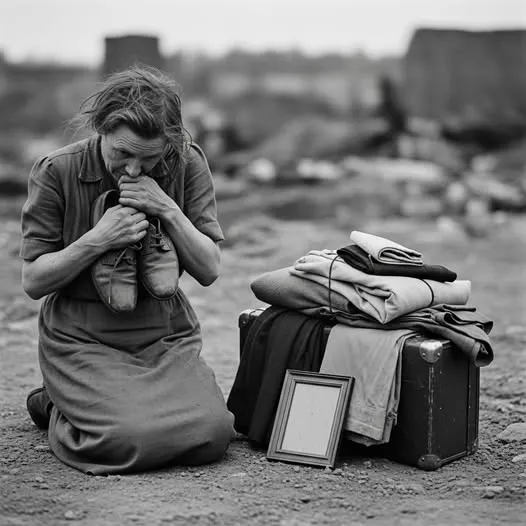
    May 1945. Europe breathes again, but the air is still heavy with ashes and an oppressive silence. Liberation has just taken place in the Mauthausen concentration camp in Austria, a few kilometers from Linz. American soldiers have opened the gates of hell, and what they see is beyond imagination. Emaciated bodies, emaciated survivors, gazes filled with fear and disbelief: everything here tells a story of inhumanity brought to paroxysm. Amid the rubble, in this dust still saturated with death and suffering, a woman kneels. She searches not for food or clothing, but for something else: a trace, a remnant, a sign of the one she has lost.

    Her gaze falls on a small pile of scattered objects, among them a pair of leather boots, worn, deformed by years of walking and working. She picks them up with a trembling hesitation, then her eyes widen: she recognizes them immediately. They were her husband’s boots. The stitching still strong despite wear, the scuffed heel, the unmistakable shape of the leather, molded to his footsteps. These details, known by heart, suddenly become stabs in her memory. In them, she sees the worker he once was, the loving man, the one who came home tired but smiling in the evenings, before war and Nazi barbarity tore their lives apart.

    She hugs them to her chest, as if holding her breath, as if to revive a body that has vanished. And then, with an instinctive, almost maternal gesture, she brings the shoes to her lips, kisses them, and weeps over them. Her sobs are not just for the old leather, but for everything they symbolize: a ripped-away husband, a destroyed family, a life consumed by furnaces and barbed wire.

    These “returned shoes,” found among thousands of items abandoned in the chaos of Mauthausen, are no ordinary objects. They have become a mirror of a collective history: the story of millions of Holocaust victims deprived of their possessions, their identities, and ultimately, their lives. Every pair of shoes, every striped jacket, every suitcase piled up in the warehouses of Nazi camps tells the story of a life cut short.

    The scene of the kneeling woman reveals the very essence of Holocaust memory. Mauthausen, like Auschwitz, Treblinka, or Sobibór, was not merely a place of isolation: it was a machine organized to reduce people to the level of numbers, objects, and materials. Deportees lost their names, replaced by numbers tattooed or sewn onto their uniforms. Their belongings were confiscated, sorted, sold, or reused. Even their hair was recovered.

    Finding a pair of shoes in 1945, then, isn’t just finding a personal object; it’s finding a fragment of identity in a universe designed to negate it. The shoes then become a historical document, silent but irrefutable proof of the existence of the person who wore them, the person they were before violence erased them.

    For the kneeling woman, these shoes are not just a memory: they are a presence. In their folded leather, she reads the steps taken in their village, the markets they passed, family walks, perhaps even dances at a youth ball. Each fold tells a story that barbarism has tried to erase.

    It’s crucial to place this image in its historical context. Mauthausen was one of the most horrific concentration camps of the Third Reich. Established in 1938, shortly after the Anschluss, it was quickly designed as a Category III camp, intended for “extermination through labor.” Prisoners from all over occupied Europe—resistance fighters, intellectuals, political prisoners, Jews, Roma, homosexuals, and opposition activists—were sent to the granite quarries.

    Forced marches up the 186 steps of the “Stufe des Todes” (Death Stairs), where deportees had to carry colossal blocks of stone, today symbolize the cruelty of the system. Starvation, beatings, summary executions, medical experiments, and exhaustion were part of daily life. It is estimated that some 190,000 prisoners were deported to Mauthausen, almost half of whom died.

    In this hellish environment, finding a pair of personal shoes in 1945 becomes a paradox: a banal object becomes special again, because it evokes the memory of life before dehumanization, the life of a husband, a father, an ordinary worker.

    On May 5, 1945, American troops of the 11th Armored Division entered Mauthausen. Survivors greeted their liberators with a mixture of exhaustion and disbelief. However, regained freedom did not mean the end of suffering. For the survivors, liberation presented a new struggle: surviving with memories, rebuilding lives after the extermination.

    For those who, like this woman, lost loved ones, the camps did not end with the fall of Nazism. They still exist in every found object, in every void left behind. Her husband’s shoes, placed on her lap, become a symbol of this ongoing pain: one life saved, but another irretrievably lost.

    The photograph of this scene, which became known as “The Returned Shoes,” illustrates this paradox. It depicts not a field of corpses or bloody barbed wire, but a woman, alone, with a familiar object. Perhaps this is what makes it all the more moving: it reminds us that the Holocaust is not just a story of numbers and statistics, but an intimate history, composed of faces, families, and everyday objects that become sacred relics.

    Today, concentration camps like Mauthausen have become places of remembrance. Museums often display recovered objects: suitcases, glasses, prosthetic limbs, clothing, shoes. These objects possess a power beyond words. They embody the essence of the Holocaust: the attempt to erase not only human life but also all traces of its presence on earth.

    “Returned Shoes” reminds every visitor that behind every pair lies a person with a unique story. This kneeling woman teaches us a universal lesson: memory thrives on detail, and it’s often the most humble objects that carry the heaviest memories.

    In SEO, it’s impossible not to mention how much this image and this story embody keywords like Mauthausen , Shoah , the liberation of Nazi camps , memories of deportation , and even the memory of World War II . But behind these words lies the truth: as long as these shoes are displayed, as long as this woman is recalled, oblivion will not prevail.

    “Returned Shoes – Mauthausen, May 1945” is more than just a postwar anecdote. It’s a metaphor for pain and survival. This simple gesture – kissing the shoes of a missing husband – captures the entire story of the Holocaust: loss, memory, dignity torn away and sometimes regained.

    This story teaches us that Nazi camps cannot be reduced to historical abstractions. They consist of people, ordinary objects that became extraordinary, gestures of mourning that transcend time. In May 1945, amid the ruins of Mauthausen, a woman kneels and weeps over a pair of shoes. And this gesture, captured in photographs, continues to move, bears witness, and warns future generations: memory is fragile, but it endures as long as we keep it alive.

  • Survivors of the Neuengamme Death March – Northern Germany, May 1945 .US

    Survivors of the Neuengamme Death March – Northern Germany, May 1945 .US

    Survivors of the Neuengamme Death March – Northern Germany, May 1945

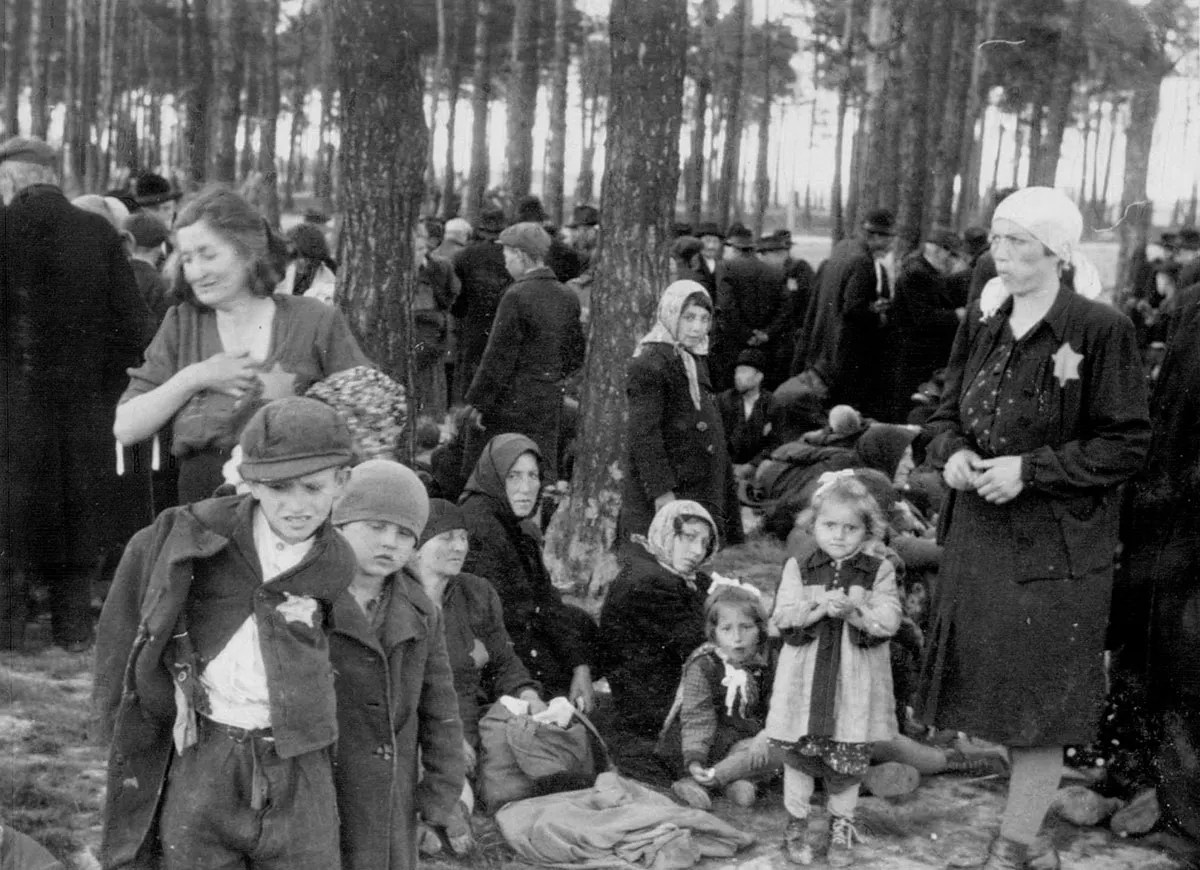
    In May 1945, at the end of a bloody world war, the roads of northern Germany became the scene of a human drama of unspeakable intensity. As the British Army advanced, liberating villages and plains, they encountered scenes no soldier, even the most experienced, could have prepared for: starving figures, bodies lying in ditches, faces sunken from hunger and exhaustion. These were survivors of the death marches from Neuengamme concentration camp, a camp near Hamburg that had become synonymous with horror and human destruction.

    These men and women were mere shadows of their former selves. For weeks, they had been forced to march, forced by SS guards to leave Neuengamme and its numerous subcamps to escape the Allied advance. The Nazis hoped to erase the traces of their crimes, to scatter the prisoners like sand before the wind, even if it meant condemning them to a slow agony. Those who collapsed by the side of the road were mercilessly shot or left for dead. Every step became torture, every breath a struggle against the inevitable.

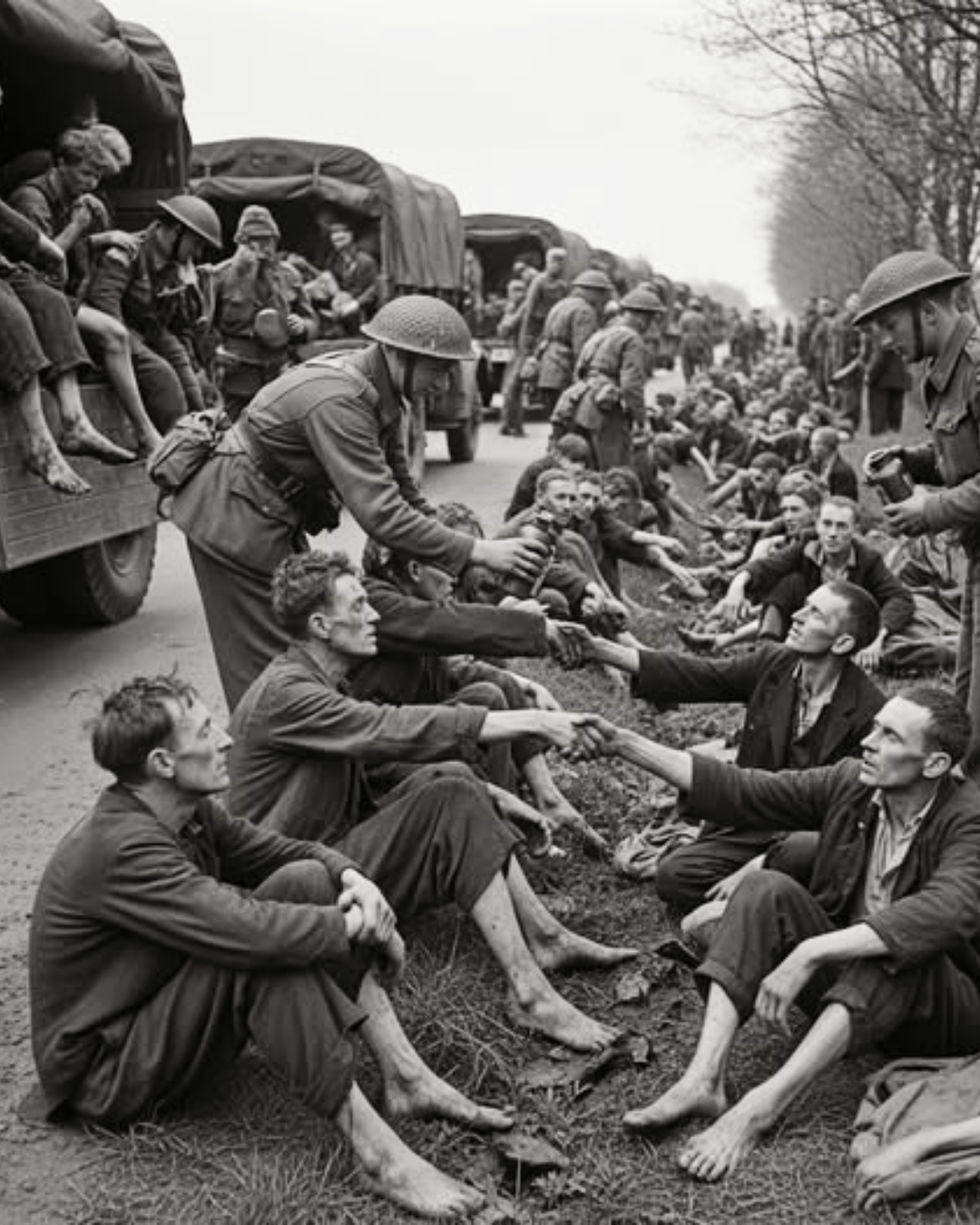
    As British trucks drove along these tree-lined roads, soldiers saw survivors lying on the ground, sometimes grouped in small circles, sometimes isolated like human wreckage washed up by an invisible wave. Liberators climbed from their vehicles, holding bottles of water, breaking pieces of bread, and muttering words of encouragement. A gesture as simple as placing a hand on a shoulder took on its full symbolic value: restoring to a broken being the certainty that it still existed.

    Many survivors no longer had the strength to speak. Their chapped lips pressed against the cold metal of the water canisters they were offered. Others, trembling, tried to smile, as if their faces, long paralyzed by fear, were slowly rediscovering the art of human emotion. A British soldier wrote in his notebook: “I have never seen such thin men. They looked like ghosts, but when we gave them water, their eyes lit up in a way I will never forget.”

    The liberation of the Neuengamme survivors did not occur at the camp gates, but on these rural roads, in the heart of a peaceful landscape that contrasted cruelly with the scale of the suffering. Blossoming trees, green meadows—all this created an almost idyllic setting, indecent in the face of human suffering. And yet, it was precisely in this contrast that the power of the moment lay: life was revived where it had been taken.

    Neuengamme, established in 1938, was one of the most powerful concentration camps in the Nazi system. More than 100,000 prisoners passed through it, exploited for slave labor in inhumane conditions, almost half of whom perished. As Germany’s defeat became inevitable, the SS organized mass evacuations. These forced marches—later called death marches —were intended to remove deportees from the combat zone, but above all, they were intended to serve a slow extermination.

    Survivors encountered in May 1945 had walked dozens, sometimes hundreds, of kilometers, barefoot and dressed in rags. The luckiest still had a blanket or a piece of dry bread. The rest clung to their desperate will to avoid falling. A man liberated near Lübeck recalled: “We were no longer walking; we were falling forward, over and over again. When someone fell, the SS left them or killed them. I survived because a comrade carried me when I could go no further.”

    For the British soldiers, this shocking discovery had a twofold significance. On the one hand, it confirmed what reports had already suggested: the horrors of the concentration camps were beyond imagination. On the other, it placed a tremendous responsibility on them: they had to rescue, care for, and rehabilitate survivors, even though the war was not officially over. Military medics set up makeshift aid stations along the roads, distributing milk, soup, and blankets. Yet, despite all efforts, many still died in the arms of their liberators, overwhelmed by mounting hunger, disease, and exhaustion.

    Yet, amidst this tragedy, moments of light emerged. One British soldier recounted seeing two prisoners silently clasping hands, their trembling fingers intertwined as if sealing a promise of life. Another described how a woman, barely able to stand, began to cry when a child from a neighboring village offered her an apple. These simple, almost innocent gestures took on an infinite dimension: they affirmed human dignity in the face of abyss.

    Through their resistance and courage, the survivors of Neuengamme unwittingly became crucial witnesses to history. Their stories later influenced the Nuremberg trials, revealing to the world the mechanisms of Nazi cruelty. However, in May 1945, on the roadsides of northern Germany, they were not yet witnesses: they were simply beings to be saved, lives in limbo that had to be preserved at all costs.

    Every sip of water, every shared piece of bread, every arm that lifted a survivor from the ground was a fragile victory over barbarity. Freedom didn’t come in a single, brilliant moment, but in fragments: a blanket thrown over bare shoulders, the offer of a cigarette, the shake of a hand. And these fragments carried an enormous burden. They were proof that, in the face of the unthinkable, survival was still possible.

    Seventy or eighty years later, images of these death marches still haunt our collective memory. They remind us that the Holocaust was not limited to barbed wire and watchtowers, but left its mark on the roads, villages, and forests of Europe. They also remind us that liberation was not merely military, but profoundly human.

    In the spring of 1945, defeated Germany still bore the scars of war, but amidst the ruins, a certainty emerged: humanity had survived. Not untouched, not unscathed, but alive. And it was in the eyes of the Neuengamme survivors, in their hands reaching out to the hands of British soldiers, that this truth first became embodied.

  • The soldier who took the photo – Mauthausen, Austria, 1945 .US

    The soldier who took the photo – Mauthausen, Austria, 1945 .US

    The soldier who took the photo – Mauthausen, Austria, 1945

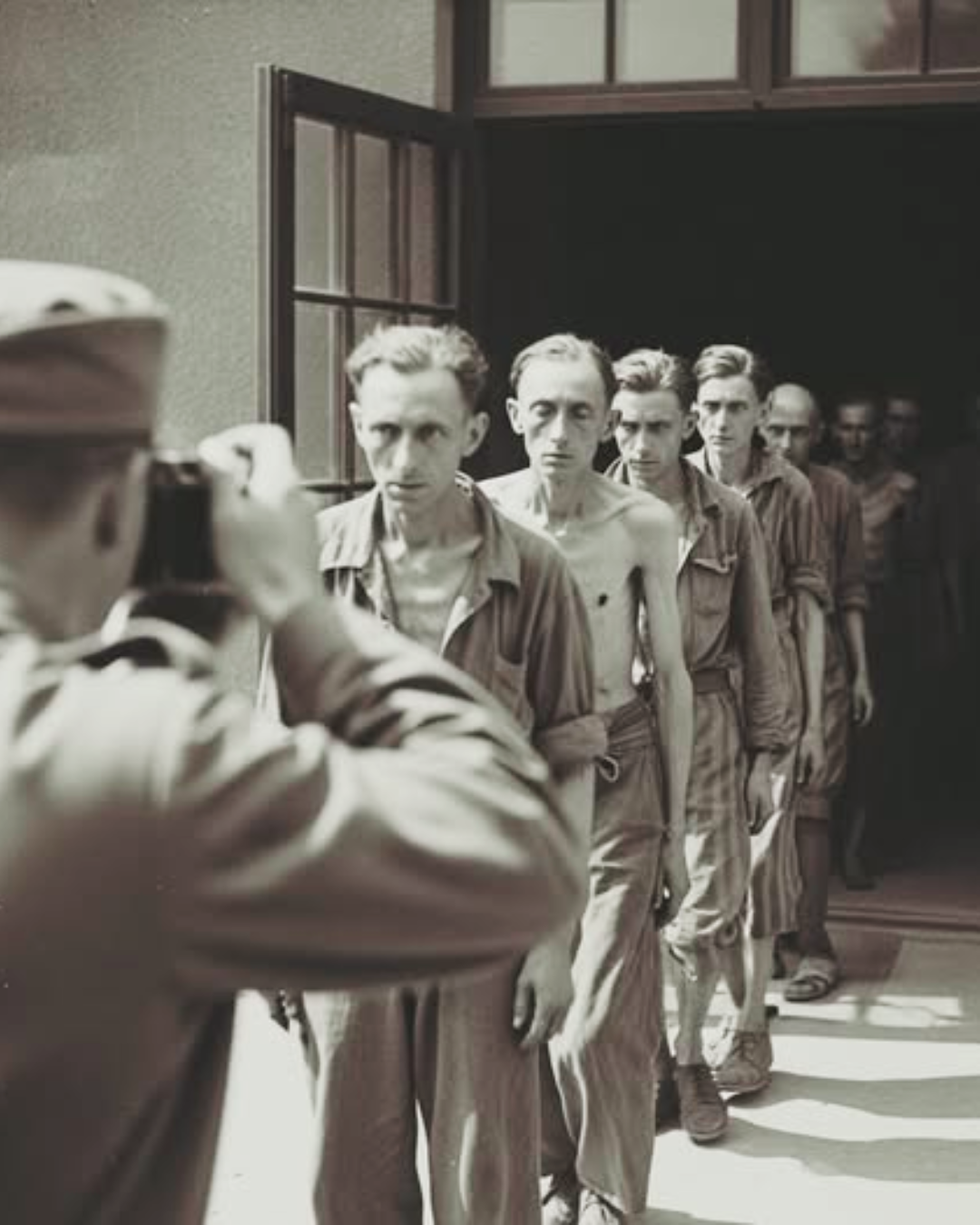
    There are images that never fade, snapshots so deeply etched in the collective memory that they become more than photographs: fragments of history. In May 1945, as World War II drew to a close in Europe, an American soldier, part of the troops liberating the Mauthausen concentration camp, raised his camera and captured the moment when emaciated, skeletal prisoners emerged from the shadows into the light.

    That simple gesture, pressing the shutter button, became an act of resistance against oblivion. For in the silence that followed Liberation, proof was needed. The world, the soldier thought, won’t believe unless it sees. Too many voices had already been silenced, too many truths suppressed by the Nazi machine. So he turned his lens on these people approaching, their eyes lost, their bodies broken, but still standing.

    The survivors of Mauthausen were mere shadows of their former selves. Their sunken cheeks, emaciated arms, and unsteady gaits testified to hunger and forced labor. Mauthausen was known as a labor camp of extermination: the steps in the quarry, which prisoners called the “stairs of death,” witnessed thousands of men collapse under the weight of the stones they were forced to carry. Each step became a struggle for life and death.

    When American soldiers entered the camp on May 5, 1945, they were struck by the stench, the sight of piles of corpses, and the ghastly image of survivors. However, the soldier-photographer realized that what he saw was beyond comprehension. He later said, “I took that picture because I knew no one would believe such faces unless I brought them back. It wasn’t a picture; it was my promise.”

    In this row of exhausted men, prisoners of all backgrounds could be seen: Spanish resistance fighters, political prisoners, Jewish deportees, intellectuals, priests, political opponents. Mauthausen held those whom the Nazi regime sought to slowly crush through backbreaking labor, starvation, and terror. The photograph became one of the first pieces of evidence the world saw. Through these faces, one could discern not only individuals, but the traces of millions of others who had vanished without a trace.

    One survivor, interviewed many years later, described this very moment: “When we crossed the threshold, we didn’t know if we were alive or already ghosts. The soldier looked at us, then held up a black box in front of our faces. We were too weak to speak, but we instinctively raised our hands as if to say, ‘We still exist.’” This seemingly insignificant gesture symbolized a regained dignity.

    The act of photography here took on an almost sacred dimension. Where the Nazis attempted to erase all traces, to reduce prisoners to mere numbers, the soldier’s camera restored their face, their uniqueness. In a world that sought to deny their humanity, this photograph proclaimed just the opposite: “These are people. These are survivors. These are witnesses.”

    After the war, these images circulated in the international press. They were brandished at trials, displayed in courtrooms at Nuremberg, and projected so that the executioners couldn’t deny them. Without them, the Holocaust risked remaining a rumor, undermined by those who preferred to turn a blind eye. Thanks to them, no one could say, “I didn’t know.”

    Mauthausen in Austria was one of the most horrific camps of World War II. More than 190,000 prisoners were deported there, almost half of whom never returned. The granite quarry steps, daily starvation, beatings, and summary executions were part of everyday life. The people in the American soldier’s photograph are not just survivors: they are returnees, narrowly escaping death.

    The soldier who took this photo never sought fame. He didn’t want to be remembered more for his name than for the photos. What mattered to him wasn’t the man holding the camera, but those standing in front of it. This photo, he said, wasn’t his work, but their legacy. He never tired of repeating: “I wanted them to have faces, so that the world would see them and not forget them.”

    This gesture, of overwhelming simplicity, reminds us of the fundamental function of photography in history. A photograph can be a weapon against Holocaust denial, irrefutable evidence. It can also be a tomb for those who were never buried, a way to preserve for eternity what was in danger of being lost.

    Every year, visitors to the Mauthausen Memorial pause before these photographs. They search for even a fleeting glimpse, a fragment of humanity to cling to. Some survivors, now very old, were able to recognize themselves or a comrade in arms. Many weep silently. The soldier’s photograph still speaks, decades after the shutter closed.

    Today, in our image-saturated world, it’s easy to forget that some of them were born in pain and carry with them the inestimable burden of history. The Mauthausen photo is not just another textbook image. It’s a living document, an irrefutable testament to the Holocaust and Nazi barbarity.

    By giving voice to these silenced prisoners, the soldier-photographer also appealed to the future: let us not close our eyes, let us not forget, let us never allow Holocaust denial and hatred to take root again. In the feeble breath of these men, staggering toward the light, lay the promise of life, the promise of memory.

    And if we still look at this photo today, it is perhaps because it is a call to each of us to become guardians of this memory.

    Because behind the barbed wire of Mauthausen, behind the stone and bloody steps of the quarry, this frozen moment remains: survivors move forward, a soldier takes photos, and the world discovers in bewilderment the faces that History would like to erase.